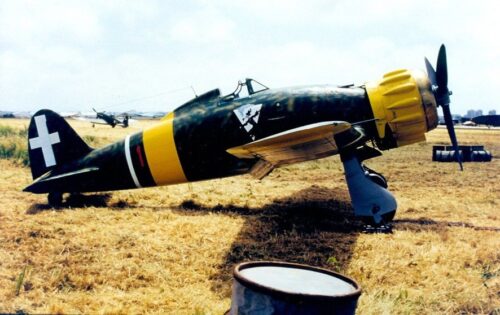
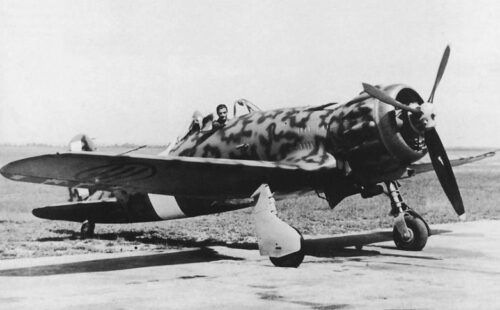
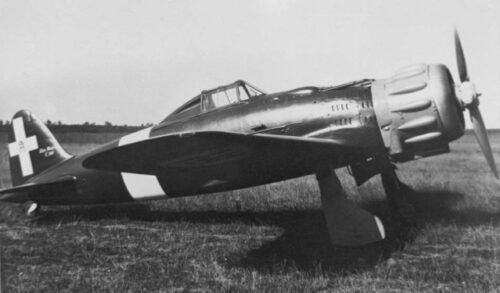
Developed by Mario Castoldi and introduced in 1939, the C.200 Saetta (“Lightning”) was Italy’s first modern monoplane fighter with retractable landing gear and all-metal construction.
Powered by a Fiat A.74 radial engine, it offered excellent manoeuvrability but was underpowered compared to Allied contemporaries.
Early Combat Use (1940–41)
The Saetta first saw action during Italy’s entry into WWII in June 1940.
It was deployed in the Mediterranean theatre, notably over Malta, Greece, and North Africa, where it performed escort and air superiority missions.
Despite its limited speed and armament (two 12.7 mm Breda-SAFAT machine guns), it proved agile and reliable.
Eastern Front Deployment (1941–43)
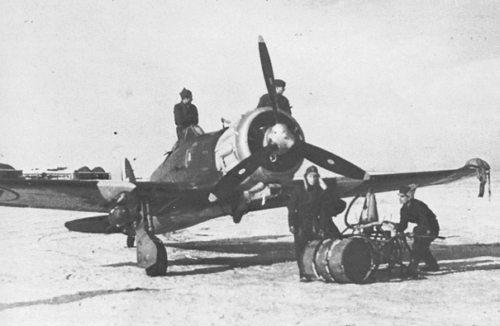
A contingent of C.200s was sent to the Soviet Union as part of the Corpo Aereo Italiano.
Operating in harsh winter conditions, the Saetta demonstrated ruggedness and adaptability, though it was increasingly outclassed by Soviet aircraft like the Yak-1 and LaGG-3.
Later War Service & Transition
As the war progressed, the C.200 was gradually replaced by its more advanced successors – the Macchi C.202 Folgore and C.205 Veltro.
However, many C.200s continued to serve in ground attack and training roles.
After the 1943 armistice, surviving aircraft were used by both the Aeronautica Nazionale Repubblicana (Axis-aligned) and the Italian Co-Belligerent Air Force (Allied-aligned).
Production & Legacy
Over 1,150 units were built between 1939 and 1943.
Though technologically surpassed by mid-war standards, the Saetta was a vital stepping stone in Italian fighter development and laid the groundwork for Castoldi’s later masterpieces.
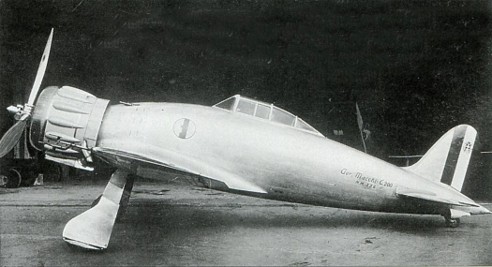
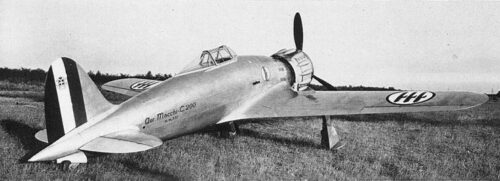
C.200 Prototypes (1937–1938)
The initial two prototypes of the Macchi C.200 Saetta were constructed in response to a 1936 Regia Aeronautica specification for a modern monoplane fighter.
Designed by Mario Castoldi, they marked a radical departure from biplane tradition, featuring:
All-metal construction with a low-wing monoplane layout
A fully enclosed cockpit (later modified to open canopy due to pilot preference)
Powered by the Fiat A.74 R.C.38 radial engine, rated at 623 kW (835 hp)
The first prototype flew on 24 December 1937, demonstrating excellent stability and manoeuvrability.
However, early trials revealed issues with lateral control at high speeds, prompting refinements to the wing design and control surfaces.
These prototypes laid the groundwork for Italy’s first mass-produced monoplane fighter.
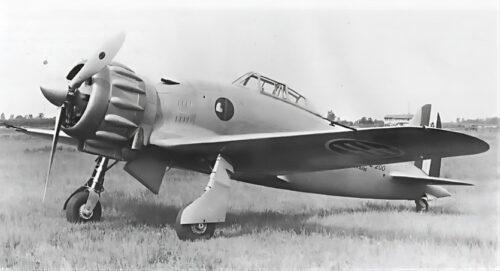
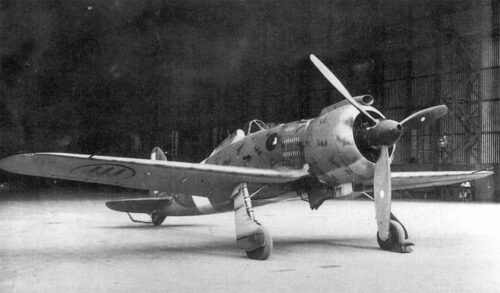
C.200 Production Variant (1939–1943)
The finalized production version of the C.200 retained the Fiat A.74 engine and introduced several refinements based on prototype feedback
Armament
Two 12.7 mm Breda-SAFAT machine guns mounted in the nose
Role versatility
Configurable as a single-seat interceptor, fighter-bomber, or escort fighter
Performance
Top speed of approximately 504 km/h (313 mph), with a service ceiling of 8,800 m (28,870 ft)
Over 1,150 units were built by Macchi, SIAI-Marchetti, and Breda, serving across multiple theatres including North Africa, Greece, Malta, and the Eastern Front.
Macchi C.200 bis
Breda-Modified Prototype
The C.200bis was a one-off experimental upgrade of the Macchi C.200 Saetta, proposed by Breda to enhance performance through re-engining.
The aircraft was retrofitted with a Piaggio P.XIX R.C.45 radial engine, delivering 880 kW (1,180 hp) at 4,500 metres (14,800 ft)—a significant power increase over the standard Fiat A.74.
Converted from an early production C.200 airframe
First flight
11 April 1942, from Milano-Bresso, piloted by Luigi Acerbi
Subsequent modifications included a larger propeller and revised engine cowling to accommodate the new powerplant
During flight trials, the C.200bis achieved a top speed of 535 km/h (332 mph)—notable for a radial-powered Italian fighter.
However, the project was abandoned as the C.200 series was being phased out in favour of more advanced designs like the C.202 Folgore and C.205 Veltro.
Macchi C.200ASNorth Africa Variant
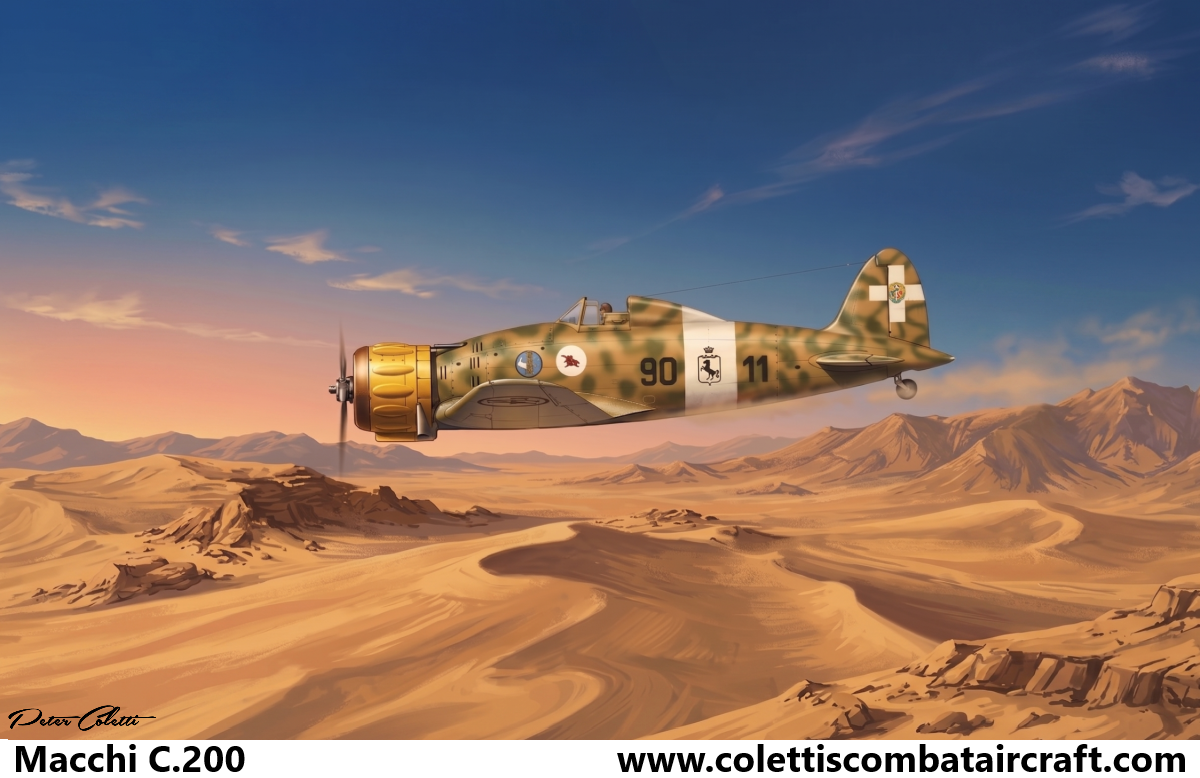
The C.200AS (Africa Settentrionale) was a desert-adapted version of the Saetta, modified for the North African Campaign.
It featured:
Dust filters over the Fiat A.74 RC.38 engine and minor cooling tweaks to withstand sand and heat
Field-installed wing hardpoints for two 160 kg bombs or auxiliary fuel tanks, enabling ground attack and escort roles
Deployed from 1941 to 1943 in Libya and Egypt, the AS variant served with units like the 372ª Squadriglia and 153° Gruppo Autonomo, flying low-level strikes and patrols from improvised desert airstrips.
Its ruggedness and agility made it a reliable multi-role asset until replaced by more advanced types.
Macchi C.200CBFighter-Bomber Variant
The Macchi C.200CB (Cacciabombardiere) was a dedicated fighter-bomber adaptation of the standard C.200 Saetta, developed to extend the aircraft’s tactical versatility beyond air superiority roles.
This variant was equipped to carry either the following:
Up to 320 kg (710 lbs) of ordnance, typically in the form of two 160 kg bombs mounted under the wings or
two external fuel tanks, enabling extended range for fighter escort missions
Modifications & Role Adaptation
To accommodate its new role, the C.200CB featured reinforced wing hardpoints and minor structural adjustments for bomb carriage and release mechanisms.
While retaining the same Fiat A.74 RC.38 radial engine and core airframe, its mission profile shifted towards the following:
Tactical ground attack in North Africa and the Balkans
Convoy interdiction and close air support for Italian ground forces
Long-range escort for bombers, especially in operations over Malta and the Mediterranean
Macchi C.201
Development Summary
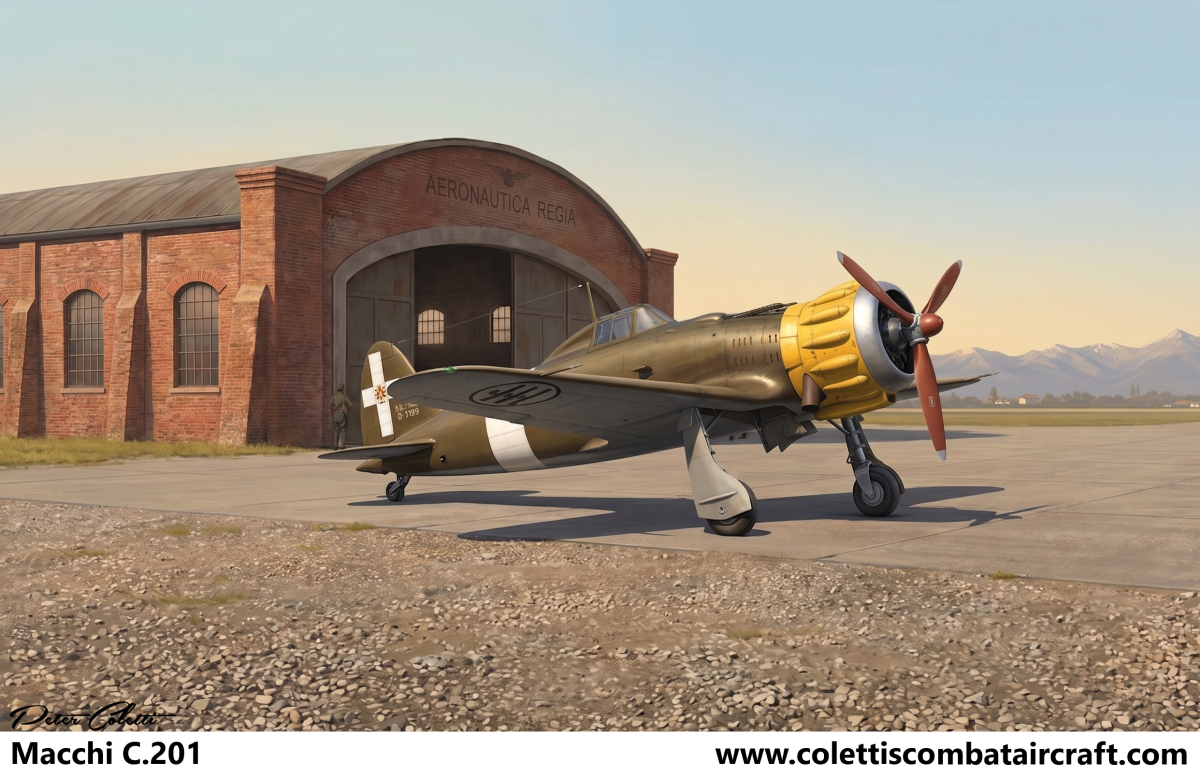
In response to a Regia Aeronautica directive issued on 5 January 1938 for a successor to the Macchi C.200, Aermacchi proposed the C.201, a modernised fighter featuring:
A redesigned fuselage
A fully enclosed, pressurized cockpit
Initially powered by the Isotta Fraschini Astro A.140RC.40, a licensed version of the French Gnome-Rhône Mistral Major GR.14Krs, delivering 870 cv (metric horsepower)
The powerplant was later switched to the Fiat A.76 R.C.40, rated at 750 kW (1,010 hp).
Two prototypes were commissioned, but the first aircraft—flown on 10 August 1940—was fitted with the less powerful Fiat A.74 engine due to delays with the A.76.
Despite Macchi’s projected top speed of 550 km/h (340 mph), flight testing yielded only 312 mph, falling short of expectations.
Development was ultimately terminated when Fiat discontinued the problematic A.76 engine, leaving the C.201 as an unrealised transitional design between the Saetta and the later Folgore.
Specifications (C.200)
Crew
1
Length
8.25 m (27 ft 1 in)
Wingspan
10.58 m (34 ft 9 in)
Height
3.05 m (10 ft 0 in)
Wing area
16.82 m² (181.0 sq ft)
Airfoil
Root
NACA 23018 (modified)
Tip
NACA 23009 (modified)
Empty weight
1,964 kg (4,330 lb)
Gross weight
2,200 kg (4,850 lb)
Max take-off weight
2,395 kg (5,280 lb)
Powerplant
1 × Fiat A.74 R.C.38 14-cylinder,
air-cooled radial engine,
650 kW (870 hp) at 2,520 rpm for take-off
Propellers
3-bladed variable-pitch propeller
Performance
Maximum speed
504 km/h (313 mph, 272 kn)
@ 4,500 m (14,800 ft)
Stall speed
128 km/h (80 mph, 69 kn)
Range
570 km (350 mi, 310 nmi)
Service ceiling
8,900 m (29,200 ft)
Rate of climb
15.3 m/s (3,000 ft/min)
Time to altitude
5,000 m (16,000 ft) in
5 minutes 52 seconds
Wing loading
131.7 kg/m² (27.0 lb/sq ft)
Power/mass
0.286 kW/kg (0.174 hp/lb)
Take-off runs
260 m (850 ft)
Landing run
300 m (980 ft)
Armament
Guns
2 × 12.7 mm (0.500 in) Breda-SAFAT machine guns,
370 rpg
Bombs
Some aircraft were field-modified to carry up to 8 × 15 kg (33 lb).