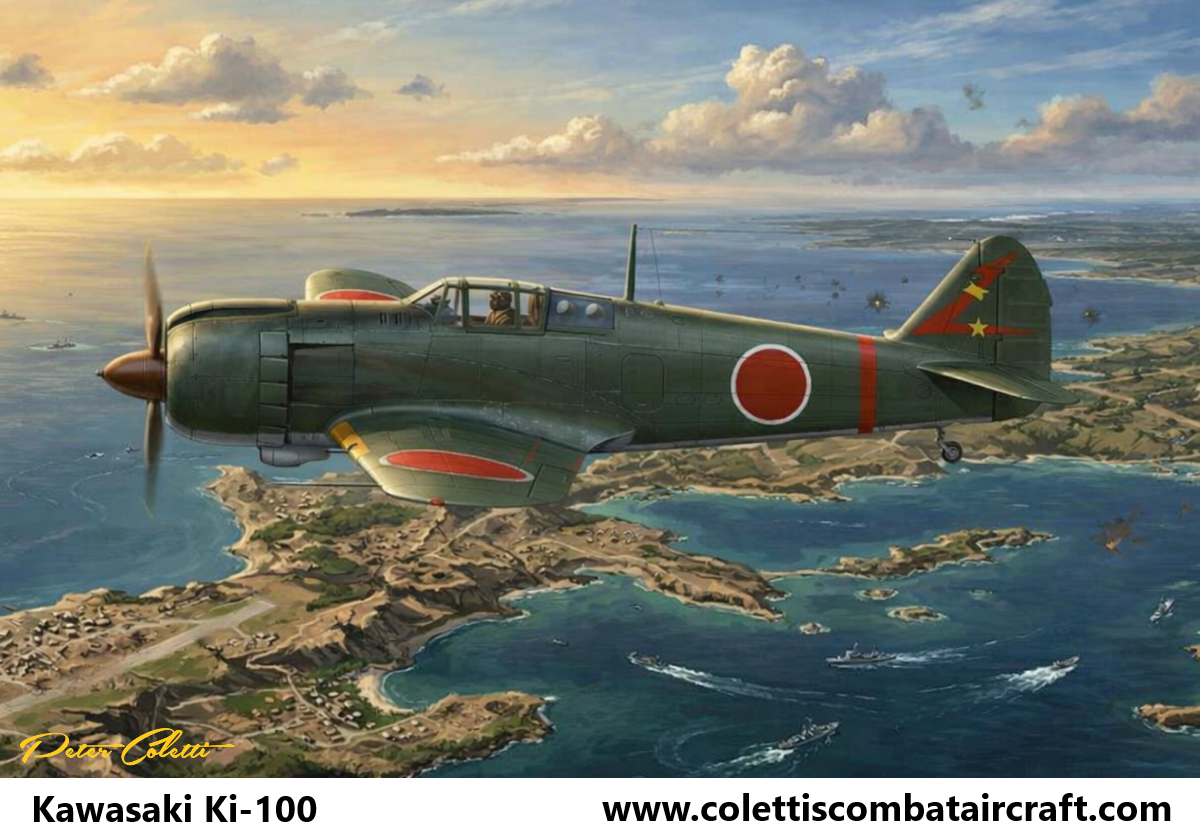
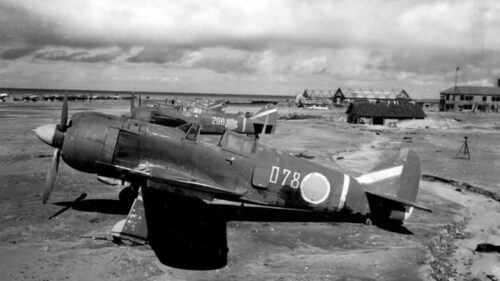
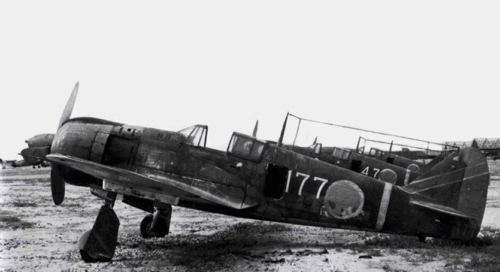
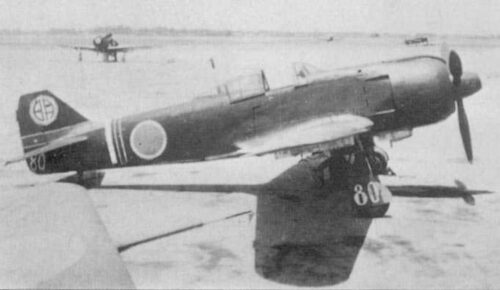
The Kawasaki Ki-100 entered service with the Imperial Japanese Army Air Service (IJAAS) in March 1945, during the final months of World War II.
It was developed as an emergency solution after Allied bombing raids destroyed the factory producing the liquid-cooled Ha-140 engines intended for the Ki-61-II-KAI fighter.
With over 270 airframes completed but lacking engines, Kawasaki retrofitted them with the air-cooled Mitsubishi Ha-112-II radial engine, resulting in the Ki-100-I Ko variant.
Later, purpose-built airframes with bubble canopies were produced as the Ki-100-I Otsu.
Despite its improvised origin, the Ki-100 proved to be one of Japan’s most effective fighters of the war.
It offered excellent manoeuvrability, a strong climb rate, and reliable engine performance.
Pilots praised its handling characteristics, especially at low to medium altitudes, where it could outperform many Allied aircraft, including the P-51 Mustang and F6F Hellcat.
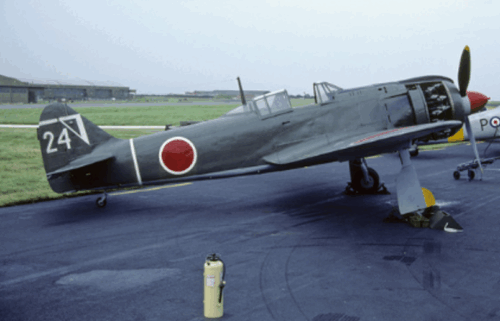
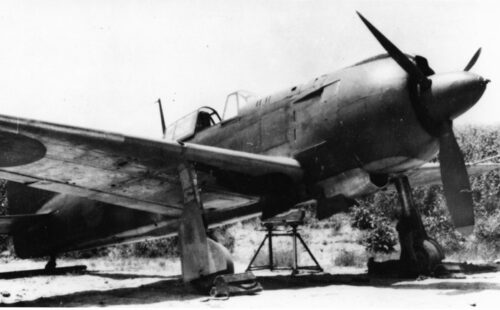
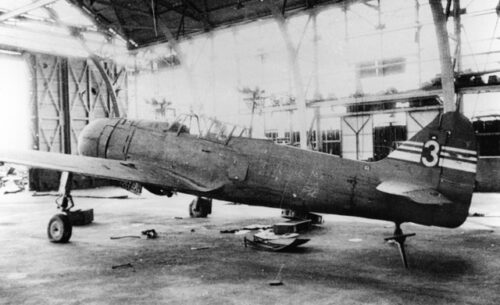
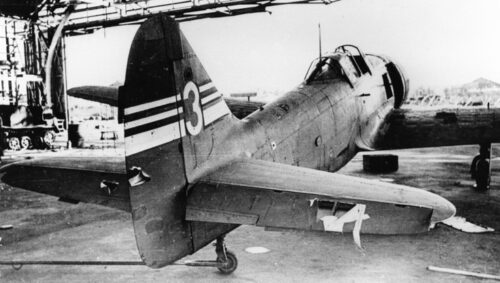
Ki-100-Ib (Otsu), Royal Air Force Museum Cosford.
The Ki-100 was deployed primarily in home defence roles, tasked with intercepting low-flying B-29 Superfortresses and escorting kamikaze formations during the Battle of Okinawa.
Units equipped with the Ki-100 included the 5th, 59th, 200th, and 244th Sentai, as well as the 81st Independent Fighter Squadron.
These squadrons operated from airfields across Honshu and Kyushu, often under intense pressure from Allied air raids.
Although the Ki-100 lacked high-altitude performance — a limitation that hindered its effectiveness against B-29s flying above 9,000 metres — its agility and reliability made it a formidable opponent in close combat.
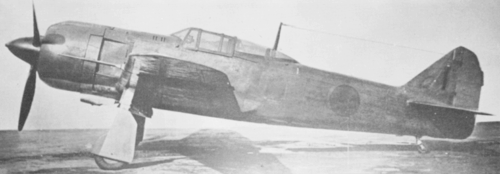
Ki-100-I Ko
In one reported engagement, Ki-100 pilots achieved a 14:0 kill ratio against Allied aircraft, though such claims remain debated.
Production of the Ki-100 ceased with Japan’s surrender in August 1945.
In total, approximately 396 units were built, including both Ko and Otsu variants.
A final high-altitude version, the Ki-100-II, was developed with a turbo-supercharged engine, but only three prototypes were completed, and none saw combat.
Today, the Ki-100 is remembered as a symbol of Japan’s wartime adaptability.
One surviving example — a Ki-100-Ib (Otsu) — is preserved at the Royal Air Force Museum Cosford, offering valuable reference for historians and restoration specialists.
Ki-100-I Ko
Origins and Conversion
Base Airframe
The Ki-100-I Ko was not a clean-sheet design but a conversion of the Kawasaki Ki-61-II-KAI fighter.
These airframes were originally built to house the liquid-cooled Kawasaki Ha-140 inline engine.
Crisis Catalyst
In early 1945, Allied bombing destroyed the Ha-140 engine factory, leaving hundreds of completed Ki-61-II-KAI airframes without powerplants.
Radial Retrofit
Kawasaki responded by fitting the airframes with the air-cooled Mitsubishi Ha-112-II 14-cylinder radial engine.
This required cutting off the integral engine mount and cowling and replacing them with a bolted tubular steel mount.
Designation
The converted aircraft were designated Ki-100-I Ko, with “Ko” indicating the first production batch using the original Ki-61 spine and canopy.
Performance
Despite the emergency nature of the conversion, the Ki-100-I Ko proved to be one of the most effective Japanese fighters of the war.
It offered
Excellent maneuverability
Reliable engine performance
Improved climb rate and handling over the Ki-61
Limitations
Its high-altitude performance was poor — above 9,000 metres, it reportedly flew “like a sack of stones”.
However, this became less critical as U.S. bombing tactics shifted to low-altitude incendiary raids.
Operational History
Entry into Service
The first Ki-100-I Ko units rolled out in mid-March 1945 and were sent to training centres at Akeno and Hitachi.
Training Challenges
Novice pilots struggled with the aircraft’s handling, leading to significant losses during training.
Nearly half of the first 150 delivered were lost due to accidents.
Combat Deployment
Veteran pilots quickly adapted and praised the aircraft.
Escorting kamikaze formations during the Battle of Okinawa
Defence against carrier-based raids on the Japanese mainland.
Ki-100-I Otsu
The Kawasaki Ki-100-I Otsu was the second production variant of the Ki-100 fighter series, developed by the Imperial Japanese Army Air Service in 1945.
Unlike the earlier Ki-100-I Ko, which was a conversion of existing Ki-61-II-KAI airframes, the Otsu was a purpose-built design that incorporated lessons learned from the emergency retrofit programme.
The Ki-100-I Otsu featured a cut-down rear fuselage and a full bubble canopy, significantly improving pilot visibility — a critical advantage in dogfights and interception missions.
The airframe was designed from the outset to accommodate the Mitsubishi Ha-112-II radial engine, a 14-cylinder air-cooled powerplant known for its reliability and ease of maintenance.
This engine replaced the problematic Kawasaki Ha-140 inline engine used in the Ki-61 series, which had suffered from production delays and mechanical failures.
Production of the Ki-100-I Otsu began in May 1945 at Kawasaki’s Kagamigahara plant, with approximately 118 units completed before the end of hostilities.
These aircraft were assigned to home defence units, including five Sentai tasked with intercepting low-flying B-29 Superfortresses and escorting kamikaze formations during the final stages of the war.
Despite its late entry into service, the Ki-100-I Otsu was praised by pilots for its manoeuvrability, climb rate, and combat effectiveness.
It was considered one of the best Japanese fighters of the war, capable of holding its own against advanced Allied aircraft such as the P-51D Mustang and F6F Hellcat.
The Ki-100 series, including the Otsu variant, never received an Allied code name and remained relatively unknown outside Japan until postwar analysis revealed its performance capabilities.
Today, the Ki-100-I Otsu is remembered as a symbol of Japan’s wartime engineering resilience.
Ki-100-II
Development Origins
Purpose
The Ki-100-II was conceived to address the high-altitude limitations of the earlier Ki-100-I Ko and Otsu variants, which struggled above 9,000 metres — a critical altitude for intercepting B-29 Superfortresses.
Engine Upgrade
Engineers fitted the Ki-100-II with a turbo-supercharged Mitsubishi Ha-112-II radial engine, aiming to boost performance at altitude without sacrificing reliability.
Airframe and Configuration
Design Lineage
The Ki-100-II retained the core structure of the Ki-100-I Otsu — including the cut-down rear fuselage and bubble canopy — but incorporated modifications to accommodate the turbo-supercharger system.
Cooling and Cowling
The revised cowling and ducting were designed to manage the increased thermal load from the turbocharger, a rare feature in Japanese fighters.
Cockpit Layout
The canopy offered excellent visibility, and the cockpit was slightly reconfigured to accommodate new instrumentation for engine management at altitude.
Prototype Status
Only three prototypes were completed before the war ended.
Testing
Flight trials reportedly showed marked improvement in high-altitude performance, but the aircraft never entered mass production or combat service.
Operational Use
None of the Ki-100-II prototypes saw frontline deployment.
They remained testbeds, and their data did not influence postwar designs due to Japan’s surrender.
Specifications (Ki-100-I-Ko/Otsu Goshikisen)
Crew
One
Length
8.82 m (28 ft 11 in)
Wingspan
12.00 m (39 ft 4 in)
Height
3.75 m (12 ft 4 in)
Wing area
20 m² (220 sq ft)
Airfoil
Root
NACA 2R116
Tip
NACA 24009
Empty weight
2,525 kg (5,567 lbs)
Gross weight
3,495 kg (7,705 lbs)
Fuel capacity
595 L (157 US gal; 131 imp gal)
(internal fuel)
Water-methanol capacity
95 L (21 imp gal; 25 US gal)
Undercarriage track
4.050 m (13.29 ft)
Powerplant
1 × Mitsubishi Ha-112-II/Ha-33,
14-cylinder two-row air-cooled radial engine,
1,120 kW (1,500 hp) at takeoff
Propellers
3-bladed constant-speed propeller,
3.00 m (9 ft 10 in) diameter
Performance
Maximum speed
580 km/h (360 mph, 310 kn) at 6,000 m (20,000 ft)
Cruise speed
400 km/h (250 mph, 220 kn) at 4,000 m (13,000 ft)
Range
1,400 km (870 mi, 760 nmi) on internal fuel only,
2,200 km (1,400 mi; 1,200 nmi) with 2 x 200 L (44 imp gal; 53 US gal) external droppable fuel tanks
Endurance
3 hours 30 minutes
Service ceiling
11,000 m (36,000 ft)
Time to altitude
6 minutes to 5,000 m (16,000 ft)
20 minutes to 10,000 m (33,000 ft)
Wing loading
174.8 kg/m² (35.8 lbs./sq ft)
Armament
Guns
2 × 20 mm (0.8 in) fuselage-mounted Ho-5 cannons (400 rpg) and 2 × 12.7 mm (0.50 in) wing-mounted Ho-103 machine guns (500 rpg)
Hardpoints
2 × 200 L (44 imp gal; 53 US gal) external drop tanks, carried outboard of the undercarriage legs
Bombs
2 × 250 kg (550 lbs) bombs, carried in lieu of drop tanks on the same hardpoints outboard of the undercarriage.