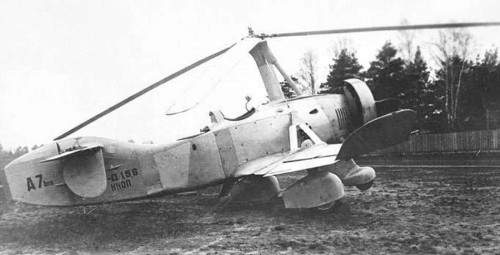
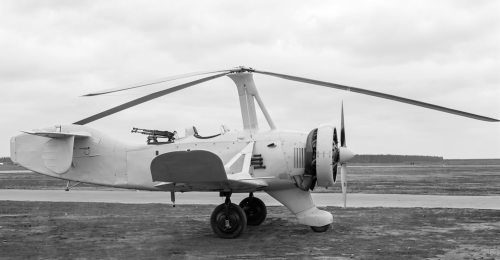
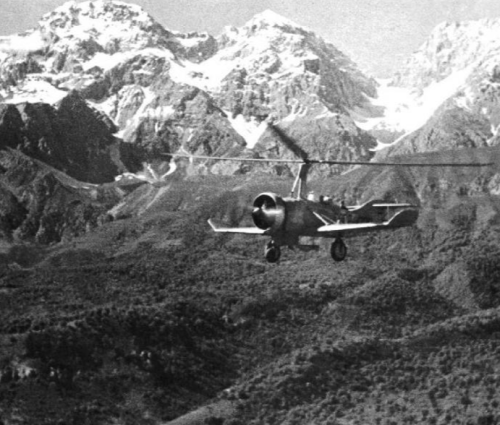
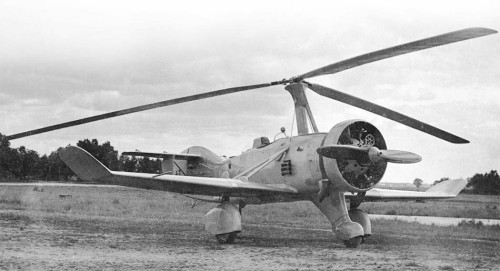
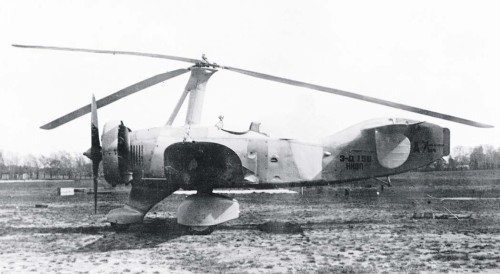
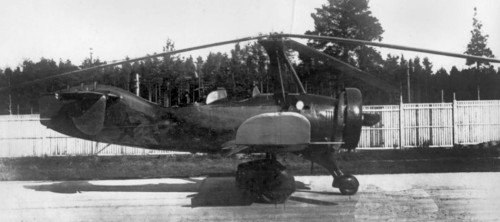
The Kamov A‑7 occupies a unique place in Soviet—and world—aviation history as the first armed autogyro ever used in combat.
Its development stemmed from the USSR’s early interest in rotary‑wing aircraft during the late 1920s and early 1930s, when autogyros were seen as promising platforms for reconnaissance, artillery spotting, and liaison duties.
The project began under Nikolai I. Kamov, whose career had already been shaped by experimental autogyro work.
After the success of the early KASKR machines, Kamov was placed in charge of a small design team within the TsAGI Special Design Bureau.
Their task: create a short‑takeoff reconnaissance and artillery‑correction aircraft capable of operating from improvised front‑line strips and offering superior low‑speed handling and observation capability compared to fixed‑wing aircraft.
Work on the A‑7 began in 1933, and the first prototype was completed in April 1934.
After ground trials, the aircraft made its maiden flight on 20 September 1934, piloted by S. A. Korzinkov.
Testing continued into late 1935, revealing vibration issues, rotor‑head refinements, and engine cooling challenges.
These were gradually resolved, and the A‑7 proved surprisingly capable—fast for an autogyro, stable, and well‑suited to low‑speed reconnaissance.
By 1938, the improved A‑7bis had completed its trials, and in 1940 a small military batch designated A‑7‑3a was ordered from the newly established autogyro plant at Ukhtomskaya, with Kamov as director and Mikhail Mil as his deputy.
Technical Description
Airframe and Layout
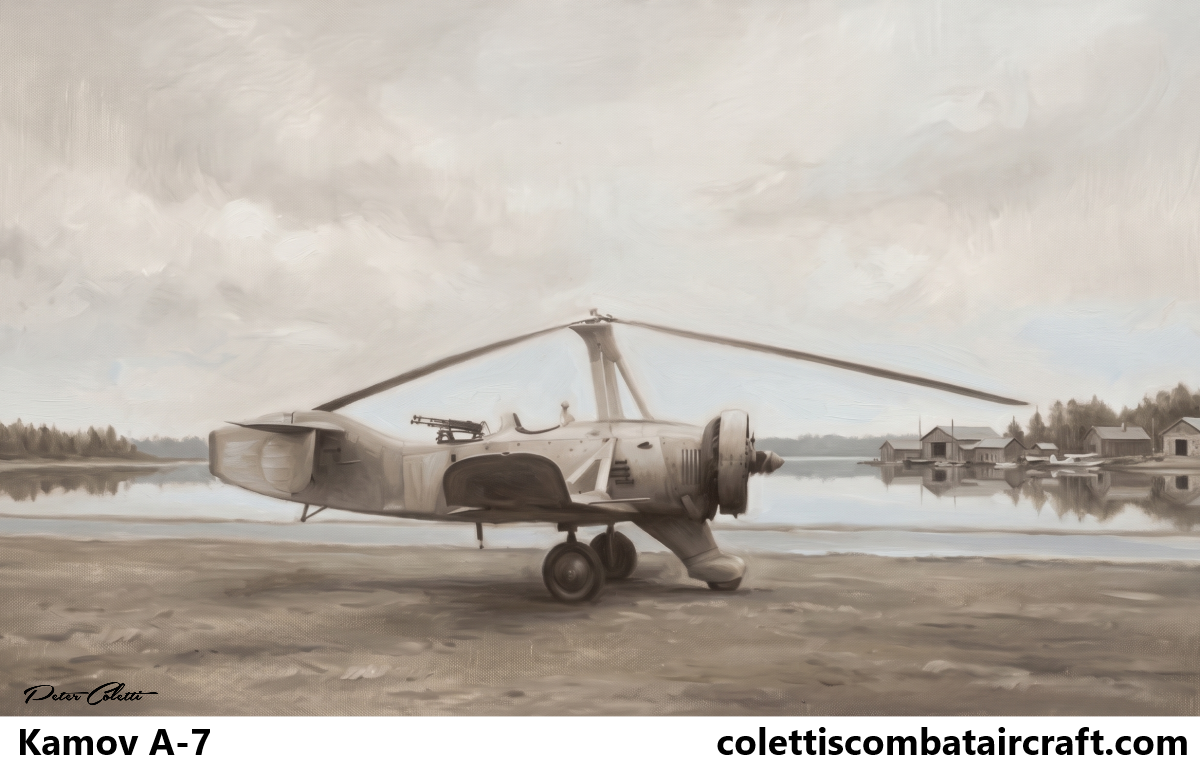
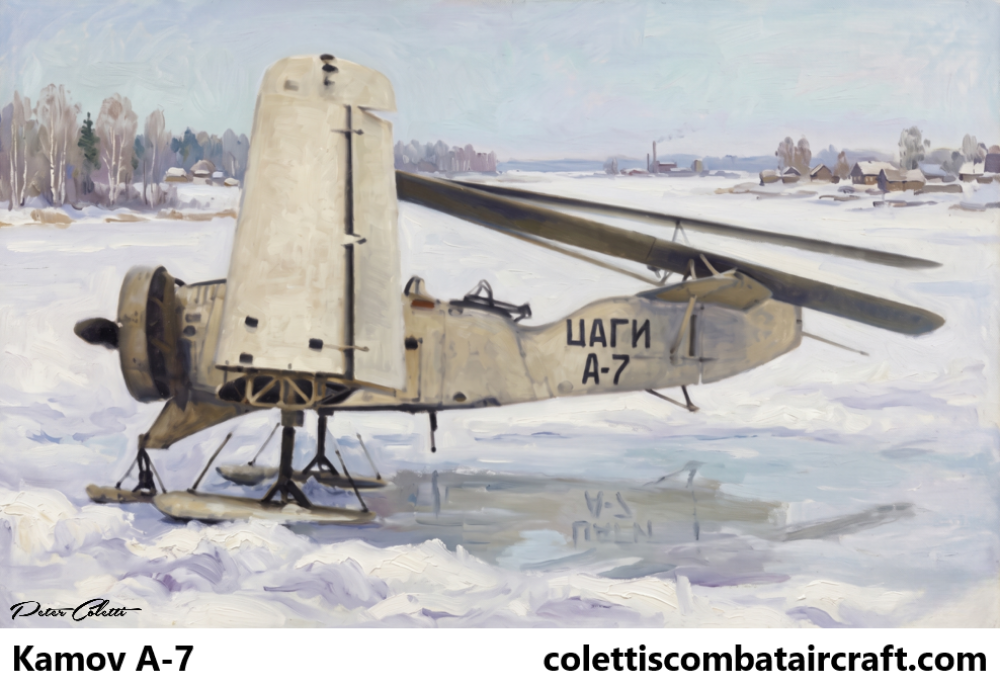
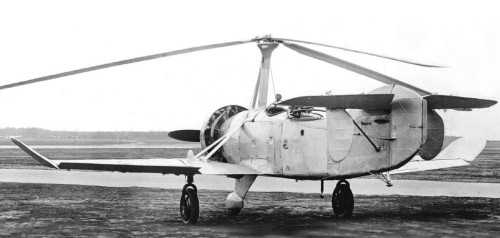
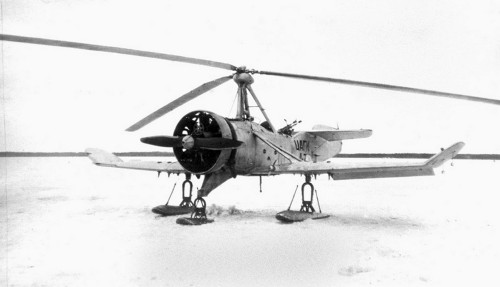
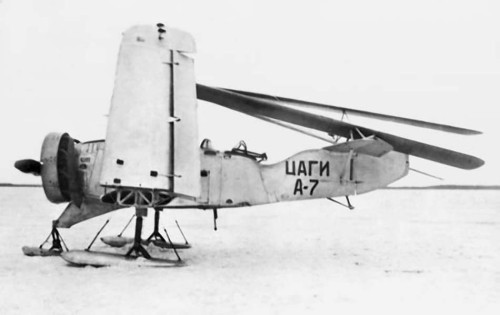
The A‑7 was a two‑seat, tractor‑engine autogyro with a three‑bladed, free‑spinning rotor and a conventional fixed wing.
Its configuration combined elements of both aeroplane and rotary‑wing design:
Fuselage: A steel‑tube truss divided into engine, cockpit, and tail sections.
The forward fuselage was skinned in removable duralumin panels; the tail boom was fabric‑covered.
Cockpits: Separate open cockpits for pilot (front) and observer/gunner (rear), with excellent downward and lateral visibility.
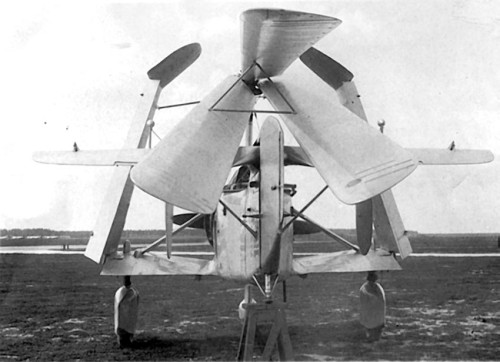
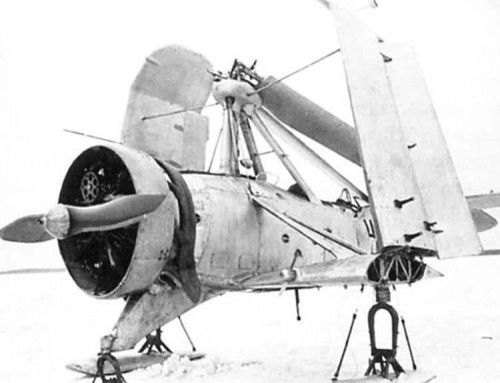
Wings: A wooden, fabric‑covered wing with a MOS‑27 airfoil, V‑struts, and folding outer panels for transport. Ailerons provided roll control at higher speeds.
Rotor System:
Three blades mounted on a tall central pylon (“kabán”).
Hinged at both vertical and horizontal axes.
Steel‑tube spar with wooden ribs and fabric covering.
Blades could be folded for transport.
Rotor pitch was fixed; control was via conventional aeroplane surfaces.
Landing Gear: A tricycle undercarriage—unusual for the 1930s—with a nosewheel and tail skid, giving excellent ground handling.
Propulsion
Engine: One M‑22 radial engine (480 hp), a Soviet‑built derivative of the Bristol Jupiter.
A mechanical prerotator allowed the rotor to be spun up before take-off, reducing ground roll.
Armament and Equipment
The A‑7 was the first autogyro designed from the outset as a combat aircraft:
Fixed forward gun: One 7.62 mm PV‑1 machine gun firing through the propeller arc.
Defensive armament: Twin 7.62 mm DA machine guns on a ring mount in the observer’s cockpit.
Ordnance:
Up to 4 × 100 kg FAB‑100 bombs,
or
6 × RS‑82 unguided rockets.
Standard reconnaissance equipment included radio gear and photographic cameras.
Performance Characteristics
Maximum speed: ~221 km/h
Minimum controllable speed: ~53 km/h
Range: 1000 km (ferry), ~400 km (combat)
Service ceiling: ~4700 m
Rate of climb: ~160 m/min
Endurance: ~2.5 hours
Crew: 2
These figures made the A‑7 one of the fastest autogyros of its era, with performance comparable to contemporary biplane reconnaissance aircraft but with vastly superior low‑speed handling and STOL capability.
Variants
A‑7 (Prototype, 1934–1935)
The initial version was used for factory and state trials.
Featured the original tall rotor pylon and early aerodynamic configuration.
A‑7bis (1936–1938)
A refined prototype incorporating:
Redesigned rotor pylon for better visibility and emergency egress.
Improved tail surfaces with ventral fins (“washers”) for directional stability.
Aerodynamic clean‑ups and structural improvements.
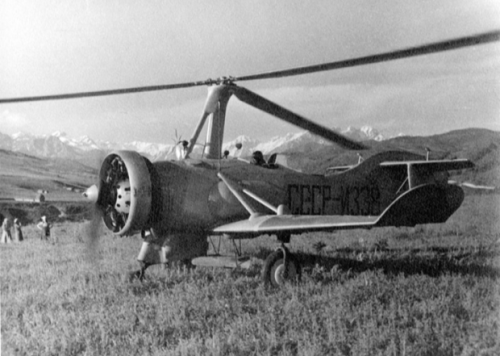
This version was used in high‑profile demonstrations and later in civilian agricultural trials in Central Asia, where it successfully dispersed pesticides over mountainous orchards.
A‑7‑3a (1940–1941)
The small pre‑series military batch:
Strengthened airframe.
Full combat equipment.
Minor refinements for field service.
Only five were built before the German invasion.
Operational History and WWII Context
Pre‑war Activities
Before the war, the A‑7 bis demonstrated its versatility in non‑military roles.
In 1941, it was deployed to the Tien Shan foothills for agricultural spraying, where its ability to manoeuvre in tight valleys and operate from tiny clearings impressed observers.
A dramatic Arctic rescue deployment was planned in 1938–39 for the Papanin drifting-ice expedition, but the autogyro arrived too late to participate.
Combat Use in the Great Patriotic War
With the outbreak of war in June 1941, the five A‑7‑3a machines were formed into the first autogyro squadron in Soviet military history, attached to the 24th Army.
Their missions included:
Artillery spotting
Short‑range reconnaissance
Night liaison flights
Delivering dispatches to partisans behind enemy lines
Operating near Yelnya, the autogyros flew in extremely hazardous conditions.
Their low speed made them vulnerable, but their ability to fly at night, land in tiny clearings, and maintain control at very low speeds gave them unique advantages.
One A‑7 was lost when its pilot mistook a forest for an airfield in darkness and autorotated into the trees.
Others suffered damage from rough field conditions and enemy action.
By late 1941, the surviving aircraft were withdrawn as the front moved and the Ukhtomskaya plant was evacuated eastward.
Kamov and Mil personally visited the front to supervise repairs, but production could not continue under wartime conditions.
The A‑7’s combat career was brief but historically significant: it was the first armed rotary‑wing aircraft ever used in war, predating operational helicopters.
Legacy
Although only a handful were built, the Kamov A‑7 had an outsized influence:
It proved the feasibility of armed rotary‑wing combat aircraft.
It established the first Soviet factory dedicated to rotorcraft.
It launched the careers of Nikolai Kamov and Mikhail Mil, who would later become the two great rival schools of Soviet helicopter design.
It provided crucial experience in rotor dynamics, autorotation behaviour, and field operation of rotary‑wing aircraft.
The A‑7 was the last autogyro Kamov ever designed; after the war he turned entirely to helicopters, culminating in the famous coaxial‑rotor Kamov lineage.