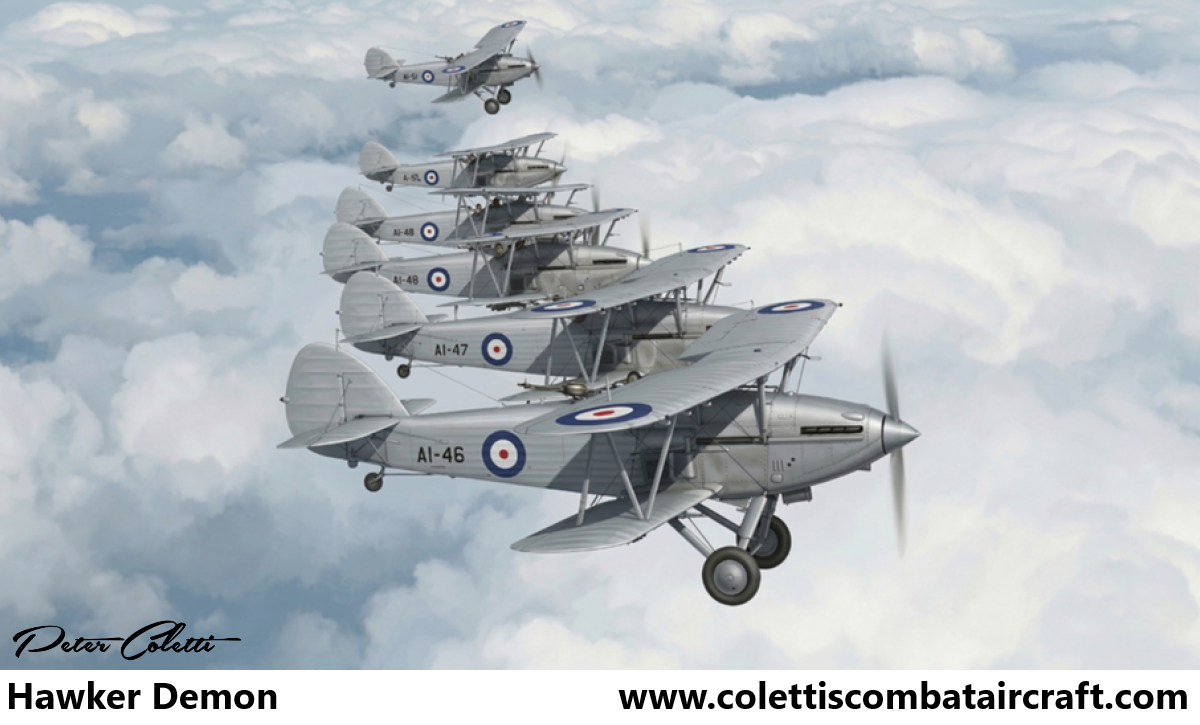
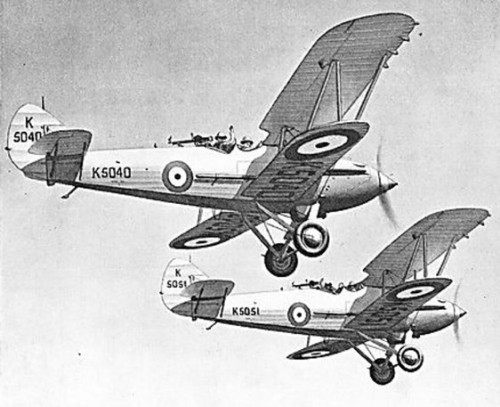
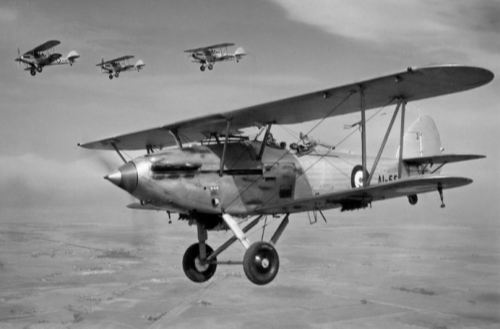
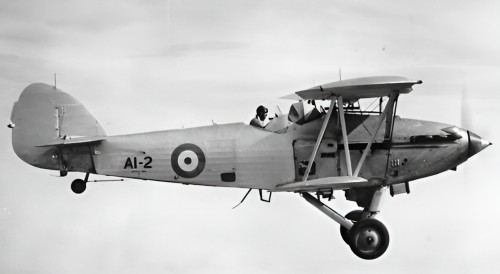
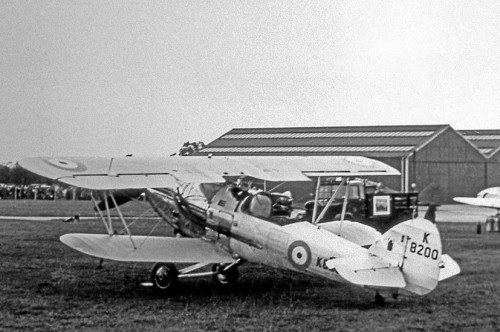
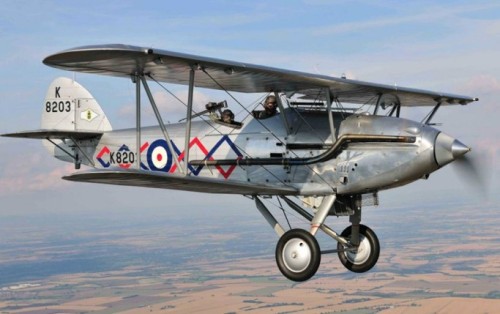
The Hawker Demon emerged as a direct response to the Royal Air Force’s evolving air defence challenges in the early 1930s.
Originally conceived as a fighter derivative of the highly successful Hawker Hart light bomber, the Demon was designed to address a critical tactical gap exposed during RAF exercises.
In these mock engagements, contemporary fighters such as the Armstrong Whitworth Siskin and Bristol Bulldog consistently failed to intercept the fast and agile Hart bombers.
So pronounced was the disparity that Hart crews were often ordered to limit their altitude and throttle back their speed to give the defending fighters a sporting chance—an unsustainable compromise that underscored the need for a dedicated fighter variant.
Although the sleek Hawker Fury offered superior performance, its limited production and higher cost rendered it unsuitable for widespread deployment.
Consequently, the Air Ministry endorsed the Hart-based fighter as a stopgap solution, bridging the capability gap until more advanced fighters could be procured in sufficient numbers.
This pragmatic decision led to the birth of the Hawker Demon.
Design and Development
The Demon retained the Hart’s basic airframe but incorporated several key modifications to suit its new role
Armament Enhancements
A second fixed .303-inch (7.7 mm) Vickers machine gun was added to the nose, significantly improving forward firepower.
Defensive capability was bolstered by a rear-mounted one. 303-inch Lewis gun, which in later variants was housed in a hydraulically powered turret—an innovation first tried on the Hart.
Crew Configuration
The rear cockpit coaming was reshaped to improve the gunner’s field of fire, enhancing survivability during engagements with enemy aircraft.
Powerplant Upgrade
A supercharged Rolls-Royce Kestrel IS engine was fitted, offering improved high-altitude performance and better climb rates compared to the bomber variant.
The prototype batch of six aircraft—initially referred to as Hart Fighters—was evaluated by a flight of No. 23 Squadron in 1931.
The trials proved successful, validating the concept and leading to full-scale production under the name Hawker Demon.
Operational History and Production
The first production Demon took to the skies on 10 February 1933.
Over its production run, a total of 305 Demons were built, including 232 for the RAF.
Manufacturing was shared between Hawker Aircraft and Boulton Paul Aircraft, the latter completing 106 units at their Wolverhampton facility, with the final aircraft delivered in December 1937.
Though never intended as a long-term frontline solution, the Demon served capably throughout the mid-1930s.
It equipped several RAF squadrons, including Nos. 23, 41, 64, and 600, and was often used in the fighter-reconnaissance and army cooperation roles.
Its two-seat configuration made it particularly suitable for training and tactical coordination missions.
The Demon also saw limited export success.
The Royal Australian Air Force acquired several examples, using them primarily for home defence and training duties.
By the outbreak of the Second World War, the Demon had been relegated to second-line service, superseded by faster, more modern monoplane fighters such as the Hawker Hurricane and Supermarine Spitfire.
The Variants
Demon I
(RAF Standard Fighter Variant)
The Demon I was the primary two-seat fighter version developed for the Royal Air Force, derived from the successful Hawker Hart bomber.
Designed to fill an urgent gap in air defence capability during the early 1930s, the Demon I retained the Hart’s basic airframe but was modified for fighter duties
Crew
Pilot and rear gunner/observer
Powerplant
Typically equipped with a supercharged Rolls-Royce Kestrel IS engine, delivering improved high-altitude performance
Armament
Two fixed forward-firing ones. 303 in (7.7 mm) Vickers machine guns
One rear-mounted .303-inch Lewis gun on a flexible mount
Role
Interception, fighter-reconnaissance, and limited escort duties
Operational Use
Widely deployed across RAF fighter squadrons, including Nos. 23, 41, and 64.
It served as a transitional type between the biplane era and the emergence of high-performance monoplanes.
The Demon I was praised for its stability and ease of handling, making it suitable for both combat and training roles.
Though outclassed by newer designs by the late 1930s, it remained in second-line service into the early stages of World War II.
Australian Demon I
(RAAF General-Purpose and Army Co-operation Variant)
The Australian Demon I was a localised adaptation of the RAF’s Demon I, tailored to meet the Royal Australian Air Force’s operational needs.
While structurally similar to its British counterpart, it featured a more powerful engine.
Powerplant
The Rolls-Royce Kestrel V, rated at 600 hp (447 kW), offers enhanced performance in hot climates and over long distances.
Production
54 aircraft built
First 18 delivered in 1935 as general-purpose fighters
An additional 36 were delivered in 1936 for army co-operation duties, including reconnaissance, artillery spotting, and tactical coordination.
Modifications
Some aircraft were fitted with radio equipment and camera mounts for observation roles.
These aircraft were operated by No. 1 and No. 3 Squadrons RAAF and played a key role in developing Australia’s interwar air defence and tactical aviation capabilities.
Their versatility made them valuable assets in both peacetime training and regional defence planning.
Australian Demon II
(RAAF Training and Target-Towing Variant)
The Demon II was a specialized training version developed for the RAAF, based on the standard Demon airframe but modified for instructional and support roles
Crew
Dual controls for instructor and trainee
Role
Advanced pilot training and aerial gunnery practice
Features
Provision for target towing gear, allowing use in live-fire exercises
Retained defensive armament for realism in training scenarios
Production
10 aircraft built
These aircraft were primarily assigned to training units and air gunnery schools, helping prepare RAAF crews for operational conversion to frontline types.
Their robust construction and forgiving flight characteristics made them ideal for instructional use.
Turret Demon
(RAF Experimental Defensive Variant)
The Turret Demon was an experimental sub-variant of the standard fighter, informally named for its distinctive rear gunner protection system
Modification
Fitted with a Frazer-Nash enclosed windshield/fairing around the rear cockpit, designed to shield the gunner from slipstream and improve visibility
Purpose
Evaluated as a potential solution to improve gunner survivability and effectiveness in combat
Armament
Retained the standard Lewis gun, but the turret fairing allowed for more stable operation in flight
While not widely adopted, the Turret Demon represented an early attempt to integrate semi-enclosed defensive positions in biplane fighters.
Lessons learned from its development influenced later turret designs in aircraft such as the Boulton Paul Defiant.
Specifications
Crew
2 (pilot and instructor or trainee)
Engine
Rolls-Royce Kestrel V (DR),
600 hp (447 kW), liquid-cooled V12
Wingspan
11.4 m (37 ft 3 in)
Length
9 m (29 ft 7 in)
Height
3.2 m (10 ft 5 in)
Wing Area
32.3 m² (348 sq ft)
Empty Weight
1,505 kg (3,319 lb)
Loaded Weight
2,117 kg (4,668 lb)
Performance
Maximum Speed
293 km/h (182 mph) at 4,999 m (16,400 ft)
249 km/h (155 mph) at 1,000 m (3,280 ft)
Climb Rate
To 1,000 m: 2.1 minutes
To 5,998 m: 16.9 minutes
Service Ceiling
8,382 m (27,500 ft)
Endurance
Approximately 2.5 hours
Armament and Equipment
Forward Armament
Two fixed .303 in (7.7 mm) Vickers machine guns
Rear Armament
One .303 in Lewis gun on flexible mount
Training Features
Dual flight controls for instructional use
Provision for target towing gear
Capability to carry light bombs under wings for gunnery practice
Production and Service
Units Built
10 aircraft (Serials A1-55 to A1-64)
Delivery Dates
Nine aircraft were delivered in October 1937; the final unit (A1-64) arrived in May 1938.