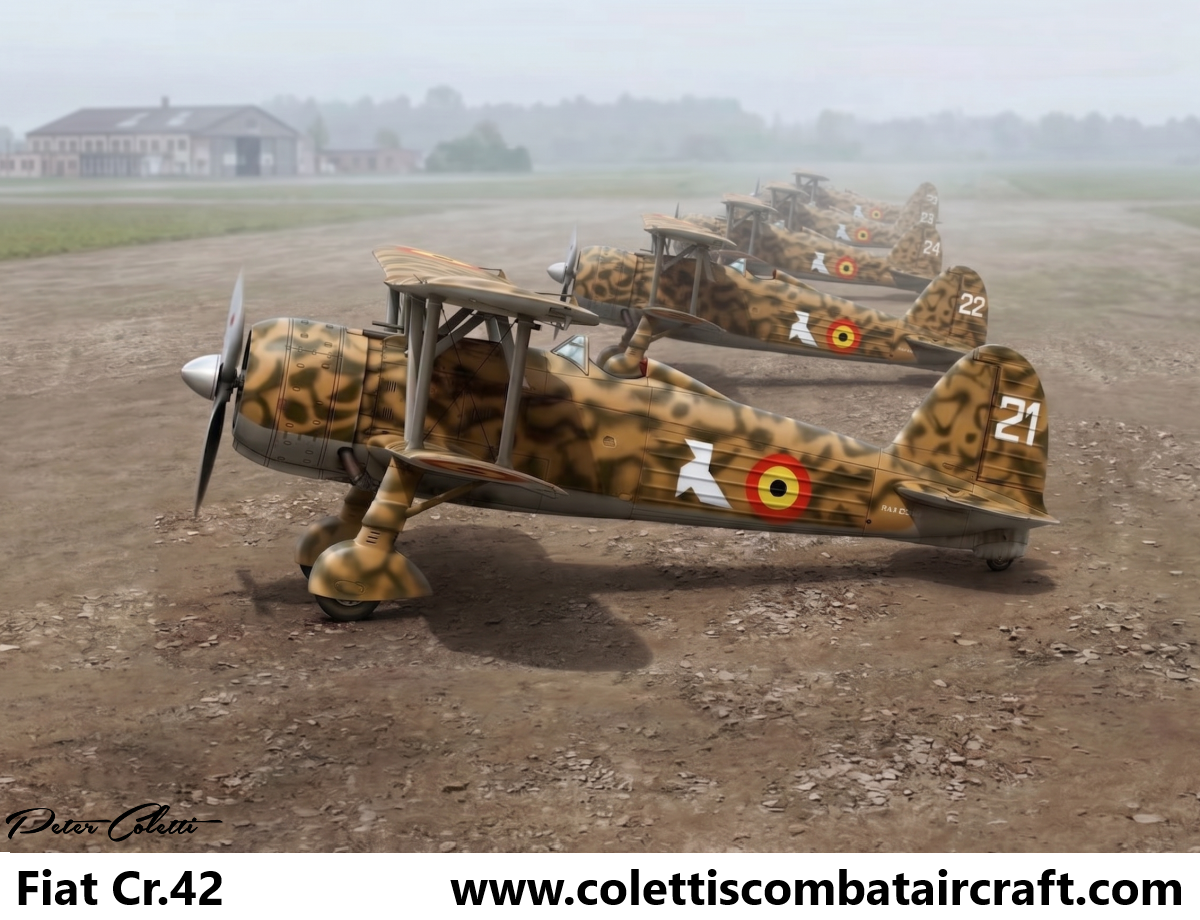
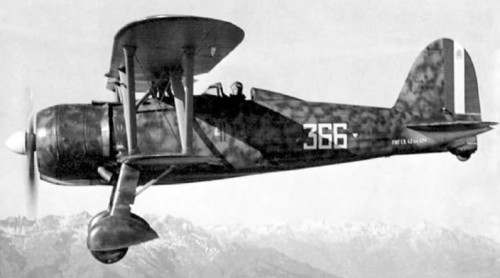
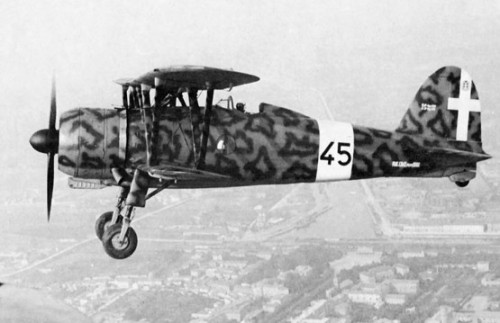
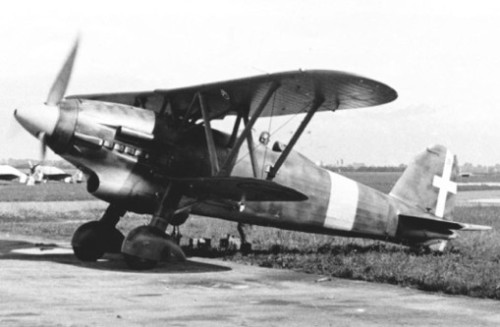
The CR.42 entered service with the Regia Aeronautica in May 1939, just before Italy’s entry into WWII.
It was the last biplane fighter to serve in front-line combat for a major power, derived from the earlier CR.32 but upgraded with a supercharged Fiat A.74 R1C.38 radial engine.
Despite being outdated by monoplane standards, it was praised for its agility, durability, and low wing loading, which gave it an edge in dogfights at lower altitudes.
Combat Theatres
Battle of France (1940)
CR.42s saw limited action supporting Italian forces in the Alps.
Engaged French aircraft in brief skirmishes, with mixed results due to inferior speed and armament.
Battle of Britain (1940)
A small contingent of CR.42s operated from Belgium under the Corpo Aereo Italiano.
Their performance against RAF Hurricanes and Spitfires was poor; the Falco’s twin machine guns were insufficient, and its speed lagged far behind.
RAF Intelligence noted its exceptional manoeuvrability and robust construction, but it was clearly outclassed.
North Africa (1940–1943)
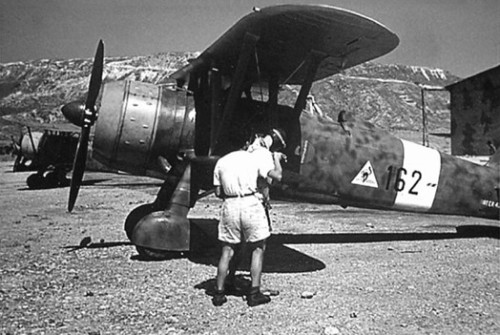
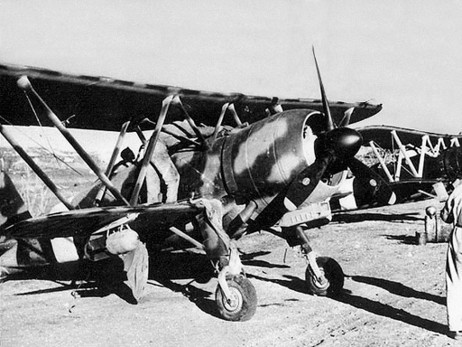
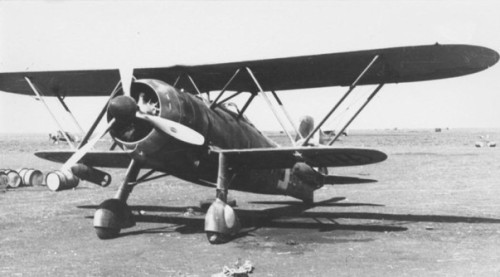
The CR.42 was widely used in Libya and Egypt, especially in the CR.42AS ground-attack configuration.
Operated in close support of Italian and German troops, often flying low-level strafing and bombing missions.
Sand filters were added to protect engines, though they reduced performance.
Eventually replaced by more modern aircraft like the Macchi C.202 and the German Bf 109s.
Malta and the Mediterranean
CR.42s flew escort and interception missions over Malta, often engaging British Blenheims and Hurricanes.
Their agility allowed them to hold their own in dogfights, but losses mounted as Allied aircraft improved.
Greece and the Balkans
Participated in the Greco-Italian War and later in operations across Yugoslavia.
Used for both air superiority and ground attack, often from forward airfields with limited infrastructure.
Eastern Front (Hungarian Service)
The Royal Hungarian Air Force operated CR.42s against Soviet forces.
Reports suggest a kill-to-loss ratio of 12:1, though this figure is debated.
Used primarily in the early stages of Operation Barbarossa for reconnaissance and ground attack.
Iraq (1941)
A small number of CR.42s were deployed during the Anglo-Iraqi War, supporting pro-Axis forces.
Their impact was minimal, and most were lost or withdrawn quickly.
Post-Armistice Use (1943–1945)
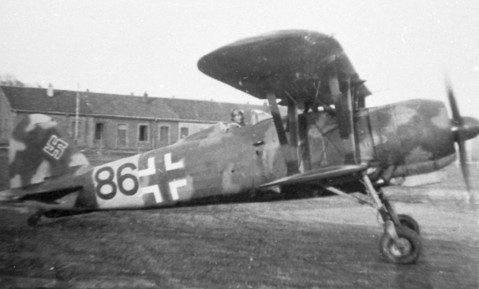
Luftwaffe Service – CR.42LW
After Italy’s armistice in September 1943, Germany seized many CR.42s.
Modified for night harassment and anti-partisan operations, especially in the Balkans.
Equipped with flame dampers and bomb racks, it retained the twin 12.7 mm guns.
Around 150 units were built or converted, with 112 accepted into Luftwaffe service.
Italian Co-Belligerent Air Force
Remaining CR.42s were used as trainers and liaison aircraft by the pro-Allied Italian forces.
Their combat role was effectively over by late 1943.
International Operators
Belgium
Operated a small number before being overrun in 1940.
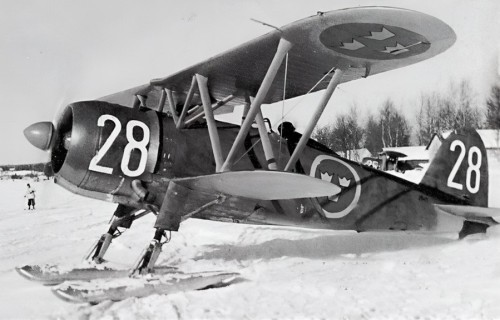
Sweden
Purchased CR.42s for air defence; used them until 1945, mostly for training.
Hungary
Most successful foreign operator, using the Falco extensively on the Eastern Front.
Legacy
Over 1,800 CR.42s were built, making it the most produced Italian fighter of WWII.
It holds the distinction of scoring the last biplane aerial victory of the war.
Though obsolete by 1941, it remained in service due to Italy’s industrial limitations and the aircraft’s rugged reliability.
The Variants
CR.42 (Standard Fighter)
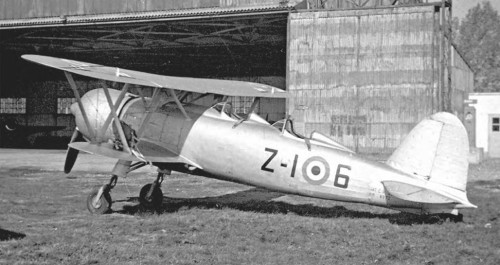
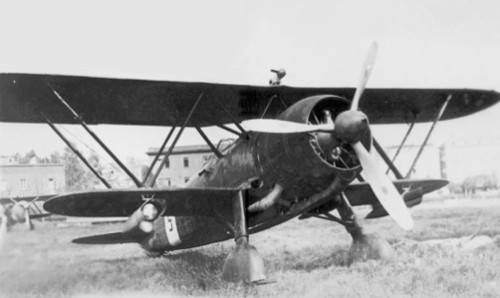
The baseline CR.42 Falco was a single-seat sesquiplane fighter introduced in 1939.
Early production models were armed with one 12.7 mm Breda-SAFAT heavy machine gun and one 7.7 mm Breda light machine gun, both mounted in the upper cowling and synchronised to fire through the propeller arc.
The aircraft was powered by a Fiat A.74 R1C.38 radial engine, delivering 840 hp, and was praised for its agility and structural strength.
Despite being a biplane in the monoplane era, it remained competitive in dogfights due to its manoeuvrability.
CR.42bis
An incremental upgrade to the standard fighter, the CR.42bis replaced the 7.7 mm gun with a second 12.7 mm Breda-SAFAT, doubling the heavy armament.
This configuration became the standard for later production runs, improving firepower without significantly altering the airframe.
CR.42 Egeo
Specialised for operations in the Aegean theatre, this variant featured an additional internal fuel tank with a capacity of approximately 80–100 litres (20–26 US gallons), increasing operational range for missions over the scattered islands.
It retained the standard fighter armament and was deployed by squadrons operating from bases in the Dodecanese.
CR.42AS (Africa Settentrionale)
Designed for close air support in North Africa, the CR.42AS was adapted to harsh desert conditions.
Key modifications included
Optional installation of two additional 12.7 mm machine guns under the wings.
Underwing bomb racks for two 100 kg (220 lb) bombs.
A sand filter fitted to the engine intake to prevent damage from airborne particles, though this reduced engine performance.
The AS variant was used extensively in ground attack roles, supporting Italian and German forces in Libya and Egypt.
CR.42B Biposto
A two-seat trainer variant with a lengthened fuselage to accommodate a second cockpit for the instructor.
This version was unarmed and used primarily for pilot conversion and advanced training.
It retained the same engine and flight characteristics as the fighter model, making it ideal for preparing pilots for frontline service.
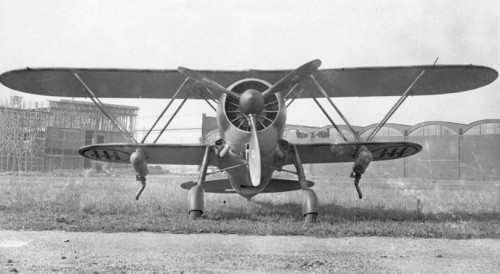
CR.42CN (Caccia Notturna)
A night fighter adaptation of the CR.42, the CN variant was equipped with
Wing-mounted searchlights in gondolas for target illumination.
Extended exhaust pipes to reduce visible flame, aiding concealment during night operations.
Though lacking radar, it was used for nocturnal interception and patrol duties, particularly over Italian cities and strategic installations.
CR.42ter
A late-war attempt to boost firepower, the CR.42ter mounted two standard 12.7 mm guns in the cowling and added two more in underwing blisters.
This configuration aimed to improve lethality against bombers and ground targets.
However, the increased weight and drag affected performance, and production was limited.
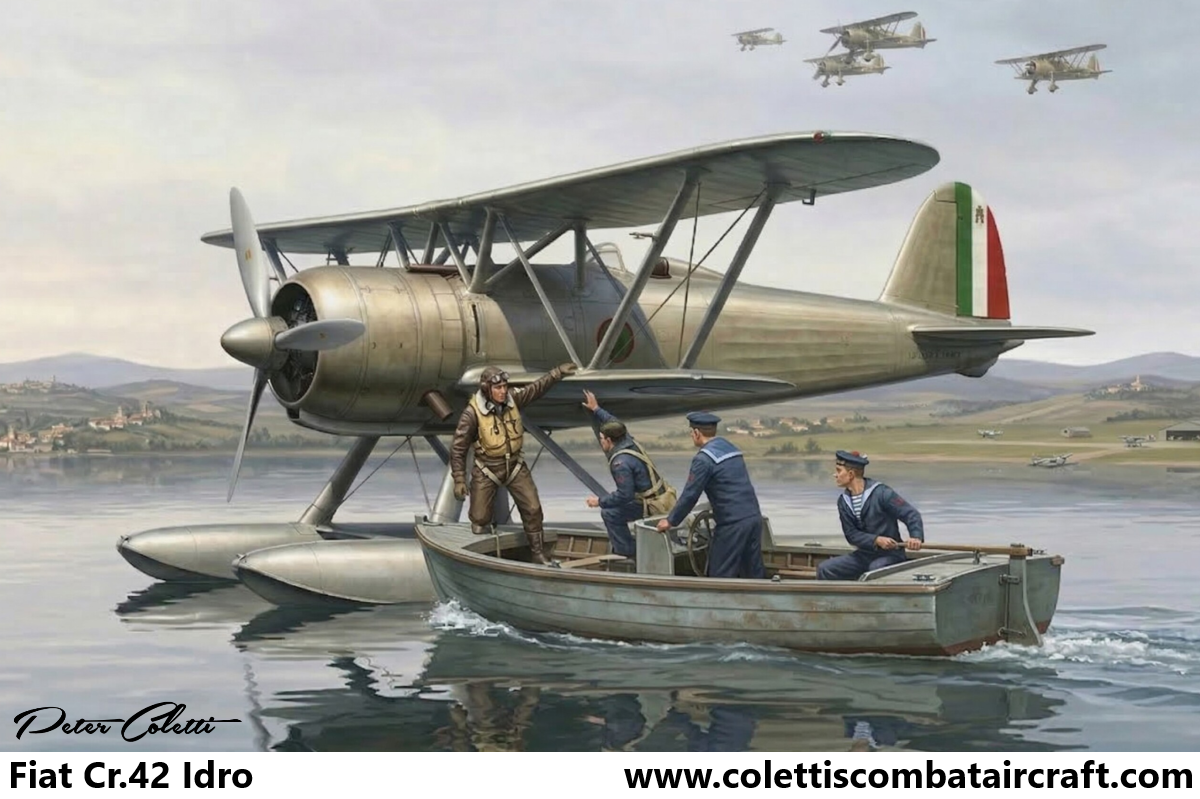
ICR.42 (Idrovolante)
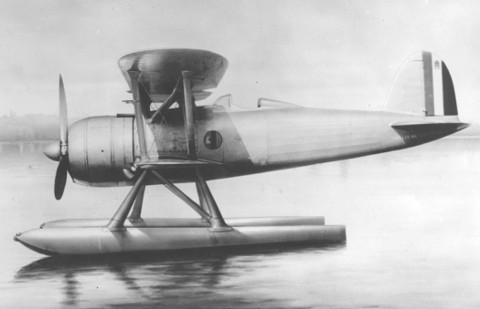
An experimental floatplane version developed by CMASA for maritime reconnaissance and patrol.
It featured twin floats and retained most of the CR.42’s structure.
Despite a weight increase of 124 kg (273 lb), its top speed dropped by only 8 km/h (5 mph), demonstrating the robustness of the original design.
The project did not proceed beyond the prototype stage.
CR.42LW (Luftwaffe Version)
Produced for the German Luftwaffe after Italy’s armistice in 1943, the CR.42LW was adapted for night harassment and anti-partisan operations.
Features included
Flame dampers on exhausts.
Two 12.7 mm machine guns.
Underwing racks for four 50 kg bombs.
Of the 150 built, 112 were accepted into Luftwaffe service and deployed in the Balkans and Eastern Europe.
CR.42 “Bombe Alari”
An unofficial designation for field-modified CR.42s converted at SRAM (Servizi di Riparazione Aeronautica Militare) depots.
These aircraft were retrofitted with underwing pylons for two 50 kg bombs, often loaded with heavier 100 kg ordnance.
The modification extended the utility of obsolete fighters for ground attack roles.
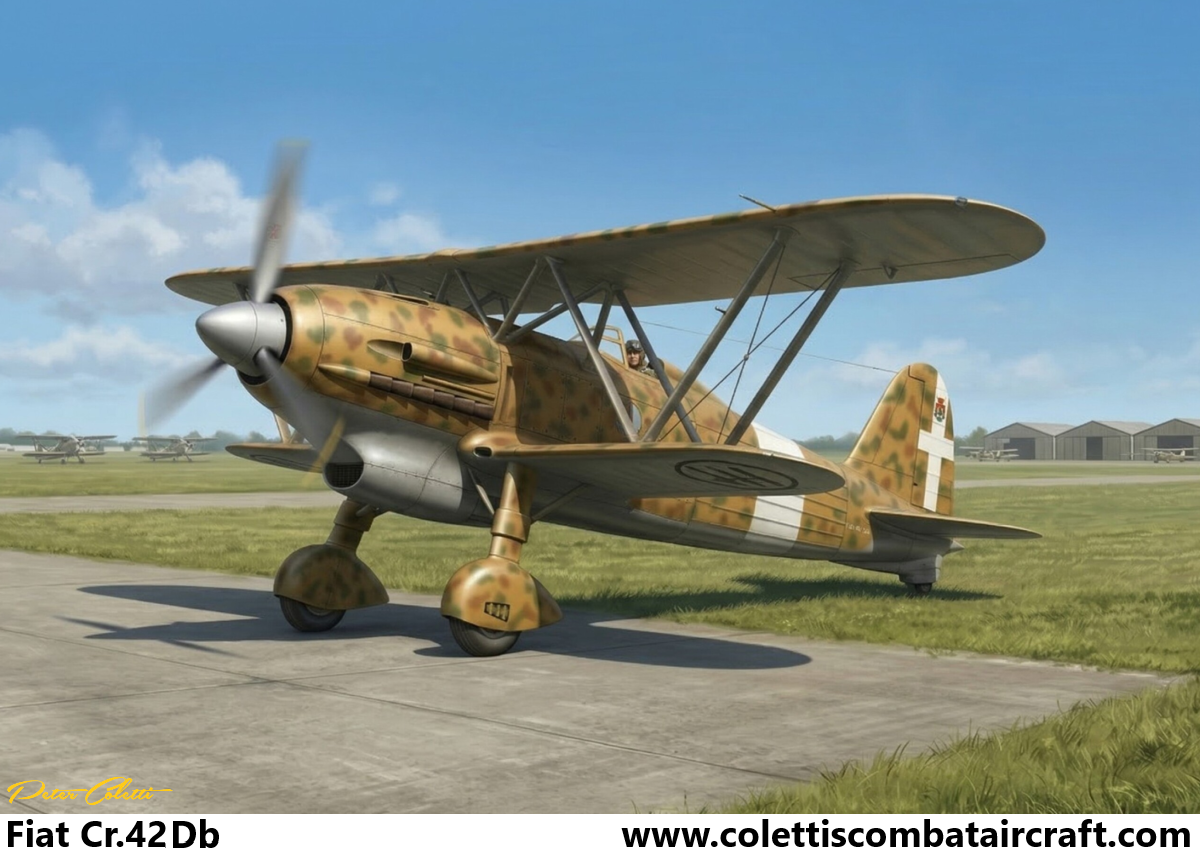
CR.42DB
A unique prototype fitted with a Daimler-Benz DB 601A inline engine rated at 895 kW (1,200 hp).
This dramatically improved performance, achieving a top speed of 525 km/h (326 mph)—a significant leap over the radial-powered versions.
Despite its promise, the DB variant remained experimental and did not enter production.
Specifications
Crew
1
Length
8.25 m (27 ft 1 in)
Upper wingspan
9.7 m (31 ft 10 in)
Lower wingspan
6.5 m (21 ft 4 in)
Height
3.585 m (11 ft 9 in)
Wing area
22.4 m² (241 sq ft)
Empty weight
1,782 kg (3,929 lbs)
Gross weight
2,295 kg (5,060 lbs)
Powerplant
1 × Fiat A.74 R.C.38,
14 cylinder air-cooled radial piston engine,
627 kW (841 hp) at 3,800 m (12,500 ft) & 2,400 rpm