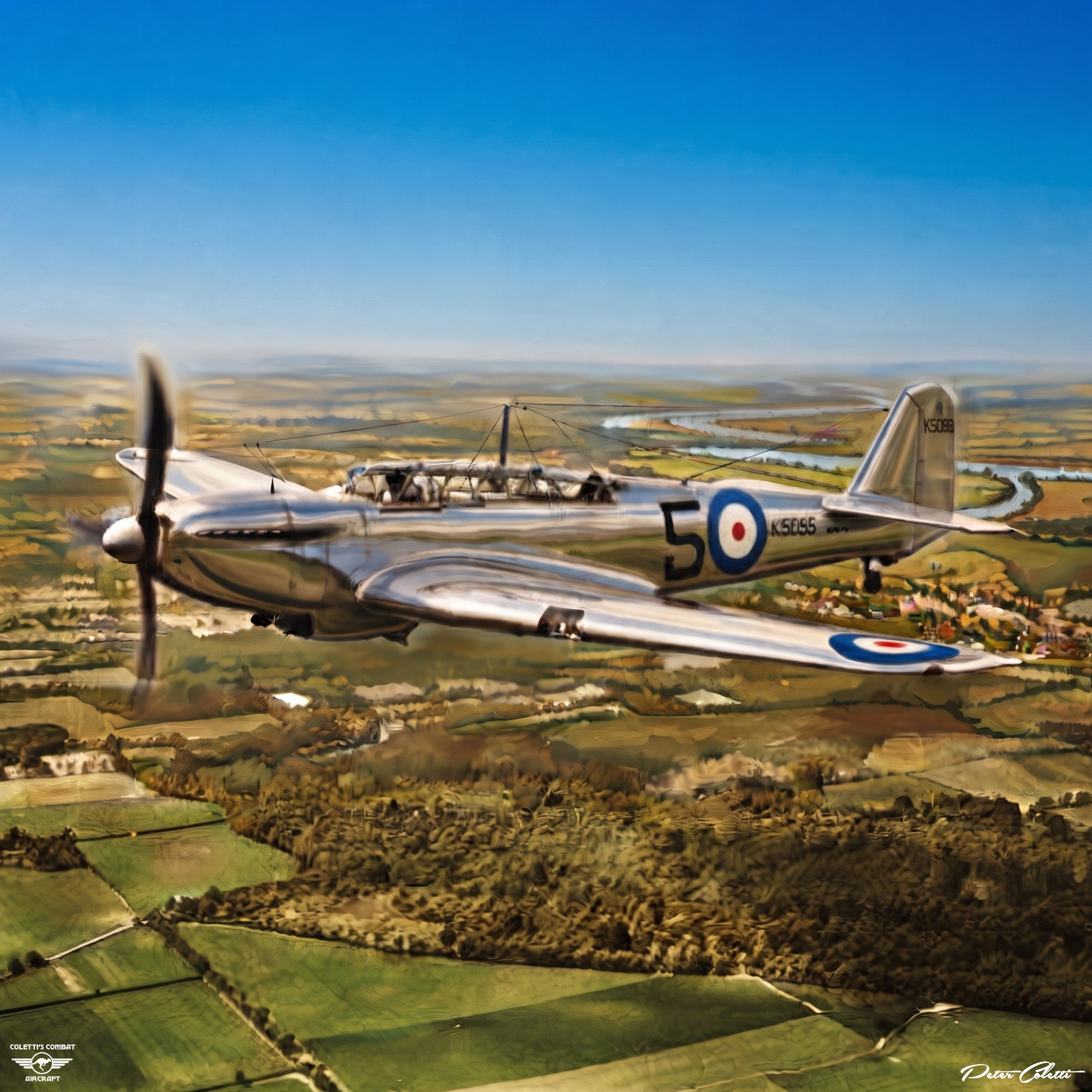
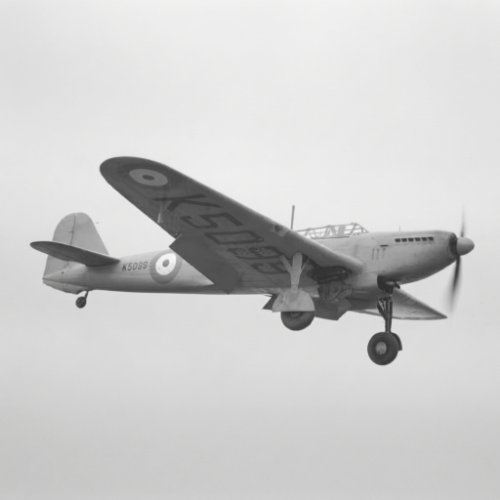
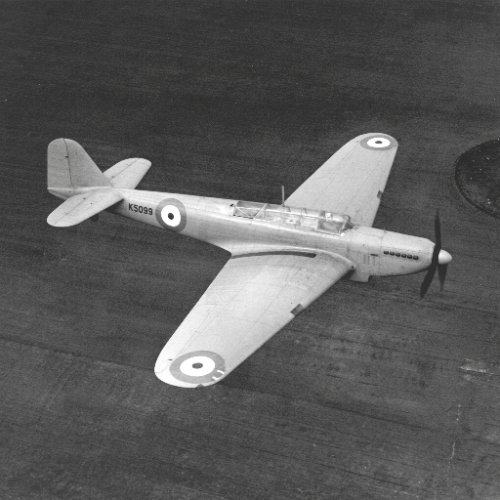
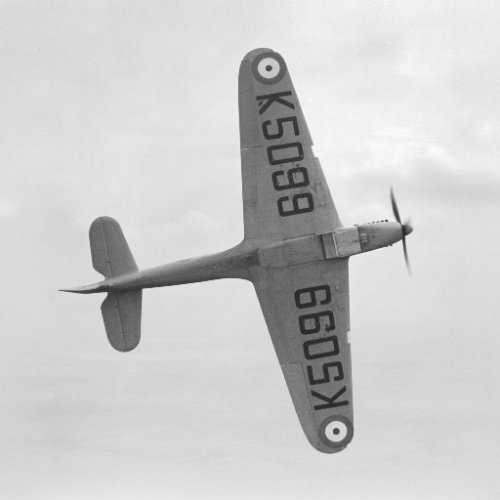
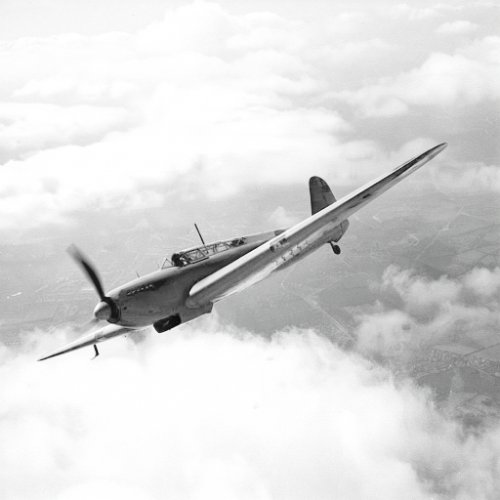
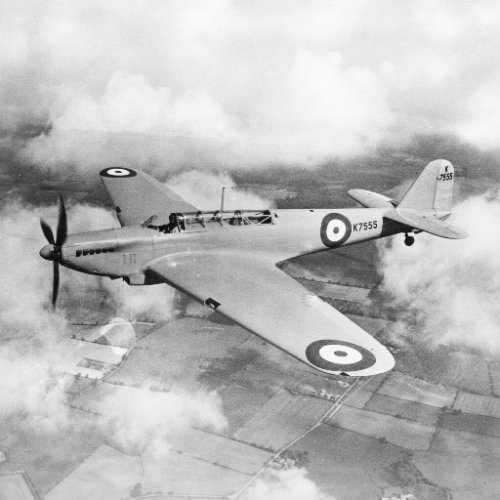
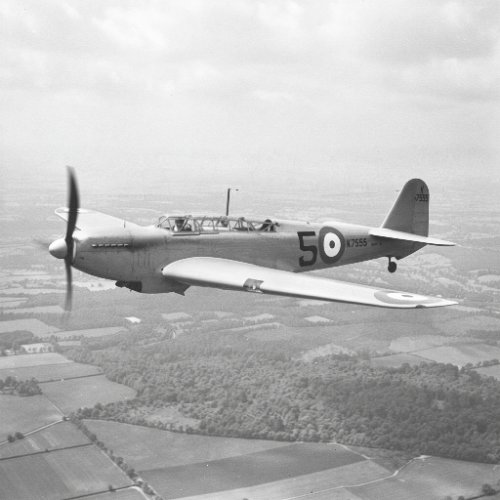
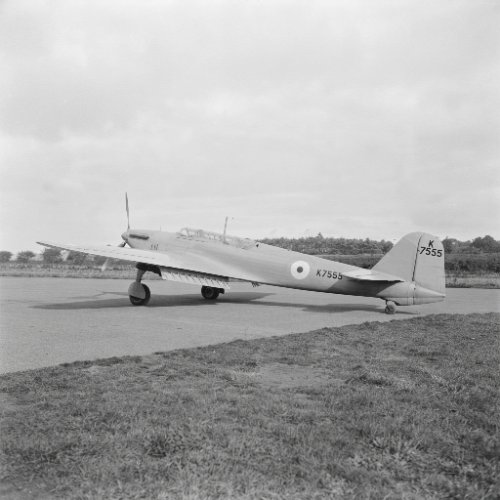
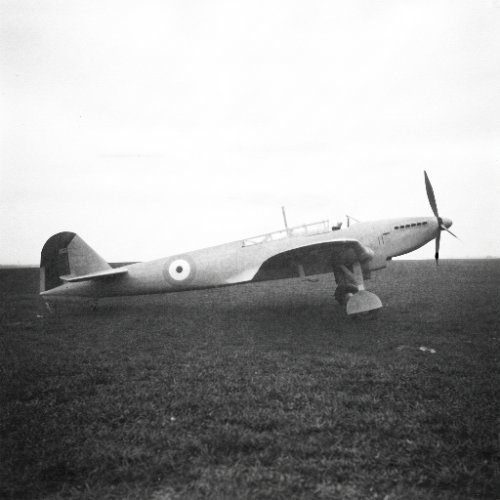
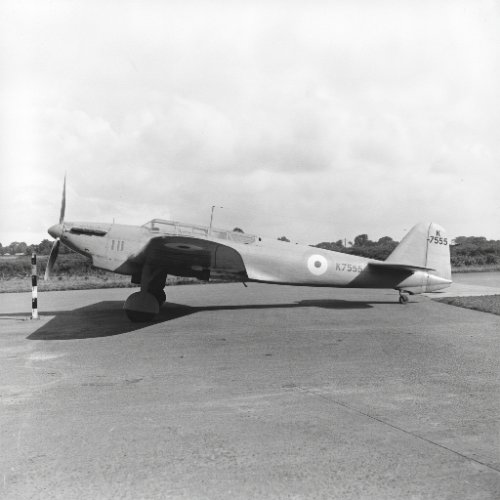
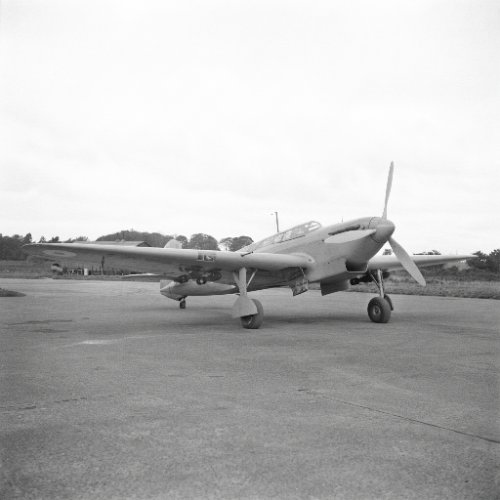
The Fairey P.4/34 was created in response to Air Ministry Specification P.4/34, issued in 1934, which called for a light day bomber capable of close‑support and dive‑bombing operations.
The specification sought a successor to the Fairey Battle and invited proposals from Fairey, Gloster, and Hawker.
Only Fairey and Hawker were authorised to build prototypes.
Fairey’s design team, led by Marcel Lobelle, developed a compact, strengthened monoplane derived from the Fairey Battle but smaller, more aerodynamic, and structurally reinforced for dive‑bombing stresses.
Two prototypes were ordered, K5099 and K7555, with the first flying on 13 January 1937.
Although the competing Hawker Henley was judged superior, the RAF’s requirement for a light bomber changed, and neither aircraft entered production in that role.
The Henley became a target tug, while the P.4/34 evolved into an important test platform and the basis for the Fairey Fulmar naval fighter.
Design and Technical Characteristics
Airframe and Structure
The P.4/34 was a low‑wing, all‑metal monoplane with a two‑seat tandem cockpit under a long glazed canopy.
Its configuration resembled the Fairey Battle but was smaller, with a wide‑track, inward‑retracting undercarriage that folded flat into the wing thickness.
To meet dive‑bombing requirements, the aircraft featured:
Reinforced fuselage and wing structure for high‑g manoeuvres.
Strengthened tail surfaces for stability during steep dives.
External bomb carriage (two 250‑lb / 113‑kg bombs) under the wings, unlike the battle’s internal bomb bay.
The cockpit arrangement placed the pilot at the wing leading‑edge position, with the observer/navigator in a separate aft compartment divided by a glazed section.
Powerplant
The aircraft was powered by a Rolls‑Royce Merlin I, producing 1,080 hp (805 kW).
This inline liquid‑cooled engine was the same family later used in Hurricanes and Spitfires, giving the P.4/34 competitive performance for its size.
Armament
The P.4/34 carried:
One fixed .303‑in Browning machine gun for the pilot.
Two 113‑kg (250‑lb) bombs mounted externally under the wings.
Dimensions and Performance
Authoritative specifications list:
Length: 12.19 m (39 ft 12 in)
Wingspan: 14.43 m (47 ft 4 in)
Height: 4.29 m (14 ft 1 in)
Empty weight: 2,908 kg (6,411 lb)
Max take-off weight: 3,989 kg (8,794 lb)
Max speed: 456 km/h
Stall speed: 86 km/h
Range: 1,481 km
Service ceiling: 8,108 m
These figures made the P.4/34 significantly faster and more agile than the Fairey Battle, though still not competitive with emerging high‑performance fighters.
Variants and Derivatives
Prototype Variants
Two prototypes were built:
K5099 – First flight 13 January 1937.
K7555 – First flight 19 April 1937; later modified with reduced‑span wings and lowered tailplane as an aerodynamic prototype for the Fulmar.
Danish Production Attempt
The Royal Danish Navy purchased a licence to build 12 aircraft, with a production line established at the Copenhagen Naval Shipyard.
None were completed before the German invasion of Denmark (Operation Weserübung, 1940).
Development into the Fairey Fulmar
The P.4/34 directly evolved into the Fairey Fulmar, the Fleet Air Arm’s long‑range two‑seat carrier fighter.
The second prototype was heavily modified to test Fulmar aerodynamic features.
Testbed Roles
The P.4/34 served extensively as a research aircraft:
Used at RAE Farnborough from 1938 onward.
Employed in barrage‑balloon collision tests, deliberately flying into weighted cables to study structural impacts.
Later used to test Fairey‑Youngman flaps, later fitted to the Fairey Firefly.
This unusual test case gave the P.4/34 a longer service life than many prototypes.
Operational and WWII Context
RAF Evaluation
The RAF ultimately rejected the P.4/34 as a frontline bomber due to shifting requirements and the Hawker Henley’s superior performance in trials.
By the time prototypes flew, the RAF was moving towards faster monoplane bombers and fighters, leaving no production role for the P.4/34.
WWII Use
The P.4/34 did not enter combat service. Its only wartime relevance was:
Continued use as a test aircraft at RAE Farnborough.
Contribution to the development of the Fairey Fulmar, which did serve extensively in WWII.
Structural and aerodynamic research supporting later Fairey aircraft, including the Firefly.
The final P.4/34 was retired from RAE service in 1949.
Assessment and Legacy
The Fairey P.4/34 was:
A technically advanced light bomber prototype, structurally strengthened for dive‑bombing.
A transitional design bridging the Fairey Battle and the successful Fairey Fulmar.
A valuable experimental platform, contributing to British research on dive‑bombing stresses, balloon‑cable impacts, and advanced flap systems.
A design that never reached production due to changing RAF doctrine rather than technical failure.