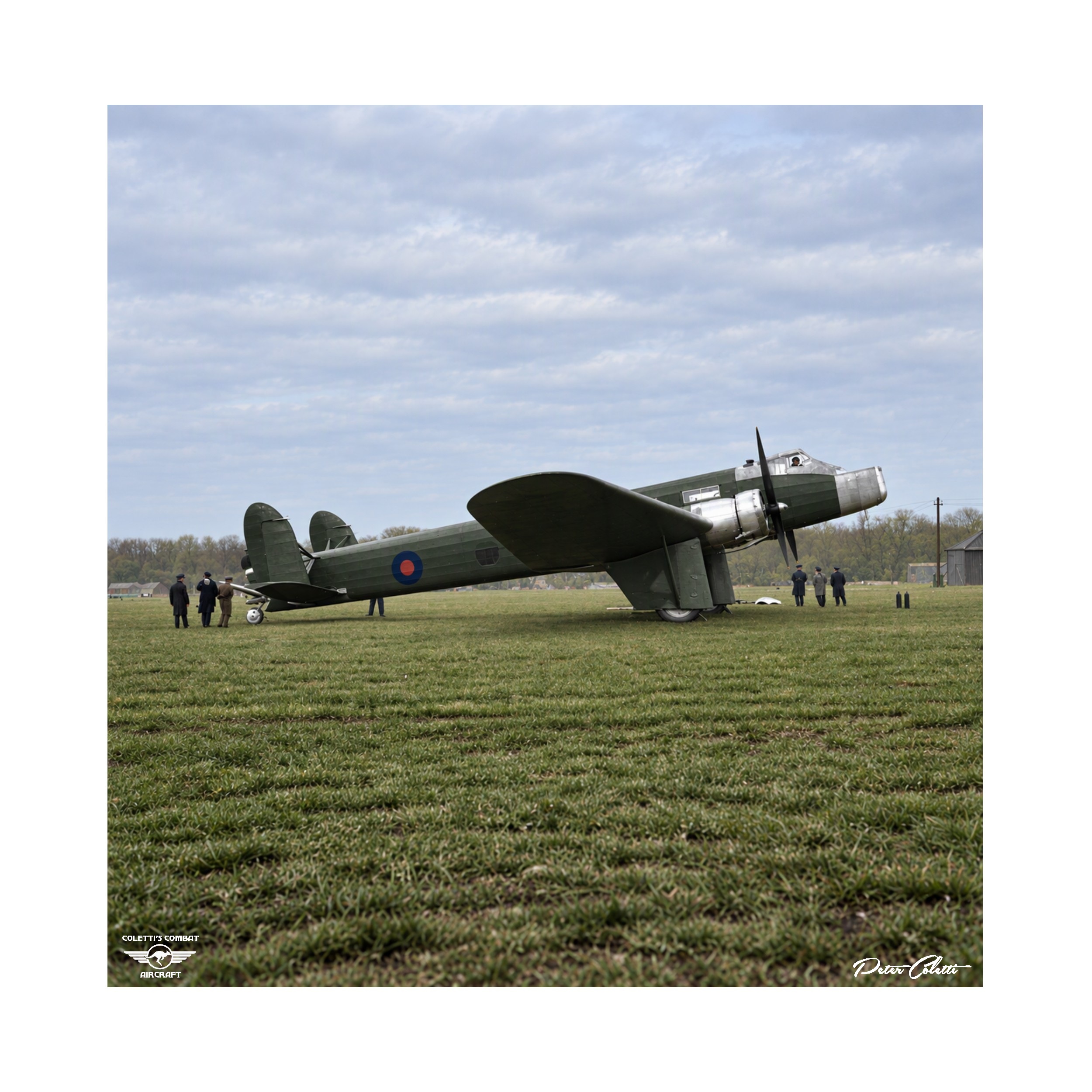
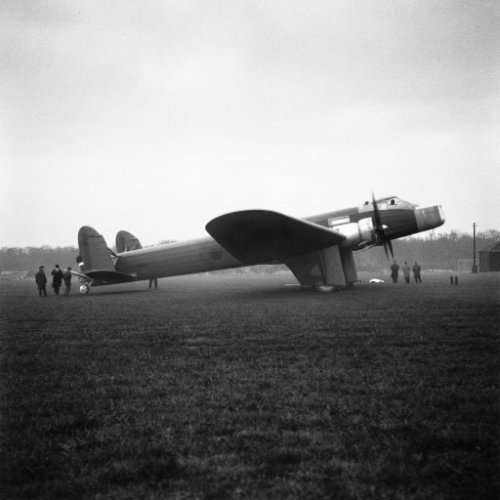
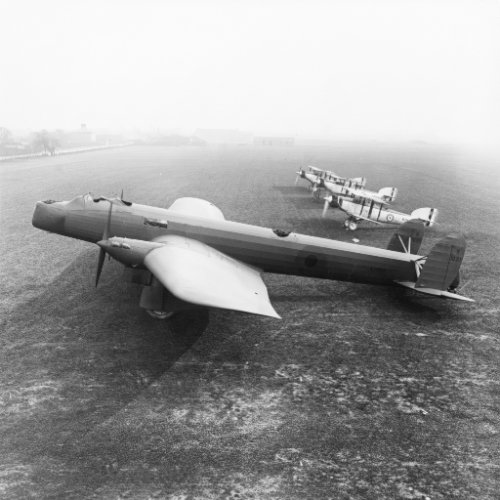
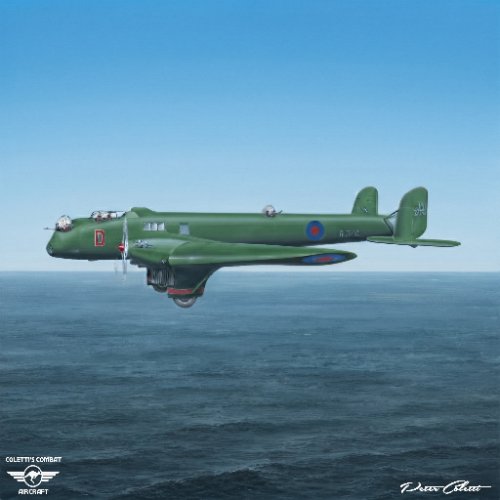
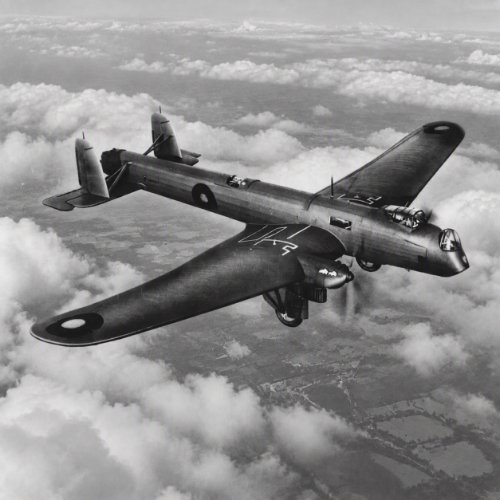
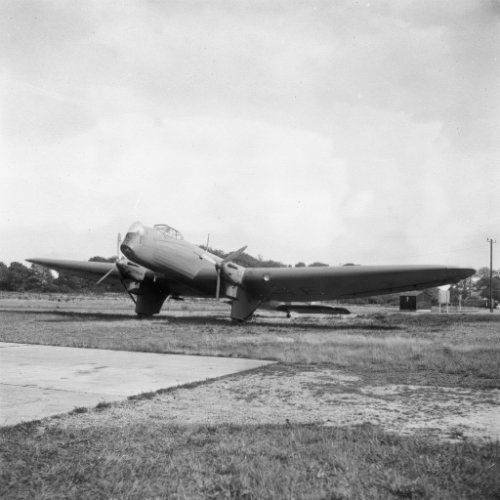
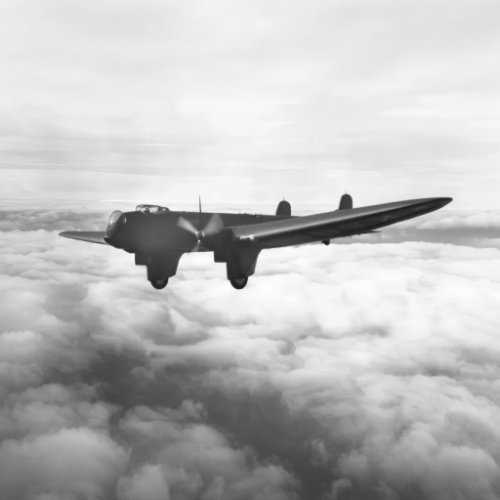
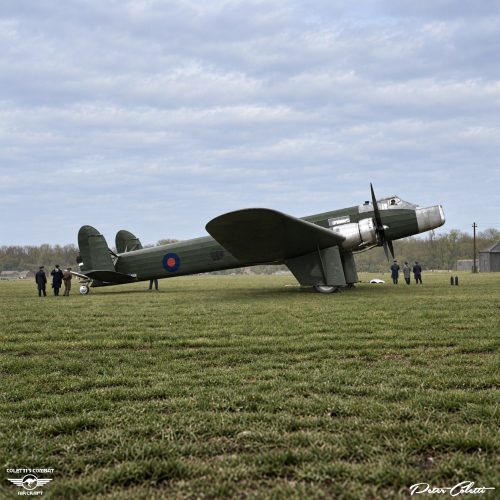
The Fairey Hendon was a British twin-engined heavy night bomber designed and built by Fairey Aviation during the interwar period.
Although produced in only small numbers and serving for a brief time with the Royal Air Force, it occupies an important place in British aviation history as the first all-metal low-wing monoplane bomber to enter RAF service.
The aircraft represented a significant departure from the biplane bombers that had dominated British military aviation throughout the 1920s and marked an early step towards the modern bomber force that Britain would field during the Second World War.
The Hendon first flew on 25 November 1930, entered operational service in 1936, and was withdrawn before the outbreak of war in 1939.
Only fifteen examples, including the prototype, were completed.
The aircraft originated from Air Ministry Specification B.19/27, issued in 1927.
This specification sought a replacement for the ageing Vickers Virginia heavy bomber and called for a twin-engined night bomber capable of carrying a substantial bomb load over a useful operational range.
Several manufacturers responded to the requirement, including Vickers, Bristol, Avro, Handley Page and Fairey.
While many contemporary designs retained traditional biplane arrangements, Fairey proposed a far more advanced low-wing cantilever monoplane.
This configuration promised lower drag, greater efficiency, and improved performance compared with existing RAF bombers.
Fairey’s design work benefited from experience gained during development of the Fairey Long-Range Monoplane, an aircraft created for record-breaking distance flights.
Engineers adapted many of the aerodynamic and structural principles learned from that programme to the new bomber.
The result was an unusually modern aircraft for its era.
Its monoplane wing and metal construction contrasted sharply with the fabric-covered biplanes then serving in RAF squadrons.
Even so, the design still retained some features typical of the transitional period between the First World War and modern aviation, including fixed landing gear and manually operated defensive gun positions.
The prototype aircraft, serial number K1695, was initially known simply as the Fairey Night Bomber.
It made its maiden flight on 25 November 1930 from Fairey’s Great West Aerodrome near Heathrow.
The prototype was powered by two Bristol Jupiter VIII radial engines.
Early testing demonstrated that the aircraft possessed considerable promise, but development suffered a severe setback in March 1931 when the prototype crashed and was heavily damaged.
This accident caused lengthy delays at a critical time when the Air Ministry was seeking rapid replacement of existing bomber types.
Rather than abandoning the project, Fairey rebuilt the damaged prototype.
During reconstruction the original radial engines were replaced with more powerful Rolls-Royce Kestrel VI liquid-cooled V-12 engines.
The rebuilt aircraft showed improved performance and eventually completed its evaluation programme successfully.
Nevertheless, the delay had already allowed rival aircraft, particularly the Handley Page Heyford, to gain momentum and secure production orders.
Although the Hendon was technically more advanced than many of its competitors, timing would ultimately undermine its prospects.
Structurally, the Hendon was a large low-wing monoplane with a steel-tube fuselage framework covered largely in fabric.
The wing was thick and robust, reflecting contemporary structural practices before widespread adoption of later stressed-skin techniques.
The aircraft featured a distinctive twin-fin tail arrangement and a fixed undercarriage fitted with streamlined wheel fairings.
It was among the most modern bombers designed anywhere in the world during the late 1920s, yet by the time it reached squadron service, several elements of the design were already becoming dated.
The Hendon was operated by a crew of five.
These consisted of a pilot, navigator or bomb aimer, radio operator, and defensive gunners.
The prototype incorporated several open crew positions, while later production aircraft provided improved enclosure for the pilot and navigator.
One unusual feature was the offset cockpit arrangement, in which the pilot sat slightly to the left of the aircraft centreline to improve visibility during landing and taxiing.
Internal catwalks allowed crew members to move between positions within the fuselage during flight.
Defensive armament was modest.
The bomber carried .303 calibre Lewis machine guns mounted in the nose, dorsal and tail positions.
This armament was considered adequate for a night bomber conceived in the late 1920s, but it rapidly became obsolete as fighter aircraft performance improved throughout the 1930s.
Offensive capability consisted of an internal bomb load of approximately 1,660 pounds carried in multiple bomb cells distributed through the fuselage and centre wing section.
Internal bomb carriage was an advanced feature for the period, reducing drag compared with externally mounted weapons.
Following the successful trials of the rebuilt prototype, the Air Ministry ordered fourteen production aircraft.
These became known as the Hendon Mk.II and were built during 1936 and 1937.
Production machines incorporated various refinements, including enclosed cockpit arrangements and standardised Rolls-Royce Kestrel engines.
Although larger future orders were initially contemplated, changing circumstances soon altered the RAF’s requirements.
Performance was respectable by early-1930s standards.
Powered by two 600-horsepower Rolls-Royce Kestrel VI engines, the Hendon could reach a maximum speed of approximately 152 to 155 miles per hour.
Service ceiling was about 21,000 feet and maximum range exceeded 1,300 miles under favourable conditions.
These figures would have appeared impressive when the aircraft was first designed.
Unfortunately, aviation technology advanced at such a rapid pace during the early 1930s that these capabilities appeared increasingly inadequate by the time the aircraft entered service.
Operational service began in November 1936 when No. 38 Squadron RAF received the type.
The squadron had previously operated the Handley Page Heyford, and the arrival of the Hendon marked a transition towards more modern aviation technology.
The aircraft initially served from RAF Mildenhall before later moving with its unit to RAF Marham.
Despite its technological significance, however, the Hendon’s operational career was remarkably short.
The principal problem facing the Hendon was that aviation progress had overtaken it.
Aircraft conceived only a few years later were dramatically superior.
While the Hendon had been revolutionary in 1930, bombers such as the Armstrong Whitworth Whitley, Handley Page Hampden and especially the Vickers
Wellington represented a new generation offering superior speed, payload, range, survivability and development potential.
In 1936 the Air Ministry cancelled plans for roughly sixty additional Hendons after recognising that more advanced bombers were becoming available.
As a consequence, the aircraft never achieved the importance originally envisioned for it.
By late 1938, replacement by the Vickers Wellington was already underway.
By January 1939 the type had been withdrawn from frontline service entirely.
Surviving airframes were relegated to training and instructional duties, including radio-school work and ground training roles.
In terms of Second World War service, the Hendon effectively had none.
The aircraft was already obsolete before Britain entered the war in September 1939 and had been withdrawn from operational bomber units months earlier.
No Hendons participated in wartime bombing operations, home defence missions, overseas deployments or combat service.
Their sole wartime contribution lay in training and instructional activities.
As a result, the type occupies a position largely within interwar aviation history rather than the operational history of the Second World War.
Only two principal versions were built.
The original prototype, K1695, began life as the Fairey Night Bomber and later became retrospectively identified as the Hendon Mk.I after reconstruction.
The production series was designated Hendon Mk.II and accounted for the fourteen operational aircraft built for the RAF.
Fairey also investigated improved derivatives and enlarged developments, including concepts sometimes referred to as “Super Hendon” projects, but none advanced beyond the proposal stage.
Although the Hendon was not a military success, its historical significance remains substantial.
The aircraft bridged the gap between the lumbering biplane bombers inherited from the First World War and the high-performance monoplanes that would form the backbone of RAF Bomber Command in the Second World War.
It demonstrated the future direction of bomber design at a time when much of the world still relied upon older concepts.
In that sense, the Fairey Hendon was less important for what it accomplished in service and more important for what it represented: the RAF’s first real step into the modern age of bomber aviation.