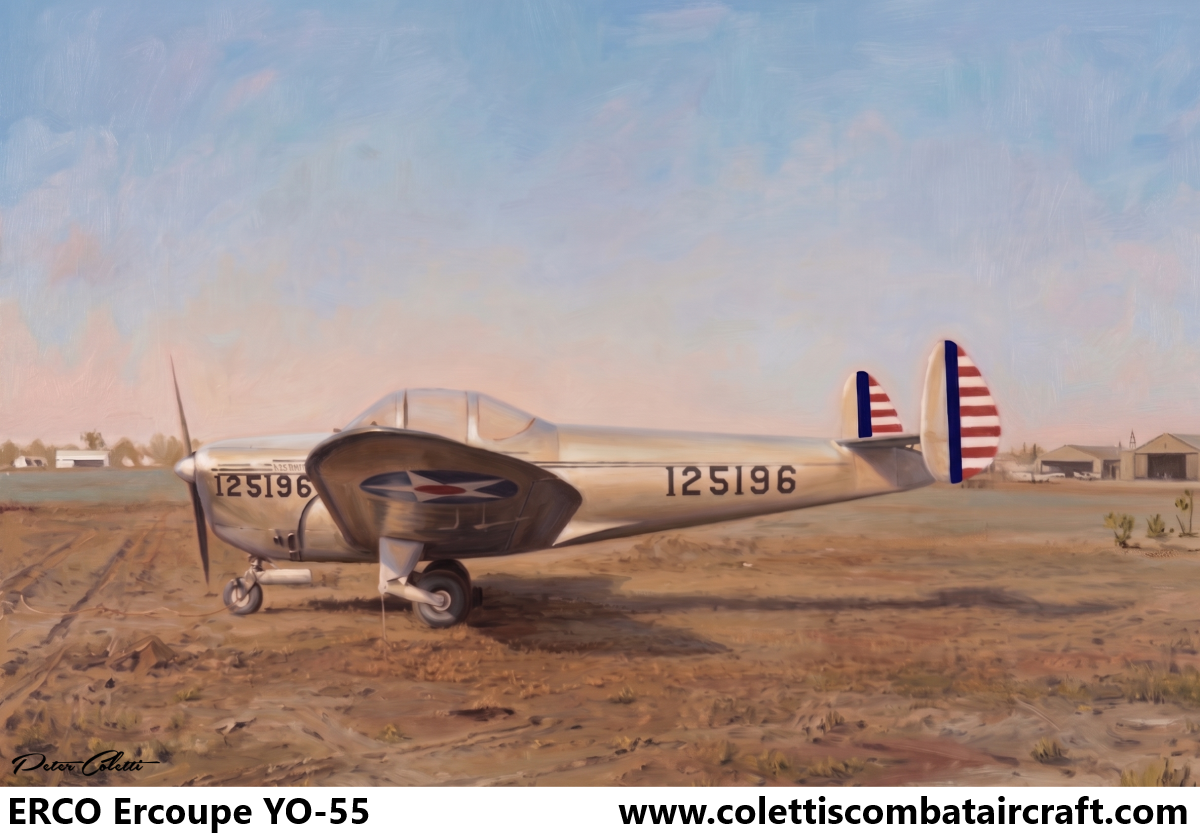
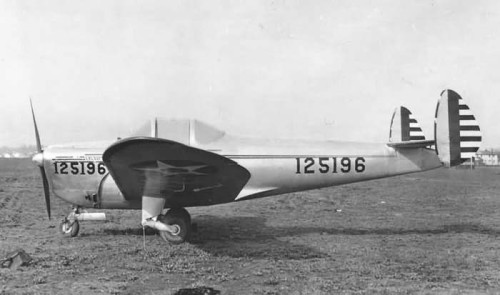
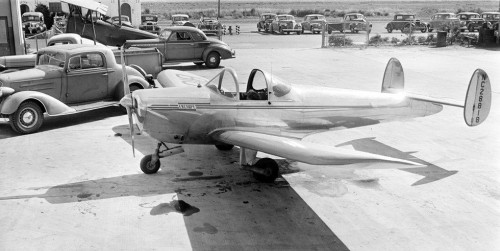
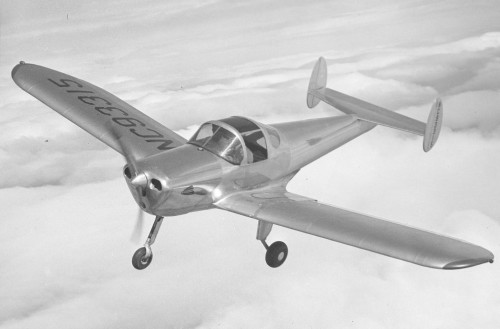
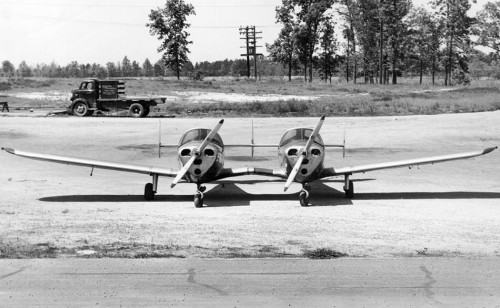
The United States Army Air Forces acquired exactly three ERCO Ercoupe model 415‑C aircraft for testing and evaluation during World War II.
Each aircraft received a unique military designation and serial number.
Their procurement represented an experimental effort to determine whether the civilian Ercoupe—known for its stall‑ and spin‑resistant design—could serve military purposes such as observation, liaison, training, or target drone development.
The first aircraft was construction number 39, originally registered as NC28944.
It was purchased on January 4, 1941.
The army designated it YO‑55 and assigned serial number 41‑18875.
This aircraft was evaluated primarily as a light observation platform.
Although its handling qualities were excellent, the Army found that the Ercoupe lacked the ruggedness and payload capacity required for operational observation missions.
The second aircraft was construction number 110, registered as NC37143.
It was purchased on August 14, 1941.
The army redesignated it PQ‑13 and assigned serial number 41‑39099.
This aircraft was used as a prototype for a radio‑controlled target drone.
It later became historically notable as the only surviving warbird‑designated Ercoupe.
The third aircraft was construction number 11, registered as NC28655.
It was purchased on December 4, 1940.
It was also redesignated PQ‑13 and assigned serial number 41‑25196.
Like the other PQ‑13, it was used for target‑drone experimentation and later for non‑flying instructional purposes.
One of the PQ‑13 aircraft, serial number 11, became especially significant for its role in early rocket‑assisted takeoff experiments.
On August 12, 1941, at March Field in California, Captain Homer Boushey conducted the first U.S. JATO (Jet‑Assisted Takeoff) experiment using an Ercoupe.
This demonstrated that small aircraft could benefit from auxiliary rocket propulsion and contributed to later developments in jet‑assisted flight and missile technology.
After their evaluation period, the Ercoupes were not adopted for operational military use.
The YO‑55 was judged unsuitable for field observation duties, and the PQ‑13 drones were quickly surpassed by purpose‑built target aircraft.
The airframes were eventually returned to civilian status or reassigned to non‑flying instructional roles.
Despite their limited military service, these three aircraft occupy an important place in aviation history for their contributions to flight‑safety research and early rocket‑propulsion experimentation.
If you want, I can also produce a text‑only chronological timeline, a text‑only narrative suitable for publication, or a text‑only technical profile of each aircraft.