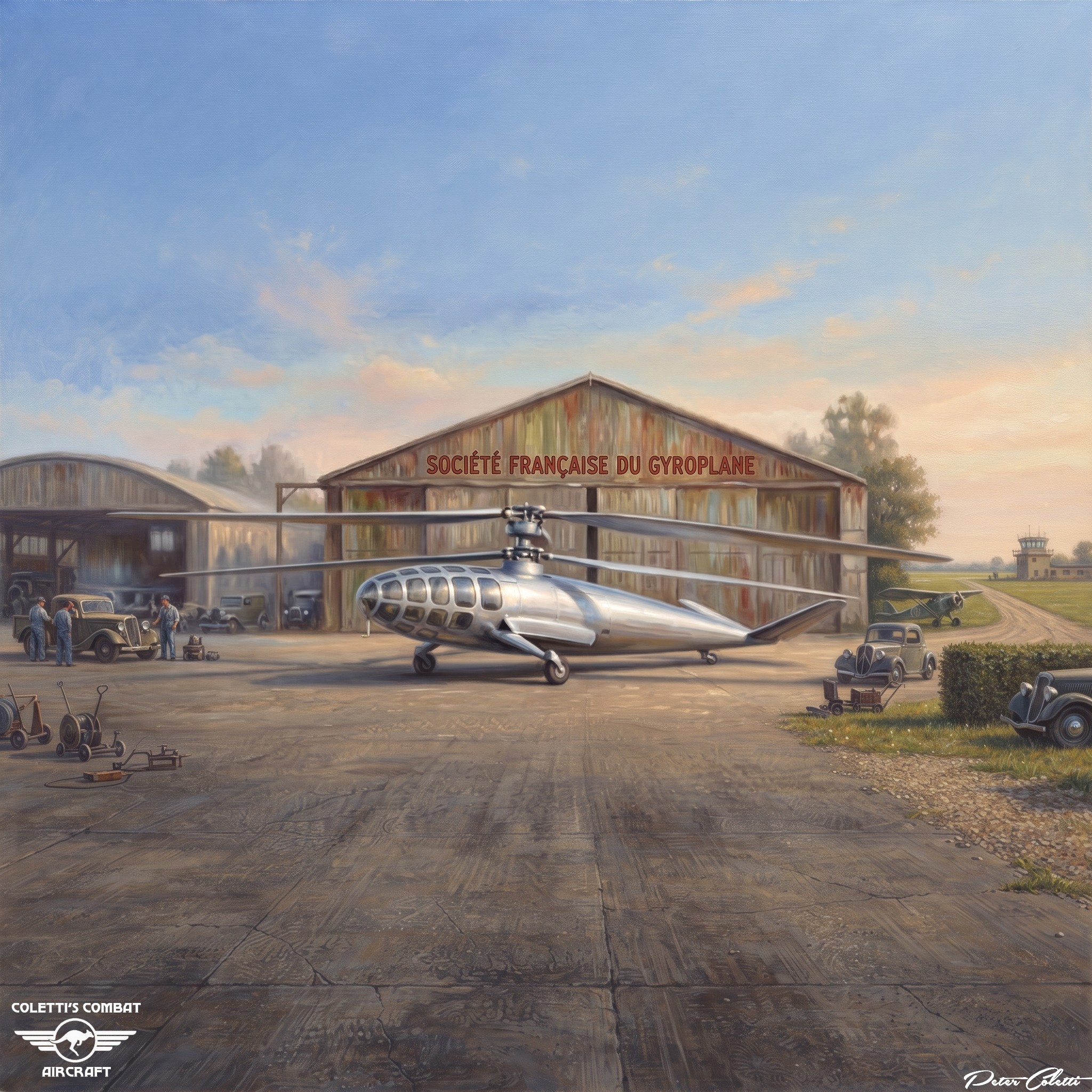
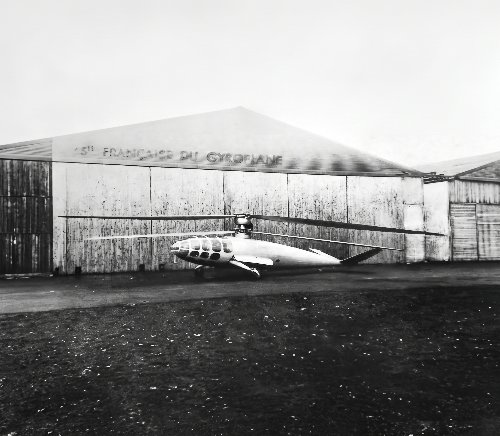
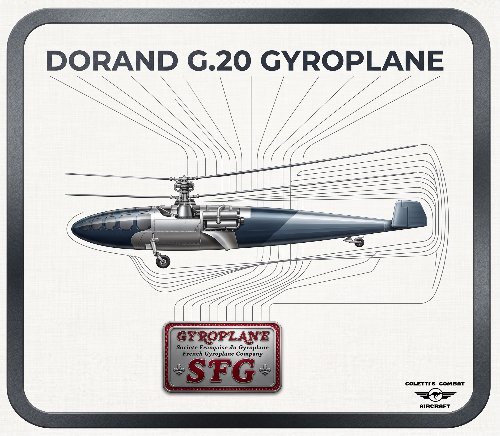
The Dorand Gyroplane G.20 emerged from France’s early rotorcraft experimentation led by René Dorand, a key figure in French helicopter development.
Dorand had previously served as technical director of the Syndicat d’Études de Gyroplane, formed in 1931 with aircraft designer Louis Bréguet, where the pair created the successful Bréguet‑Dorand Gyroplane Laboratoire, first flown in 1935.
In 1938, Dorand amicably separated from Bréguet and founded the Société Française du Gyroplane (SFG).
The French Navy (Marine Nationale) commissioned SFG to design a new helicopter specifically for coastal defence and anti‑submarine warfare, intended to operate from the large cruiser‑submarine Surcouf.
The Navy demanded unprecedented performance for the era:
250 km/h top speed
800 km range
These specifications were far beyond what contemporary helicopters could achieve.
Dorand designated the new aircraft Gyroplane G.20, also known as Dorand G.20 or G.II.
Development began before WWII, but construction was repeatedly disrupted by the war, occupation, and relocation.
The prototype was ultimately completed only in 1947, long after its military relevance had passed.
Airframe and Structural Design
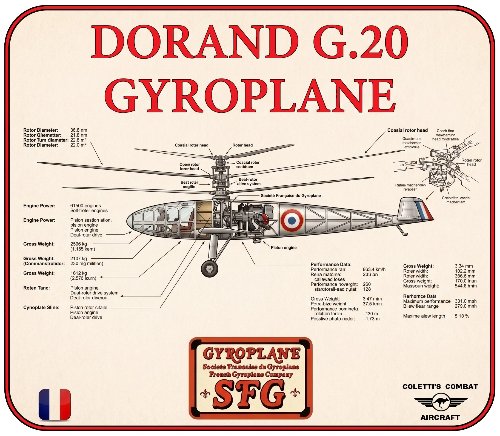
The G.20 featured a sleek, cigar‑shaped fuselage of all‑metal construction, reflecting a significant step forward from the open‑frame Gyroplane Laboratoire.
Key structural characteristics included:
Streamlined plexiglass‑paneled nose for the pilot’s cockpit.
Butterfly (V‑tail) empennage, with fabric‑covered control surfaces.
Retractable conventional landing gear, unusual for helicopters of the era.
Internal bomb bay or depth‑charge compartment, reflecting its original anti‑submarine role.
Crew layout varied during design evolution:
Early concepts: three‑man crew, including a gunner positioned inside the rotor mast, providing theoretical 360° firing arcs.
This arrangement was quickly abandoned as impractical.
Final prototype: two‑ to three‑man tandem crew, without armament.
Rotor System and Helicopter Mechanics
The G.20 continued Dorand’s pioneering work with coaxial contra‑rotating rotors, eliminating the need for a tail rotor.
This configuration had been proven on the Gyroplane Laboratoire.
Rotor Characteristics
Two three‑bladed coaxial rotors.
Upper rotor diameter: 15.4 m (50 ft 6 in).
Lower rotor diameter: 13.0 m (42 ft 8 in).
Vertical separation: only 65 cm, imposed by Surcouf’s hangar height limits.
Magnesium blades, built with a box‑section leading edge and separate trailing edge.
Full cyclic and collective pitch articulation, enabling pitch, roll, climb, and descent control.
The lower rotor’s smaller diameter required different engine RPM regimes to prevent blade collision.
Propulsion and Transmission
The G.20 was powered by two inverted Renault 6Q‑04 inline six‑cylinder engines, each producing 240 hp.
A sophisticated transmission system allowed:
Power delivery from both engines to both rotors.
Automatic isolation of a failed engine.
Continued operation on a single engine by transferring remaining power to both rotors.
This redundancy was essential for naval anti‑submarine missions, where engine failure could be fatal.
Armament Concepts and Mission Equipment
Early design studies envisioned the G.20 as a heavily armed naval helicopter, including:
A machine gun firing rearward and downward from behind the pilot.
A gunner in a rotor‑mast cupola with 360° firing capability.
Bomb bay for depth charges or light bombs.
These features were ultimately abandoned due to impracticality and wartime constraints.
The completed prototype had no armament and was intended only for observation, liaison, and mail transport.
Performance Estimates
The French Navy’s required performance—250 km/h speed and 800 km range—was far beyond what any helicopter of the late 1930s could achieve.
Actual projected performance figures were never validated because the aircraft never flew.
The design’s ambitious goals contributed to scepticism among pilots and engineers, and no test pilot agreed to attempt the first flight.
World War II Context and Fate
The G.20’s development was deeply affected by WWII:
Construction began in Guéthary (south-west France).
After France’s 1940 capitulation, the project was moved to Chambéry (south-east France).
German forces discovered the aircraft but allowed slow continuation, showing little interest.
By the time the prototype was completed in 1947, helicopter technology had advanced dramatically—particularly in Germany and the United States.
The Marine Nationale had lost interest, funding evaporated, and the G.20 was considered obsolete.
The aircraft never flew and was eventually scrapped.
Legacy
Although the Dorand G.20 never entered service, it represents an important transitional step in French rotorcraft development:
It demonstrated advanced coaxial rotor engineering.
It explored early concepts of naval helicopter deployment, including submarine‑borne aircraft.
It highlighted the challenges of pushing helicopter performance beyond the technological limits of the 1930s.
The project’s cancellation marked the end of Dorand’s independent helicopter work, though SFG later collaborated with Bréguet on the G.11E.
Summary
The Dorand Gyroplane G.20 was an ambitious French naval helicopter project conceived before WWII, featuring advanced coaxial rotors, twin engines, retractable landing gear, and a streamlined fuselage.
Designed for anti‑submarine warfare from the submarine Surcouf, it was ultimately overtaken by wartime disruption and rapid postwar helicopter advances.
Completed in 1947 but never flown, the G.20 remains a fascinating example of early helicopter innovation and unrealised potential.