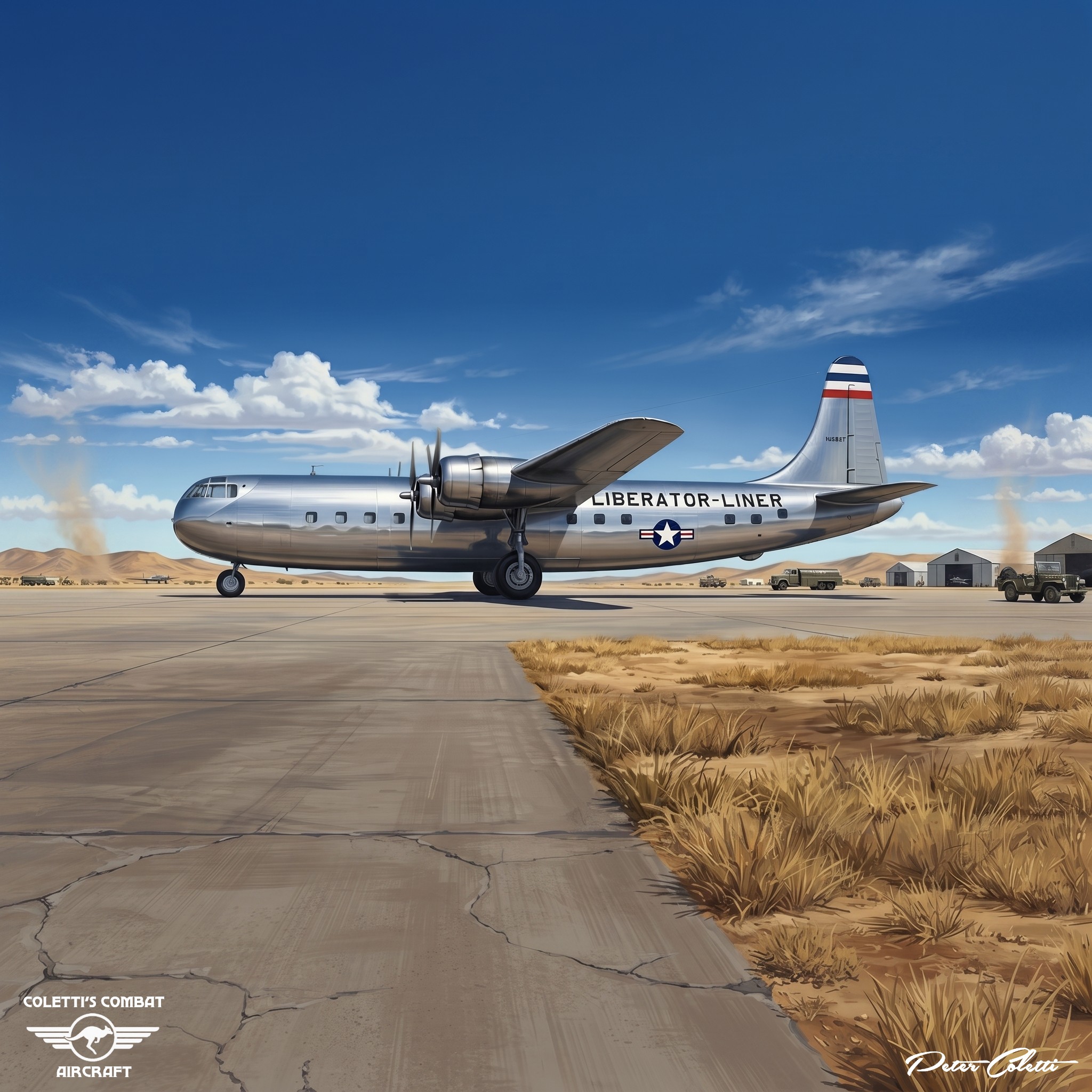
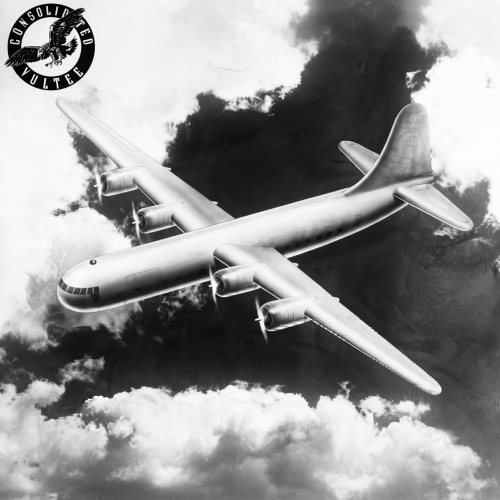
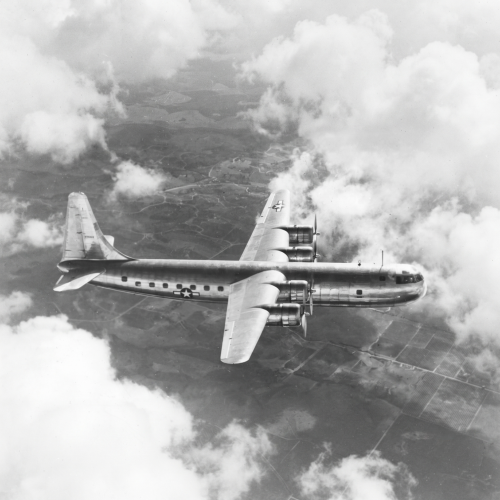
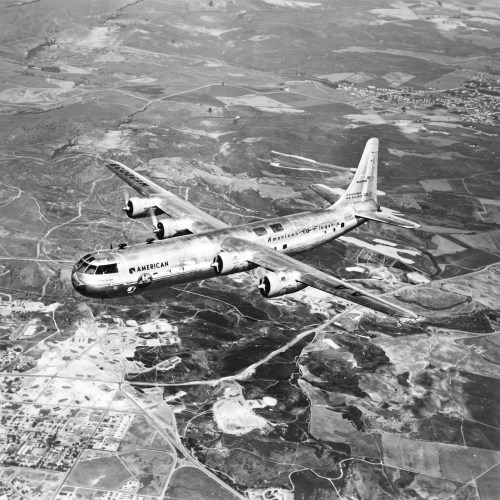
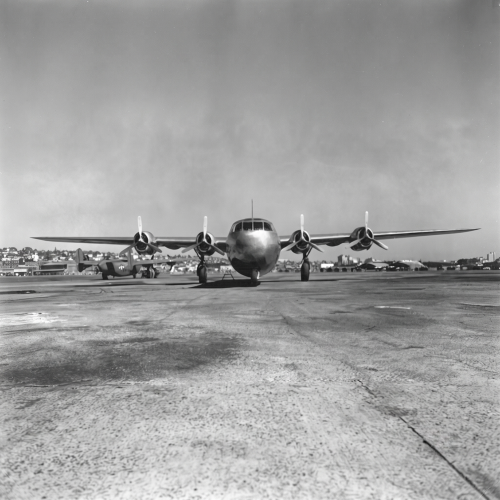
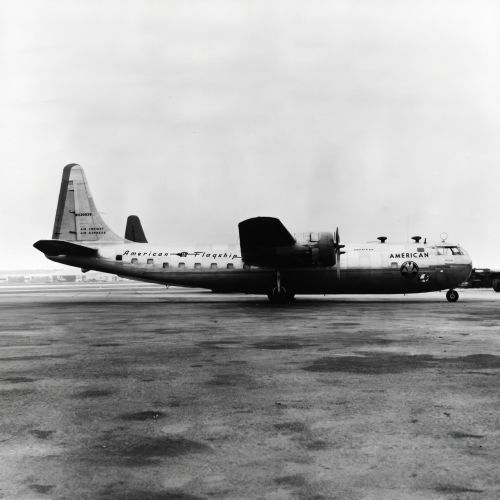
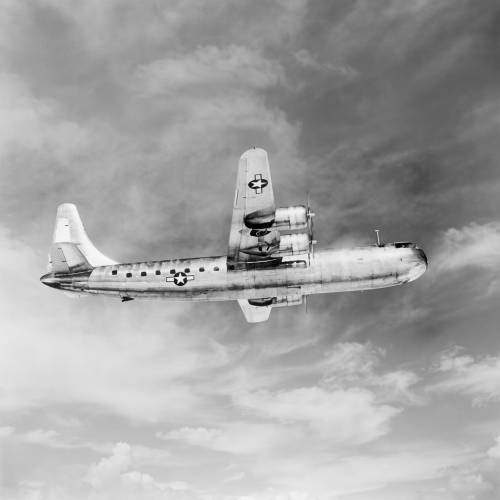
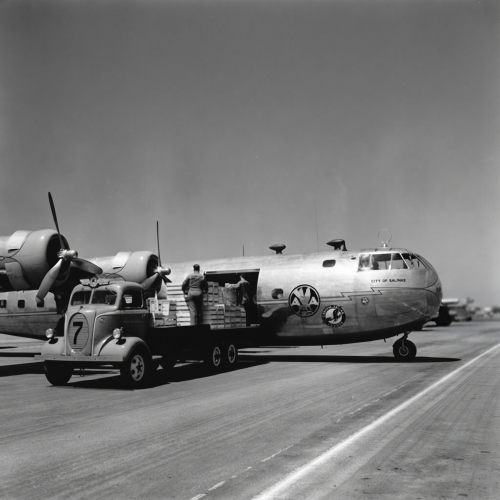
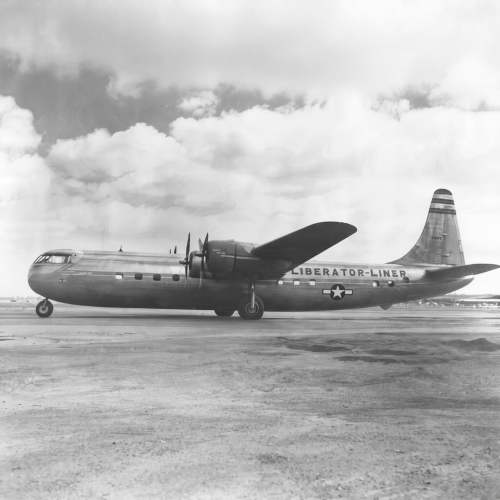
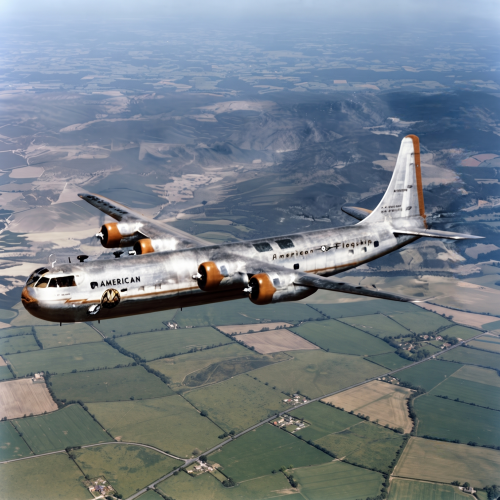
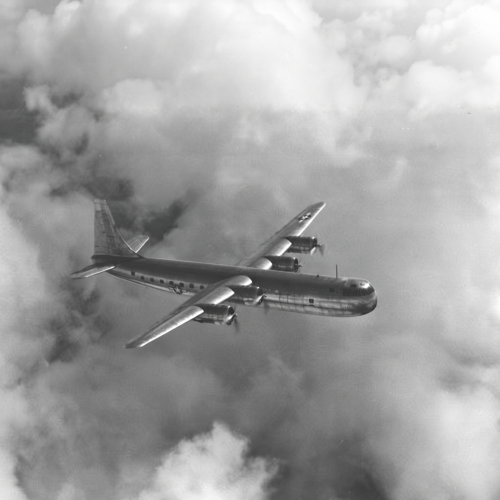
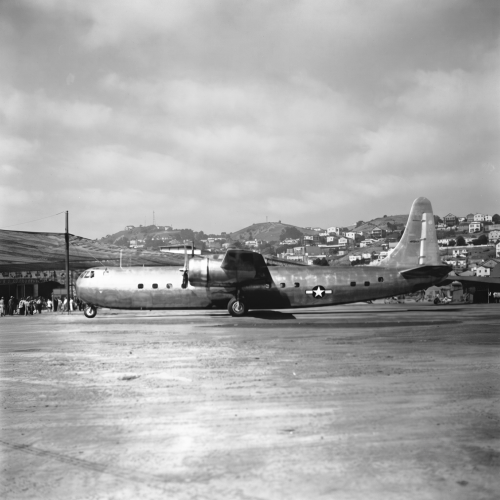
The Consolidated R2Y “Liberator Liner”, also known as the Consolidated Model 39 and designated XR2Y‑1 in U.S. Navy service, was conceived during World War II as a long‑range transport aircraft derived from the B‑24 Liberator heavy bomber.
Its purpose was to provide the U.S. Navy with a fast, high‑capacity aircraft capable of carrying personnel, mail, and cargo to distant bases across the Pacific and other theatres.
Development began in the early 1940s, with the prototype making its first flight on 15 April 1944.
Only one aircraft was built, reflecting its experimental nature and the Navy’s shifting priorities late in the war.
Although derived from the B‑24, the Liberator Liner was not simply a conversion.
Consolidated designed an entirely new fuselage, incorporating pressurisation and passenger windows—features absent from the bomber.
The aircraft was intended to serve as a military airliner, bridging the gap between wartime transport needs and emerging postwar long‑range passenger aviation.
Design Characteristics
The Liberator Liner was a hybrid of proven bomber components and new transport-oriented innovations:
Wing and Landing Gear: It retained the B‑24’s high‑aspect‑ratio Davis wing, celebrated for its efficiency and long range, and the bomber’s tricycle landing gear, unusual for heavy aircraft of the era.
Vertical Tail: The vertical stabiliser was taken from the PB4Y Privateer, the naval derivative of the B‑24.
Fuselage: The fuselage was completely redesigned and pressurised, giving the aircraft an appearance reminiscent of a smaller Boeing B‑29 Superfortress, but with passenger windows.
Powerplant: Four Pratt & Whitney R‑1830‑94 radial engines, each producing 1,200 hp, powered the aircraft.
Capacity: The cabin accommodated 48 passengers, plus 1,200 lb (550 kg) of mail.
After later civilian refit, it could carry 12,000 lb (5,500 kg) of cargo.
Performance
The Liberator Liner’s performance reflected its bomber lineage but was optimised for transport roles:
Cruise Speed: Approximately 240 mph (380 km/h).
Range: Up to 4,000 miles (6,400 km) at 200 mph—significant for a 1944 transport aircraft and well suited to Pacific operations.
Dimensions
Length: 90 ft (27.45 m)
Wingspan: 110 ft (33.55 m)
Gross Weight: 56,000 lb (25,000 kg)
Maximum Take-off Weight: 64,000 lb (29,000 kg)
The Davis wing’s efficiency contributed to the aircraft’s long range, though the B‑24 family’s handling characteristics—less forgiving than the B‑17—were inherited to some degree.
Operational Evaluation and Fate
Despite its promising specifications, the Liberator Liner did not meet U.S. Navy requirements during evaluation.
The Navy judged the prototype unsatisfactory, and the programme was cancelled before any production aircraft were built.
After cancellation, the aircraft was demilitarised and returned to Convair (the post‑merger successor to Consolidated).
It was then leased to American Airlines as a cargo aircraft, operating under the name “City of Salinas”.
This brief civilian career marked the end of the Liberator Liner’s operational life.
No further development occurred, and the aircraft remained a unique experimental type.
Relationship to the B‑24 Liberator and WWII Context
The Liberator Liner emerged from the broader context of the B‑24 Liberator, one of the most important and widely produced aircraft of World War II.
The B‑24s:
Davis wing, long range, high speed, and large internal volume
made it a natural candidate for transport derivatives.
The B‑24 served in every theatre, performing bombing, anti‑submarine warfare, maritime patrol, cargo transport, and reconnaissance missions.
Its production—over 18,000 aircraft—was an industrial achievement unmatched by any other American military aircraft.
Transport variants such as the C‑87 Liberator Express and the experimental R2Y Liberator Liner reflected the wartime need for long‑range logistics aircraft.
However, while the C‑87 saw widespread service, the R2Y’s more ambitious pressurised‑fuselage design proved too specialised and arrived too late in the war to justify mass production.
Variants
Only one true variant existed:
XR2Y‑1 / R2Y‑1 Liberator Liner
The sole prototype, evaluated by the U.S. Navy and later operated by American Airlines as a freighter.
Significance
Although the Liberator Liner never entered production, it represented an important transitional concept: a pressurised, long‑range military transport derived from a heavy bomber.
Its design anticipated postwar trends in large‑capacity, long‑distance airliners and military transports.
The aircraft stands today as a rare example of wartime experimentation—an attempt to adapt a high‑performance bomber into a modern airliner at a time when global air transport was on the cusp of dramatic expansion.