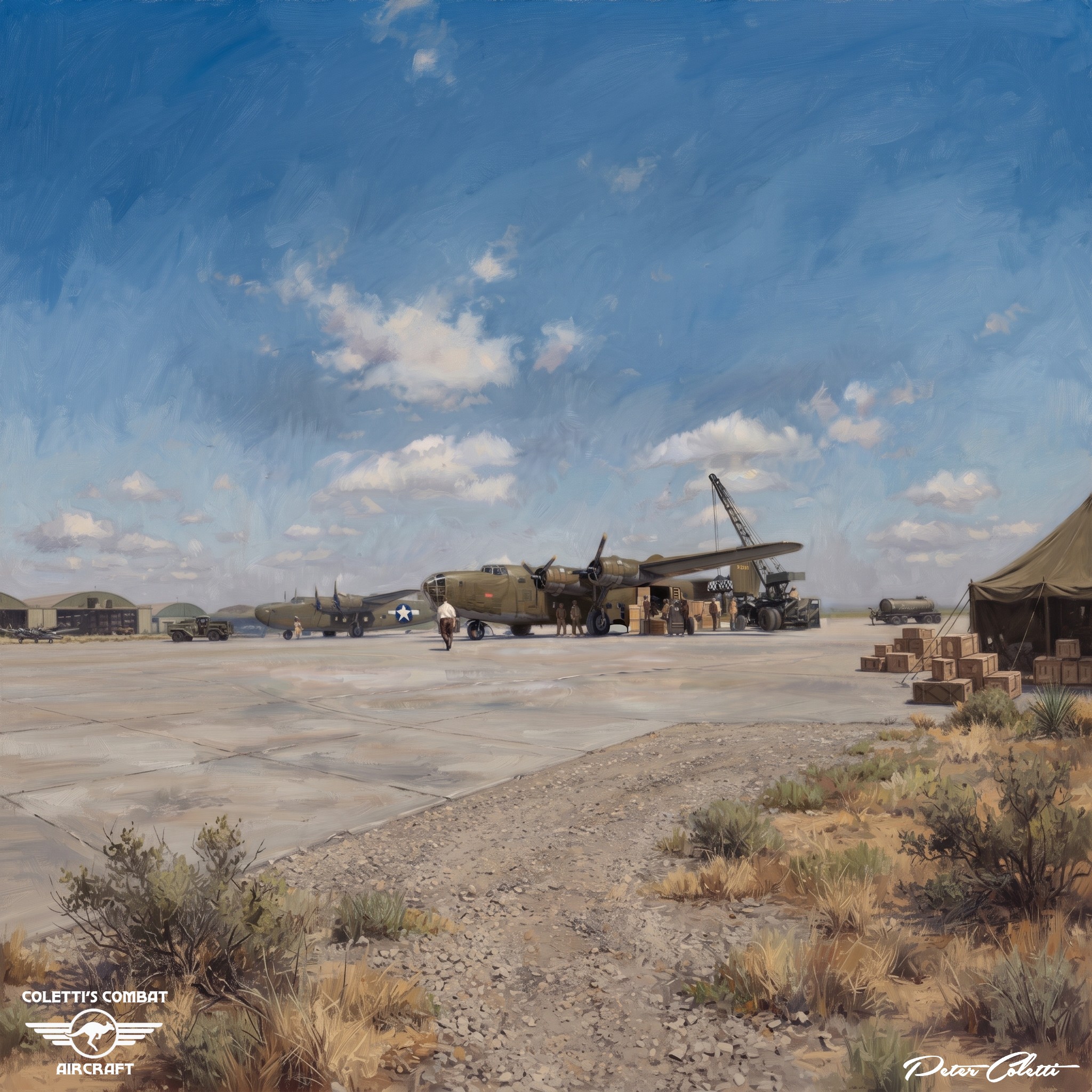
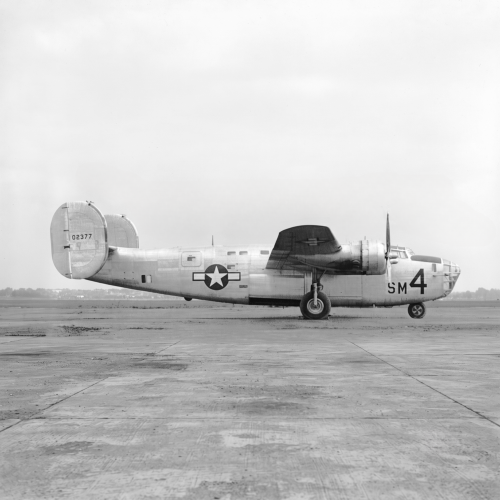
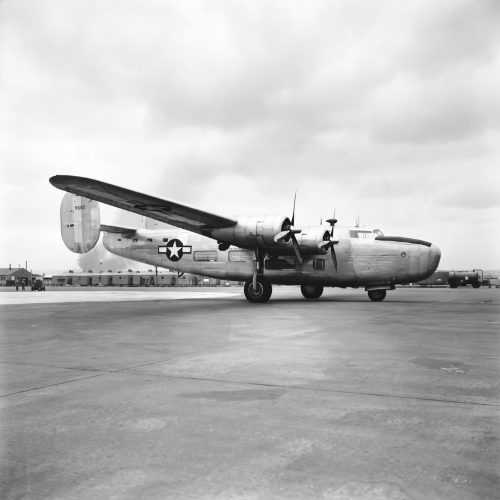
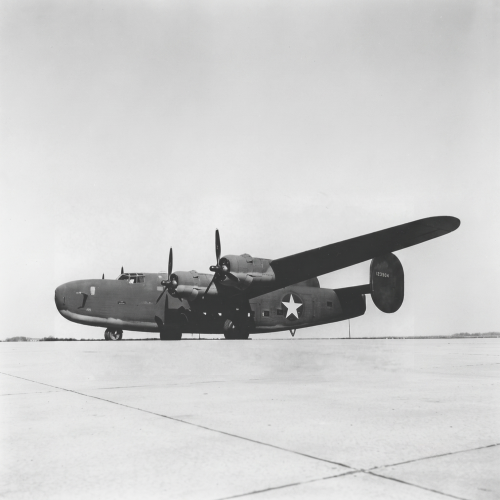
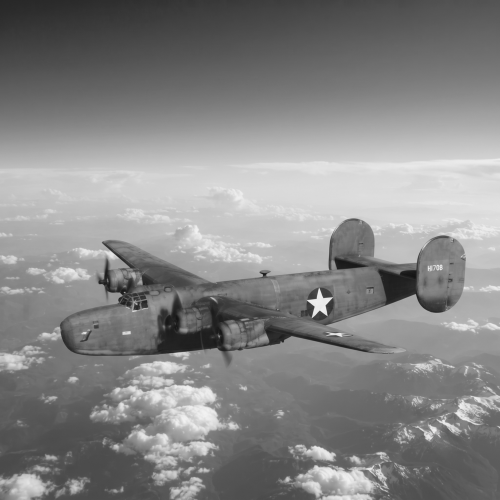
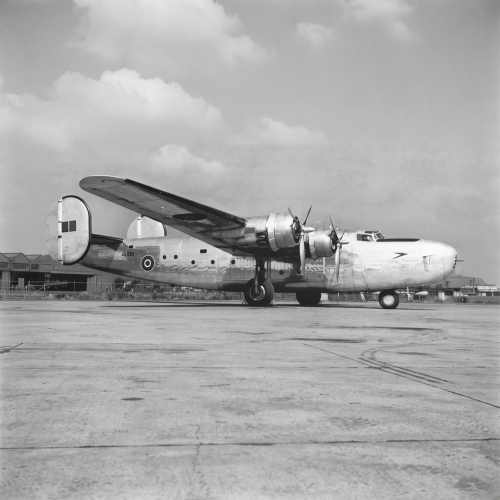
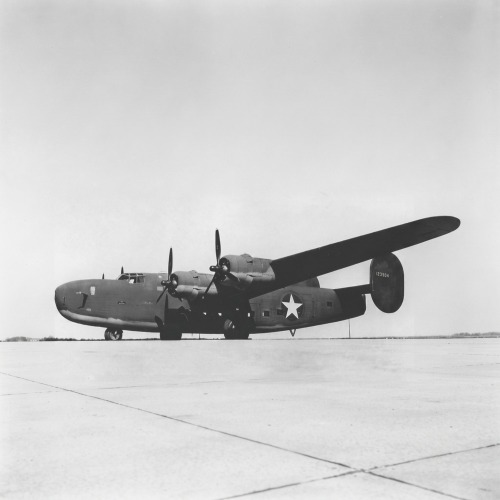
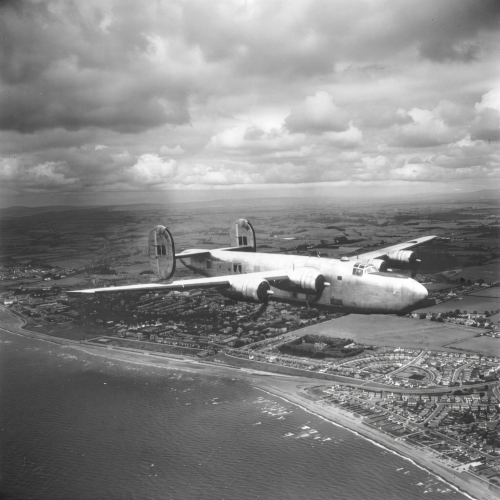
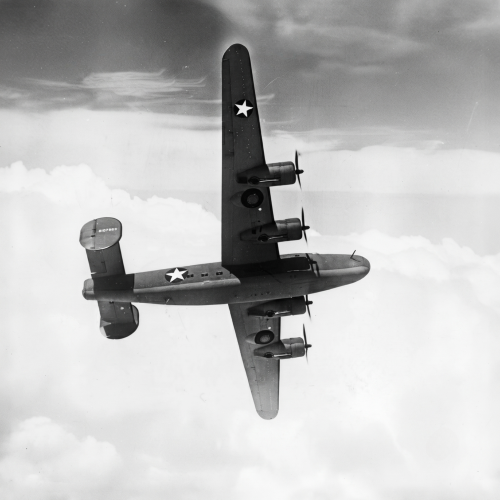
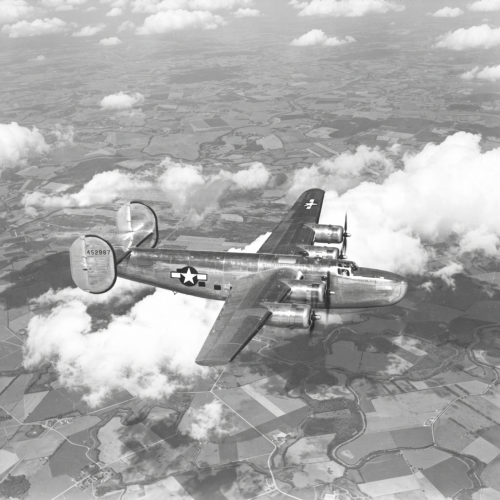
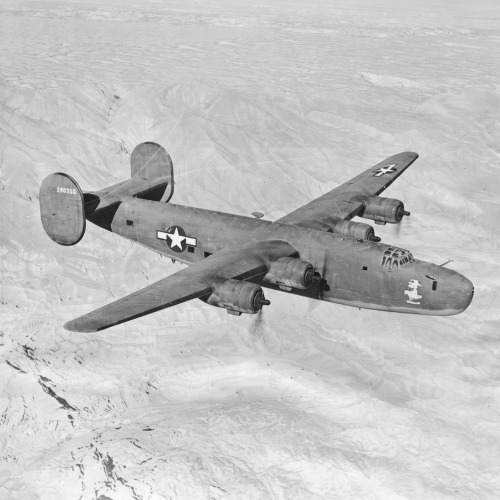
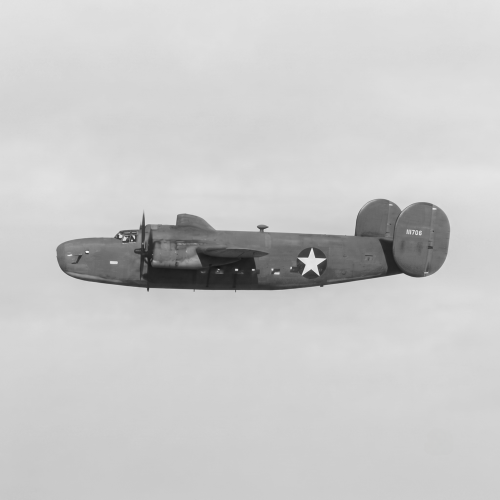
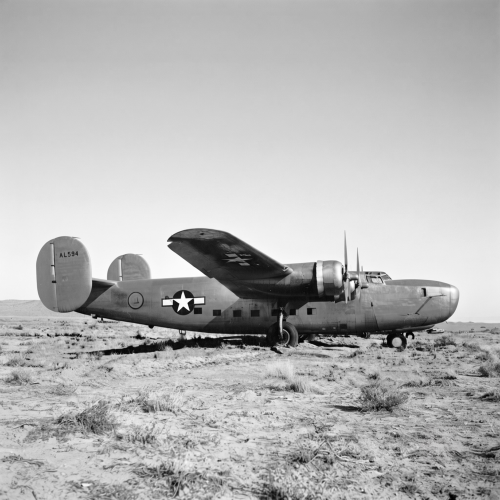
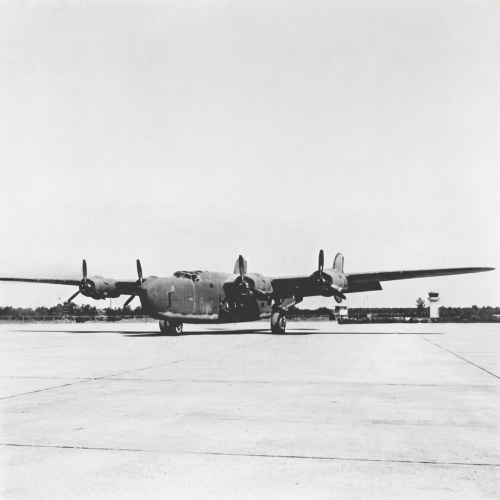
The Consolidated C‑87 Liberator Express emerged from one of the most important bomber programmes of the Second World War:
The Consolidated B‑24 Liberator.
By 1941, the U.S. Army Air Forces urgently needed long‑range transports capable of carrying personnel, cargo, and critical wartime materiel across the Atlantic and Pacific.
The B‑24’s high‑aspect‑ratio Davis wing, large internal volume, and long range made it an attractive candidate for conversion into a transport aircraft.
Consolidated Aircraft responded by designing a dedicated transport variant based on the B‑24D airframe.
Unlike the bomber, the C‑87 eliminated armament, armour, and bomb racks, replacing them with a reconfigured fuselage interior optimised for cargo or passenger carriage.
The aircraft retained the B‑24’s wing, engines, and tail surfaces, but the fuselage was modified with a new floor, cargo tie‑downs, and a large cargo door on the port side.
Early prototypes flew in 1942, and production began shortly thereafter.
Although derived from a bomber, the C‑87 was intended from the outset as a strategic transport.
It was used for high‑priority cargo, VIP transport, and long‑range ferry missions.
Its range and payload made it one of the few Allied transports capable of reliably crossing oceans early in the war.
Design Characteristics
Airframe and Structure
The C‑87 retained the B‑24’s distinctive high‑mounted Davis wing, known for its excellent lift‑to‑drag ratio.
This wing gave the aircraft long range and relatively efficient cruise performance.
The fuselage, however, was significantly altered.
The bomber’s internal bomb bays were replaced by a strengthened cargo floor, and the interior was reconfigured to accommodate freight, passengers, or medical evacuation stretchers.
The aircraft featured:
A large cargo door on the port side for loading bulky items.
Reinforced flooring and tie‑down points.
Optional passenger seating for up to 20–25 passengers depending on configuration.
A tricycle landing gear arrangement identical to the B‑24’s, which improved ground handling compared to tailwheel transports.
Powerplant and Systems
The C‑87 was powered by four Pratt & Whitney R‑1830 Twin Wasp radial engines, each producing approximately 1,200 horsepower.
These engines were reliable and widely used across many U.S. aircraft types, simplifying maintenance and logistics.
Flight engineer or loadmaster (depending on mission)
The cockpit layout was nearly identical to the B‑24’s, though some military equipment was removed.
Performance
The C‑87’s performance was broadly similar to the B‑24 bomber, though slightly improved in some respects due to reduced weight and drag from removed armament.
Approximate performance characteristics:
Cruise speed: ~200–215 mph (320–345 km/h)
Maximum speed: ~250 mph (400 km/h)
Range: ~2,400–3,000 miles (3,800–4,800 km), depending on load
Service ceiling: ~24,000 ft (7,300 m)
Payload: Up to ~10,000–12,000 lb of cargo or ~20+ passengers
The aircraft’s long range made it suitable for transatlantic and transpacific missions, though its performance was often hampered by reliability issues inherited from the B‑24’s complex systems.
Operational Use and WWII Context
Strategic Transport Role
During World War II, the C‑87 was used primarily by the U.S. Army Air Forces for the following:
Ferrying high‑priority cargo such as aircraft parts, engines, and electronics.
Transporting personnel, including VIPs and military specialists.
Medical evacuation missions.
Long‑range courier flights.
The aircraft was heavily employed in the India–China route, known as “The Hump”, where Allied transports flew supplies over the Himalayas to support Chinese forces.
The C‑87’s high‑altitude capability made it suitable for this dangerous route, though pilots often criticised its handling characteristics and reliability under extreme conditions.
Operational Challenges
Despite its usefulness, the C‑87 developed a reputation for the following:
Difficult handling, especially during take-off and landing.
Poor cockpit heating and ventilation.
Mechanical complexity inherited from the B‑24.
Limited passenger comfort due to noise, vibration, and sparse interior fittings.
These issues led some crews to prefer the Douglas C‑54 Skymaster, which was more comfortable and reliable.
Nevertheless, the C‑87 filled a critical gap during the early and mid‑war years when long‑range transports were scarce.
Variants
C‑87 (Base Model)
The initial production version, based on the B‑24D airframe.
Configurable for cargo or passengers.
C‑87A
A VIP transport variant with improved interior accommodations.
Used for high‑ranking officers and government officials.
C‑87B
A proposed but largely unbuilt version with defensive armament for hazardous routes.
It did not enter significant production.
C‑87C
A medical evacuation variant equipped with stretcher racks and medical equipment.
R5D / Navy Use
The U.S. Navy evaluated transport versions of the Liberator family, though the C‑87 itself was primarily an Army Air Forces aircraft.
The Navy’s closest equivalent was the PB4Y‑2 Privateer (a patrol bomber), not a transport.
Legacy
The Consolidated C‑87 Liberator Express occupies a unique place in aviation history.
Although overshadowed by more refined transports like the C‑54, it was one of the earliest American aircraft capable of true intercontinental transport during WWII.
Its long range and large payload made it indispensable during critical phases of the war, particularly in theatres where no other aircraft could perform similar missions.
The C‑87 also demonstrated the adaptability of the B‑24 airframe, leading to further transport and tanker derivatives.
While not beloved by its crews, it was a workhorse that helped sustain Allied operations across vast distances.