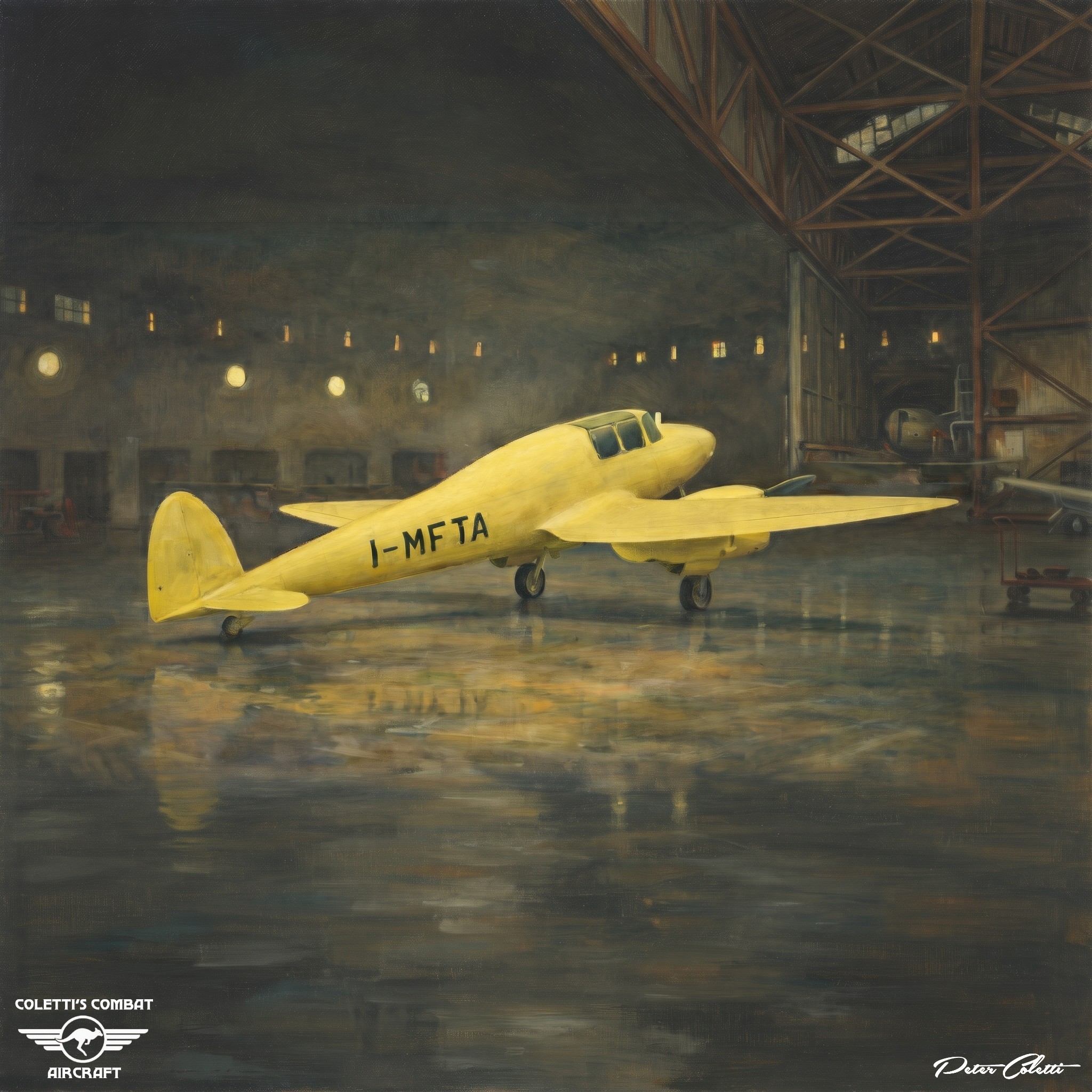
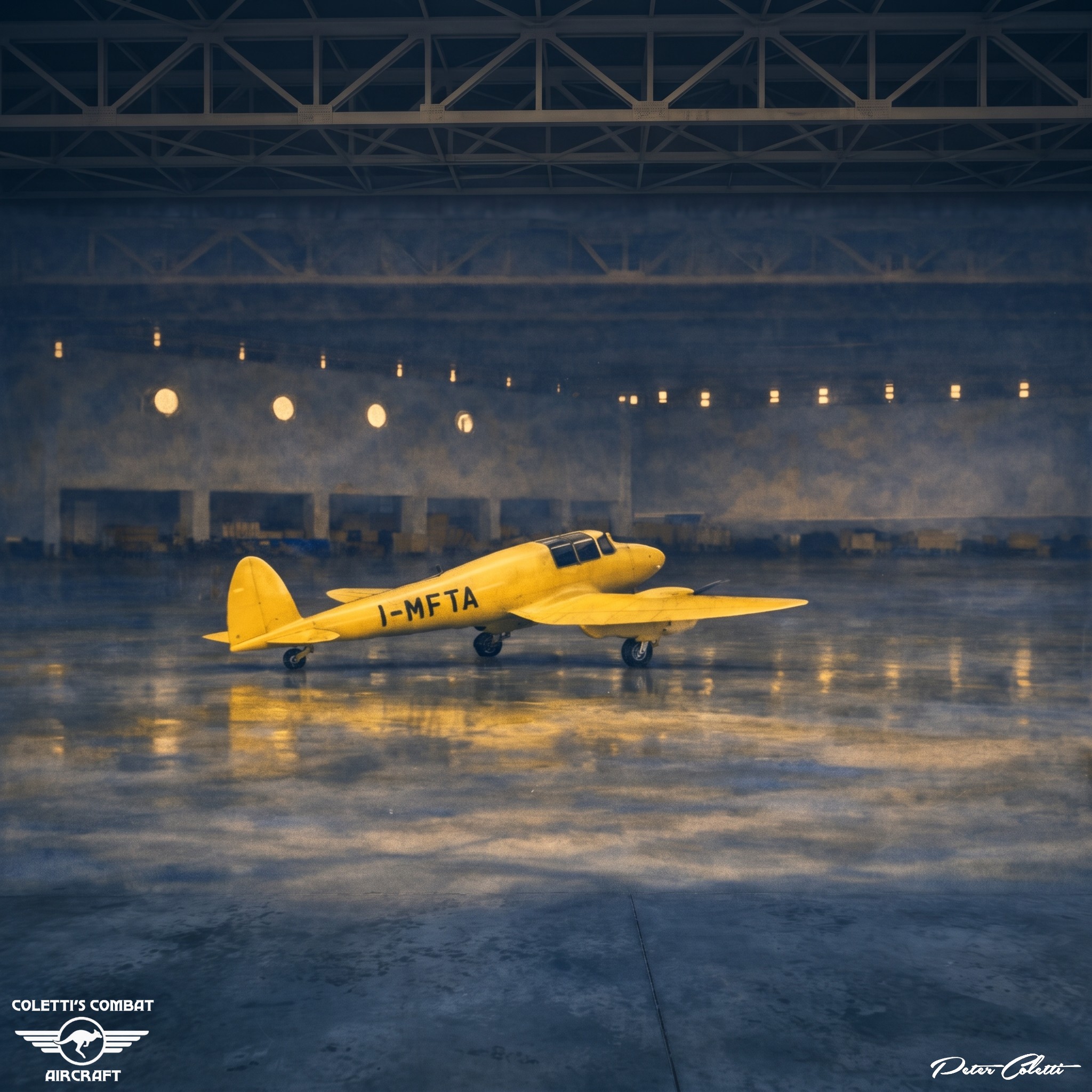
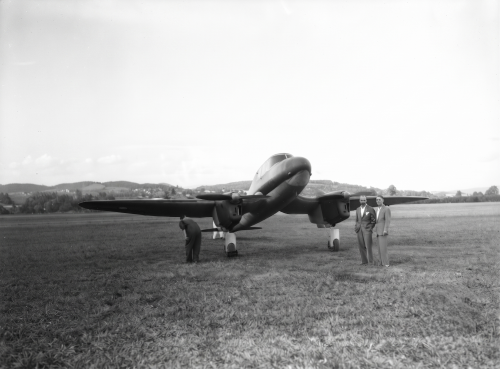
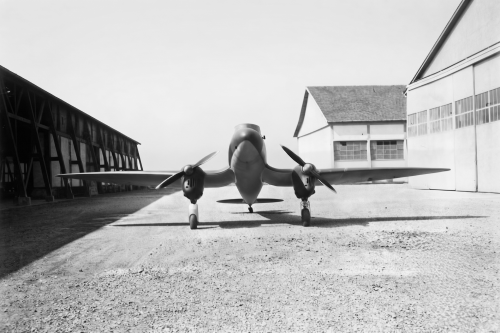
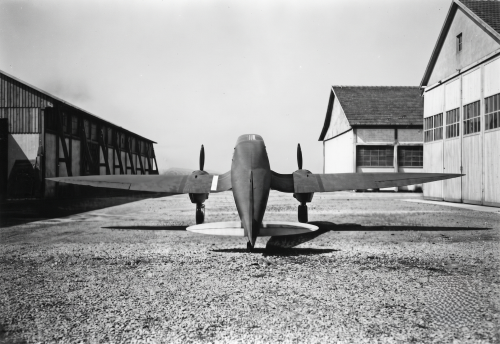
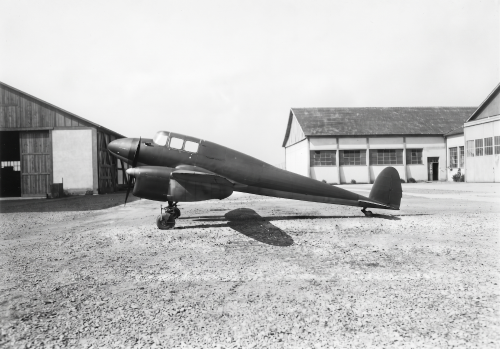
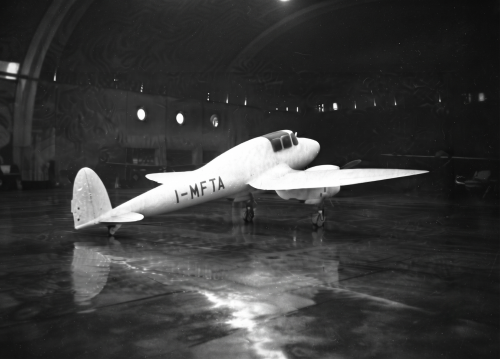
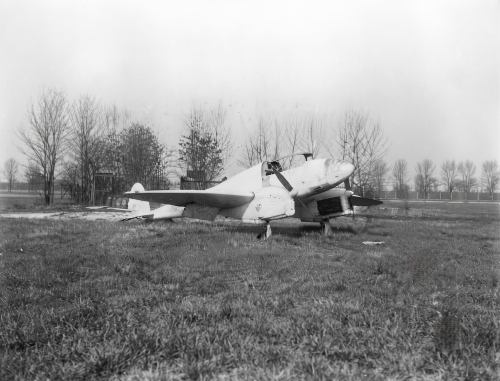
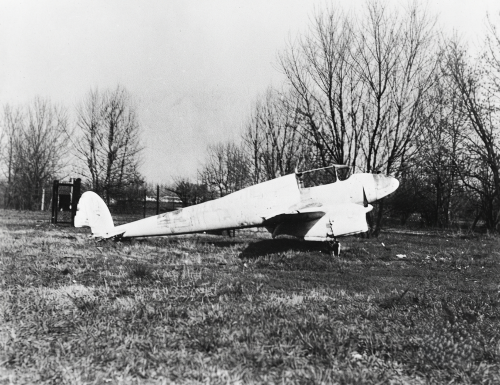
The CAT Marinavia company—Costruzioni Aeronautiche e Tecniche Marinavia—was one of several small Italian aviation firms that emerged during the late 1930s to supply niche aircraft to the Regia Aeronautica.
Its QR‑series (“Ricognizione Rapida”) projects aimed to produce fast, lightweight tactical reconnaissance aircraft that could be built quickly and cheaply.
The QR.14 Levriero (“Greyhound”) originated in 1941 as a response to two pressures:
Italy’s need for a high‑speed battlefield scout capable of operating independently without fighter escort.
Severe industrial shortages that forced manufacturers to rely on mixed construction and simplified tooling.
CAT Marinavia proposed a compact, single‑engine aircraft emphasising speed, climb rate, and ease of production.
The Regia Aeronautica accepted the prototype order in early 1942, hoping the Levriero could replace ageing reconnaissance types such as the Caproni Ca.310 and IMAM Ro.37.
The prototype flew in late 1942 and immediately impressed test pilots with its acceleration and handling.
However, its limited payload and cramped internal volume prevented it from becoming a major production aircraft.
Small‑batch manufacturing continued into mid‑1943, with roughly two dozen airframes completed before Italy’s armistice.
Airframe and Design Philosophy
The Levriero’s design was shaped by CAT Marinavia’s philosophy of speed through simplicity.
The aircraft was built around a compact fuselage and a powerful inline engine, with aerodynamic refinement prioritised over structural sophistication.
Fuselage
Semi‑monocoque structure using wooden formers and plywood skin over a metal frame.
Narrow cross‑section to reduce drag, resulting in a tight cockpit and limited internal fuel volume.
Sliding canopy with good forward visibility but restricted rearward view.
Wings
A low‑wing cantilever design with laminar‑flow-inspired profiles, unusual for Italian aircraft of the period.
Wooden wing box with metal fittings at the root.
Split flaps and ailerons are optimised for responsiveness rather than low‑speed lift.
Undercarriage
Fully retractable tailwheel configuration.
Main gear retracted inward into shallow bays, reducing drag but complicating maintenance.
Engine and Systems
The Levriero used the Isotta‑Fraschini Delta RC.40, a liquid‑cooled inverted V‑12 producing around 750–800 hp.
Key features:
Tight cowling with minimal frontal area.
Two‑stage mechanical supercharger for improved mid‑altitude performance.
Radiator bath under the fuselage with adjustable shutters.
The aircraft lacked advanced avionics; its equipment suite was typical of Italian light aircraft:
Basic radio set.
Compact vertical‑camera installation behind the cockpit.
Simple reflector gunsight for the attack variant.
Performance Characteristics
The Levriero’s performance was its strongest asset.
Pilots described it as “nervous but obedient”, with fighter‑like acceleration and roll rate.
General Performance
Maximum speed: ~480 km/h (300 mph) at 4,000 m
Cruise speed: ~380 km/h
Range: 650–700 km depending on fuel load
Service ceiling: ~8,500 m
Climb rate: ~12 m/s (excellent for its class)
Handling
Very responsive ailerons, giving it a sharp roll rate.
High wing loading produced fast landing speeds and unforgiving stall behaviour.
Stable at high speed but twitchy at low speed, limiting novice pilot use.
Operational Strengths
Difficult for enemy fighters to intercept at low altitude.
Quick to accelerate out of danger during reconnaissance runs.
Small radar and visual signature.
Operational Weaknesses
Limited endurance.
Small camera bay and restricted field of view.
Vulnerable cooling system—radiator damage often forced emergency landings.
Armament and Equipment
The baseline QR.14 was unarmed, but wartime realities led to the development of a light‑attack configuration.
Reconnaissance Variant (QR.14R)
Vertical and oblique cameras.
No fixed armament.
Optional underwing flare racks.
Attack Variant (QR.14A)
Two 12.7 mm Breda‑SAFAT machine guns in the nose.
Up to 200 kg of ordnance:
Light bombs
Small fragmentation canisters
Occasional use of anti‑personnel bomblets
Reinforced wing spars to handle the extra weight.
The attack variant was used sparingly due to limited payload and vulnerability during low‑altitude strikes.
WWII Context and Operational Use
The Levriero entered service during a period of severe strain on Italy’s aviation industry.
Larger manufacturers were focused on fighters and bombers, leaving reconnaissance units with outdated aircraft.
The Levriero filled a niche:
Mediterranean Theatre
Used for coastal reconnaissance, convoy shadowing, and rapid battlefield observation.
Its speed allowed it to evade British Hurricanes and early Spitfires at low altitude.
Pilots appreciated its ability to “dash in and dash out” before enemy interception.
North Africa
A small number were deployed in 1943, but desert conditions proved harsh:
Sand ingestion caused engine wear.
Wooden structures suffered in heat and dryness.
Limited range restricted its usefulness in wide‑open desert operations.
Post‑Armistice
After September 1943:
A handful of aircraft were seized by the Italian Social Republic (RSI).
Others were captured by German forces and used for liaison and courier duties.
No significant combat use occurred after early 1944.
Production never resumed due to the collapse of Italy’s industrial capacity.
Variants
Below is a structured list of the Levriero’s known variants.
QR.14 Prototype — First airframe; used for aerodynamic testing and engine calibration.
QR.14R Reconnaissance — Standard production model; camera bay; unarmed.
QR.14A Attack — Light‑attack version with machine guns and small bomb load.
QR.14B Long‑Range — Proposed but never built; enlarged fuel tanks and revised wing.
QR.14C Trainer — Two‑seat conversion for familiarisation; only one prototype completed.
Legacy and Assessment
The CAT Marinavia QR.14 Levriero was ultimately a promising but limited aircraft:
Technically advanced for a small manufacturer.
Aerodynamically refined and impressively fast.
Hampered by Italy’s industrial shortages and its own structural compromises.
It never achieved widespread use, but it remains an interesting example of Italy’s late‑war attempts to produce high‑performance reconnaissance aircraft under severe constraints.