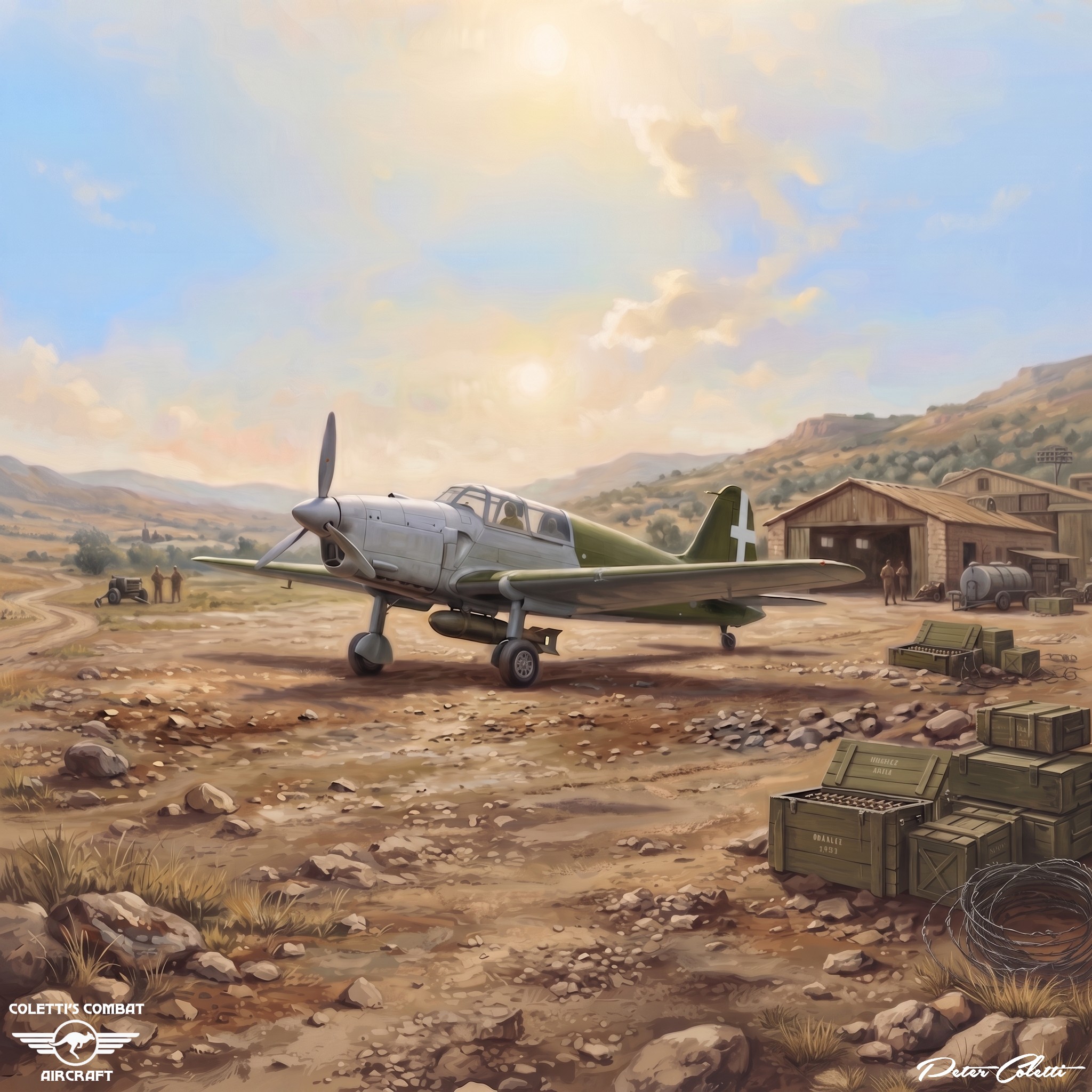
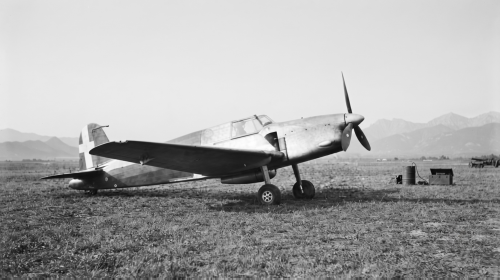
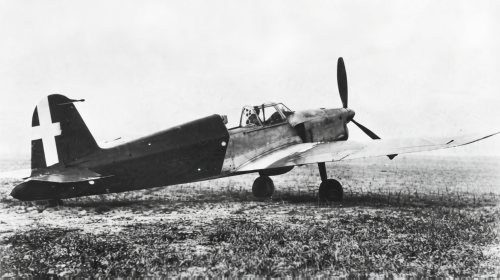
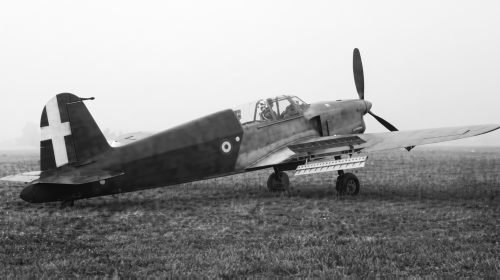
The Caproni Ca.355 was an Italian single-seat dive bomber prototype developed on the eve of the Second World War, representing one of the Regia
Aeronautica’s last attempts to produce a domestically designed aircraft in the same operational category as the German Junkers Ju 87.
Although technically competent and aerodynamically refined, the Ca.355 never progressed beyond a single prototype, and its story reflects both the industrial
limitations and doctrinal uncertainties of Italy’s wartime aviation sector.
Development History
The origins of the Ca.355 trace back to 1939, when the Italian Ministry of Aeronautics issued a requirement for a purpose-built dive bomber comparable to the Ju 87 Stuka.
Italy had already begun receiving Ju 87s from Germany, but the Regia Aeronautica still hoped to field an indigenous design that could be produced without reliance on foreign supply chains.
Caproni, one of Italy’s largest aircraft manufacturers, assigned the project to its subsidiary Cantieri Aeronautici Bergamaschi (CAB), under the direction of engineer Cesare Pallavicino.
Pallavicino based the new aircraft on the earlier Caproni Ca.335 Maestrale, a two‑seat reconnaissance and attack aircraft developed in the late 1930s.
The Ca.355 was conceived as a simplified, lighter, single‑seat derivative optimised specifically for steep‑angle dive bombing.
The second cockpit of the Ca.335 was removed, the fuselage was narrowed, and the airframe was redesigned to reduce weight and drag.
The goal was to produce an aircraft that could match or exceed the Ju 87’s accuracy in dive attacks while offering higher speed and more modern aerodynamic characteristics.
Design & Structure
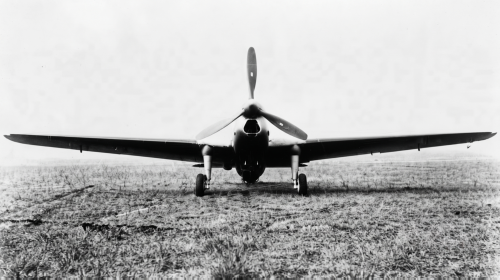
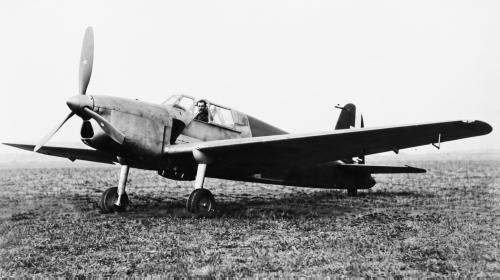
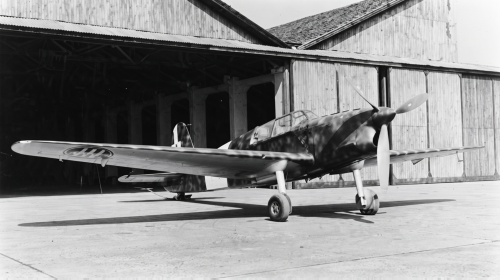
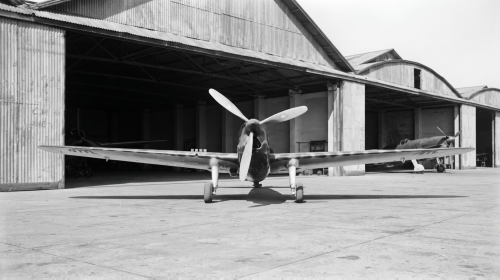
The Ca.355 was a low-wing, all-metal monoplane with a conventional tail and a single enclosed cockpit.
Its structural layout combined Italian aerodynamic practice with features borrowed from foreign designs.
The wings were fitted with dive brakes to stabilise the aircraft during steep dives, allowing the pilot to maintain a controlled trajectory and release bombs with precision.
Beneath the fuselage, Caproni installed a tubular bomb trapeze designed to swing the bomb clear of the propeller arc during vertical release.
This mechanism was essential for safe dive bombing and closely resembled the system used on the Ju 87.
The landing gear was notable for being influenced by American practice.
Caproni adopted a wide‑track undercarriage based on the Curtiss P‑40, which provided stability during take-off and landing and could withstand the repeated high‑stress cycles associated with dive‑bombing operations.
The cockpit canopy slid rearward for entry and exit, and the pilot sat in a relatively compact fuselage that emphasised aerodynamic cleanliness.
Dimensions & Weight
The Ca.355 had a wingspan of approximately 12.96 metres and a length of 9.93 metres.
Its empty weight was around 1,980 kilograms, with a normal take-off weight of about 3,050 kilograms.
These dimensions placed it among the smaller and lighter single‑engine dive bombers of the era, reflecting Caproni’s intent to produce a nimble, fast‑climbing aircraft rather than a heavily armoured battlefield striker.
Powerplant & Performance
The aircraft was powered by the Isotta‑Fraschini Delta RC.35, a 12‑cylinder liquid‑cooled inline engine producing roughly 850 horsepower.
This engine was part of the Caproni group’s internal industrial network, allowing the company to avoid dependence on foreign powerplants.
With this engine, the Ca.355 achieved a maximum speed of approximately 490 kilometres per hour and a cruising speed near 380 kilometres per hour.
These figures made it faster in level flight than the Ju 87B, although the Ca.355 lacked the Stuka’s heavy armour protection and battlefield survivability.
The aircraft’s bomb load was around 500 kilograms, carried on the articulated centreline trapeze.
This load was typical for a light dive bomber and sufficient for precision attacks against ships, bridges, and fortified positions.
Flight Testing & Evaluation
The sole prototype, designated MM.470, made its first flight on 14 January 1941 at Caproni’s airfield in Ponte San Pietro.
The test pilot was Ettore Wengi, who reported no major handling problems during initial trials.
The aircraft demonstrated stable dive characteristics, adequate speed, and generally satisfactory performance for its intended role.
Despite these positive results, the Regia Aeronautica was not convinced that the Ca.355 offered a meaningful advantage over the Ju 87, which Italy was already operating in increasing numbers.
The Stuka was combat‑proven, widely available, and supported by German logistics.
In contrast, the Ca.355 was a single prototype with no production tooling in place, and its engine type had limited manufacturing capacity.
The Italian Air Force also lacked the industrial depth to rapidly produce a new specialised aircraft in large numbers.
Strategic & Operational Context
By 1941, Italy’s dive‑bombing doctrine was increasingly shaped by German experience.
The Ju 87 had already demonstrated its effectiveness in Poland, France, and the early stages of the war in the Mediterranean.
Italian commanders saw little reason to divert resources into a new design when a proven aircraft was readily available from Germany.
At the same time, Italy began converting older fighters such as the Fiat CR.42, Fiat G.50, and Macchi MC.200 into makeshift dive bombers.
These conversions were cheaper and faster to field than a new aircraft requiring full production setup.
As a result, the Ca.355 was deemed unnecessary, and the project was quietly terminated.
The fate of the prototype is unknown; it may have been scrapped or used for parts.
Proposed Variants
Although only one Ca.355 was built, Caproni proposed several derivative designs intended to improve performance or explore alternative configurations.
The Ca.355 Twin‑Tail was a radical concept featuring twin tail booms and a push‑pull twin‑engine layout.
It was proposed with either Daimler-Benz DB 601 engines or additional Isotta-Fraschini Deltas.
This design aimed to increase power and stability but never progressed beyond paper studies.
The Ca.357 was a proposed variant powered by the Daimler-Benz DB 601, the same engine used in the Macchi C.202 fighter.
This would have significantly improved performance, but the variant remained unbuilt.
The Ca.358 was another proposed development, intended to use the Isotta‑Fraschini Zeta engine. Like the Ca.357, it never left the drawing board.
Bomb load: Approximately 500 kg on centreline trapeze
Dive brakes: Wing‑mounted
Landing gear: Wide‑track, P‑40‑influenced design
Conclusion
The Caproni Ca.355 stands as a compelling example of Italy’s late‑war struggle to modernise its air arm.
Technically sound and aerodynamically refined, it nonetheless arrived too late and offered too little improvement over the German aircraft already in service.
The Ca.355’s cancellation reflects the broader industrial and strategic constraints that shaped Italy’s wartime aviation efforts.
Although it never entered production, the Ca.355 remains an interesting footnote in the history of dive‑bomber development and a testament to Caproni’s engineering ambitions during a period of intense military pressure.