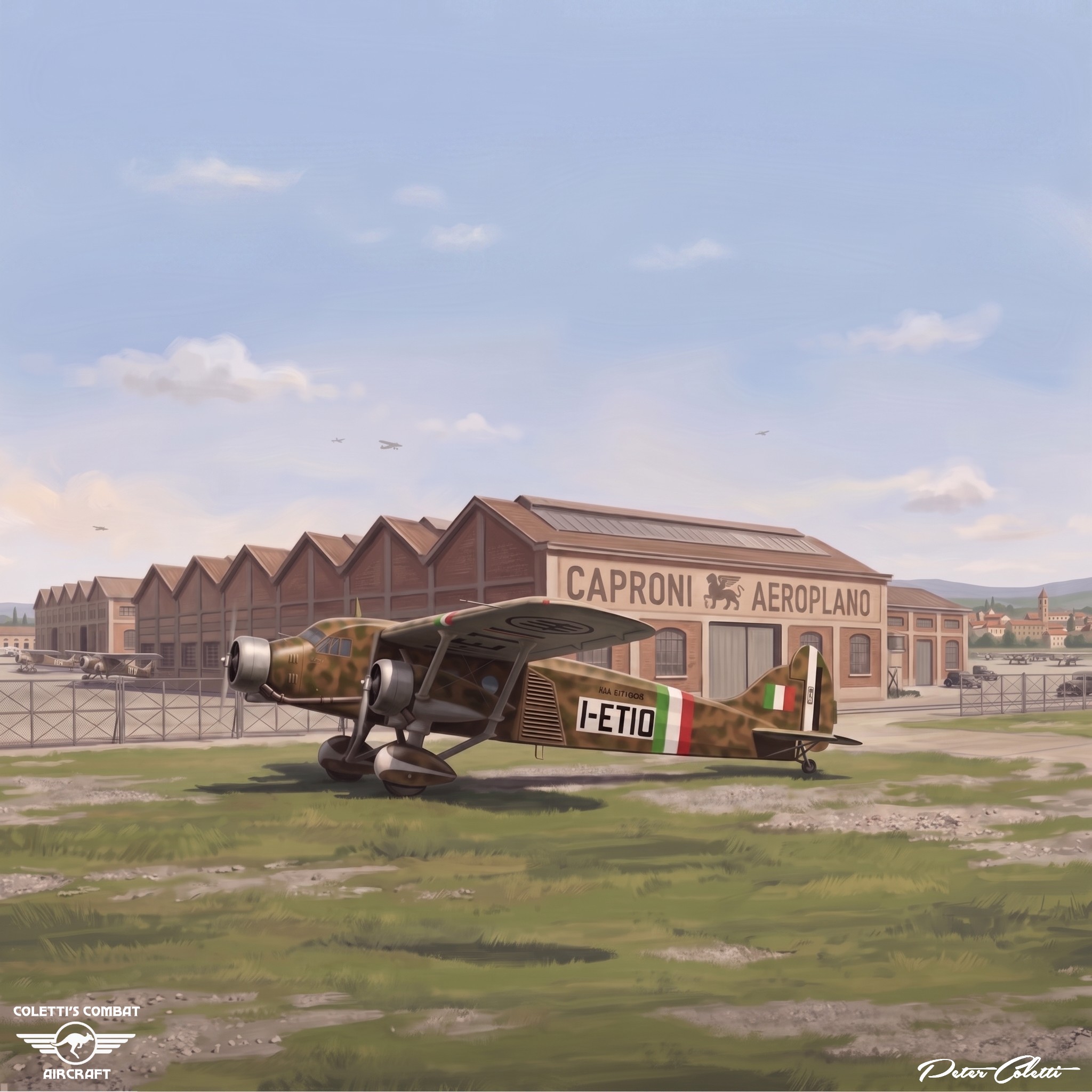
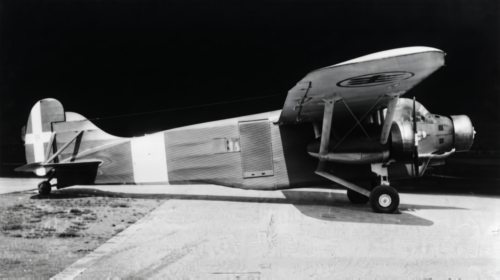
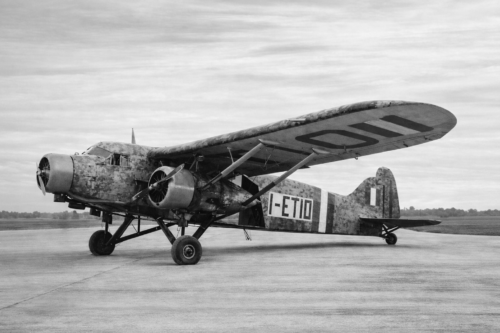
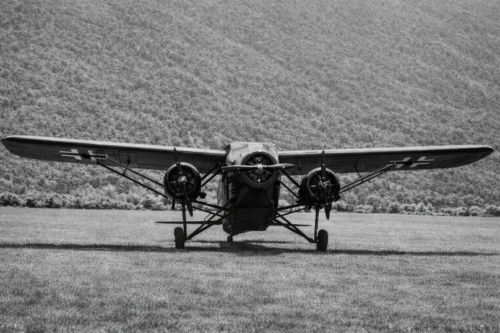
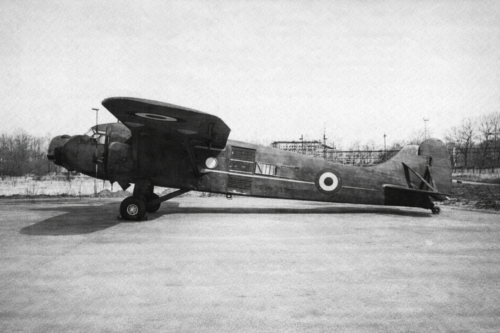
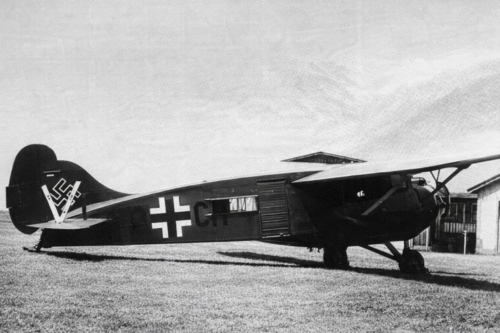
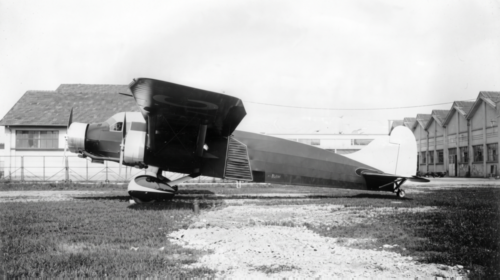
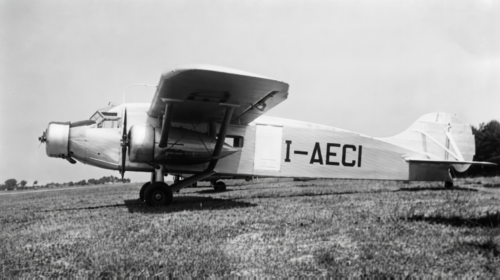
The Caproni Ca.148 emerged in 1938 as a direct evolutionary refinement of the earlier Caproni Ca.133 series, itself derived from the single‑engine Ca.97 of 1927.
The initiative came from Gianni Caproni, assisted by Agostino Caratti and the Caproni technical office, who sought to modernise the Ca.133 by improving aerodynamics, structural strength, and crew/passenger accommodations.
Although the Ca.148 retained the mixed construction and high-wing braced configuration of its predecessors, Caproni advanced the cockpit by 0.91 m, relocated the main entrance, and strengthened the steel tube fuselage frame to give the aircraft a more robust appearance and improved operational durability.
Development began in response to Italian colonial and military needs, particularly for operations in Africa Orientale Italiana (AOI).
Even though comparative testing showed that the Ca.148 did not significantly outperform the Ca.133, the Regia Aeronautica required new transports for East Africa and placed an order for 106 aircraft, including 100 Ca.148P units with enlarged fuselages for paratrooper transport.
Design and Construction
Airframe and Structure The Ca.148 followed Caproni’s established pattern of a welded steel‑tube fuselage, covered with a combination of metal and fabric.
The high-wing layout used solid braced struts, and the aircraft retained fixed landing gear, though strengthened for rough-field operations in East Africa.
Crew and Cabin
The aircraft typically carried two crew and up to 16–18 passengers, depending on configuration.
The Ca.148P variant was specifically enlarged for paratrooper transport, with internal arrangements optimised for rapid deployment.
Powerplant
The Ca.148 employed three Piaggio Stella P.VII C168 radial engines, each producing 510 hp, arranged in the same tri‑motor configuration as the Ca.133.
Some sources note the use of Piaggio Stella P.VII C.16 engines rated at 460 hp, likely reflecting production variations or civil vs. military configurations.
Propellers
A key improvement over the Ca.133 was the adoption of Piaggio d’Ascanio variable‑pitch propellers, enhancing climb and cruise efficiency.
Dimensions
Wingspan: 21.44 m
Length: 15.83 m (some sources list 15.36 m depending on variant)
Height: 4.00 m
Wing area: 65 m²
Weights
Empty weight: 4,787 kg
Normal/maximum take-off weight: approx. 8,000 kg (some sources list 6,700 kg for civil Ca.148)
Performance
Maximum speed: 241 km/h
Cruising speed: 200 km/h
Range: 900 km
Service ceiling: 3,900 m
Although adequate for transport duties, these figures show that the Ca.148 was not a high-performance aircraft.
Its capabilities were modest, reflecting its origins as a rugged, utilitarian transport rather than a cutting‑edge combat aircraft.
Operational History and WWII Context
Role in Italian East Africa (AOI)
Unlike the multi-role Ca.133, the Ca.148 was used exclusively as a tactical transport aircraft by the Regia Aeronautica’s transport units in AOI.
It carried troops, supplies, and paratroopers across the vast colonial territories.
When Italian East Africa fell in 1941, surviving Ca.148s were either destroyed, captured, or flown back to Europe.
At least one aircraft, I‑ETIO, is documented as returning to European service.
Service in Italy and German Requisition
After the Armistice of Cassibile (September 1943), German forces seized several Ca.148s.
Three newly built aircraft were found at Vizzola, and the Germans authorised continued production up to the 40th airframe.
By December 1942, Ca.148 aircraft were already in Luftwaffe use, including one at the FFS B20 flying school.
Additional aircraft (MM.61147, 61149, 61150, 61151, 61163, 61171, and 61180) were confirmed in German service.
By March 1944, the Luftwaffe operated 13 Ca.148s, increasing to 32 by June, primarily in paratrooper training schools at Wittstock, Rechlin, and Papa.
Two were destroyed by Allied strafing at Gallarate on 31 July 1944.
Post‑War Civil Use
After WWII, surviving Ca.148s were converted into short‑haul airliners, retaining the Ca.148P designation.
They operated into the late 1940s, demonstrating the design’s durability and utility in peacetime transport roles.
Variants
Ca.148 (Base Model)
Military transport
Three Piaggio radial engines
Strengthened landing gear
Capacity for ~16 passengers or equivalent cargo
Ca.148P (Enlarged Fuselage Variant)
Primary paratrooper transport version
100 built out of 106 total
Enlarged cabin for up to 18 paratroopers
Later used as a civil airliner post-war
Related Aircraft (Contextual Lineage)
Ca.133: Predecessor, multi-role transport/bomber used in Ethiopia, Spain, Albania, and early WWII.
The Caproni Ca.148 was not a revolutionary aircraft, nor was it intended to be.
Instead, it represented a practical, incremental improvement on a proven airframe, optimised for Italy’s colonial and wartime transport needs.
Its strengths were:
Ruggedness and reliability in harsh environments
Simplicity of maintenance
Adequate payload capacity for paratroopers and supplies
Structural improvements over the Ca.133
Its weaknesses included the following:
Limited speed and altitude performance
Obsolescence by mid‑WWII, especially compared to Allied transports
Vulnerability due to fixed landing gear and modest defensive capabilities
Nevertheless, the Ca.148 served Italy and later Germany in a variety of transport and training roles, and its post-war civil use underscores its practical value.