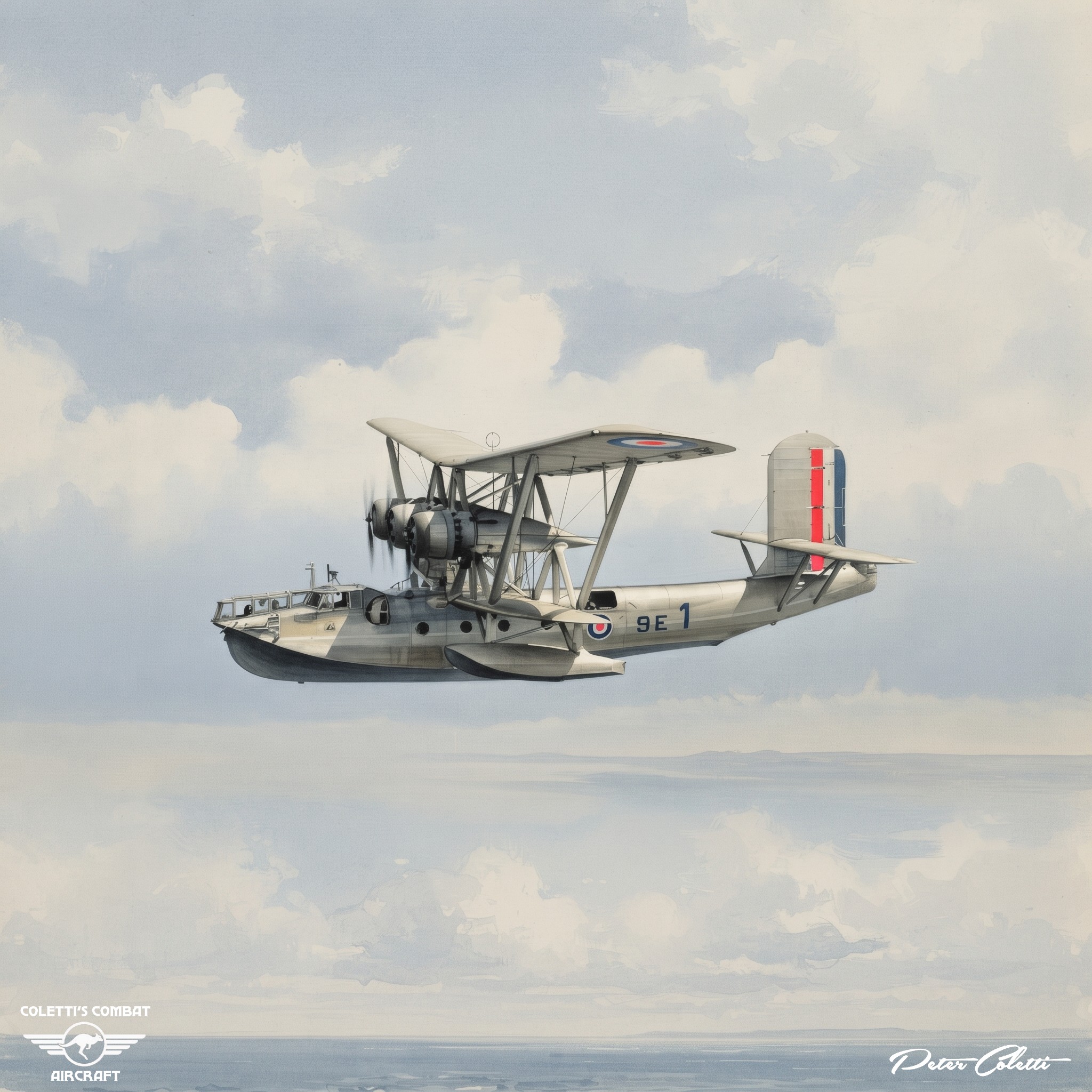
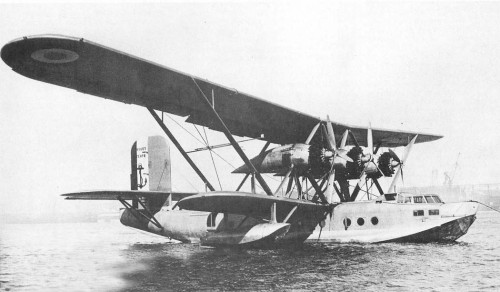
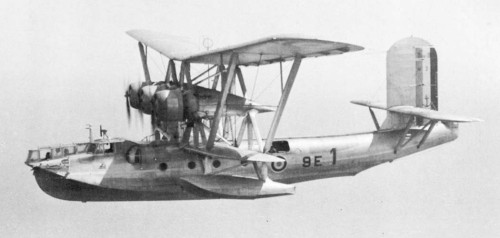
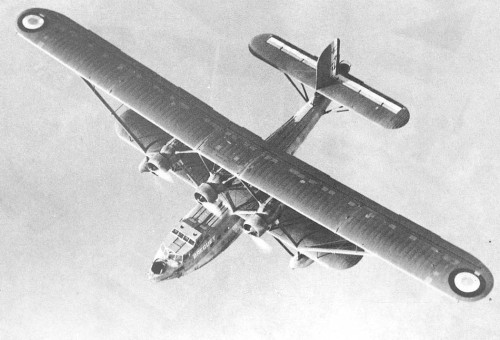
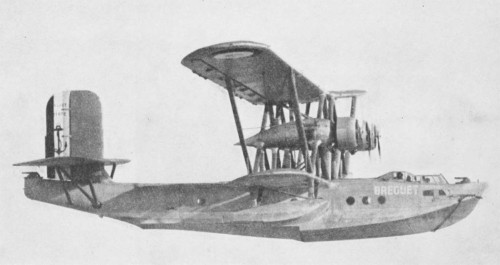
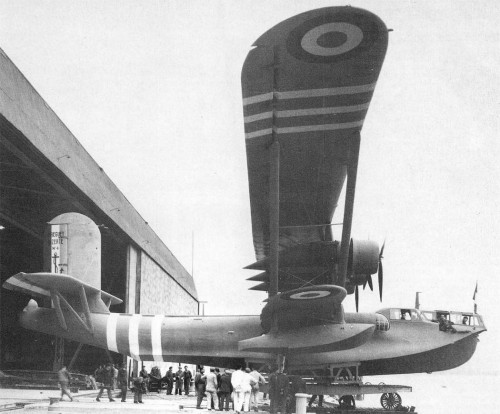
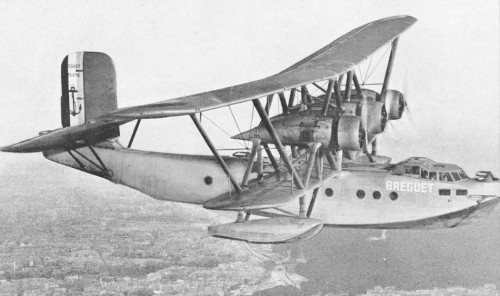
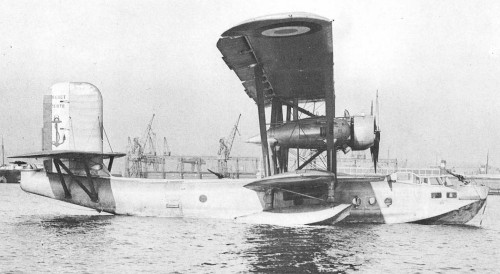
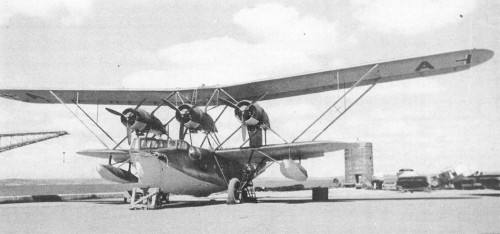
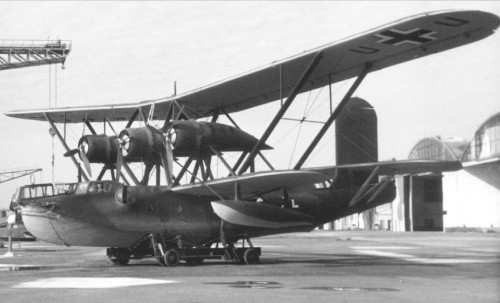
The Bréguet 521 Bizerte emerged from France’s interwar ambition to field long‑range maritime reconnaissance flying boats capable of patrolling vast oceanic sectors.
Its lineage traces directly to the British Short S.8 Calcutta, for which Bréguet acquired a licence in 1931.
Although the Calcutta provided the structural and aerodynamic foundation, the French Navy required a significantly larger, militarised aircraft optimised for extended patrols, convoy escort, and maritime surveillance.
In 1932, the French Navy issued a formal requirement for a long‑range reconnaissance flying boat, prompting Bréguet to begin work on a substantially redesigned derivative, designated Br.521‑01.
The prototype was powered by three Gnome‑Rhône 14Kdrs radial engines rated at 825 hp each.
522
It first flew on 11 September 1933 at Le Havre.
Early testing revealed aerodynamic and cooling improvements were needed, leading to the adoption of NACA cowlings around the previously uncowled engines.
Official trials began in January 1934 at Saint‑Raphaël and continued until September of that year.
By April 1935, the prototype was transferred to Cherbourg for service trials with Escadrille 1E2.
Even before testing concluded, the Navy ordered a pre‑production batch of three aircraft, delivered beginning in late 1935.
The second aircraft incorporated substantial refinements, including removal of the open nose gun position, extension of the cockpit canopy forward, and installation of blister gun mounts behind the cockpit.
Production continued in small batches through the late 1930s, aided by the nationalisation of Bréguet’s Le Havre factory into SNCAN in 1937, which did not disrupt output.
Structural and Aerodynamic Design
The Bizerte was a large, all‑metal parasol‑wing flying boat, reflecting both Short Brothers’ structural philosophy and Bréguet’s own metal‑airframe expertise.
Hull and Fuselage
Fully metal construction with a deep, seaworthy hull optimised for open-ocean operations.
The internal arrangement supported a crew of eight, including pilots, a navigator, a radio operator, engineers, and gunners.
Fuel tanks were housed entirely within the lower wing, with a total capacity of 5,250 litres—a substantial volume enabling long‑range patrols.
Wing and Tail
High‑mounted parasol wing with a span of 35.15 m, providing excellent lift at low speeds and good water‑handling characteristics.
Wing area: 162.6 m².
Conventional tail unit mounted high to avoid spray during take-off and landing.
Powerplant
Production aircraft used:
Three Gnome‑Rhône 14Kirs or 14N‑11 radial engines, each rated at 900 hp.
The triple‑engine configuration gave the Bizerte adequate reliability for long maritime sorties, though by late‑1930s standards its performance was modest.
Armament
The Bizerte carried:
Five 7.5 mm Darne machine guns
Two forward beam positions
Two aft beam positions
One tail position
Underwing ordnance capacity:
Up to 1,600 kg of bombs,
or
Two 800‑kg torpedoes (rarely used operationally)
This armament suite was typical of interwar flying boats—adequate for self-defence but not suited for heavy combat.
Performance Characteristics
Br.521 (standard production)
Wingspan: 35.15 m
Length: 20.50 m
Height: 7.45 m
Empty weight: 9,470 kg
Normal take-off weight: 16,600 kg
Engines: 3 × 900 hp Gnome‑Rhône radials
Maximum speed: 245 km/h
Cruise speed: 200 km/h
Range: 3,000 km
Service ceiling: 6,000 m
These figures underscore the aircraft’s suitability for long‑duration patrols rather than high‑performance combat roles.
Production and Variants
Br.521
The baseline military reconnaissance flying boat.
Most aircraft delivered to the French Navy belonged to this version.
Br.522
A single experimental aircraft fitted with three Hispano‑Suiza 14AA radial engines rated at 1,000 hp each.
It was the only Bizerte not powered by Gnome–Rhône engines.
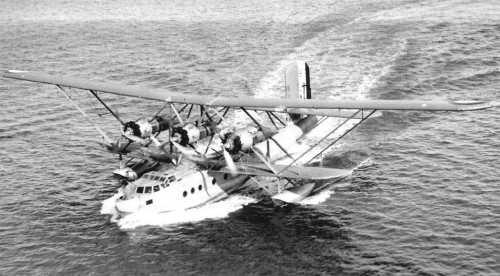
Br.530 Saigon
A civilian passenger variant equipped with three Hispano‑Suiza 12Ybr liquid‑cooled engines.
Intended for long‑range transport, it remained a rare derivative.
Operational Service Before WWII
By 1 September 1939, the French Navy operated Bizerte aircraft in Escadrilles E1, E2, E3, and E5, each with four to five aircraft.
A new unit, E9, was formed in October 1939 with four aircraft.
Despite its ageing design, France ordered 12 additional Bizertes on 12 September 1939, though this was later reduced to three aircraft delivered in early 1940.
World War II Service
Early War Patrols
From the outbreak of hostilities, Bizertes patrolled both the Atlantic and the Mediterranean, performing reconnaissance, anti‑submarine sweeps, and convoy escort duties.
After the Fall of France
On 1 August 1940, naval aviation units were renumbered (E1 → 1E, etc.).
By mid-August, 20 Bizertes remained operational, though half were undergoing maintenance or repair.
Under Vichy control, only 1E and 9E retained Bizertes; other units were disbanded.
1E operated from Karouba with three Bizertes and three LeO 257bis floatplanes.
9E flew from Berre with three Bizertes and three LeO H.470 flying boats; by November 1942, it had four Bizertes.
German Requisition
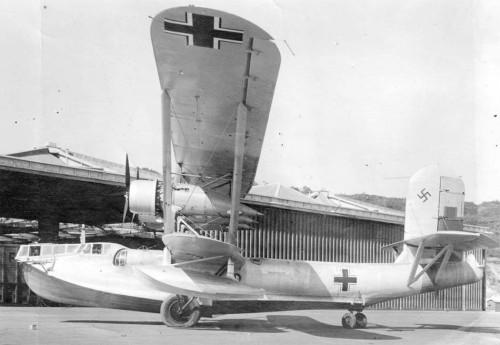
Following the German occupation of Vichy territory in November 1942, the Luftwaffe seized all remaining Bizertes, including four stored aircraft from 9E.
They were used for air‑sea rescue missions from Lorient and Saint‑Mandrier.
Post‑war Use
In August 1944, Canadian forces captured one Luftwaffe‑operated Bizerte and returned it to France.
After repairs, it served briefly as a transport aircraft on North Africa–metropole routes with Flottille 9FTY until its loss in an accident in May 1946.
This aircraft was the final operational one in Bizerte.
Assessment and Legacy
The Bréguet 521 Bizerte was emblematic of interwar flying-boat design: large, seaworthy, long‑ranged, and structurally robust.
Although outdated by 1939—slow, lightly armed, and vulnerable—it remained in frontline service due to France’s limited resources and the absence of modern replacements.