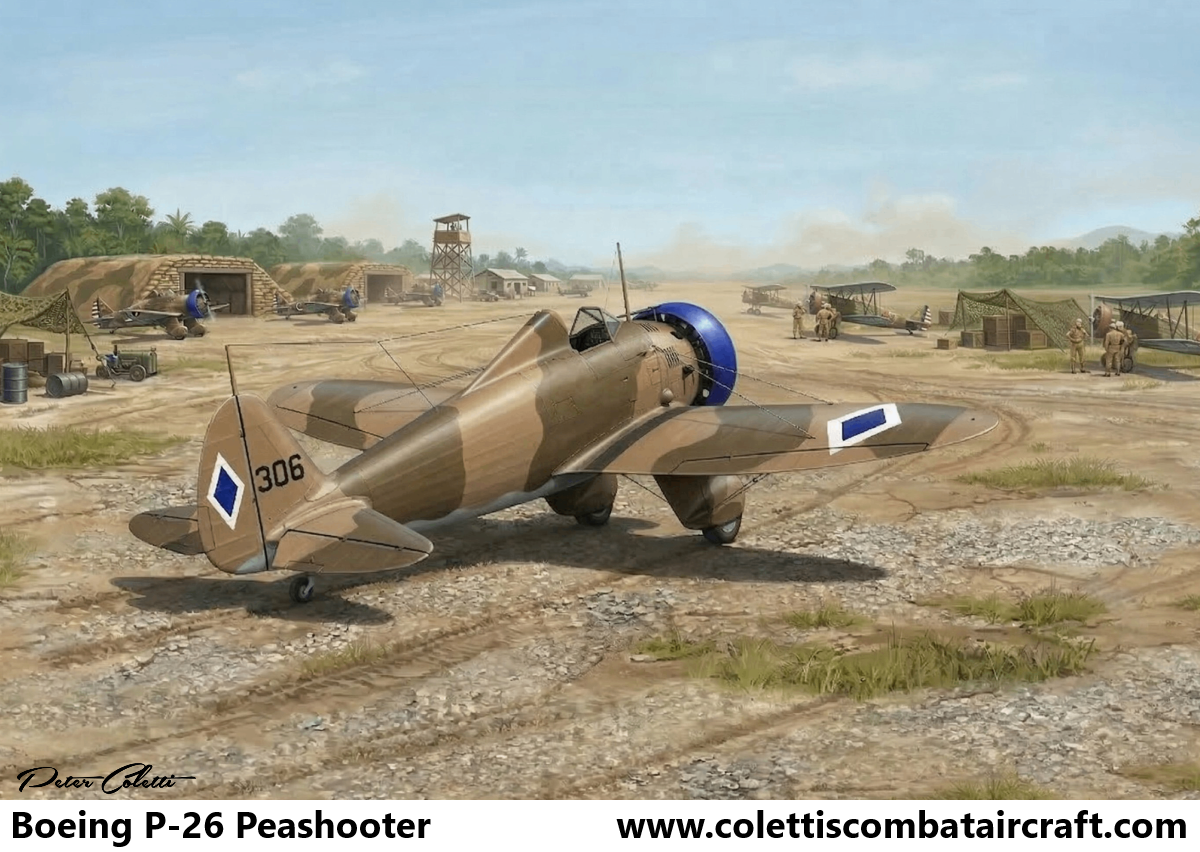
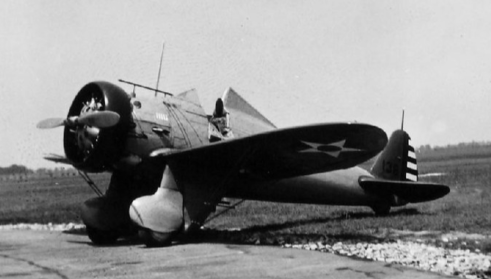
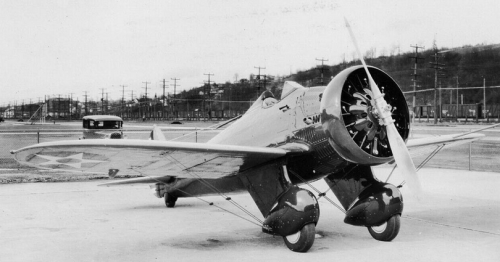
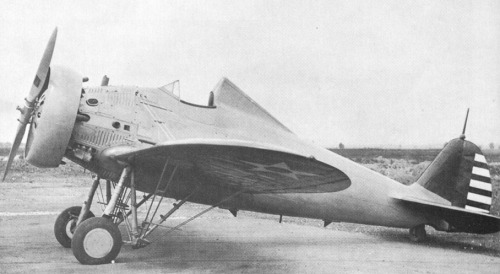
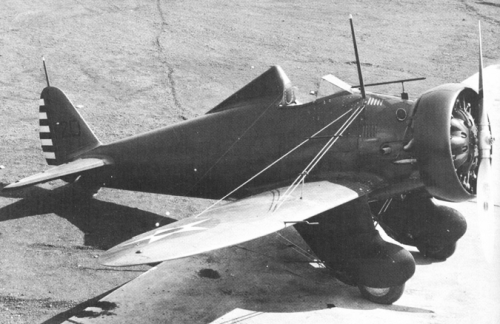
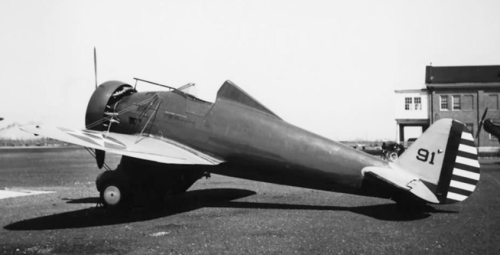
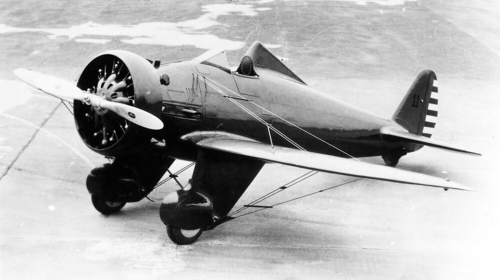
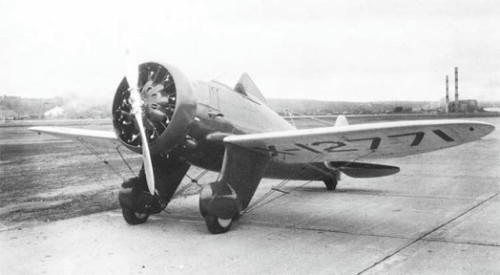
Deliveries of the P-26 to U.S. Army Air Corps (USAAC) pursuit squadrons commenced in December 1933, with the final P-26C rolling off the production line in 1936.
At its peak in 1936, six squadrons operated the type, though a total of 22 squadrons flew the Peashooter during its tenure.
It remained the USAAC’s primary fighter until 1938, when it was gradually replaced by the Seversky P-35 and Curtiss P-36.
Between 1934 and the U.S. entry into World War II in December 1941, twenty P-26s were lost in accidents—only five of these occurred prior to 1940.
From 1938 to 1940, P-26s were deployed to Hawaii to reinforce Seversky P-35s in defence units at Wheeler Field:
18th Pursuit Group (6th, 19th, 73rd, 78th Squadrons)
15th Pursuit Group (45th, 47th Squadrons)
In 1935, the 17th Pursuit Group was redesignated as the 17th Attack Group. Its P-26s were reassigned in 1938 to the 16th Pursuit Group (24th, 29th, and 78th Squadrons) at Albrook Field, Panama.
These aircraft were subsequently transferred in 1940 to the 37th Pursuit Group (28th, 30th, and 31st Squadrons), which operated them until May 1941, when they were replaced by P-40s.
Some P-26s continued service with the 32nd Pursuit Group (51st and 53rd Squadrons).
At the outbreak of World War II, only nine remained operational in Central America.
Notably, seven P-26As were still listed with the Sixth Air Force as late as May 1943.
In the Philippines, the 3rd Pursuit Squadron of the 4th Composite Group flew P-26As.
Between 1937 and 1941, 31 aircraft were sold to the newly established Philippine Army Air Corps.
Combat Service
The P-26’s first combat appearance was as a Model 281 exported to Spain prior to the Spanish Civil War.
Operated by the Spanish Republican Air Force, it was shot down on 21 October 1936 without scoring any victories.
On 15 August 1937, eight Model 281s of the Chinese Nationalist Air Force’s 3rd Pursuit Group (17th Squadron) intercepted Japanese Mitsubishi G3M “Nell” bombers over Nanking.
Four P-26s downed three of the fourteen bombers destroyed that day, with no losses.
The remaining eleven were claimed by Chinese Hawk IIs, Hawk IIIs, and Fiat CR.32s.
Subsequent engagements between Chinese P-26s and Japanese Mitsubishi A5Ms marked the first dogfights between all-metal monoplane fighters.
Among the Chinese-American volunteer aces were John “Buffalo” Huang and John Wong Pan-yang.
Wong Pan-yang achieved two shared kills on 22 September 1937 and a solo victory on 12 October 1937 over Nanking.
By December 1941, 28 P-26s remained in the Philippines, with 12 operational in the 6th Pursuit Squadron of the Philippine Army Air Corps.
Captain Jesús A. Villamor led his squadron against Japanese Mitsubishi A6M Zeros over Zablan and Batangas Fields.
Despite being outmatched, they claimed four kills—one G3M bomber and three Zeros, two credited to Villamor.
He was awarded the Distinguished Service Cross and an Oak Leaf Cluster for his actions.
To prevent capture, remaining P-26s in the Philippines were destroyed on 24 December 1941.
Nine airworthy examples continued service with the newly renamed United States Army Air Forces in the Panama Canal Zone.
Final Service and Legacy
Between 1942 and 1943, seven P-26s were transferred to the Guatemalan Air Force, redesignated as “Boeing PT-26A” trainers to bypass U.S. restrictions on fighter exports to Latin America.
These aircraft saw their final combat during Guatemala’s 1954 coup d’état.
The last two P-26s in military service were retired in 1956.
The Variants
XP-936 (Model 248)
The original prototype configuration of the Peashooter, the XP-936, was Boeing’s response to the U.S. Army Air Corps’ interest in monoplane fighter development.
Engine
522 hp (389 kW) Pratt & Whitney SR-1340E Wasp radial
Configuration
Fixed landing gear, open cockpit, wire-braced wings
Quantity
Three built
Notable Features
These aircraft introduced the streamlined fuselage and cantilever wing design that would define the P-26 series.
They lacked flaps and featured a tail skid instead of a tailwheel.
XP-26 / Y1P-26 / XY1P-26
Upon acquisition by the USAAC on 15 June 1932, the XP-936 prototypes were redesignated XP-26.
Alternate Designations
Y1P-26 (used for service testing), XY1P-26 (experimental configuration)
Purpose
Used for evaluation and refinement of the production-standard P-26A
Evolution
These aircraft served as testbeds for aerodynamic improvements, armament trials, and engine upgrades.
They were instrumental in validating the monoplane fighter concept for the Army Air Corps.
P-26A (Model 266)
The first full production variant and the most numerous of the series are the following:
Engine
600 hp (450 kW) Pratt & Whitney R-1340-27 Wasp radial
Armament
Two fixed forward-firing .30 cal or .50 cal machine guns; provision for light bomb racks
Quantity
111 built
Modifications
Included strengthened landing gear, improved cockpit instrumentation, and optional radio equipment.
Later aircraft received tailwheels and rudimentary flaps retrofitted in the field.
Redesignations
Surviving aircraft were redesignated RP-26A in October 1942 (restricted service) and ZP-26A in December 1942 (obsolete classification).
Operational Note
The P-26A was the first all-metal monoplane fighter to enter squadron service with the USAAC.
P-26B (Model 266A)
An improved sub-variant focused on engine performance and fuel delivery.
Engine
600 hp (450 kW) Pratt & Whitney R-1340-33 Wasp radial with fuel injection
Quantity
Two built new, plus 17 conversions from P-26C airframes
Enhancements
Fuel injection improved throttle response and reliability, especially at altitude.
Operational Use
These aircraft were used primarily for advanced testing and limited squadron service.
Distinguishing Features
Minor cowling and intake changes differentiated the B-model from earlier variants.
P-26C
An interim production variant bridging the A and B models.
Engine
600 hp (450 kW) R-1340-27 Wasp radial with carburettor
Quantity
23 built
Factory Additions
First variant to receive flaps installed during production, improving landing characteristics
Fuel System
Modified for better reliability and simplified maintenance
Conversions
All surviving P-26Cs were upgraded to the P-26B standard by 1936, making the C model a transitional type in the lineage.
Model 281 (Export Variant)
The international version of the P-26C, tailored for foreign military customers.
Engine
Same as P-26C – 600 hp (450 kW) R-1340-27
Quantity
12 built (11 for China, 1 for Spain)
Chinese Service
Delivered to the Chinese Nationalist Air Force in 1936–1937, where they saw combat against Japanese bombers and fighters.
Spanish Service
A single aircraft was sent to the Spanish Republican Air Force before the outbreak of the Spanish Civil War; it was shot down in October 1936.
Modifications
Export versions featured metric instrumentation and minor equipment changes to suit local requirements.
Legacy
The Model 281 was among the first all-metal monoplane fighters to engage in combat globally, marking a pivotal shift in aerial warfare.