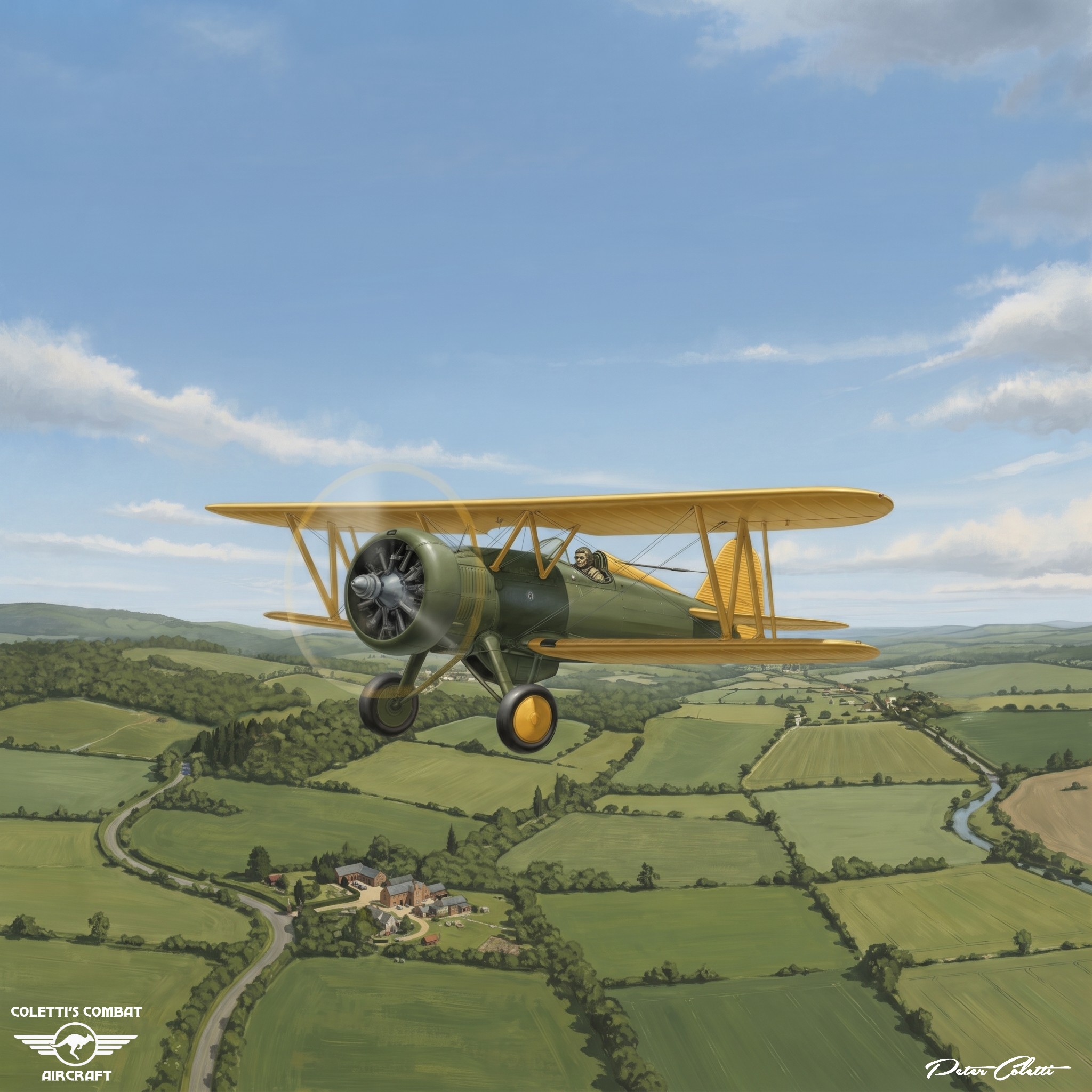
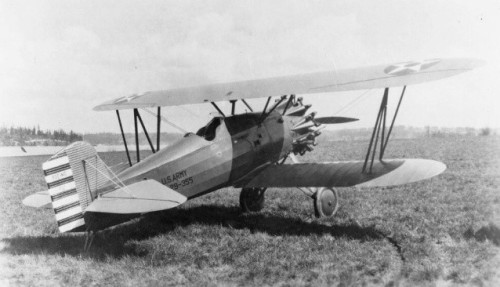
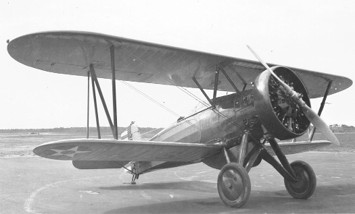
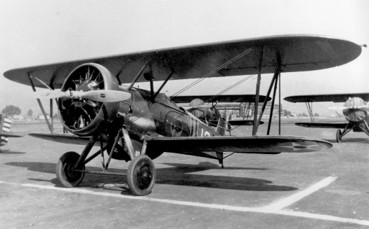
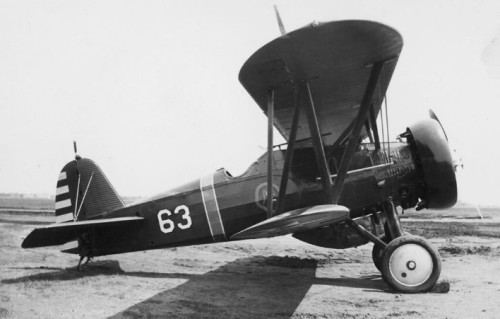
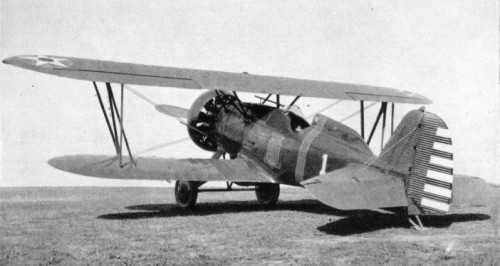
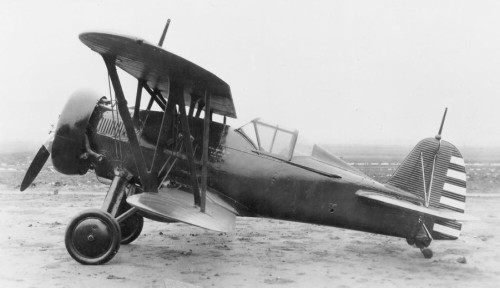
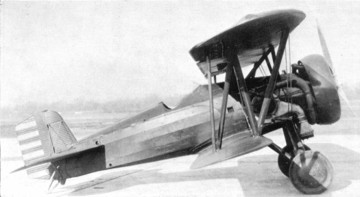
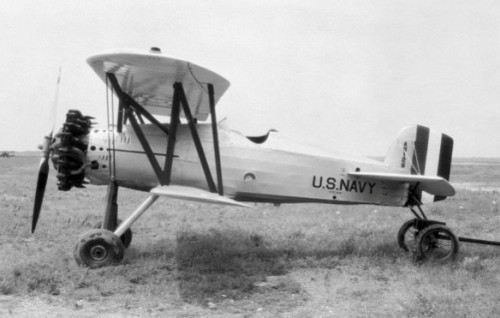
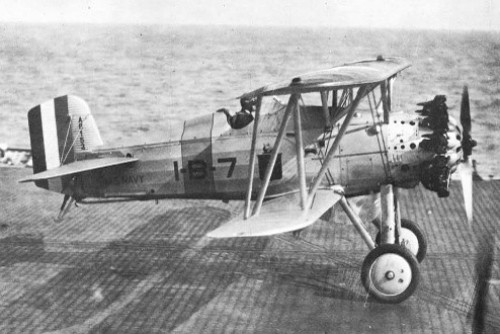
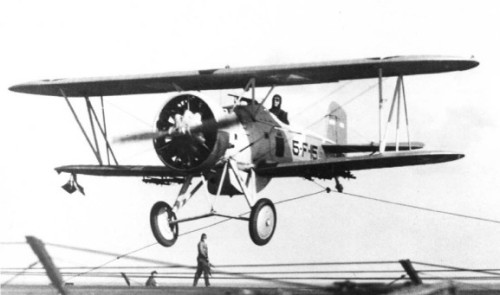
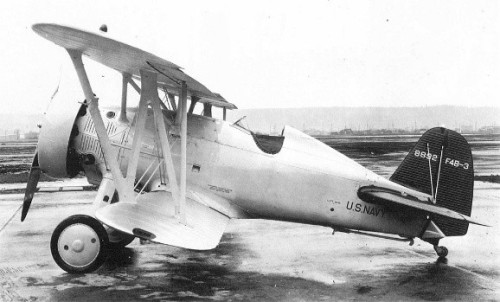
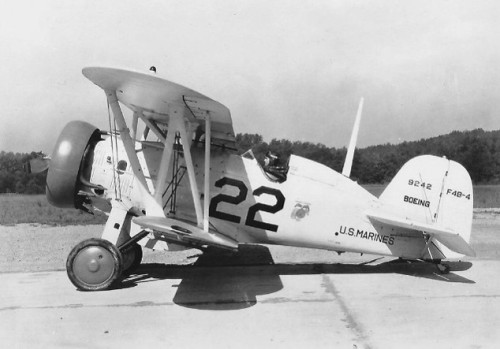
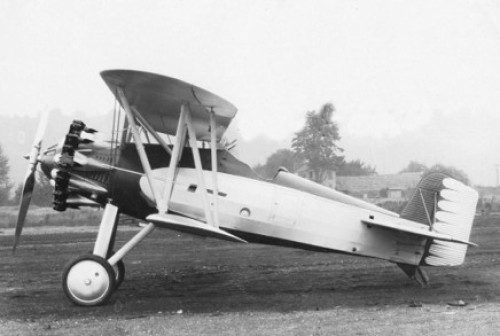
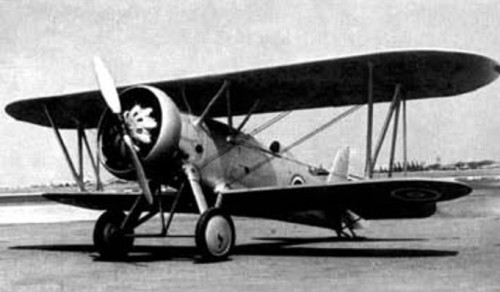
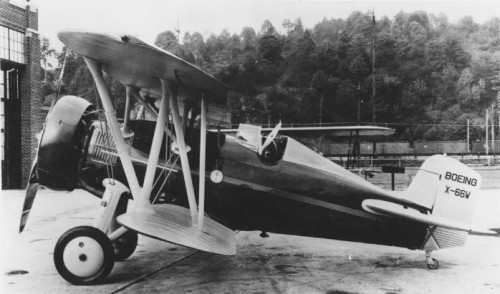
The Boeing P-12 (Army designation) and F4B (Navy designation) were developed from the Boeing Model 83 and Model 89 prototypes as a private venture to replace the PW-9 (Army) and F2B/F3B (Navy) fighters.
First Flight
25 June 1928
Construction
Welded steel tube fuselage with wood and fabric covering; wooden wings with fabric skin.
The aircraft featured an open cockpit, fixed landing gear, and a tail skid or tailwheel depending on the variant.
Engine
Powered by the Pratt & Whitney R-1340 Wasp radial engine, ranging from 450 hp to 600 hp across variants.
U.S. Military Service
U.S. Army Air Corps (P-12)
Role
Main pursuit aircraft from 1929 to the mid-1930s.
Variants
Included P-12A through P-12F, with progressive improvements in engine power, fuselage design, and armament.
Production
366 P-12s delivered between 1929 and 1932.
Retirement
Phased out of frontline service by the late 1930s; retained for training into early WWII.
U.S. Navy and Marine Corps (F4B)
Role
Carrier-based fighters operated from the USS Lexington, Saratoga, and Ranger.
Variants
F4B-1 through F4B-4, with the F4B-4 being the most advanced, featuring bomb racks and a life raft compartment.
Production
187 F4Bs built.
Marine Use
The USMC operated 22 F4B-4s.
International Operators
Brazilian Air Force
Operated Model 256 (F4B-4 export)
&
Model 267 (F4B-3/P-12E hybrid).
Used until 1949.
Chinese Nationalist Air Force
Received the Boeing 218 (export version of F4B-3).
Famously flown by Robert M. Short during the 1932 Shanghai Incident.
Philippine Army Air Corps
Used P-12s for training and patrols prior to the Japanese invasion.
Royal Thai Air Force
Operated Model 100E (export P-12E), designated B.Kh. 7.
One later transferred to the Japanese Navy.
Spanish Air Force
Limited use, likely for training or liaison duties during Spain’s WWII neutrality.
The Variants
U.S. Army Air Corps (P-12 Series)
P-12 (Model 102)
The army version of the F4B-1, powered by a 450 hp R-1340-7 engine.
Nine built.
XP-12A (Model 101)
The tenth P-12 was built, featuring a NACA cowling, a 525 hp R-1340-9 engine, and a shortened undercarriage.
One built.
P-12B (Model 102B)
Improved P-12 with larger mainwheels and refinements from XP-12A.
90 built.
P-12C (Model 222)
P-12B with a ring-type cowling and spreader-bar undercarriage.
96 built.
P-12D (Model 227)
P-12C upgraded with a 525 hp R-1340-17 engine.
35 built.
P-12E (Model 234)
Featured a semi-monocoque metal fuselage and redesigned tail surfaces.
Some were later fitted with tailwheels.
110 built.
P-12F (Model 251)
P-12E fitted with a more powerful 600 hp R-1340-19 engine.
25 built.
XP-12G
The P-12B was modified with an R-1340-15 engine and side-mounted supercharger.
One converted.
XP-12H
P-12D fitted with the experimental GISR-1340E engine.
One converted.
P-12J
P-12E re-engined with a 575 hp R-1340-23 and equipped with a bomb sight.
One converted.
YP-12K
Temporary conversions of P-12E and P-12J with fuel-injected SR-1340E engines.
Seven converted.
XP-12L
YP-12K fitted with an F-2 supercharger for evaluation.
One converted.
A-5 Proposed designation for radio-controlled target drone conversion of P-12.
Cancelled.
U.S. Navy / Marine Corps (F4B Series)
XF4B-1
Navy evaluation prototypes derived from Model 83 and Model 89.
F4B-1 (Model 99)
Standard Navy fighter with split-axle landing gear and ventral bomb rack.
27 built.
F4B-1A
One F4B-1 (BuNo A-8133) was converted to an unarmed executive transport for the Assistant Secretary of the Navy.
The fuel tank was relocated to the upper wing centre section.
F4B-2 (Model 223)
Introduced spreader-bar landing gear, frise ailerons, and a tailwheel.
46 were built.
F4B-3 (Model 235)
F4B-2 with semi-monocoque fuselage and updated equipment.
21 built.
F4B-4 (Model 235)
The final production variant with a redesigned tail, a 550 hp R-1340-16 engine, underwing bomb racks, and a life raft headrest in the last 45 units.
92 built + 1 from spares.
F4B-4A
23 assorted P-12s transferred from USAAC for Navy training.
Later modified under Project FOX for radio-controlled target use.
Boeing Prototype and Civil Models
Model 83
Prototype with spreader-bar gear and a 425 hp R-1340-8 engine.
Became XF4B-1.
Model 89
Prototype with split-axle gear and ventral bomb rack.
Also redesignated XF4B-1.
Model 91
Similar to Model 83 but with metal-framed wings.
Model 100
Civil version of F4B-1 with upper wing fuel tank.
Four built.
Model 100A
A two-seat civil variant was built for Howard Hughes and later converted to single-seat.
One built.
Model 100D
One Model 100 was temporarily used as a P-12 demonstrator.
Model 100E
Export version of P-12E for Siam (Royal Thai Air Force), designated B.Kh. 7.
Two built.
One later transferred to the Japanese Navy as AXB.
Model 100F
Civil P-12F variant sold to Pratt & Whitney for engine testing.
One built.
Export Variants
Model 218
Prototype of the P-12E/F4B-3 configuration.
Sold to the Chinese Nationalist Air Force after evaluation.
Model 256
Export version of F4B-4 for the Brazilian Navy.
14 built.
Locally designated C1B.
Model 267
Brazilian export variant combining F4B-3 fuselage with P-12E wings.
Nine built.
Model 303 / 303A
P-12E with an upgraded engine and brazier-head rivets.
Version with wing tanks designated 303A.
Model 304 / 304A
Similar to Model 303 but retained the fabric-covered steel tube fuselage of the P-12C.