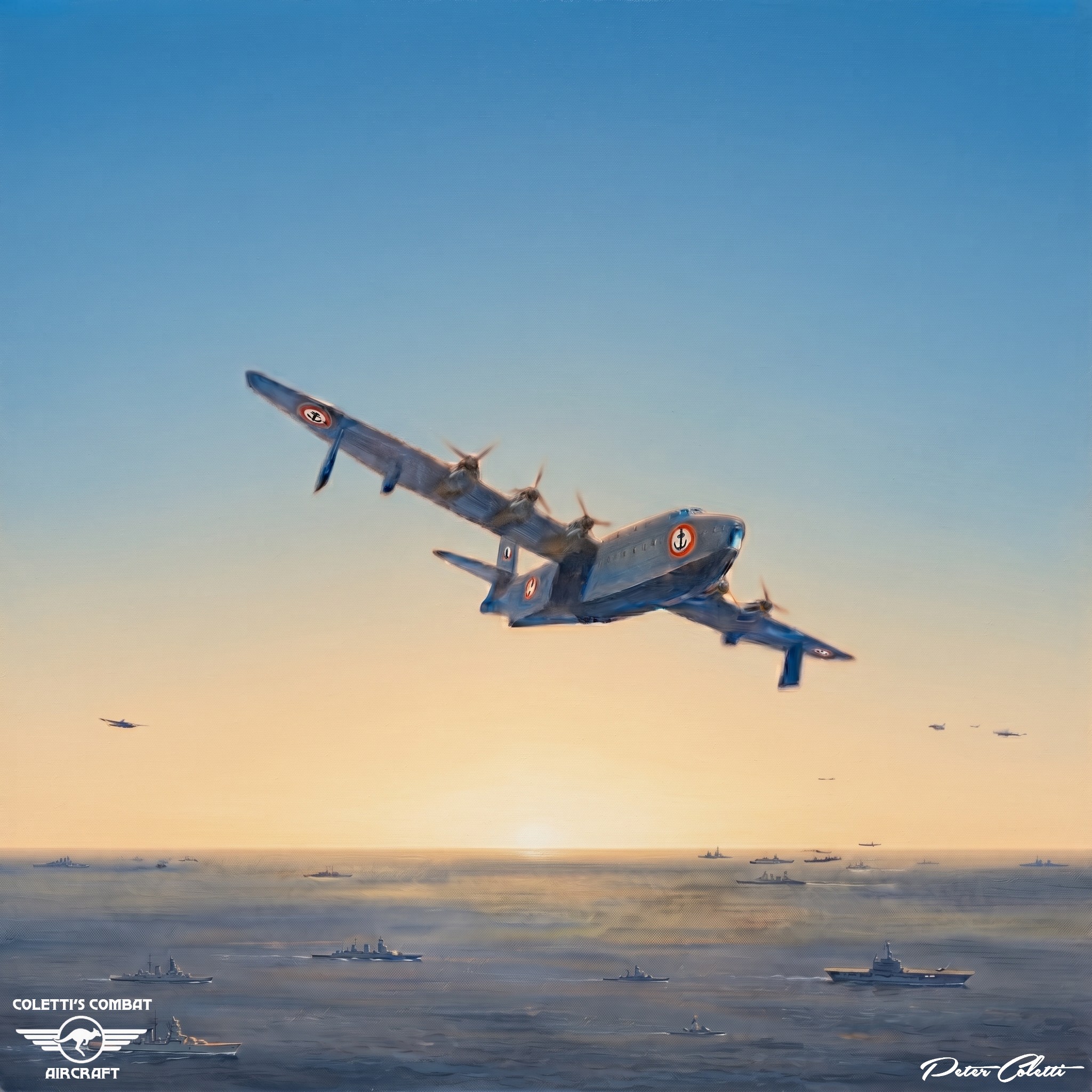
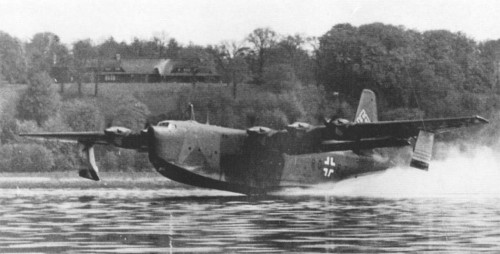
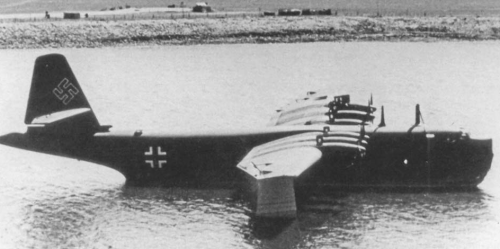
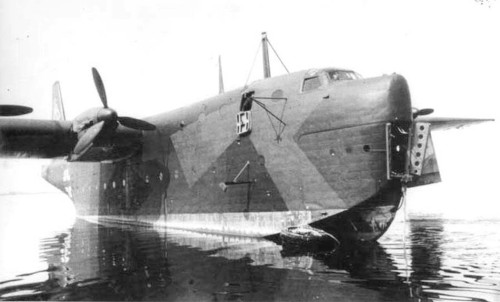
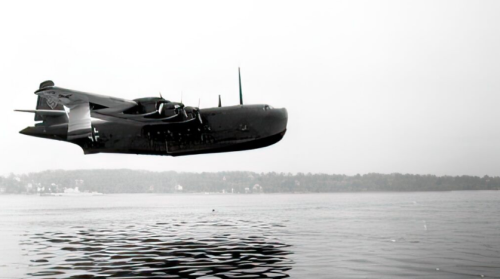
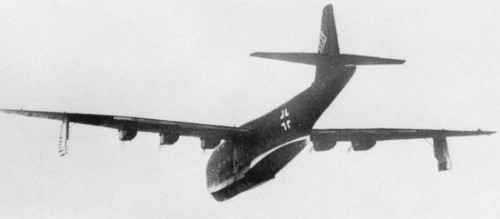
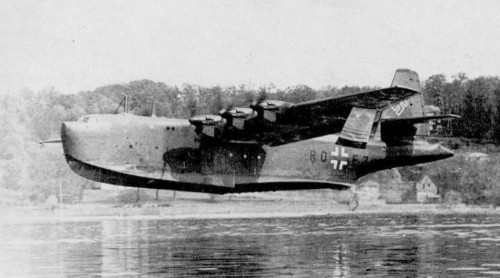
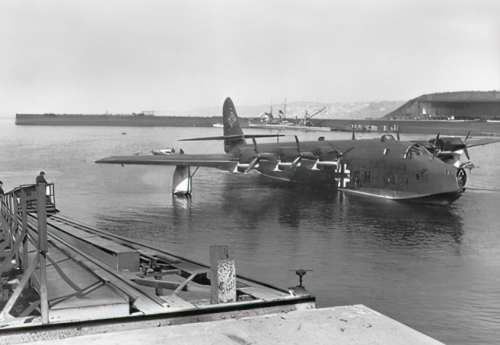
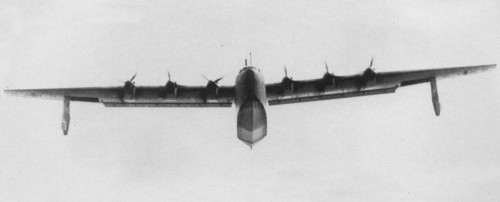
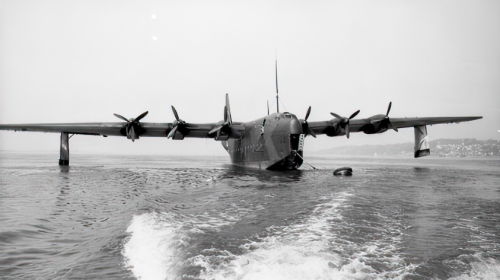
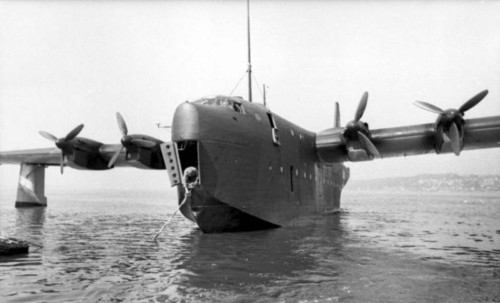
The Blohm & Voss BV 238 was the largest aircraft built by Germany during the Second World War and, at the time of its first flight, the heaviest aircraft ever to fly.
Conceived as a long‑range, multi‑purpose flying boat, it represented the ultimate evolution of German maritime transport and reconnaissance concepts—yet only a single prototype was completed before the war ended and the project was abandoned.
Origins and development
From BV 222 to a “super” flying boat
BV 222 background: Blohm & Voss had already gained experience with large flying boats through the BV 222 Wiking, which was used for long‑range transport and maritime roles.
Its relative success encouraged the Reichsluftfahrtministerium (RLM) to consider even larger designs for extended-range operations.
Early civil concept (P.200): Around 1940, the company studied an enormous eight‑engined flying boat project, the P.200, intended for future transatlantic routes of Deutsche Luft Hansa, with projected weights around 200,000 kg and capacity for roughly 120 passengers.
This civil‑oriented concept was shelved when wartime priorities shifted.
RLM requirement and project launch
In January 1941, the RLM issued a requirement for a long‑range, multi‑purpose flying boat capable of reconnaissance, transport, and potentially strike missions over oceanic distances.
Blohm & Voss responded with what became the BV 238, initially explored as a four‑engined design but quickly enlarged and re‑engined as the scale of the requirement and the limitations of available powerplants became clear.
Chief designer Dr-Ing. Richard Vogt essentially took the BV 222 as a starting point and expanded it—a longer hull, greater span, more engines, and refined hydrodynamics.
By mid‑war, the BV 238 had evolved into a six‑engined giant, intended to carry heavy loads over intercontinental distances and operate from open water.
The FGP 227 scale model
To reduce risk and gather data on the new hull and aerodynamic configuration, the RLM ordered a quarter‑scale flying model, the FGP 227, to be built by Flugtechnische Fertigungsgemeinschaft in Prague.
Configuration: The FGP 227 was a small, six‑engined test aircraft (using low‑power engines) with a landing gear for land operations rather than water, intended to validate stability and handling.
Delays and limited value: Construction delays, transport damage, and disappointing performance meant that by the time it flew, the full‑scale BV 238 design was already well advanced.
As a result, the model contributed little practical data to the main programme.
Prototypes and wartime progress
The RLM ordered several prototypes, with construction of the first full‑scale aircraft (V1) beginning in early 1944 at the Blohm & Voss facilities near Hamburg.
First flight: The BV 238 V1 took to the air in 1944–45 (sources differ slightly on the exact date, but it was in the final phase of the war).
Test operations: Flight testing was conducted from Lake Schaal (Schaalsee), where the aircraft operated as a pure flying boat.
Testing remained limited due to fuel shortages, Allied air superiority, and the collapsing German war situation.
Destruction: In 1945, while moored, the V1 was attacked and sunk by Allied aircraft.
Recovery was considered technically possible, but with Germany’s defeat imminent and Allied restrictions on further aircraft development, the programme was terminated.
Two additional prototypes were under construction but never completed when the war ended.
Airframe and structural design
General configuration
The BV 238 was a high‑wing, all‑metal flying boat of conventional aerodynamic layout but extreme size:
Type: Six‑engined, long‑range flying boat
Construction: All-metal, with stressed skin and a characteristic Blohm & Voss tubular steel main spar in the wing, which also served as an armoured fuel tank.
Dimensions (approximate):
Wingspan: About 60 m (around 196 ft)
Length: About 43 m (around 141 ft)
Maximum takeoff weight: Around 100,000 kg (220,000 lb), making it the heaviest aircraft to fly during the war.
Only a handful of aircraft worldwide—such as the Tupolev ANT‑20, Martin XPB2M‑1, and later Hughes H‑4—matched or exceeded its span, but none surpassed its weight at the time it flew.
Hull and hydrodynamics
The hull was designed for efficient planing and seaworthiness.
Long, slim planing bottom: A two‑step hull with additional small auxiliary steps aft of the main step to improve water handling and reduce drag during takeoff.
Nose door and internal volume: A large nose door opened into a cavernous interior, allowing direct loading of cargo.
The main crew compartment was located above and behind this door, giving good visibility forward and downward.
Internal layout: The hull contained cargo holds, fuel tanks (in the wing spar and fuselage), crew rest areas, and positions for defensive armament.
Wings and floats
The wing was a straight, constant‑chord centre section with tapered outer panels:
Wing structure: The tubular steel main spar doubled as an armoured fuel tank, with an internal catwalk ahead of it, allowing crew access to the engine nacelles in flight for inspection or minor servicing.
Auxiliary floats: The outer wing sections housed retractable floats that folded into the underside of the wing, presenting a clean aerodynamic surface in flight while providing stability on the water.
Tail unit The BV 238 used a conventional tailplane and fin arrangement, refined from the BV 222 experience to improve stability and control at high weights and low speeds.
The large tail surfaces were necessary to manage the aircraft’s enormous moment arms and to maintain control during take‑off and landing on rough water.
Powerplant and systems
Engines and propulsion
The BV 238 was designed around six powerful inline engines:
Type: Daimler‑Benz DB 603 liquid‑cooled inverted V‑12 engines
Power: Around 1,750 hp (1,287 kW) each in the A‑series configuration.
Installation: The engines were mounted in individual nacelles along the leading edge of the wing centre section, driving large propellers optimised for cruise efficiency and heavy-weight takeoff.
Alternative engine fits (BMW 801 radials) were considered for later variants, but the prototype used DB 603s.
Fuel and range systems
Fuel was carried both in the wing spar tanks and additional fuselage tanks, giving the aircraft very long endurance.
Range: On the order of 6,000–6,600 km at cruising speeds, depending on load and altitude—sufficient for transatlantic or deep‑ocean patrol missions.
The armoured spar‑tank concept improved survivability by protecting fuel from small‑calibre fire and shrapnel, a concern for long‑range maritime operations.
Crew and equipment
The BV 238’s crew could number up to roughly 18, including the following:
Pilots and co-pilots
Navigator and radio operators
Flight engineers and mechanics (who could move through the wing catwalk)
Gunners for multiple defensive positions
The aircraft carried navigation, radio, and likely maritime reconnaissance equipment appropriate to late‑war German standards, though detailed fit varied and was never fully standardised due to the limited test programme.
Performance
Exact performance figures vary slightly by source and projected vs. tested values, but typical data for the BV 238 are the following:
Maximum speed: Around 350–425 km/h (roughly 220–260 mph), depending on weight and altitude.
Cruise speed: Approximately 360 km/h.
Range: About 6,600 km at cruise with a heavy load.
Service ceiling: Around 7,000–7,300 m.
Landing speed: Around 140 km/h, reflecting the high wing loading and large mass.
These figures placed the BV 238 in the same general performance class as other large flying boats of the era, but with significantly greater weight and payload potential.
Armament and payload
Defensive armament
The BV 238 was designed with heavy defensive armament to protect it against fighters during long overwater missions:
Machine guns:
Multiple 13 mm MG 131 machine guns are in the following:
Nose and tail turrets
Wing‑mounted remote or semi‑remote turrets
Beam/waist positions
Cannon: 20 mm MG 151/20 cannon in dorsal positions for heavier defensive fire.
The exact arrangement evolved on paper and may not have been fully implemented on the prototype, but the intent was a heavily armed aircraft capable of defending itself from multiple directions.
Offensive and transport capability
Bomb load: Up to about 20 × 250 kg bombs (around 5,000 kg total) in internal bays, giving it a secondary maritime strike capability against shipping.
Transport role: The huge hull volume allowed carriage of large quantities of cargo, fuel, or personnel.
In a pure transport configuration, it could have moved troops, vehicles, or supplies over long distances, similar in concept to the BV 222 but on a larger scale.
Variants and projected developments
Prototype series (V‑aircraft)
BV 238 V1: The only completed aircraft, used for flight testing on Lake Schaal and destroyed in 1945.
V2 and V3: Additional prototypes under construction at war’s end, never completed.
A‑ and B‑series concepts
Design studies distinguished between engine fits and roles:
BV 238 A‑series: Powered by six DB 603 inline engines (as on the prototype), optimised for long‑range transport and reconnaissance.
BV 238 B‑series: A proposed variant with six BMW 801 radial engines, potentially simplifying logistics and maintenance but never realised in hardware.
Land‑based derivative: BV 250
Blohm & Voss also proposed a land‑based derivative, the BV 250, which would have used the same general airframe concept but with a conventional wheeled undercarriage instead of a flying‑boat hull.
This project remained on paper and was cancelled along with the BV 238 programme at the end of the war.
Operational context and WWII role
Strategic intent
The BV 238 was conceived in a strategic environment where Germany sought:
Long‑range maritime reconnaissance: To monitor Allied convoys and support U‑boat operations in the Atlantic.
Heavy transport capability: To move critical cargo and personnel over long distances, including to remote theatres or across oceans.
Potential strike platform: With bombs or mines against shipping and coastal targets.
In theory, the BV 238 could have served as a multi‑role oceanic platform, similar in concept to large Allied flying boats but with greater payload and range.
Constraints and realities
By the time the BV 238 was ready to fly, Germany’s situation had deteriorated:
Allied air superiority: Large, slow-flying boats were highly vulnerable, limiting their operational use.
Fuel and resource shortages: Late‑war Germany struggled to supply even existing aircraft, making large, fuel‑hungry giants impractical.
Production disruption: Allied bombing and the general collapse of German industry prevented any meaningful series production.
As a result, the BV 238 never entered operational service. Its flights were limited to test sorties, and it never performed the long‑range missions for which it was designed.
Post‑war fate and legacy
After the prototype was sunk and the war ended, the Allies prohibited further development of such large German aircraft.
The incomplete airframes were scrapped, and no BV 238 survived.
However, the aircraft left a technical legacy:
Demonstration of extreme scale: It showed that Germany could design and build aircraft at the very limits of contemporary structural and propulsion technology.
Influence on later thinking: While direct lineage is hard to trace, the BV 238 belongs to the small family of “mega‑flying boats” that informed post‑war thinking about large transports and seaplanes worldwide.
Summary
The Blohm & Voss BV 238 was the ultimate expression of German large flying boat design in WWII: a six-engined, 100-tonne giant derived from the BV 222, intended for long-range maritime reconnaissance, transport, and strike roles.
Its advanced hull, massive all‑metal wing with integrated fuel‑spar, heavy defensive armament, and enormous payload potential made it one of the most ambitious aircraft projects of the war.
Yet it arrived too late, in too small numbers, and under conditions too chaotic for it to influence the conflict.
Only one prototype flew, briefly, before being destroyed—leaving the BV 238 as a fascinating “what‑if” in aviation history rather than an operational weapon system.