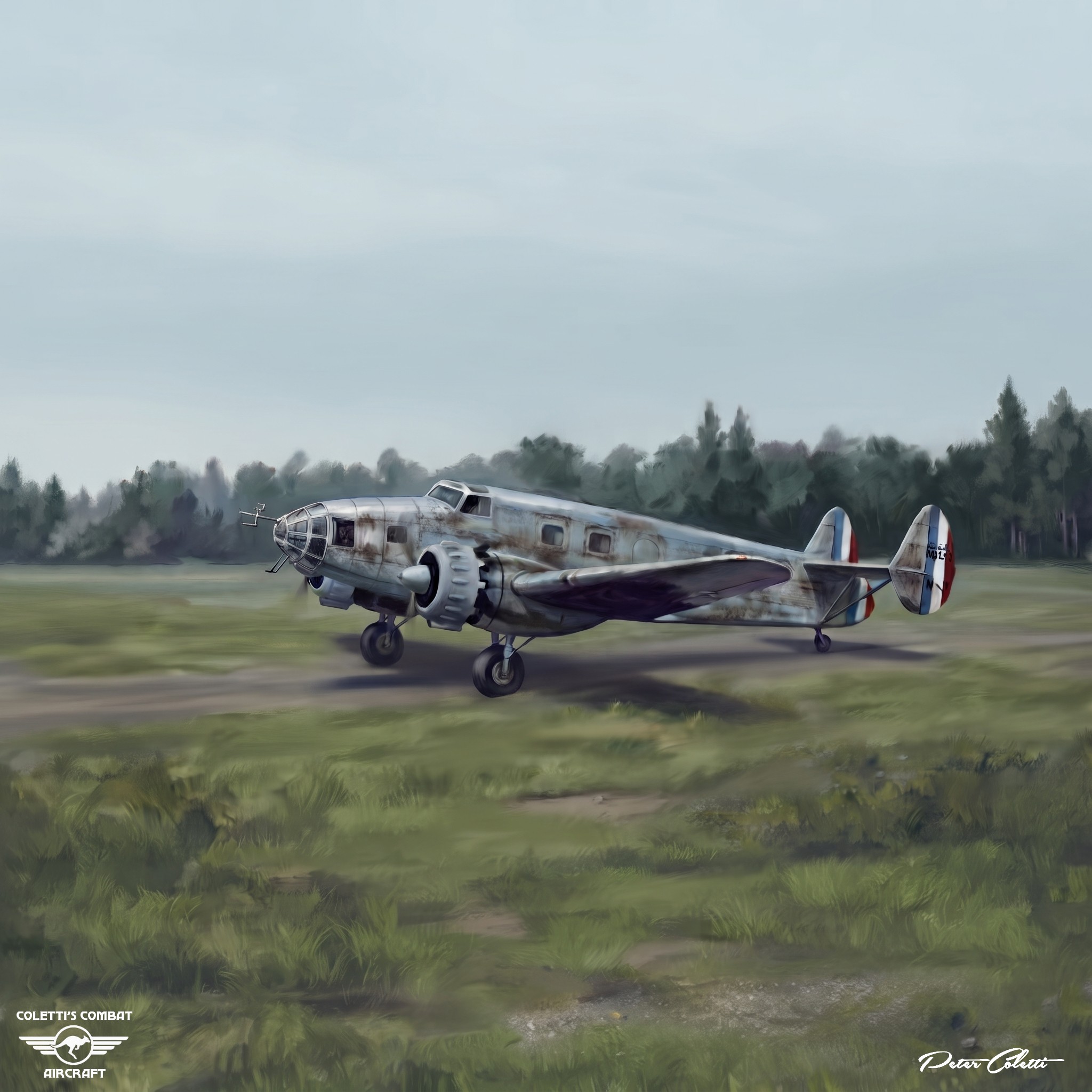
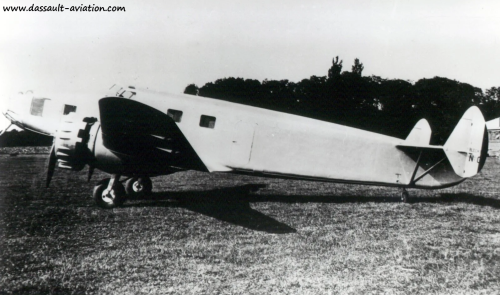
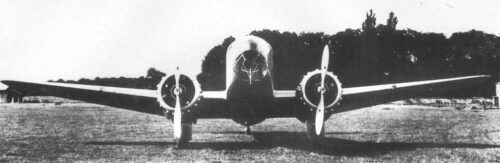
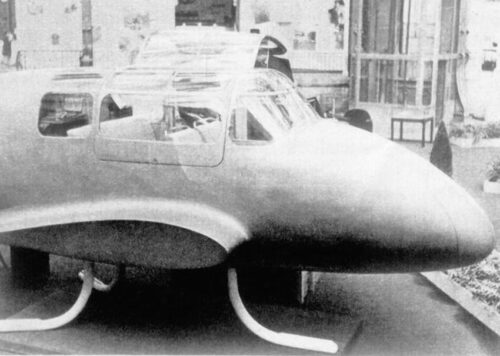
The Bloch MB.500 emerged in the late 1930s as part of France’s effort to modernise its military aviation training infrastructure.
By 1937–1938, the French Air Ministry recognised that its expanding fleet of twin‑engine bombers and reconnaissance aircraft required a new generation of multi‑engine trainers capable of preparing crews for increasingly complex operational aircraft.
Société des Avions Marcel Bloch—later to become Dassault—responded with a clean‑sheet design intended to provide a stable, reliable, and modern training platform.
The aircraft made its first flight in June 1938.
This placed it at a critical moment: France was accelerating rearmament, but the window before the outbreak of the Second World War was rapidly closing.
Only a single prototype was completed before the German invasion halted further development and production.
Although the MB.500 never entered series manufacture, it represents an important transitional design in the Bloch lineage—bridging earlier, more conservative twin‑engine trainers and the more advanced military aircraft the company would later produce.
Design Philosophy and Airframe Characteristics
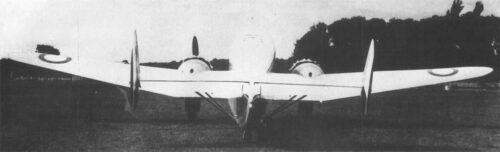
The MB.500 was conceived as a low‑wing monoplane, reflecting the shift away from biplane trainers towards more modern, aerodynamically efficient configurations.
Its structure was typical of Bloch’s late‑1930s design language: robust, straightforward, and optimised for ease of maintenance.
Crew and Training Layout
The aircraft carried a crew of three—a student pilot, an instructor, and an additional trainee or navigator—allowing simultaneous instruction in piloting, navigation, and engine management tasks.
This multi‑station arrangement mirrored the operational environment of contemporary French bombers and reconnaissance aircraft.
Dimensions
Length: 11.54 m
Wingspan: 15.75 m
Height: 3.65 m
These proportions placed the MB.500 in the same general size category as other European twin‑engine trainers of the period, such as the British Airspeed Oxford and the German Gotha Go 145 derivatives.
Wing and Fuselage
The wing planform was designed for stability and predictable handling—essential qualities for a training aircraft.
The fuselage was streamlined but not aggressively optimised for speed; instead, it prioritised internal volume for crew stations and instructional equipment.
Landing Gear
The MB.500 employed a conventional tailwheel undercarriage, typical of the era.
While retractable gear was becoming more common, fixed or semi‑retractable systems were still widely used in trainers to reduce mechanical complexity and maintenance demands.
Powerplant and Propulsion
The aircraft was powered by two Lorraine 9Na Algol nine‑cylinder, two‑row, air‑cooled radial engines, each producing 220 kW (300 hp).
These engines were well‑proven and widely used in French aviation, offering a balance of reliability and moderate power output suitable for instructional use.
Each engine drove a three‑bladed Ratier variable‑pitch propeller.
Variable‑pitch propellers were an important training feature, allowing student pilots to learn propeller‑management techniques required for operational multi‑engine aircraft.
Performance and Handling
Although detailed performance figures are scarce, the MB.500’s power‑to‑weight ratio and aerodynamic layout suggest the following:
Moderate cruise speed, appropriate for training without overwhelming novice pilots.
Predictable stall behaviour, aided by the broad wing and conservative aerodynamic design.
Good engine-out handling is a critical requirement for multi-engine instruction.
The aircraft was not intended to match the performance of frontline combat aircraft; instead, it provided a forgiving platform for mastering the fundamentals of twin‑engine flight, navigation, and systems management.
Variants
Only one prototype of the MB.500 was built and flown.
No official variants were produced, though archival notes suggest that Bloch considered potential sub‑variants with alternative engines or modified training equipment.
These remained conceptual due to the onset of war and the collapse of French aircraft production in 1940.
Operational Context and WWII Impact
The MB.500’s development coincided with a period of intense pressure on the French aviation industry.
By 1938–1939, France was attempting to modernise its air force while simultaneously dealing with industrial bottlenecks, political constraints, and the rapid pace of technological change.
The MB.500 was intended to support this modernisation by providing a standardised twin‑engine trainer for bomber and reconnaissance crews.
However, the German invasion in May 1940 abruptly halted the programme.
With only a single prototype completed, the aircraft never reached operational service.
During the occupation, French aircraft development was heavily restricted, and Bloch’s facilities were reorganised under German oversight.
The MB.500 project was abandoned, and no further airframes were constructed.
Legacy
Although the MB.500 did not enter production, it occupies a meaningful place in the evolution of French military aviation:
It demonstrated Bloch’s capability to design modern, purpose‑built training aircraft.
It contributed to the lineage of twin‑engine designs that would eventually lead to postwar Dassault aircraft.
It reflects the broader challenges faced by the French aviation industry on the eve of WWII—ambitious modernisation efforts cut short by geopolitical catastrophe.
Today, the MB.500 survives only in photographs, technical notes, and brief archival references, but it remains a noteworthy example of late‑interwar French aeronautical engineering.