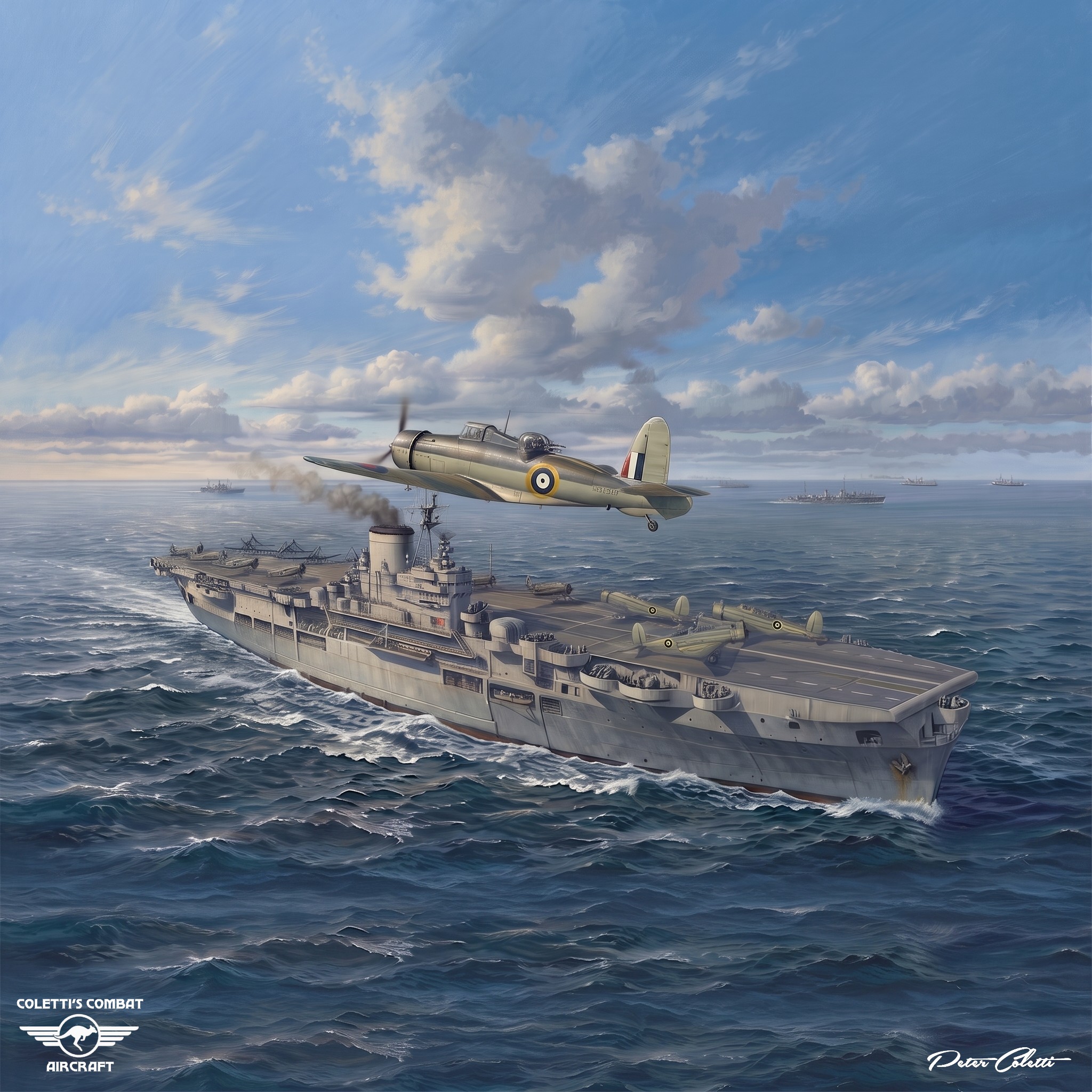
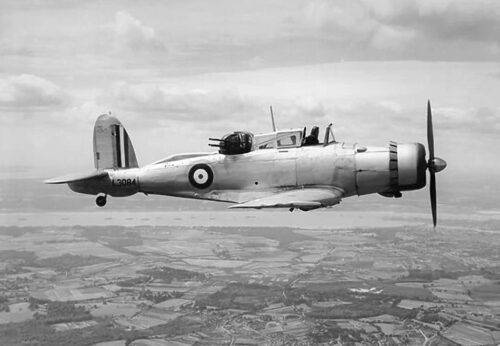
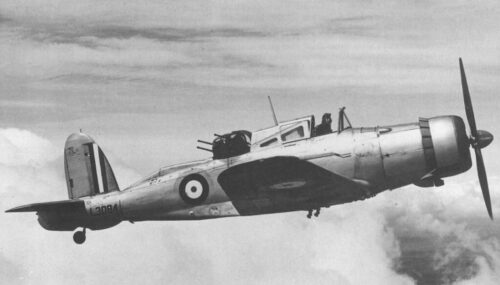
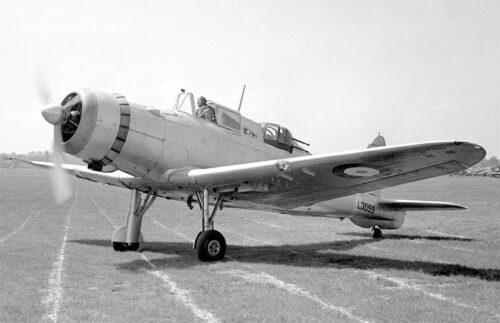
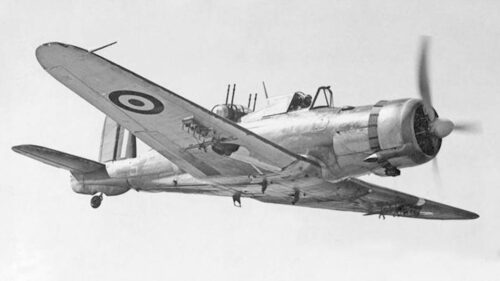
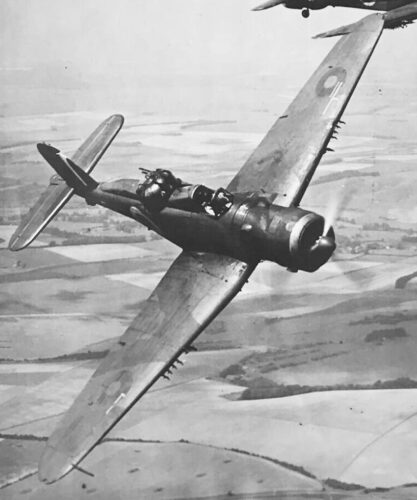
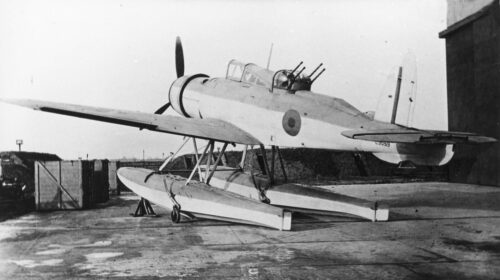
The Blackburn Roc was one of the most unusual and short-lived British naval aircraft of the Second World War—a turret-armed carrier fighter conceived at a moment when the Fleet Air Arm (FAA) and the Air Ministry were still experimenting with defensive fighter concepts.
Although it ultimately proved unsuccessful in front‑line service, the Roc remains a significant example of interwar British naval aviation thinking and the industrial pressures that shaped aircraft procurement.
Origins and Development
A Turret Fighter for the Fleet Air Arm
The Roc originated from Air Ministry Specification O.30/35, issued on 31 December 1935, which called for a carrier‑based fighter armed with a power‑operated turret rather than fixed forward‑firing guns.
Blackburn Aircraft, led by designer G. E. Petty, proposed adapting their new Skua dive-bomber/fighter into a turret-equipped derivative, widening the fuselage to accommodate the turret and modifying the wing structure accordingly.
Boulton Paul, already developing the land‑based Defiant turret fighter, offered a navalised version (the P.85 “Sea Defiant”), which was projected to be significantly faster.
Nevertheless, the Air Ministry selected Blackburn’s proposal, despite the Sea Defiant’s estimated 85 mph speed advantage.
Industrial Constraints and Production
On 28 April 1937, the Air Ministry placed an “off-the-drawing-board” order for 136 Rocs.
Because Blackburn’s factories were already committed to the Skua and Botha, detailed design and production were subcontracted to Boulton Paul, whose involvement slowed progress on their own Defiant fighter.
The prototype Roc flew on 23 December 1938, piloted by H. J. Wilson.
Early trials at Martlesham Heath in early 1939 confirmed acceptable handling but revealed a critical flaw: a maximum speed of only 223 mph, far below contemporary fighter standards.
By late 1938, senior naval leadership already recognised the Roc’s inadequacy.
Fifth Sea Lord Alexander Ramsay recommended cancellation, but production continued to avoid industrial disruption at Boulton Paul.
The Roc entered service in April 1939—just months before the outbreak of war.
Design and Technical Characteristics
Airframe and Configuration
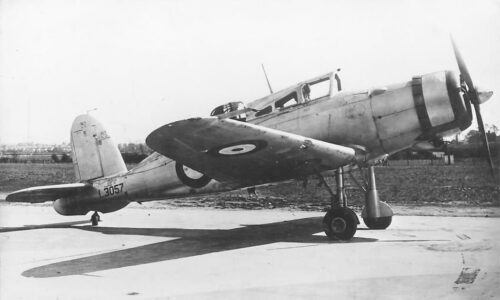
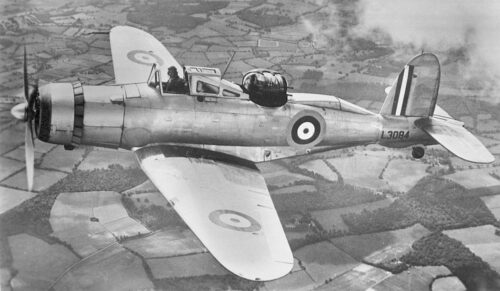
The Roc was a two‑seat, low‑wing, all‑metal monoplane with folding wings for carrier stowage, a retractable tailwheel undercarriage, and dive brakes inherited from the Skua.
It was powered by a Bristol Perseus XII radial engine producing 890 hp, driving a three‑bladed propeller.
Turret Armament
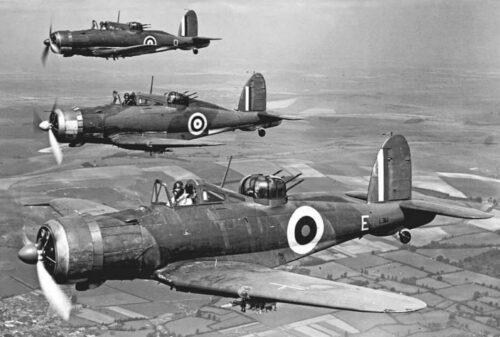
The defining feature was its Boulton Paul Type A four-gun turret, mounting four .303 Browning machine guns capable of 360° rotation and 85° elevation, hydraulically powered and electrically fired with automatic interrupters to prevent shooting off the aircraft’s own structure.
The Roc carried eight 30‑lb bombs or two 250‑lb bombs under the wings and could mount a 70‑gallon drop tank for extended range.
Performance
The Roc’s performance was its undoing. With a top speed of 223 mph, a service ceiling of 18,000 ft, and a climb rate of 1,500 ft/min, it was slower than many bombers it was expected to intercept.
Its cruise speed of 135 mph further limited operational flexibility.
Variants and Experiments
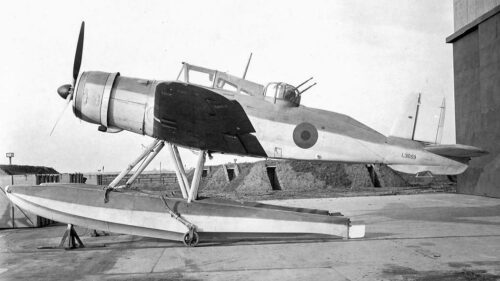
Roc Floatplane The Roc was designed with floatplane capability in mind, using floats from the Blackburn Shark.
The first conversion suffered from directional instability and crashed in December 1939; the second was improved with an enlarged ventral fin but remained even slower, with a maximum speed of 193 mph.
Plans to form a floatplane fighter squadron were abandoned, and even later attempts to use the floatplane Roc as a target tug in 1942 were rejected due to poor performance.
Production End By August 1940, Roc production ceased, and resources shifted to more capable fighters such as the Fairey Fulmar and Hawker Sea Hurricane.
Operational History
Early Service and Norway Campaign Rocs entered service in April 1939, initially supplementing Skua squadrons.
At RAF Wick, they were deemed a “constant hindrance” due to poor performance and were soon removed from 803 Squadron’s strength.
During the Norwegian campaign, Rocs aboard HMS Ark Royal flew combat air patrols but proved ineffective at intercepting German aircraft, confirming fears about their inadequate speed and climb rate.
Dunkirk and the Channel Operations
Rocs participated in Operation Dynamo and Operation Aerial, flying patrols and ground‑attack missions over the Channel in mid‑1940.
The Roc achieved its only confirmed aerial victory on 28 May 1940, when Midshipman A. G. Day of 806 Squadron shot down a Junkers Ju 88 by attacking from below while accompanying Skuas engaged from above.
Rocs also took part in attacks on German E‑boats at Boulogne and gun positions at Cap Gris Nez in June 1940.
Withdrawal to Secondary Duties
By late 1940, the Roc was relegated to air-sea rescue and target-towing roles, replacing older Blackburn Sharks in some units.
They patrolled the Channel searching for survivors of downed aircraft and sunken ships, occasionally engaging enemy aircraft such as the Heinkel He 59 in September 1940.
Some Rocs were sent to distant stations such as Bermuda, but the type faded rapidly.
The last operational examples were withdrawn in June 1943, though a few unairworthy airframes lingered at Gosport until late 1944, their turrets used for anti‑aircraft defence training.
Assessment and Legacy
The Blackburn Roc stands today as a cautionary example of flawed interwar fighter doctrine.
The concept of a turret‑armed naval interceptor proved incompatible with the rapidly advancing performance of enemy aircraft.
Industrial constraints and the desire to maintain production capacity ensured the Roc entered service despite clear shortcomings.
Yet the Roc’s story is valuable: it illustrates the challenges of naval aircraft design in the 1930s, the risks of untested tactical concepts, and the pressures of rearmament on British industry.
Though operationally unsuccessful, the Roc remains an important chapter in the evolution of Fleet Air Arm fighter development.