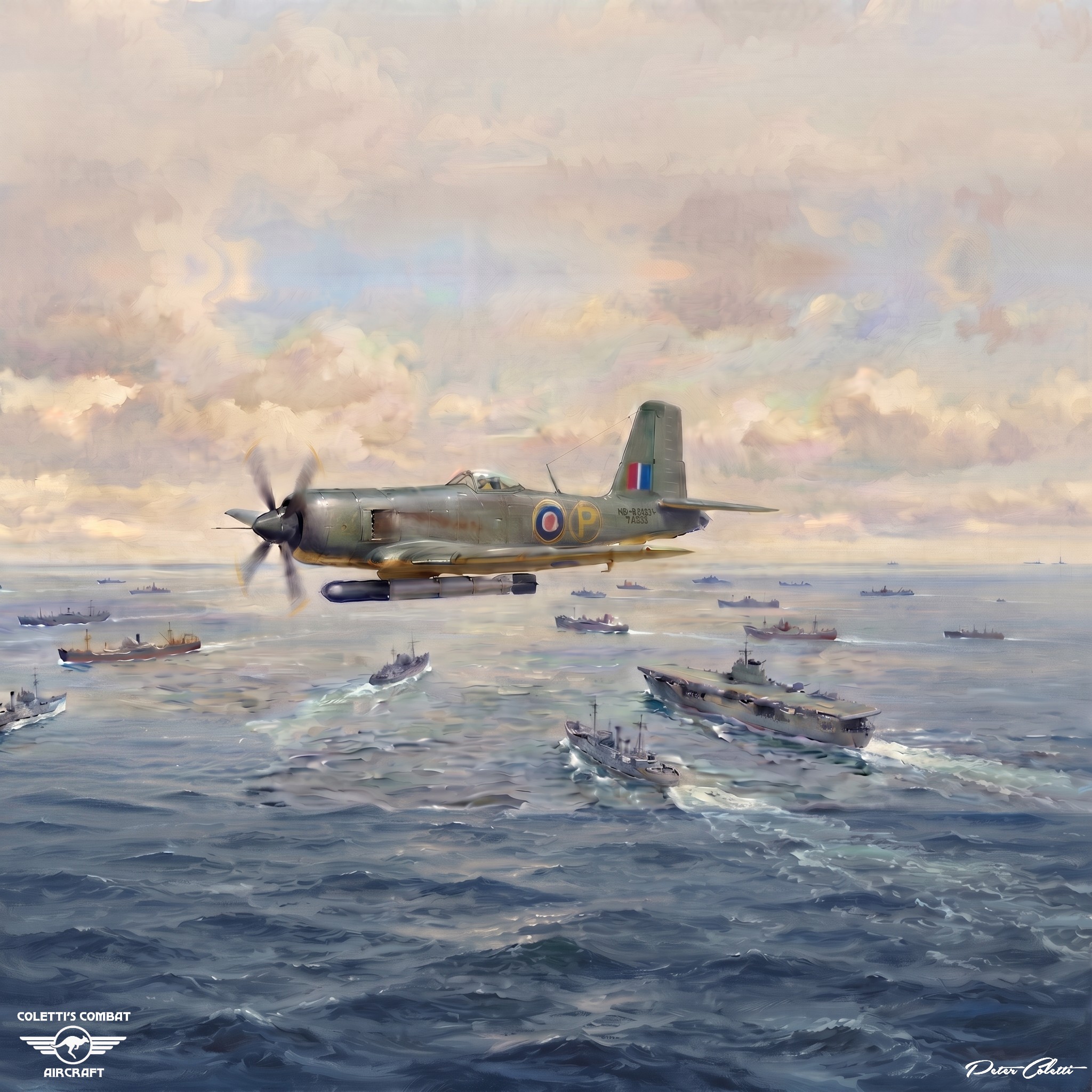
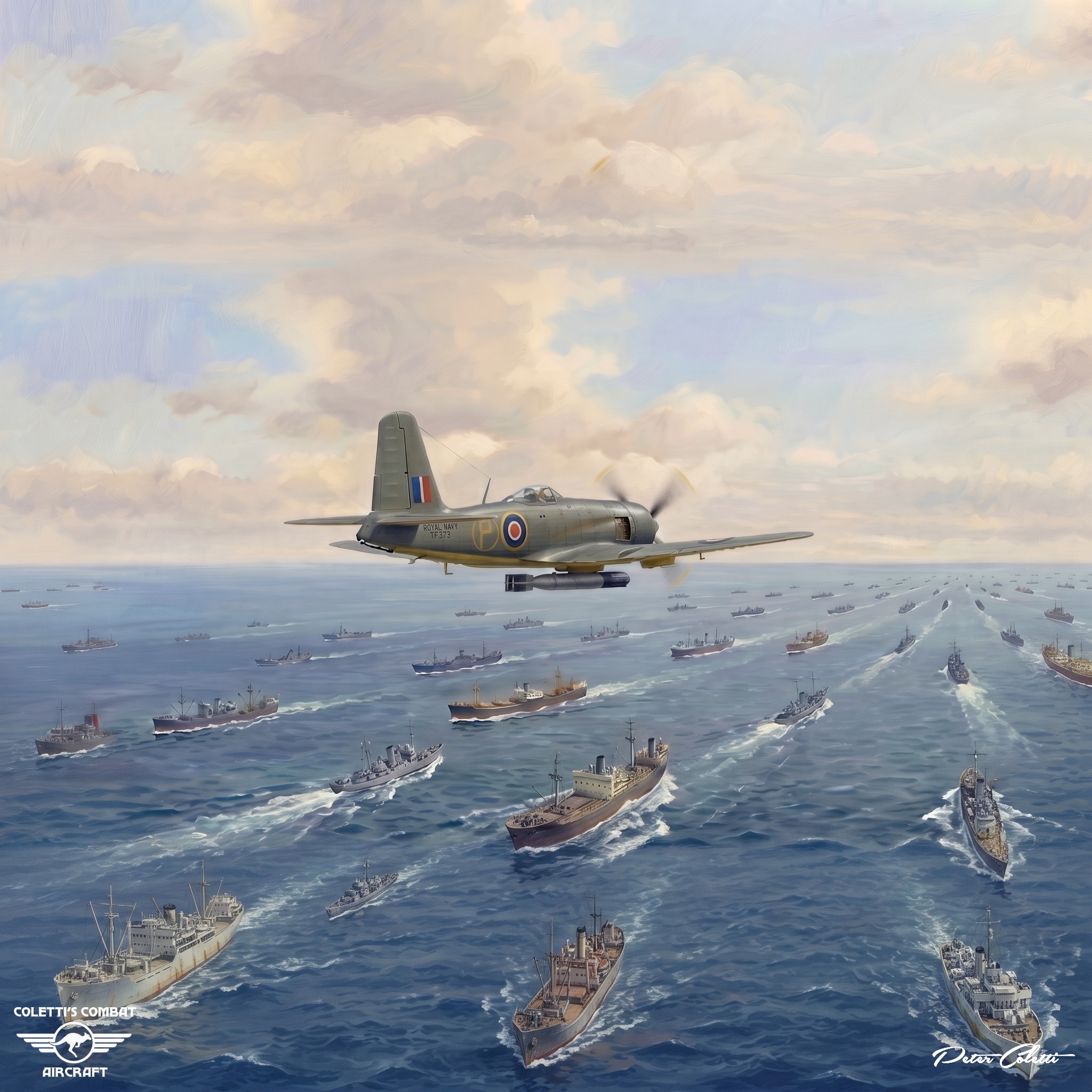
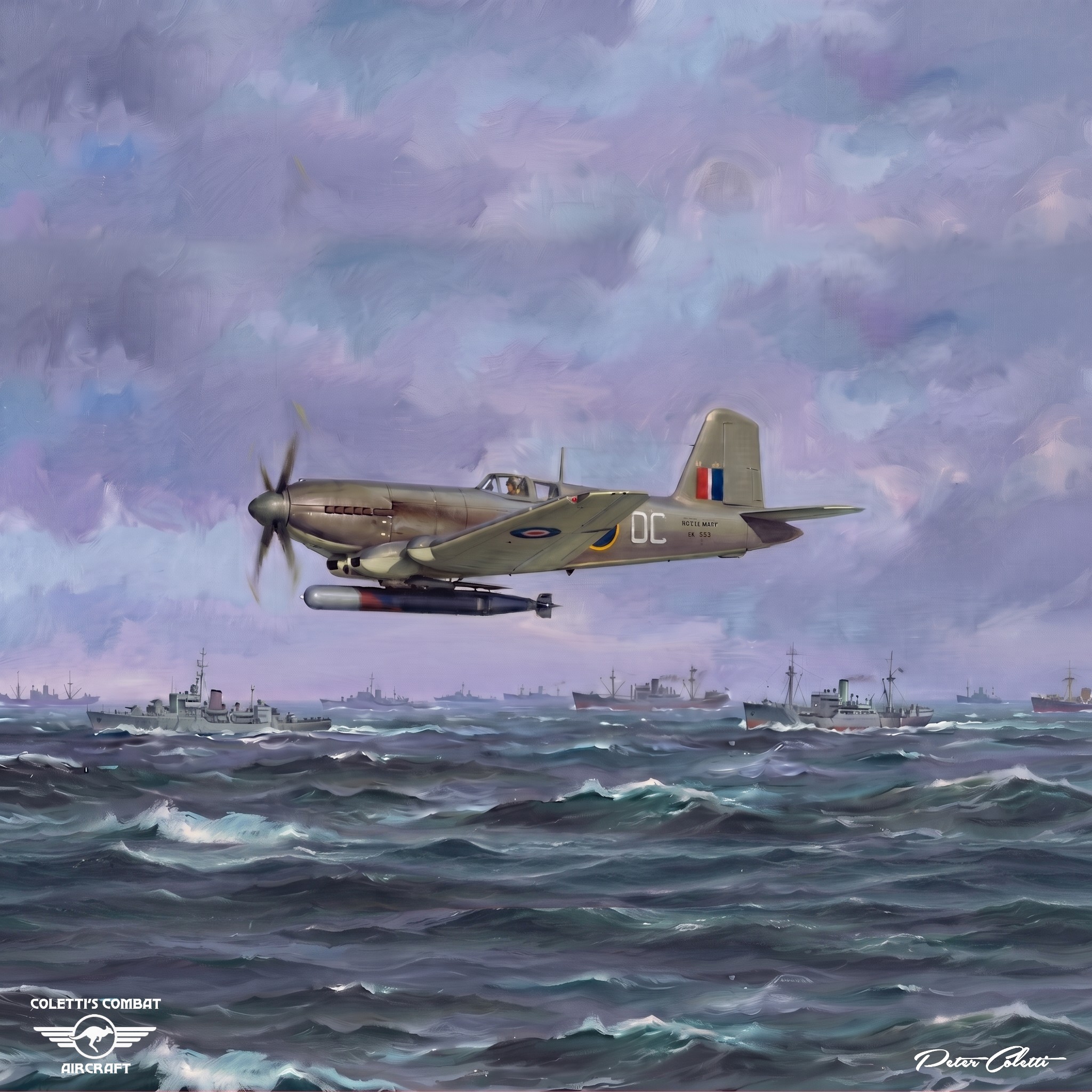
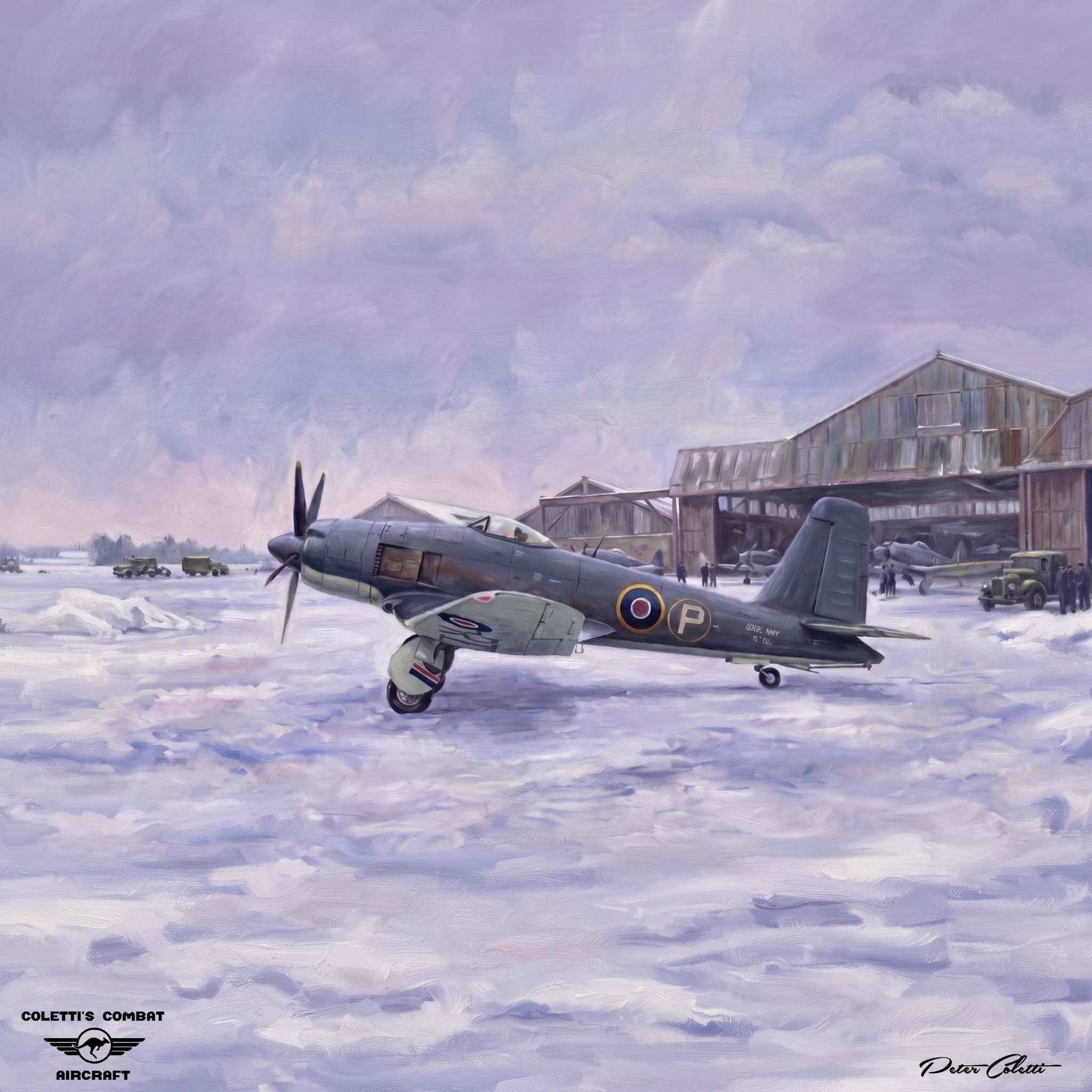
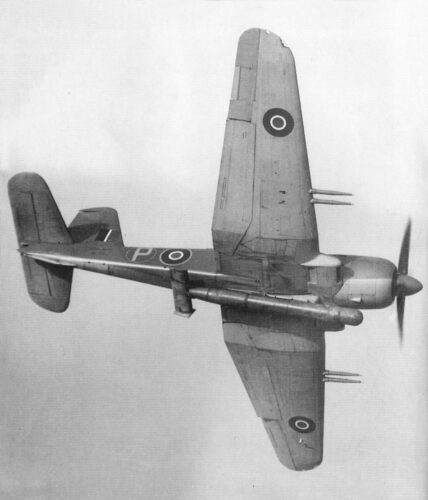
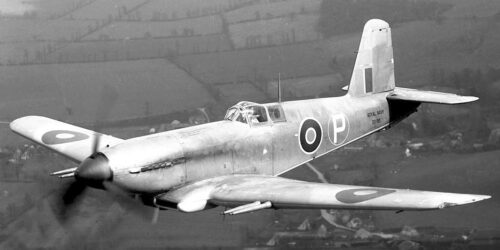
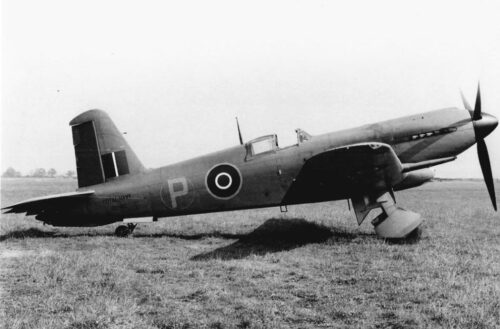
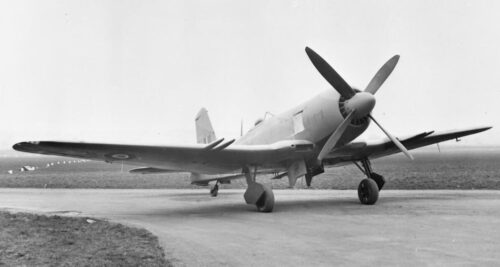
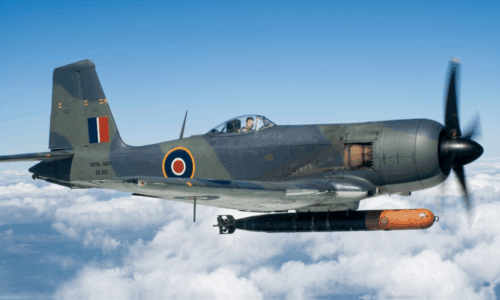
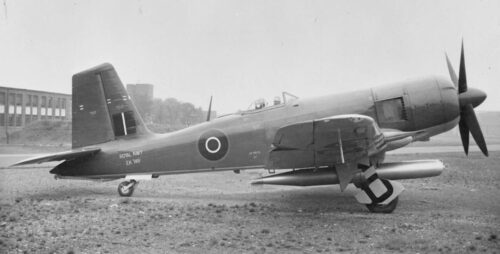
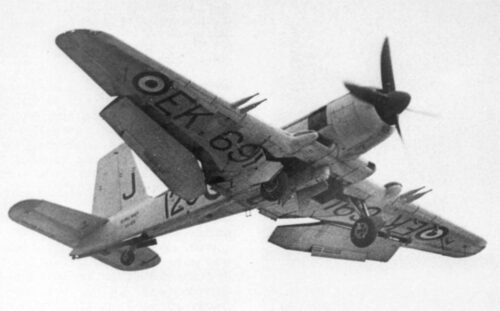
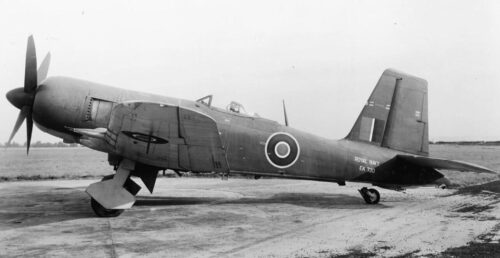
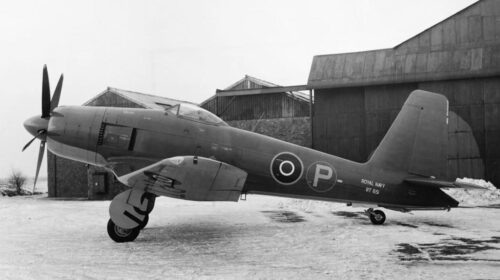
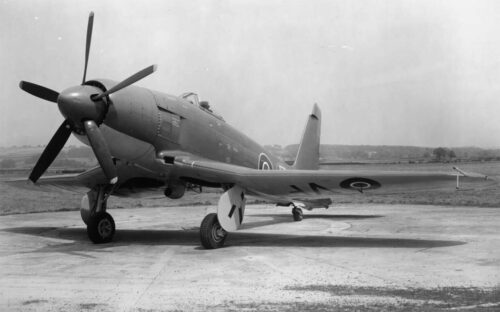
The Blackburn Firebrand emerged from a period of deep confusion within the Royal Navy’s Fleet Air Arm (FAA) on the eve of the Second World War.
In 1939, the Admiralty issued Specification N.8/39 for a two‑seat fleet interceptor, alongside the turret‑armed N.9/39 intended to replace the Blackburn Roc.
Early combat experience quickly proved turret fighters hopelessly inadequate against modern single‑seat fighters, leading to the cancellation of N.9/39 and a revision of N.8/39 into Specification N.5/40, which ultimately produced the Fairey Firefly rather than a Blackburn design.
By mid‑1940, the Fleet Air Arm faced a crisis: its frontline fighters consisted largely of the Gloster Sea Gladiator biplane and the underperforming Blackburn Skua.
The Admiralty belatedly recognised the need for a modern single‑seat carrier fighter and issued Specification N.11/40. Blackburn, eager to redeem earlier failures, submitted a new design under chief designer George Petty, designated B‑37.
The B‑37 Concept and Early Prototypes
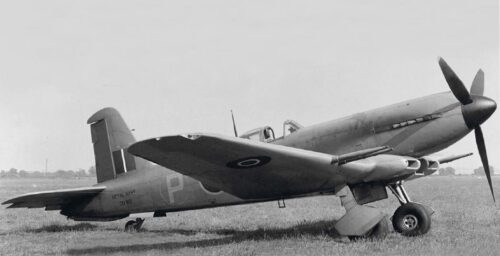
The B‑37 was an unusually large single‑seat fighter, with a 50‑ft (15.24 m) wingspan and a bulky fuselage derived from Blackburn’s earlier two‑seat concepts.
It was powered initially by the Napier Sabre III, a 24‑cylinder H‑type liquid‑cooled engine producing over 2,300 hp, driving a large three‑bladed propeller.
Even with this power, the aircraft promised only modest performance due to its size and weight.
Three prototypes were ordered.
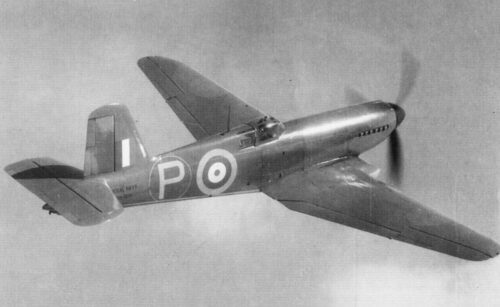
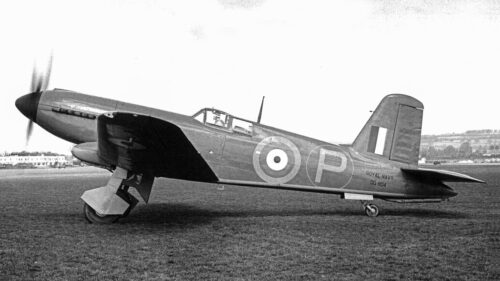
The first, DD804, flew on 27 February 1942.
Initial flights were smooth, but testing at Boscombe Down revealed severe deficiencies:
strong right‑wing drop and directional instability
heavy ailerons and poor control harmony
inadequate forward visibility due to cockpit placement
dangerous landing characteristics for carrier operations
Repeated modifications—a larger fin and rudder, revised elevators, and additional flaps—improved but never solved the handling problems.
The second prototype, DD810, introduced armament and bomb racks but was badly damaged in 1943 after an engine failure and emergency landing mishap; it was later rebuilt as the prototype for the torpedo‑fighter variant.
By mid‑1943, the type was officially named the Firebrand F.I., but its future as a fighter was already doubtful.
The Seafire, a navalised Spitfire, dramatically outperformed it in trials, and the Sabre engine was being redirected to Hawker Typhoon production, threatening the Firebrand’s powerplant supply entirely.
Reimagining the Firebrand as a Torpedo Fighter
The FAA also lacked a modern torpedo bomber. Its frontline types—the Swordfish and Albacore—were slow biplanes, and the newer Barracuda was optimised for dive-bombing rather than torpedo attack.
Blackburn proposed converting the Firebrand into a single‑seat torpedo‑fighter, combining heavy armament, rockets, and a torpedo in a role analogous to the Bristol Beaufighter but carrier‑capable.
This shift saved the programme.
The rebuilt DD810 became Firebrand TF.II prototype NV636, featuring:
widened centre section to carry a full-size torpedo
strengthened structure
revised under-fuselage mounting point
aerodynamic fairings to reduce drag
Testing showed only modest performance loss with a torpedo, but handling problems persisted, especially in low‑speed carrier regimes.
A&AEE considered the TF.II unsuitable for combat but acceptable for experimental and training use by experienced pilots.
The Centaurus Solution and the TF.III
With the Sabre engine no longer available, the only viable alternative was the Bristol Centaurus, a powerful 18‑cylinder radial engine.
Earlier Admiralty prejudice against radial engines on fighters had evaporated after combat experience with the Fw 190.
Specification S.8/43 authorised the conversion of the Firebrand to Centaurus power, producing the Firebrand TF. III.
Major changes included:
completely redesigned forward fuselage
Centaurus VII radial engine (later IX on some aircraft)
four‑bladed Rotol propeller
removal of the fuselage spine (“hump”) to improve visibility
revised cockpit canopy (eventually a teardrop type)
spring‑tabbed control surfaces
enlarged tail surfaces on later prototypes
The first TF.III flew in December 1943.
Handling improved but remained marginal.
Directional stability was still poor, and the aircraft was considered unsafe for carrier operations.
Production TF.III aircraft were built before all fixes were incorporated, resulting in a batch of aircraft that were quickly relegated to trials and training and soon scrapped.
The First Combat‑Capable Variant: Firebrand TF.IV
The Firebrand TF.IV, first flown on 17 May 1945, was the first version considered genuinely combat‑worthy.
It incorporated:
a significantly enlarged fin and rudder
improved spring‑tab controls
refined torpedo‑release geometry
further cockpit and systems improvements
Although the war in Europe had ended by the time it flew, the TF.IV finally delivered the performance and handling expected of a frontline strike aircraft.
The Ultimate Version: Firebrand TF.5
Postwar development led to the Firebrand TF.5, the definitive model.
It featured:
the Centaurus 59 engine
a redesigned wing with hydraulically powered ailerons
improved stability and control
strengthened structure for heavier ordnance
enhanced cockpit ergonomics
The TF.5 entered service with several FAA squadrons in the late 1940s and early 1950s.
Although powerful and fast at low altitude, it remained demanding to fly, with heavy controls and challenging deck‑landing behaviour.
Operational Service and Legacy
Despite its long gestation, the Firebrand saw no combat in WWII.
The only wartime operational use was by 708 Naval Air Squadron, a second‑line tactical trials unit, which flew TF.II aircraft in 1944–45 without engaging the enemy.
Postwar TF.5s served in limited numbers aboard carriers such as HMS Illustrious and HMS Implacable, but the aircraft’s reputation for difficult handling and poor visibility persisted.
It was soon overshadowed by the Hawker Sea Fury and later by jet‑powered strike aircraft.
The Firebrand’s legacy is mixed:
Technically, it demonstrated Blackburn’s ability to engineer rugged naval aircraft and contributed to British experience with large single‑seat strike fighters.
Operationally, it was a cautionary tale of shifting specifications, engine shortages, and the dangers of forcing an unsuitable airframe into a new role.
Historically, it represents the Fleet Air Arm’s struggle to modernise under wartime pressure.
Related development: Blackburn Firecrest
Although often mentioned alongside the Firebrand, the Blackburn Firecrest was not a direct variant but a clean‑sheet successor that grew out of the Firebrand experience.
Where the Firebrand was essentially a reworked wartime design repeatedly adapted to new roles and engines, the Firecrest was conceived from the outset as a postwar single-seat carrier strike aircraft optimised for the Bristol Centaurus radial and heavy ordnance.
Blackburn’s engineers tried to cure almost every criticism levelled at the Firebrand.
The Firecrest featured the following:
A new, slimmer fuselage with better pilot visibility and cleaner aerodynamics.
A redesigned wing with improved low‑speed characteristics for safer deck landings.
More refined control surfaces and systems, aiming for lighter, more responsive handling.
Provision for torpedoes, bombs, and rockets, continuing the torpedo‑fighter/strike lineage.
In concept, it represented the logical evolution of the Firebrand idea: a powerful, fast, single‑seat strike fighter for the Fleet Air Arm.
In practice, it arrived in a rapidly changing environment.
Jet aircraft and more capable piston types such as the Hawker Sea Fury were already in or nearing service, and the Firecrest’s advantages were not compelling enough to justify large‑scale production.
Only prototypes were built, and the type never entered squadron service.
As a result, the Firecrest stands as a technical and doctrinal epilogue to the Firebrand story—evidence that the Royal Navy still believed in the single-seat torpedo-fighter concept but also a marker of how quickly that concept was overtaken by jet-age carrier aviation.