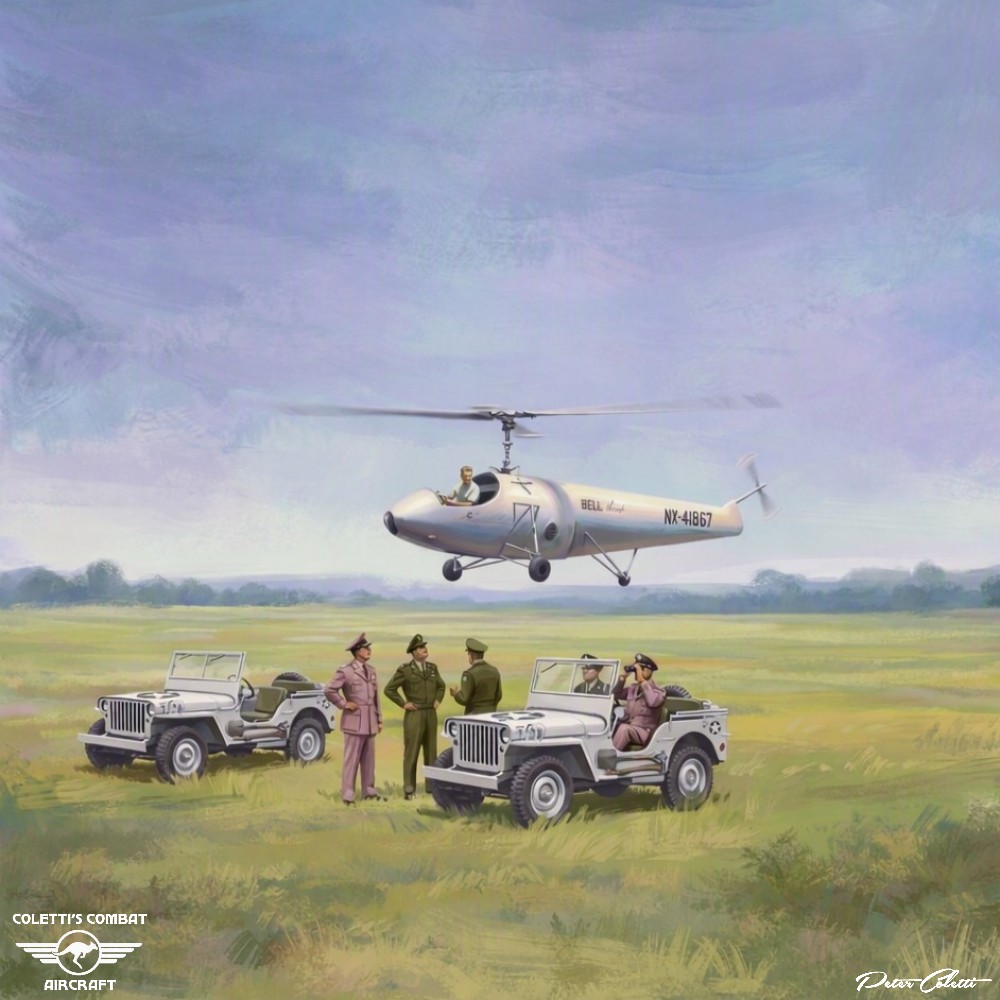
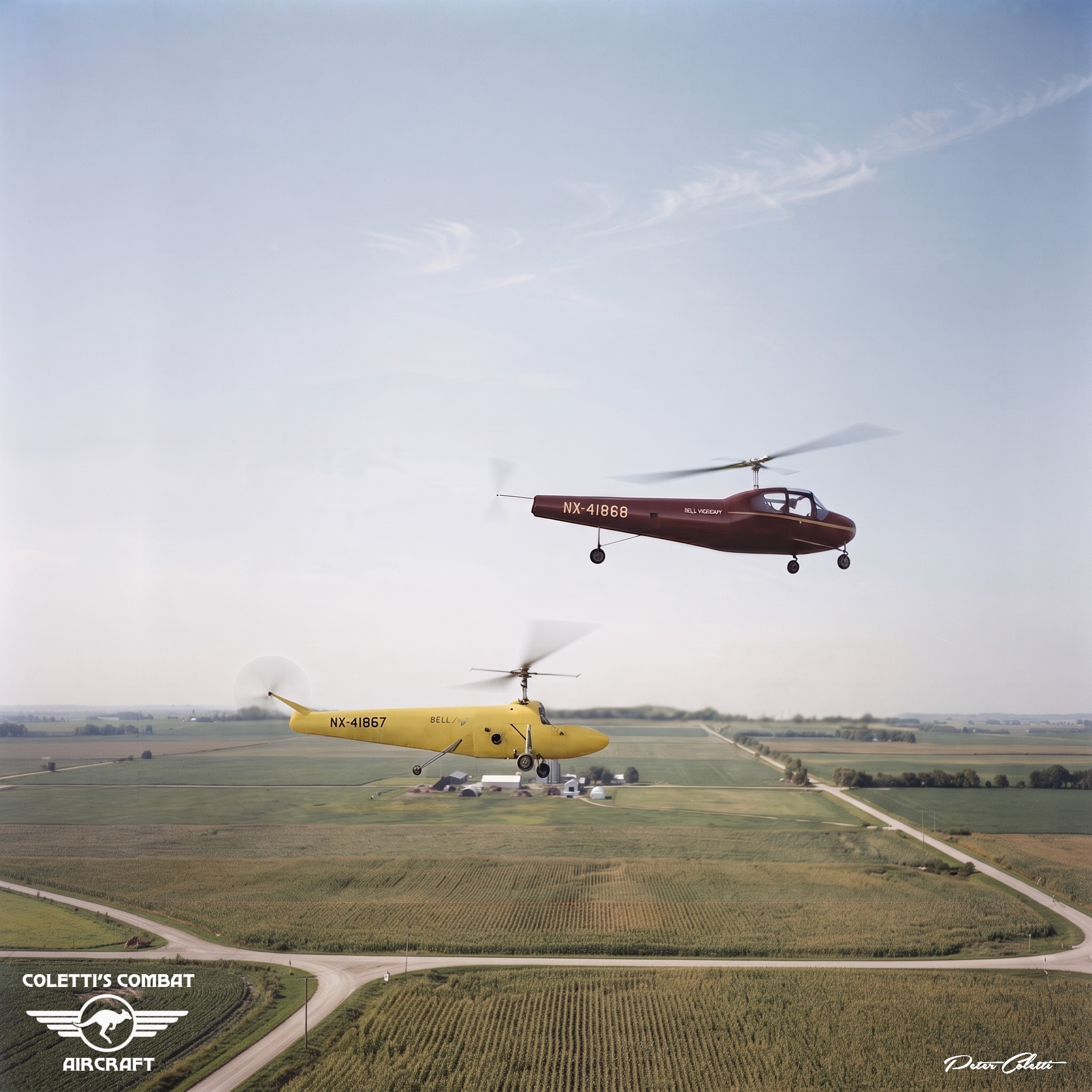
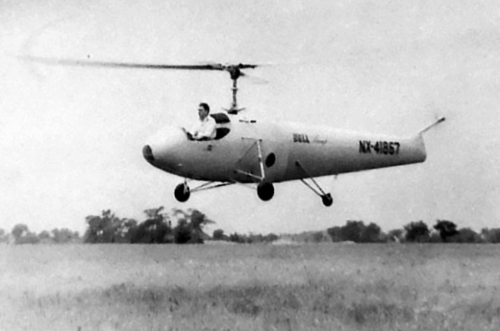
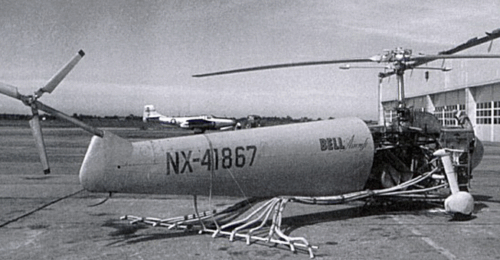
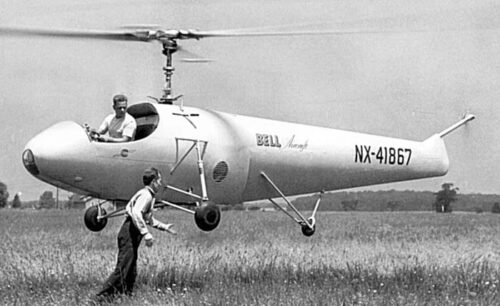
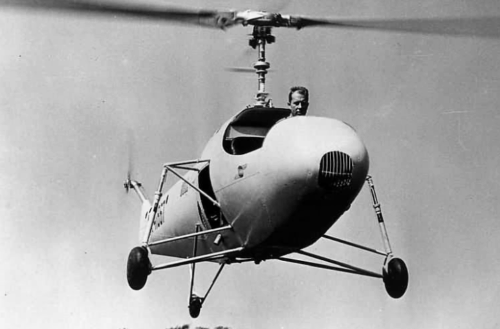
The Bell 30 was the first helicopter built by the Bell Aircraft Corporation and the direct prototype for what became the Bell 47, the first commercially certified helicopter in the United States.
Conceived during World War II but aimed at the postwar civilian market, the Bell 30 represented a decisive technological leap in rotorcraft stability and control.
Origins and Development
The Bell 30 originated from the pioneering work of Arthur M. Young, who had spent over a decade experimenting with small‑scale helicopter models on his Pennsylvania farm.
By the late 1920s and 1930s, Young recognised that helicopter instability—particularly rotor oscillation—was the central obstacle preventing practical vertical‑lift aircraft.
He approached the problem scientifically, using remotely controlled scale models to test aerodynamic concepts rather than relying on full‑scale trial‑and‑error, which was common among other early helicopter experimenters.
Young’s breakthrough came with the invention of the stabiliser bar, a transverse flybar mounted perpendicular to the rotor blades.
This device acted as a gyroscopic reference, damping unwanted oscillations and giving the rotor system a stable plane of rotation independent of fuselage movement.
This innovation became the defining feature of the Bell 30 and later the Bell 47.
In 1941, Young demonstrated his models to Lawrence (Larry) Bell, founder of Bell Aircraft. Bell recognised the potential for a postwar civilian helicopter market and agreed to fund full‑scale development.
Young and his assistant Bartram Kelley joined Bell Aircraft in November 1941.
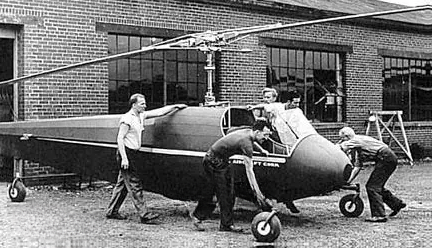
With Bell’s main factories occupied by wartime production, the helicopter team relocated to a former Chrysler dealership in Gardenville, New York, where a small group of about fifteen engineers began constructing the first prototypes.
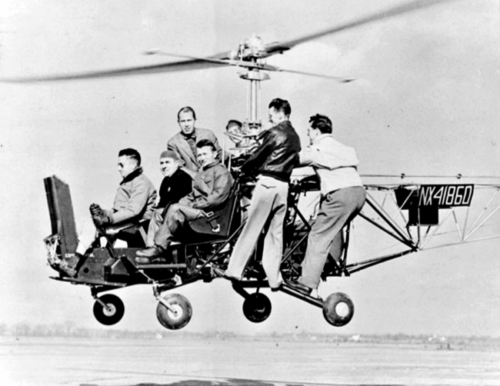
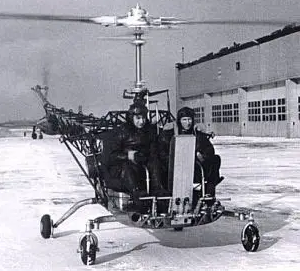
The first prototype, later known as Ship 1, rolled out on 24 December 1942 and made its first tethered flight on 29 December 1942.
Early testing revealed issues with resonance and landing gear suitability, but the aircraft demonstrated the fundamental viability of Young’s stabiliser‑bar rotor system.
The first free flight occurred on 26 June 1943, making the Bell 30 only the third American helicopter to fly.
Technical Design and Configuration
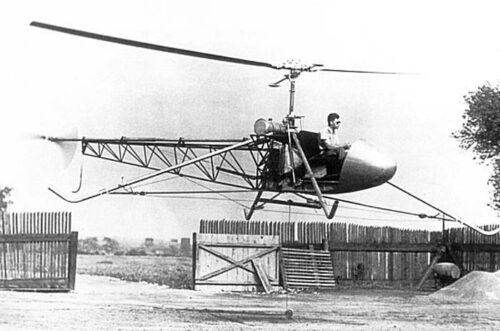
The Bell 30 was an experimental, single‑engine, two‑bladed main‑rotor helicopter with a simple welded‑tube structure.
Its design evolved significantly across its three prototypes, but several core features defined the type:
Airframe
Open‑frame tubular steel fuselage in early versions, later partially enclosed.
Wide four‑legged landing gear made from 3‑inch aluminium tubing was on Ship 1; later prototypes adopted tricycle or four‑wheel gear for improved ground handling.
Powerplant
A 160 hp Franklin six‑cylinder, horizontally opposed, air‑cooled engine, mounted vertically behind the cockpit.
The engine drove the main rotor through a centrifugal clutch and two‑stage planetary transmission with a 9:1 reduction ratio.
Rotor System
Two‑bladed wooden main rotor, symmetrical airfoil, with steel leading‑edge inserts.
Stabiliser bar mounted perpendicular to the blades, acting as a gyroscopic damper.
Two-bladed wooden tail rotor mounted on a tubular tailboom.
Cockpit
Ship 1: open cockpit.
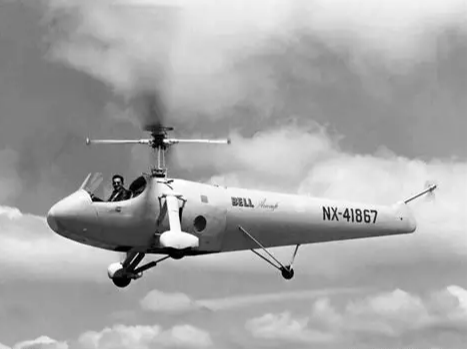
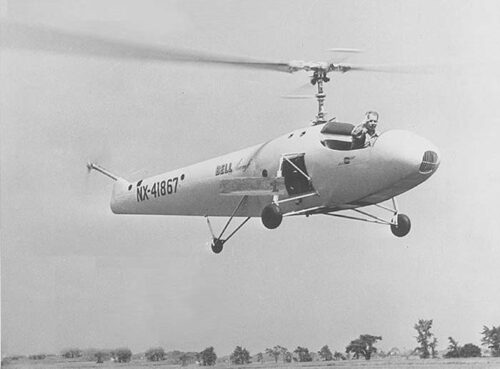
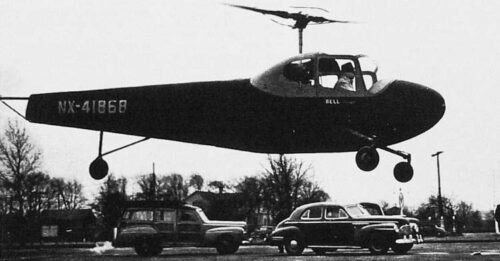
Later prototypes: semi‑enclosed or fully enclosed cabins, with side‑by‑side seating in Ship 2 and Ship 3.
Performance
While detailed performance data varied across prototypes, testing demonstrated:
Speeds exceeding 70 mph by mid‑1943.
Improved autorotation and landing characteristics after landing‑gear redesigns.
The Bell 30’s performance was less important than its stability, which was unprecedented for a helicopter of its era and directly attributable to Young’s stabiliser bar.
Testing, Accidents, and Refinements
Early testing was challenging.
A notable incident occurred in late 1942 when a Bell corporate pilot attempted a captive flight without proper restraints, causing the rotor to enter resonance and resulting in a crash that injured the pilot and damaged the aircraft.
This confirmed Young’s warnings about resonance and led to structural and procedural improvements.
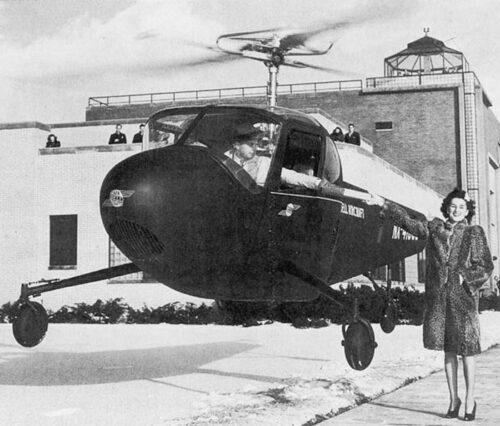
Ship 1 crashed again in September 1943, after which it was rebuilt as Ship 1A with the following:
A strutted tricycle undercarriage,
A semi‑enclosed cockpit,
A raised tail rotor,
Improved autorotation behaviour.
Ship 2 introduced a two‑seat enclosed cabin, addressing both comfort and aerodynamic refinement.
Ship 3, begun in early 1945, incorporated the best features of its predecessors, including a four‑wheel landing gear, improved visibility, and a more refined fuselage shape. It became the direct precursor to the Bell 47.
Variants of the Bell 30
Ship No. 1
First prototype (c/n 1).
Open‑frame structure, open cockpit, four‑legged landing gear.
First flown 29 December 1942; crashed September 1943.
Ship No. 1A
Rebuilt Ship 1 with tricycle gear and a semi‑enclosed cockpit.
Returned to testing by March 1944.
Nicknamed “Genevieve”, now displayed at the Smithsonian Udvar‑Hazy Centre.
Immediate success and direct basis for the Bell 47.
World War II Context
Although developed during World War II, the Bell 30 was not a military programme.
Bell Aircraft was heavily committed to wartime production of fighters and bombers, so the helicopter project was intentionally kept small and isolated in Gardenville to avoid disrupting war contracts.
Larry Bell’s strategic vision was that postwar civilian aviation would include a strong market for personal and utility helicopters.
The Bell 30 was therefore a forward‑looking investment, intended to position Bell Aircraft for the transition from wartime to peacetime production.
The war indirectly shaped the Bell 30 by
Limiting resources and forcing a small, agile development team,
Encouraging innovation through necessity,
Creating a postwar environment where new aviation markets were expected to flourish.
The Bell 30 never saw military service, but its successor, the Bell 47, became widely used by the U.S. military (notably in the Korean War) and globally in both civil and military roles.
Legacy
The Bell 30’s greatest legacy is its role as the proof‑of‑concept for the Bell 47, the first helicopter to receive a U.S. Civil Aeronautics Authority type certificate (H‑1) and one of the most widely produced helicopters in history.
The stabiliser-bar rotor system pioneered on the Bell 30 became a hallmark of Bell helicopter design for decades.
Today, Ship 1A “Genevieve” survives as a museum piece, representing the moment when practical, stable helicopter flight became a reality.