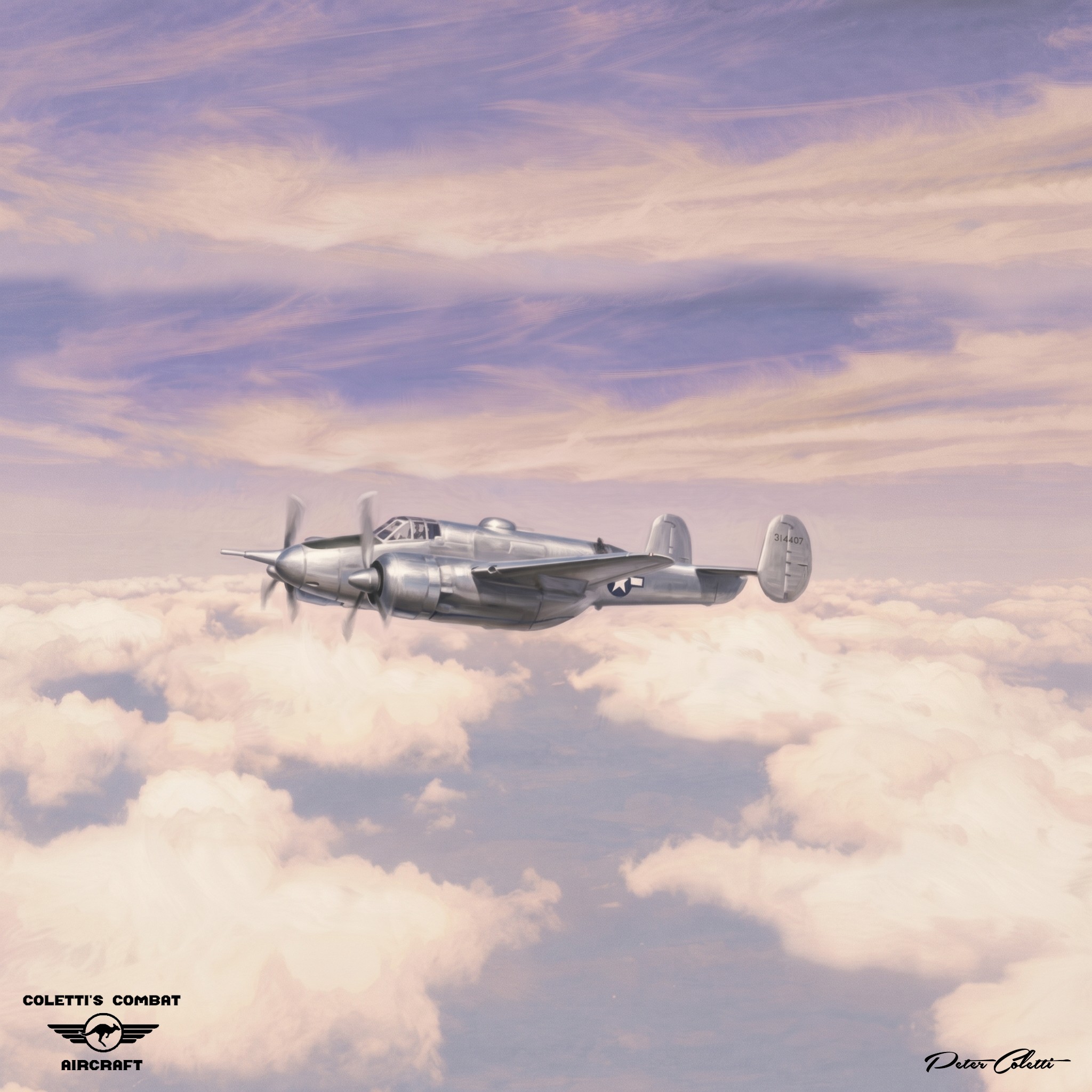
Beechcraft XA‑38 Grizzly
Origins and Strategic Context
By 1942, the United States Army Air Forces (USAAF) had learnt from both Allied and Axis experience that ground‑attack aircraft needed far more firepower and survivability than pre‑war doctrine had assumed.
The Soviet Il‑2 demonstrated the value of a dedicated armoured attacker, while German experiments with heavy cannon—such as the 75 mm BK 7.5 on the Hs 129B‑3—showed that aircraft‑mounted anti‑armour guns could decisively influence ground operations.
The USAAF, meanwhile, relied primarily on the Douglas A‑20 Havoc and early A‑26 Invader, both capable aircraft but not optimised for destroying hardened targets such as tanks, bunkers, and coastal shipping.
In this environment, the USAAF issued a requirement for a heavy, twin‑engine attack aircraft capable of delivering a single devastating blow to armoured targets.
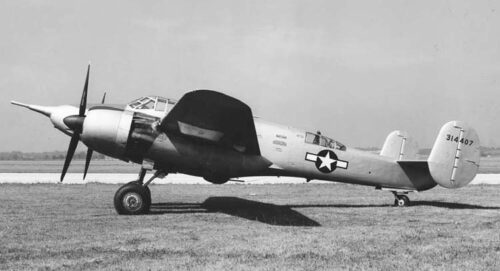
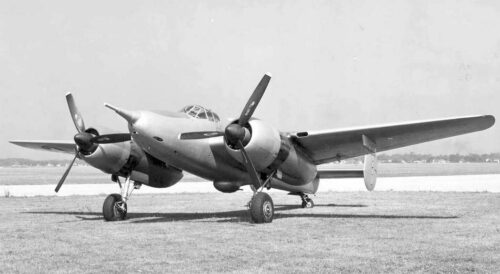
Beech Aircraft Corporation responded with Model 28, later designated XA‑38, a machine conceived as a “flying battery” with a fixed 75 mm cannon as its primary weapon.
The contract for two prototypes was awarded in December 1942.
Conceptual Evolution
Beech originally envisioned Model 28 as a bomber destroyer, a role similar to the German Bf 110 or American XP‑58.
However, USAAF priorities shifted towards a ground‑attack platform with the ability to penetrate armour and fortifications.
The design was reoriented accordingly, retaining the speed and firepower of a heavy fighter but optimised for low‑level attack.
The XA‑38’s closest competitor was the Hughes XA‑37, derived from the D‑2/D‑5 reconnaissance aircraft family, but the Hughes design never matured beyond early development.
Airframe and Structural Design
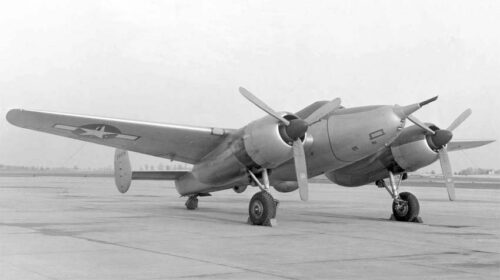
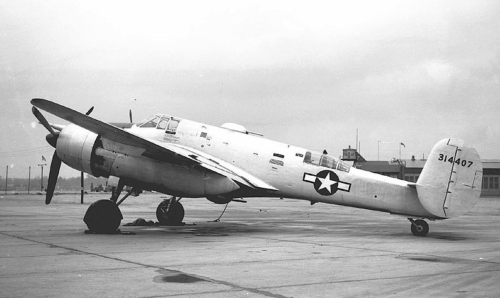
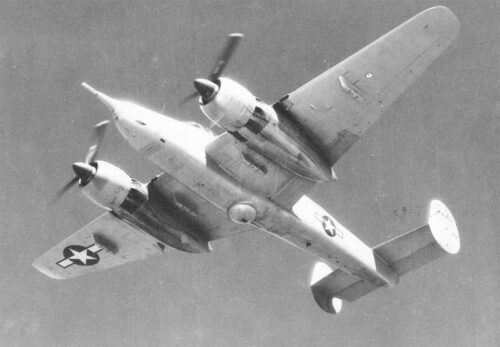
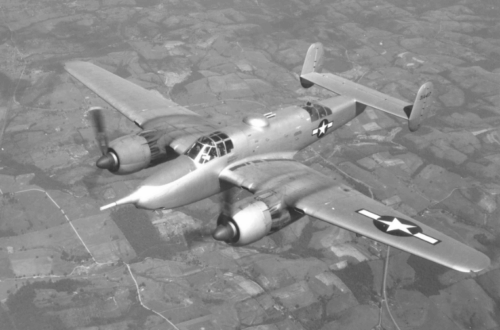
The XA‑38 was a mid‑wing, all‑metal monoplane with a conventional taildragger undercarriage.
Its structure was robust but not heavily armoured; unlike the Il‑2 or Hs 129, Beech prioritised speed and manoeuvrability over extensive armour plating.
The aircraft’s size and weight placed it closer to a medium bomber than a typical attack aircraft.
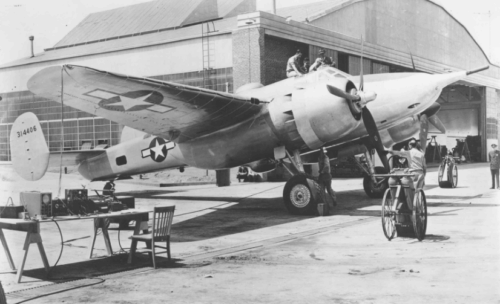
Key structural features
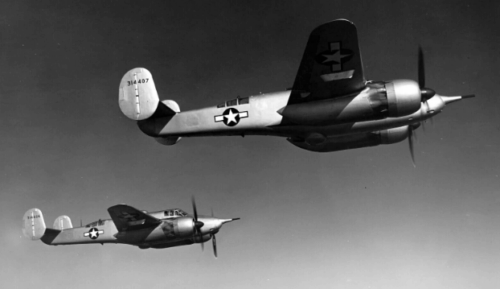
Twin‑tail empennage for improved rear gunner visibility and firing arcs
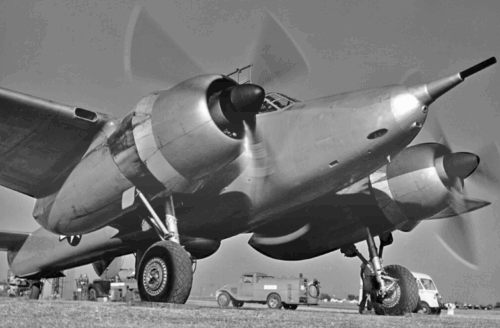
Retractable landing gear, with main wheels folding into the engine nacelles
Three‑man crew in early design studies, later reduced to two (pilot and rear gunner/observer) in the final configuration
Large internal volume in the nose to accommodate the 75 mm cannon and ammunition feed
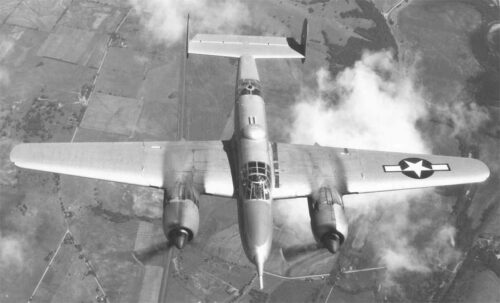
Powerplant and Performance Philosophy
The aircraft was powered by two Wright R‑3350 Cyclone 18 radial engines—the same family used in the B‑29 Superfortress.
Early prototypes used the R‑3350‑43, rated at 2,300 hp, with water injection available for temporary power increases.
These engines were among the most powerful radials available, enabling the XA‑38 to achieve exceptionally high speed for its size.
The R‑3350, however, was also the XA‑38’s Achilles’ heel.
Production of the B‑29 had absolute priority, and the USAAF could not allocate engines to a new attack aircraft programme.
This shortage delayed prototype completion and ultimately doomed the project despite excellent test results.
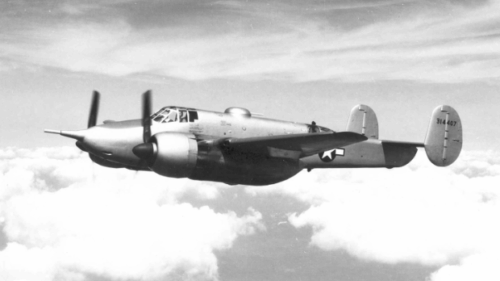
Armament: A Flying Anti‑Armour Gun Platform
The XA‑38’s defining feature was its nose‑mounted 75 mm T9E1 (M10) cannon, with a 20‑round magazine. This weapon was capable of destroying tanks, pillboxes, and ships with a single hit. Unlike the B‑25G/H—which also carried a 75 mm gun—the XA‑38’s cannon was integrated into the airframe from the outset, improving accuracy, recoil absorption, and rate of fire.
Offensive armament
1 × 75 mm T9E1 cannon, fixed forward
2 × .50 cal. M2 Browning machine guns mounted beneath the cannon for supplementary fire
Defensive armament
Two remotely controlled turrets (dorsal and ventral), each with twins. 50-cal machine guns, aimed via periscope from the rear cabin
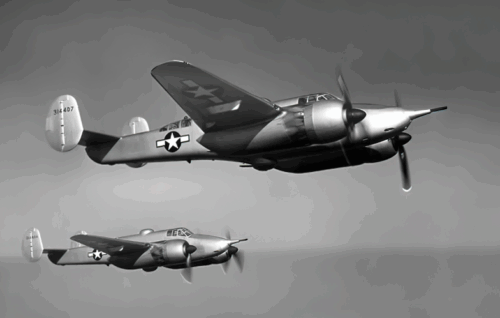
Ordnance capability
Up to 907 kg (2,000 lb) of bombs or drop tanks on underwing hardpoints
The combination of a 75 mm cannon and six heavy machine guns made the XA‑38 one of the most heavily armed piston‑engine aircraft ever built.
Flight Testing and Operational Evaluation
The first prototype flew on 7 May 1944, piloted by Beech test pilot Vern Carstens.
Initial flights used wooden mock‑ups of the cannon and turrets, but live‑fire testing began later that summer.
Performance and handling
Test pilots—both Beech and USAAF—reported that the XA‑38:
Was highly manoeuvrable for its size
Had excellent takeoff and landing characteristics, requiring shorter runways than expected
Achieved top speeds exceeding 370 mph (600 km/h), reportedly fast enough to outrun a P‑51B Mustang in at least one anecdotal chase
Demonstrated high reliability and maintainability, with military ground crews praising its serviceability
The second prototype flew on 22 September 1944, but by then the strategic situation had changed dramatically.
Cancellation and Postwar Fate
By mid‑1945, the USAAF no longer required a specialised anti‑armour aircraft.
Germany had surrendered, Japan was nearing defeat, and the planned invasion of the Japanese home islands (Operation Downfall) was being re-evaluated.
More importantly, the R‑3350 engines remained reserved for the B‑29 programme.
Although the XA‑38 performed superbly in testing, the USAAF concluded that it would not be ready in time for major combat operations.
The programme was cancelled after the two prototypes were completed.
Prototype disposition
One prototype was scrapped shortly after cancellation.
The second was reportedly earmarked for the USAF Museum, but its ultimate fate is unknown.
No airframes survive today.
Technical Specifications (XA‑38)
Crew: 2
Length: 15.77 m (51 ft 9 in)
Wingspan: 20.52 m (67 ft 4 in)
Height: 4.72 m (15 ft 6 in)
Wing area: 58.2 m² (626 ft²)
Empty weight: ~10,200 kg
Max takeoff weight: ~16,000 kg
Engines: 2 × Wright R‑3350‑43, 2,300 hp each
Maximum speed: ~600 km/h (370 mph)
Range: ~2,615 km
Service ceiling: ~8,800 m
Armament: 1 × 75 mm cannon (20 rounds)
6 × .50 cal machine guns
Up to 907 kg of bombs
Assessment and Legacy
Although it never entered production, the XA‑38 Grizzly stands as one of the most formidable piston‑engine attack aircraft ever built.
Its combination of:
High speed,
Exceptional firepower,
Good handling, and
Robust construction
suggests it would have been a devastating anti‑armour and anti‑shipping platform had it reached combat.
In many ways, the XA‑38 represented the culmination of the heavy gun-armed attack aircraft concept—a design philosophy that disappeared with the arrival of jet aircraft and guided munitions.
Today, it remains a fascinating “what‑if” of late‑WWII aviation history.
Digital Artworks by Peter Coletti.