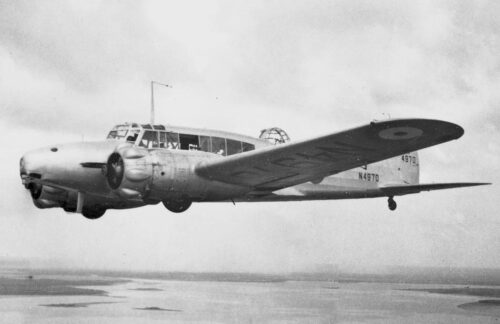
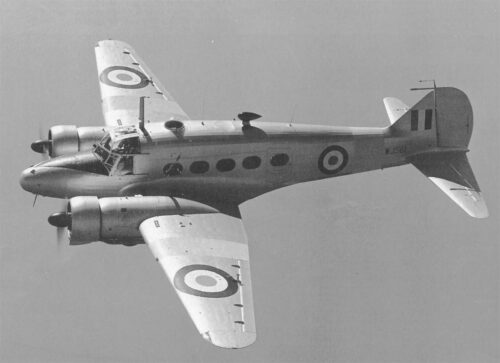
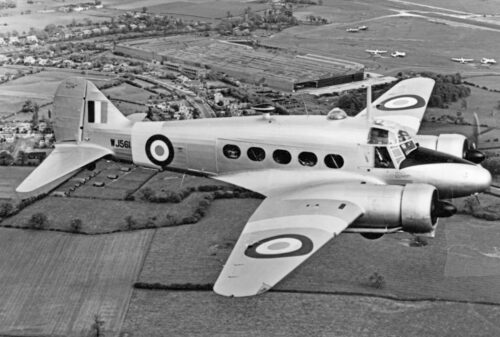
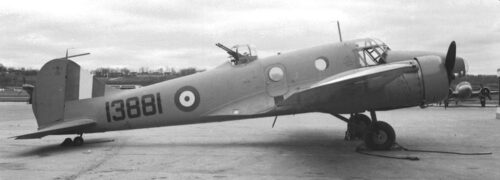
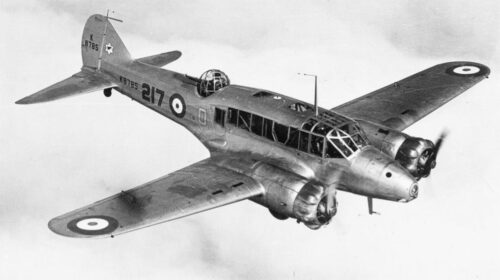
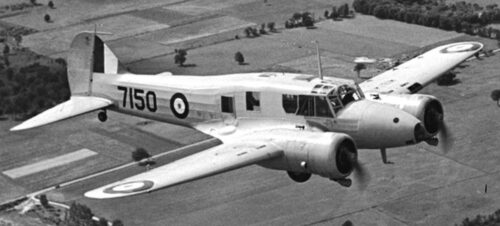
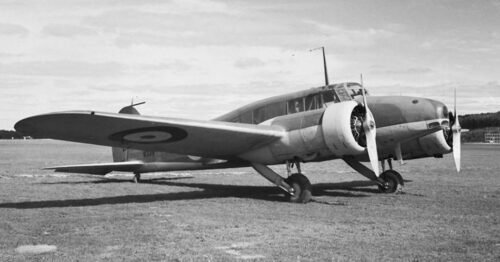
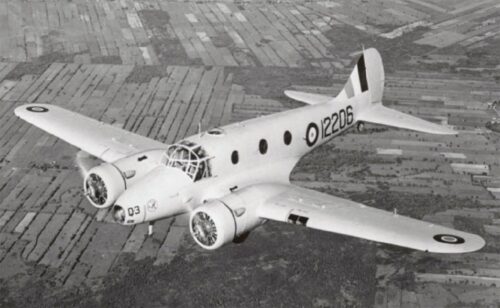
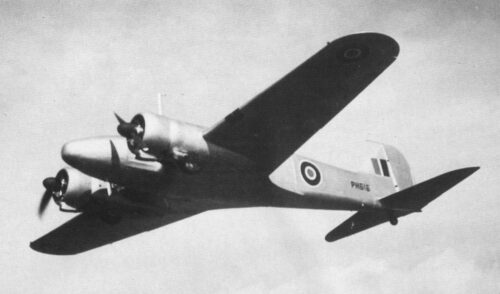
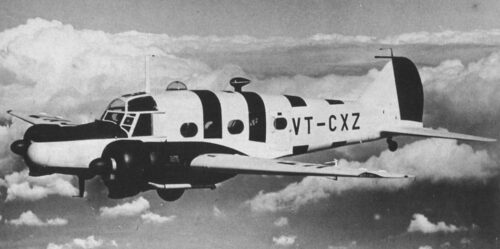
The Avro Anson began life in the mid‑1930s as Britain’s response to a rapidly changing strategic environment.
The Royal Air Force, still transitioning from biplanes to modern monoplanes, urgently needed a coastal reconnaissance aircraft capable of patrolling Britain’s maritime approaches.
Avro’s design team, led by Roy Chadwick, adapted the commercial Avro 652—a small twin‑engine airliner—into a military platform.
This approach allowed the RAF to field a modern aircraft quickly, without the delays of a clean‑sheet design.
The prototype, designated Avro 652A, first flew on 7 January 1935.
Its performance and handling impressed the Air Ministry, which ordered it into production as the Anson Mk I.
In March 1936, the Anson became the first monoplane to enter RAF service, marking a symbolic break from the biplane era.
Although conceived as a frontline maritime patrol aircraft, the Anson’s rapid obsolescence in combat roles became clear even before the outbreak of the Second World War.
However, its reliability, forgiving handling, and adaptability made it invaluable in a different capacity: training the massive aircrew pipeline required for the British Commonwealth Air Training Plan (BCATP).
This shift would define Anson’s wartime legacy.
Design Characteristics
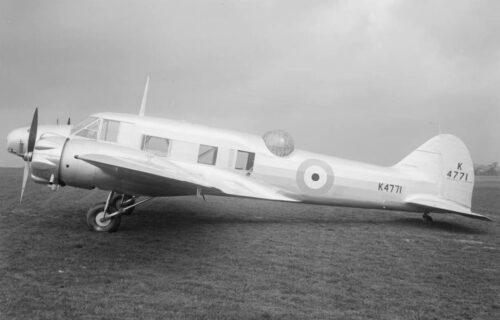
The Anson was a low‑wing, twin‑engine monoplane with a mixed construction typical of the 1930s transitional period.
Structure
Fuselage: Welded steel tube frame with fabric covering.
Wings: Wooden structure with plywood skinning.
Undercarriage: Manually operated retractable main gear—famously requiring 144 turns of a hand crank to raise or lower.
Crew: Typically 3–4 in early reconnaissance roles; up to 5–6 in training configurations.
This hybrid construction made the aircraft easy to repair and maintain, especially in remote training schools across Canada, Australia, and South Africa.
Powerplant
The Mk I used:
Two Armstrong Siddeley Cheetah IX or XIX radial engines
Power output: ~350–420 hp each, depending on variant
Later marks adopted American engines (Jacobs or Wright radials), especially in Canadian production.
Armament (Early Marks)
One fixed forward-firing. 303 Browning machine gun
One .303 Lewis or Vickers K gun in a manually operated dorsal turret
Up to 360 lb (160 kg) of bombs in small internal bays
This armament was modest even by late‑1930s standards, contributing to the Anson’s rapid withdrawal from combat roles.
Performance
Performance varied by mark, but the Mk I—by far the most numerous—had typical characteristics:
Maximum speed: ~188 mph (303 km/h)
Cruise speed: ~150 mph (240 km/h)
Range: ~660 miles (1,060 km)
Service ceiling: ~19,000 ft (5,800 m)
These figures were adequate for coastal patrol in 1936 but insufficient once war began and enemy aircraft and submarines improved.
Operational History and WWII Context
Early War Service
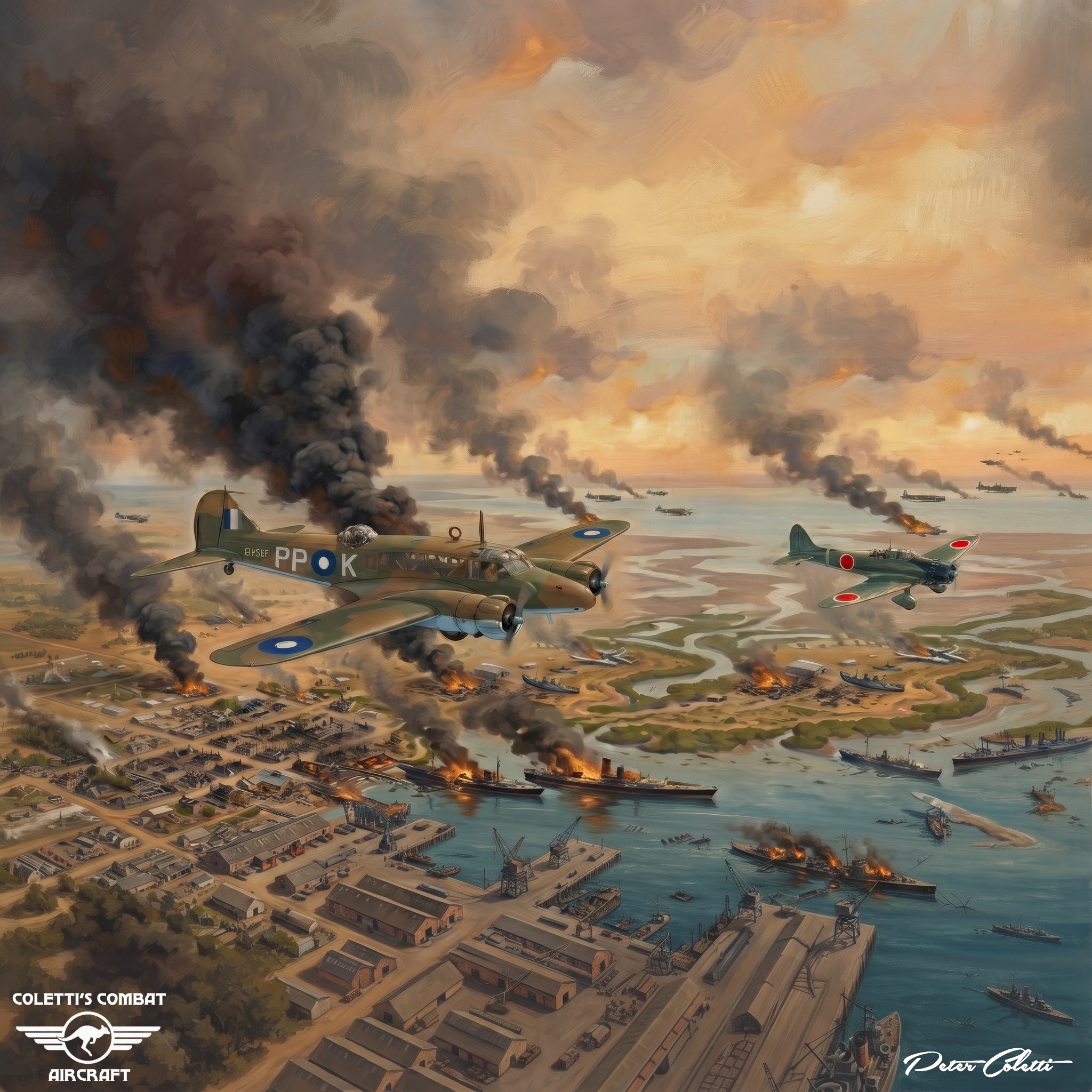
At the outbreak of WWII, the Anson equipped several RAF Coastal Command squadrons.
It performed:
Anti-submarine patrols
Convoy escort
General reconnaissance
Despite its limitations, the Anson occasionally achieved surprising successes.
In one famous 1940 incident, an Anson crew engaged and forced down two Italian Fiat CR. 42 fighters—an anecdote often cited to illustrate the aircraft’s ruggedness and the ingenuity of its crews.
Transition to Training Role
By 1941, more capable aircraft such as the Lockheed Hudson and Bristol Beaufort replaced the Anson in frontline service.
However, the RAF and Commonwealth air forces faced an enormous challenge: training tens of thousands of aircrew for Bomber Command and other branches.
The Anson became the backbone of this effort.
It served as:
A navigation trainer
A bombing and gunnery trainer
A multi‑engine pilot trainer
A radio operator and wireless trainer
Its stable flight characteristics, roomy cabin, and forgiving nature made it ideal for novice crews.
Under the BCATP, thousands of Ansons were built in Canada, where they became a familiar sight at training bases from Manitoba to Alberta.
Post‑War Service
After 1945, the Anson continued in military and civilian roles:
Light transport
Communications aircraft
Air ambulance
Survey and mapping platform
The RAF retired its last Ansons in 1968, giving the type an extraordinary service life of over three decades.
Variants
The Anson family is extensive, but the major variants include:
Mk I
Original RAF version
Cheetah radial engines
Over 6,700 built, mostly in Britain
Mk II
Canadian-built
Jacobs L‑6MB engines
Wooden wings and simplified construction for mass production
Mk III / Mk IV
Canadian variants with Wright R‑760 engines
Improved performance and reliability in cold climates
Mk V
Canadian version with a completely redesigned plywood fuselage
More spacious cabin, improved aerodynamics
Mk X / Mk XI / Mk XII
Post‑war British transport and communications variants
Modernized interiors and systems
Used extensively by RAF and civilian operators
In total, more than 11,000 Ansons were built—making it one of the most produced British aircraft of all time.
Technical Legacy
The Avro Anson’s significance lies not in combat achievements but in its enormous contribution to Allied aircrew training.
It was the aircraft in which:
Navigators learned celestial and dead-reckoning techniques
Pilots transitioned to multi‑engine flight
Wireless operators mastered radio procedures
Gunners practiced turret operation
Its reliability and adaptability made it indispensable.
For many Commonwealth airmen, the Anson was the first multi-engine aircraft they ever flew—and the one that prepared them for Wellingtons, Lancasters, Halifaxes, and Mosquitos.
Conclusion
The Avro Anson occupies a unique place in aviation history.
Conceived as a modest coastal patrol aircraft, it evolved into one of the most important training platforms of the Second World War.
Its long service life, vast production numbers, and global footprint reflect its versatility and the soundness of its original design.
While overshadowed by more glamorous wartime aircraft, the Anson quietly shaped the Allied air forces by training the crews who would go on to fight—and win—the air war.