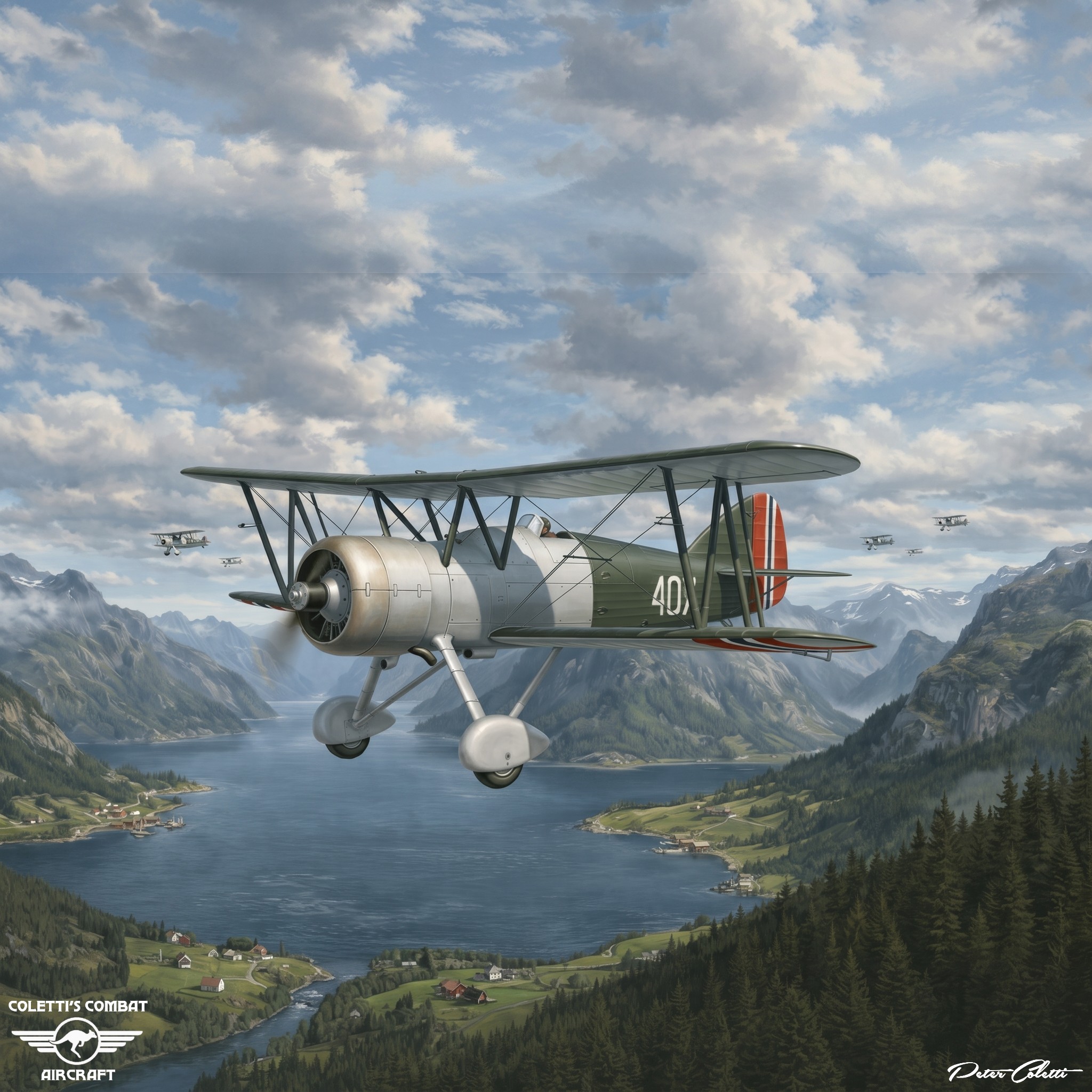
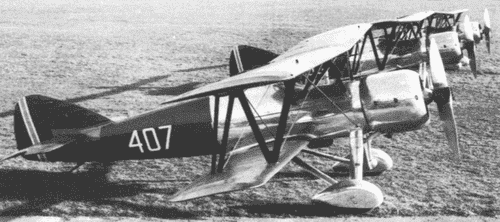
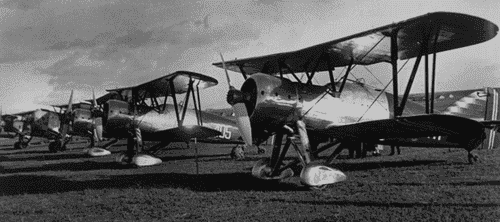
The Armstrong Whitworth A.W.35 Scimitar had a brief and largely non-combat operational history during World War II.
Development and Design
Origin
The Scimitar was a refinement of the earlier Armstrong Whitworth A.W.16 fighter, featuring a lowered nose profile.
enlarged tail surfaces, and powered by a 735 hp Armstrong Siddeley Panther radial engine.
First Flight
29 April 1935 (prototype converted from an A.W.16).
Construction
Mixed metal and fabric structure, with streamlined fairings and fixed undercarriage.
Norwegian Service
Order
Four production aircraft were ordered by the Norwegian Army Air Service in 1936.
Licence Agreement
Norway planned to build more Scimitars locally at Kjeller, but the deal was cancelled when the aircraft proved unsuitable for ski operations without redesign.
Operational Role
Used primarily for training and evaluation; never deployed in combat.
World War II Status
Combat Readiness
At the time of the German invasion of Norway in April 1940, all Scimitars were undergoing maintenance and could not be made operational.
Combat Use
None—no Scimitars flew in combat during WWII.
Legacy
The aircraft was quickly rendered obsolete by rapid advances in monoplane fighter design.
Prototype Fate
The second prototype was retained by Armstrong Whitworth until 1958 before being scrapped.
Strategic Context
The Scimitar was a transitional biplane design that arrived just as monoplane fighters like the Hawker Hurricane and the Messerschmitt Bf 109 were redefining air combat.
Its limited production and lack of combat deployment reflect the rapid pace of aviation development in the 1930s.
Prototypes
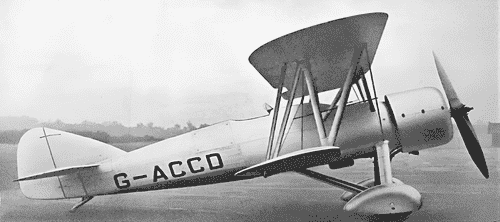
The first prototype, Scimitar (G-ACCD)
Originally built as an A.W.16, it was converted into the A.W.35 Scimitar in 1935 with a lowered nose, an enlarged tail, and a 735 hp Panther IIIa engine.
First flown on 29 April 1935, it served as a demonstrator for export, notably to Norway, which ordered four but later cancelled local production.
Used for evaluation and display; never saw combat.
Retained by Armstrong Whitworth until 1958, when it was scrapped.
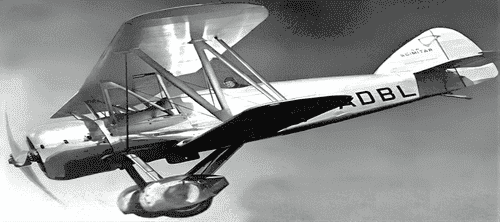
The Second Scimitar Prototype (G-ADBL)
Built in 1935 as the second prototype of the A.W.35 Scimitar, following G-ACCD.
Purpose
Used for demonstration and evaluation, particularly for export interest.
Norwegian Trials
G-ADBL was sent to Norway for cold-weather testing and ski compatibility trials but failed to meet operational requirements.
Outcome
Norway cancelled plans for local production due to poor ski performance and limited adaptability.
Fate
Returned to the UK and retained by Armstrong Whitworth until it was eventually scrapped.
G-ADBL’s brief career mirrored the Scimitar’s overall fate—an evolutionary biplane design overtaken by the rapid rise of monoplane fighters.
Production Aircraft
(Norwegian Order)
Customer
Norwegian Army Air Service
(Hærens Flyvevesen).
Year Ordered
1935–1936.
Quantity
Four aircraft, built by Armstrong Whitworth following the Norwegian evaluation of the prototype.
Norwegian Service
Purpose
Intended as frontline fighters and trainers.
Deployment
Operated from Kjeller Airfield.
Issues
Poor performance in cold weather.
Incompatibility with ski landing gear.
Rapid obsolescence due to emerging monoplane designs.
World War II Status
April 1940
During the German invasion of Norway, all four Scimitars were undergoing maintenance and were not operational.
Combat Use
None—no Scimitars flew during the campaign.
Fate
Likely destroyed or captured during the invasion; no confirmed postwar survivors.
Crew
1
Length
25 ft 0 in (7.62 m)
Wingspan
33 ft 0 in (10.06 m)
Height
12 ft 0 in (3.66 m)
Wing area
261.3 sq ft (24.28 m²)
Empty weight
2,956 lbs (1,341 kg)
Max takeoff weight
4,100 lbs (1,860 kg)
Powerplant
1 × Armstrong Siddeley Panther X
14-cylinder radial engine,
735 hp (548 kW)
Performance
Maximum speed
221 mph (356 km/h, 192 kn) at 14,000 ft (4,300 m)
Endurance
2 hrs. 30 min
Service ceiling
31,600 ft (9,600 m)
Time to altitude
5 min 15 sec to 10,000 ft (3,000 m)
Armament
Guns
2 × forward-firing .303 in (7.7 mm) Vickers machine guns.