Arado Ar 68
The Arado Ar 68 emerged during a transitional moment in German fighter development, when the Luftwaffe—still forming in secrecy—was shifting from biplanes to the first generation of modern monoplane fighters.
Designed by Walter Rethel’s team at Arado, the Ar 68 was conceived as the successor to the Ar 65, but its development was shaped by engine shortages, bureaucratic hesitation, and the rapid pace of aeronautical change in the mid‑1930s.
Origins and Development
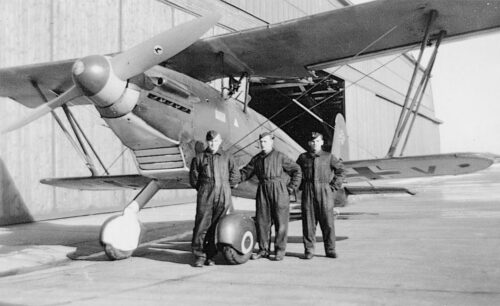
Work on the Ar 68 began shortly after the cancellation of the Ar 67, with Arado engineers turning their attention to a larger, heavier, and more capable biplane fighter.
Early in the design phase, Arado hoped to equip the aircraft with foreign inline engines such as the Rolls‑Royce Kestrel or Curtiss Conqueror, but the German Air Ministry rejected this outright, insisting that the new Junkers Jumo 210—then nearing completion—would be the standard powerplant for future fighters.
Despite this, the first prototype, the Ar 68a (D‑IKIN), flew in 1934 with a BMW VI engine because the Jumo 210 was not yet available in sufficient numbers.
Flight tests showed excellent handling and manoeuvrability, though speed and climb were only marginally better than the Ar 65 due to the similar engine.
Test pilots also reported exhaust fumes entering the cockpit, and forward visibility was reduced by the longer nose required for improved aerodynamics.
Both issues were addressed when the inverted‑V Jumo 210 was installed on later prototypes.
Two additional prototypes followed: the Ar 68b (D‑IVUS) and Ar 68c (D‑IBAS), both powered by early Jumo 210 variants.
The Ar 68c introduced the fighter’s standard armament of two 7.92 mm MG 17 machine guns.
Refinements to radiator design and engine installation continued through 1935 as Arado sought to demonstrate superiority over the Heinkel He 51, then entering Luftwaffe service.
By early 1936, the Ar 68’s future was still uncertain.
The Luftwaffe had suffered high accident rates transitioning pilots from the forgiving Arado biplanes to the heavier, more demanding He 51, and there was concern that the Ar 68—having even higher wing loading—would be more difficult still.
The stalemate ended when Ernst Udet, newly appointed Inspector of Fighter and Dive-Bomber Aviation, personally staged a mock dogfight between an experienced He 51 pilot and himself, flying an Ar 68.
Udet decisively outmanoeuvred the Heinkel, proving the Arado’s superior agility and settling the matter in the Arado’s favour.
Entry Into Production
Even after Udet’s demonstration, engine availability continued to shape the programme.
The Air Ministry reversed its earlier stance on the Jumo 210, delaying its mass production.
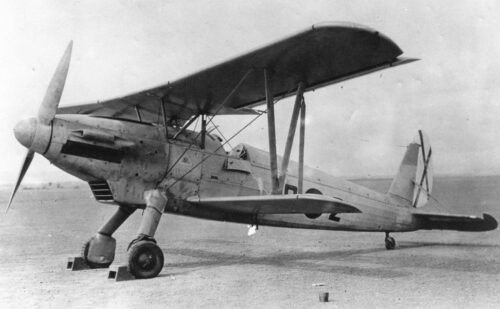
As a stopgap, Arado was instructed to begin series manufacture using the BMW VI 7.3Z engine.
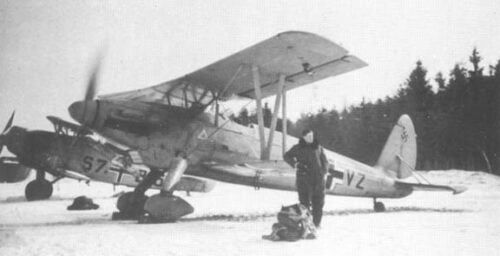
This interim model became the Ar 68F‑1, entering service in late summer 1936 with I./JG 134 “Horst Wessel” and later I./JG 121.
Combat in Spain quickly revealed the He 51’s inferiority to the Soviet Polikarpov I-15, prompting renewed urgency for improved fighters.
As Jumo 210 production finally increased, Arado shifted to the definitive Ar 68E‑1, which became the Luftwaffe’s last operational biplane fighter and the most numerous Ar 68 variant before the arrival of the Messerschmitt Bf 109 in 1938.
Design and Construction
The Ar 68 was a single‑seat, single‑engine biplane fighter of mixed construction, typical of early‑1930s German design philosophy.
Airframe
Upper wing: wooden structure with plywood skin on the leading edge and underside to the rear spar; the remainder is fabric‑covered.
Lower wing: fully plywood‑skinned for strength.
Ailerons: mounted only on the upper wing.
Flaps: fitted to the lower wing.
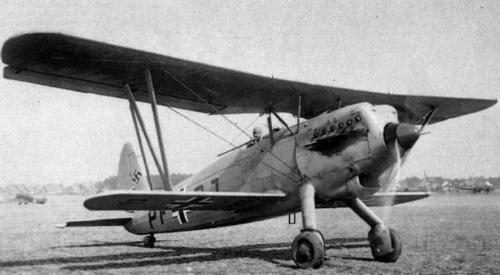
Interplane struts: N‑type with slight outward cant for rigidity.
Fuselage: welded steel‑tube frame, metal‑skinned forward of the cockpit and fabric‑covered aft.
Tail surfaces: metal frame with fabric covering; braced horizontal stabiliser.
Landing gear: fixed, faired main gear with a tail skid.
Powerplant
The standard production engine for the Ar 68E was the Junkers Jumo 210Da/Ea, a 12‑cylinder inverted‑V liquid‑cooled engine producing 680–730 hp, driving a two‑blade fixed‑pitch wooden propeller.
Armament
Two 7.92 mm MG 17 machine guns are mounted in the upper fuselage, synchronised to fire through the propeller arc.
Provision for six 10‑kg fragmentation bombs on a ventral rack, though this was rarely used due to drag penalties.
Cockpit and Equipment
The pilot was equipped with a Revi IIIa reflector gunsight, and fuel was carried in a single 200‑litre tank behind the firewall.
Performance
The Ar 68E‑1’s performance reflected the limits of biplane design at the dawn of the monoplane era.
Maximum speed: 305 km/h at sea level; 323 km/h at altitude
Rate of climb: 756 m/min
Service ceiling: 8,100 m
Empty weight: 1,600 kg
Takeoff weight: 2,020 kg
Wingspan: 11.0 m
Length: 9.5 m
Wing area: 26.5 m²
While not fast, the Ar 68 excelled in manoeuvrability, structural strength, and pilot‑friendly handling, qualities that endeared it to many Luftwaffe pilots during its brief frontline career.
Variants
The Ar 68 family included numerous prototypes and production models:
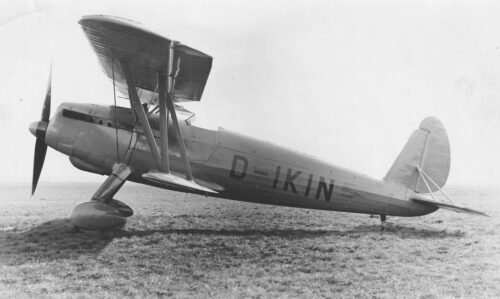
Ar 68a — first prototype with BMW VI engine.
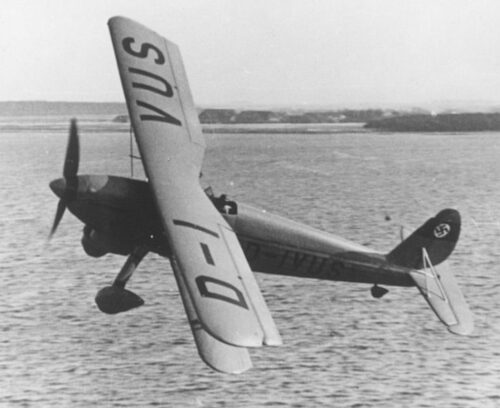
Ar 68b — second prototype with Jumo 210A.
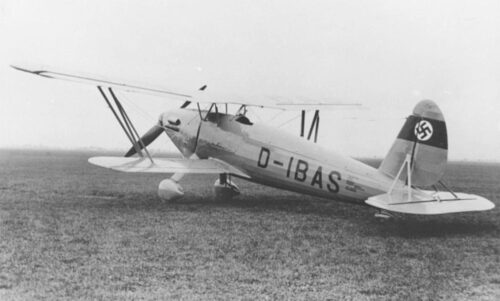
AR 68c — third prototype; first with MG 17 armament.
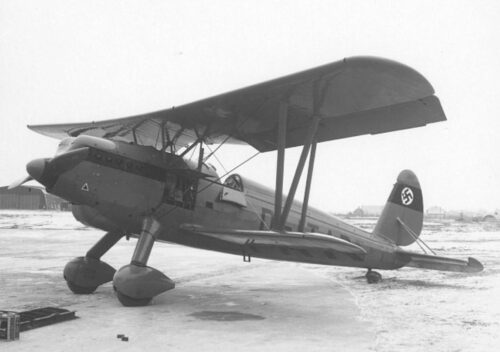
Ar 68d — pre‑series model with BMW VI; later redesignated Ar 68E‑0.
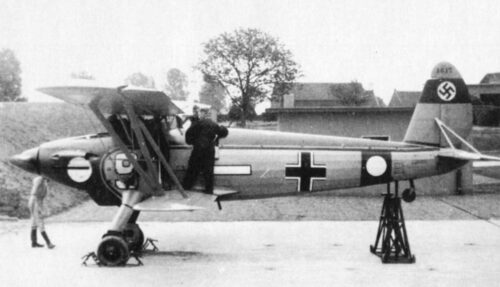
Ar 68e — pre‑series Jumo‑powered prototype (Ar 68V‑5).
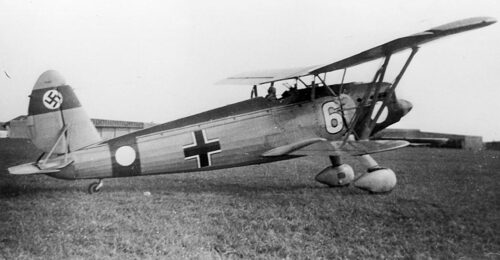
Ar 68F‑1 is an early production model with a BMW VI due to Jumo shortages.
AR 68G — intended Jumo-powered production version; limited use.
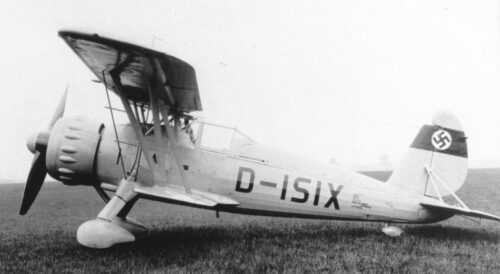
Ar 68H — advanced prototype with BMW 132Da radial engine (800–850 hp), sliding canopy, and four MG 17s; reached 335 km/h at altitude.
This design directly influenced the later Arado Ar 197 carrier fighter project.
Operational History and WWII Context
Although overshadowed by the rapid rise of the Bf 109, the Ar 68 played a meaningful role in the early Luftwaffe.
Pre‑war Service
By 1937, several Jagdgeschwader were equipped with Ar 68s, including the following:
I., II., III./JG 134
I./JG 135
II./JG 234
I. and II./JG 334
III./JG 141
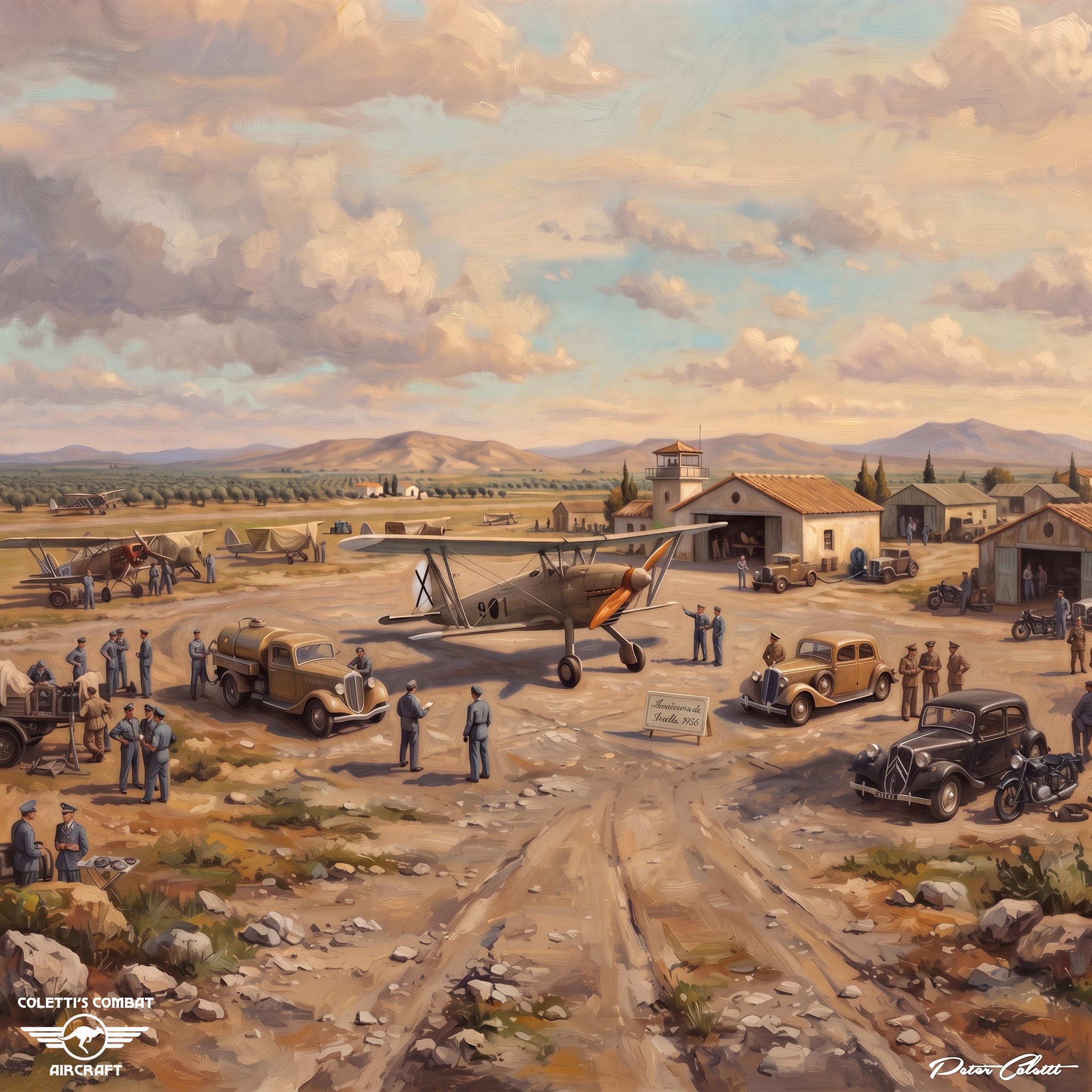
The type was briefly served alongside the He 51 in Spain, where two Ar 68E fighters were evaluated—primarily as night fighters—operating from La Cenia.
World War II
At the outbreak of WWII, the Ar 68 had already been relegated to secondary duties.
Nevertheless, it continued to serve as a night fighter along the German–French border with the following:
10. and 11. (Nacht)/JG 72, flying patrols with 16 and 12 aircraft, respectively.
Later, 10.(N)/JG 53, which used Ar 68F‑1s during the winter of 1939–40.
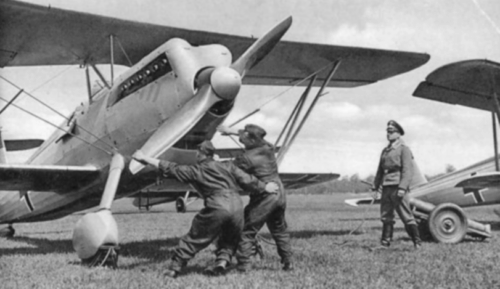
As more capable aircraft became available, all remaining Ar 68s were transferred to flight schools, where they served as advanced trainers well into the early war years.
Assessment and Legacy
The Arado Ar 68 stands as the last biplane fighter to enter Luftwaffe service, representing the final refinement of a design philosophy that was already being eclipsed by all‑metal monoplanes.
Though quickly outclassed, it played a crucial transitional role—training pilots, filling early fighter units, and proving itself a nimble and reliable aircraft at a time when Germany was rebuilding its air arm.
Its development also highlighted the growing pains of the German aviation industry: engine shortages, shifting bureaucratic priorities, and the tension between traditional biplane agility and the emerging need for speed and firepower.
In the end, the Ar 68’s greatest legacy may be that it bridged the gap between the interwar biplane era and the modern fighter age embodied by the Bf 109.
Digital Artworks by Peter Coletti.