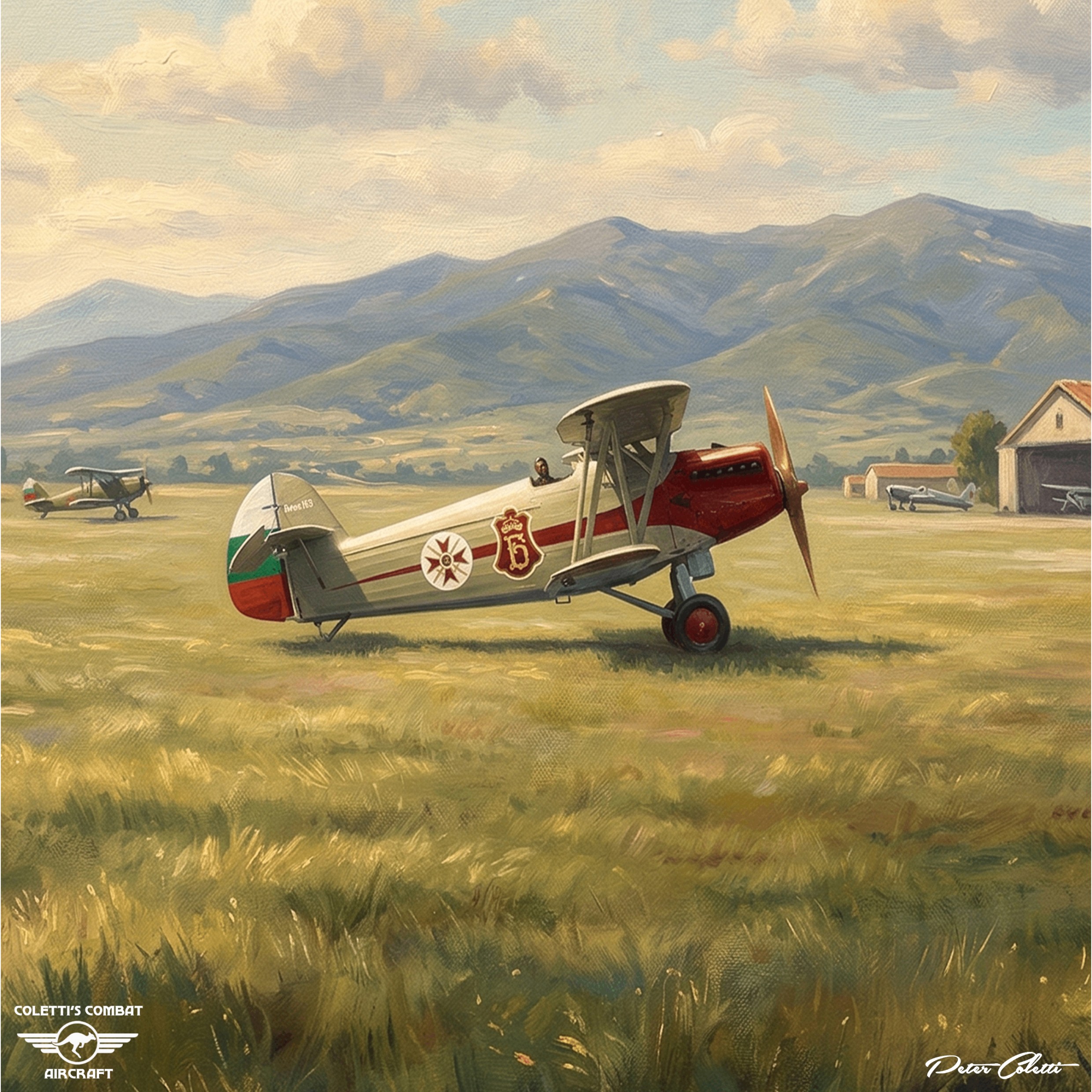
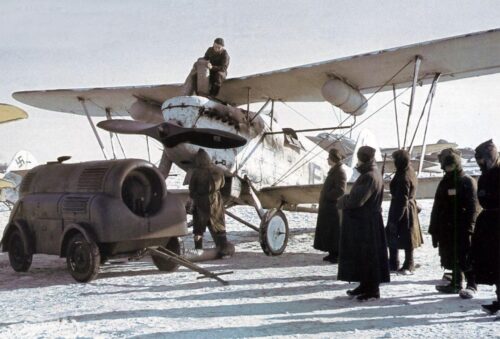
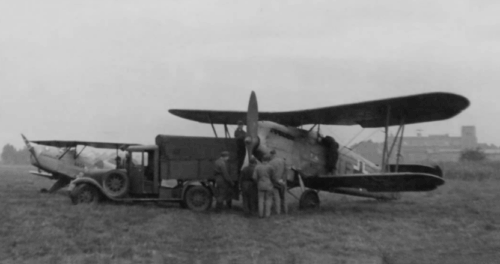
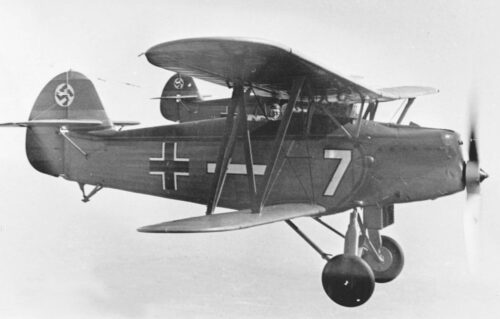
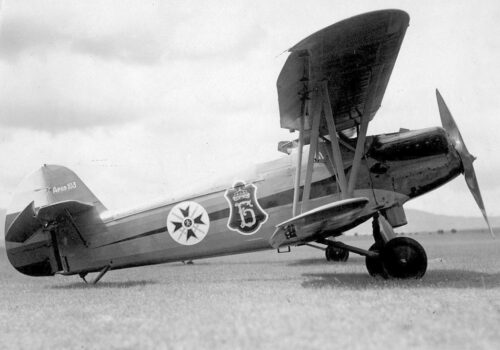
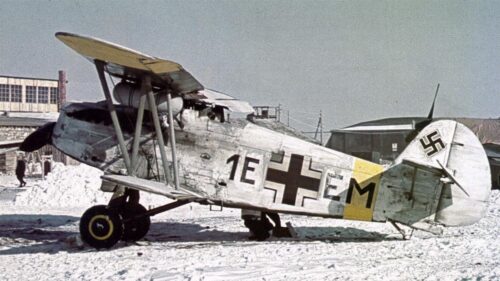
The Arado Ar 65 emerged during a transitional moment in German aviation history.
In the mid‑1920s, the Reichswehrministerium sought to rebuild German military aviation capability despite the restrictions of the Treaty of Versailles.
Aircraft development continued under the guise of “civil” or “sport” aviation, with prototypes often tested abroad.
Arado Flugzeugwerke, already experienced with biplane fighters, began work on a new single‑seat design intended to replace the earlier Arado SD series.
Design work began around 1926–1927 under Walter Rethel and later Walter Blume.
The prototype series, initially designated SD IV, represented a refinement of Arado’s earlier biplane concepts.
The SD IVa and SD IVb prototypes demonstrated promising handling but required structural strengthening and aerodynamic refinement.
As the design matured, the aircraft received the new designation Ar 65, marking it as part of Arado’s standardised nomenclature.
By 1928–1929, the Ar 65 had evolved into a fully militarised fighter suitable for the clandestine training programmes Germany operated in the Soviet Union at Lipetsk.
Although the aircraft would never serve as a front‑line fighter in wartime, it became one of the Luftwaffe’s foundational training and early operational types during the force’s re‑emergence in the early 1930s.
Design Characteristics
Airframe and Structure
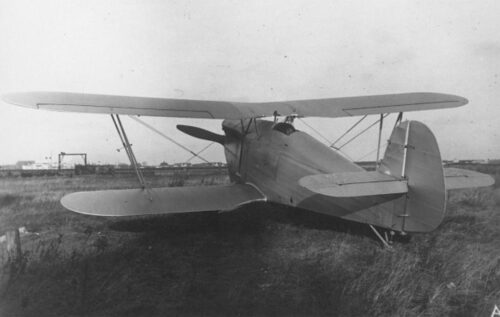
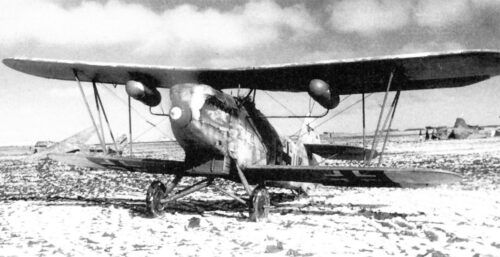
The Arado Ar 65 was a single-seat, single-engine biplane of mixed construction.
Its fuselage consisted of a welded steel‑tube frame with fabric covering, a common approach for the era that balanced strength with ease of repair.
The wings were of wood construction with fabric covering, arranged in a conventional single‑bay biplane configuration with N‑type interplane struts and wire bracing.
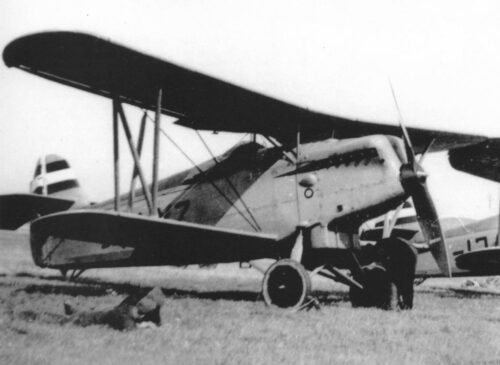
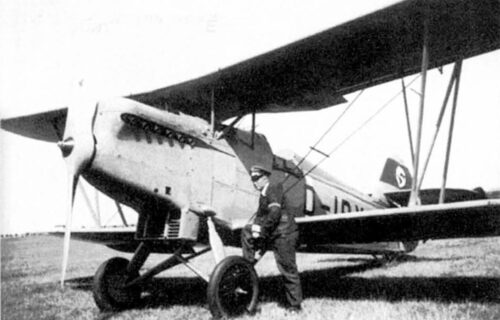
The aircraft featured a fixed, tail-skid undercarriage with robust main struts designed to withstand rough-field operations.
The open cockpit provided good visibility, though the high upper wing imposed some upward blind spots typical of biplanes.
Powerplant
The Ar 65 was powered by the BMW VI, a liquid‑cooled V‑12 engine producing roughly 600 horsepower depending on the variant.
This engine was widely used in German aircraft of the late 1920s and early 1930s and provided reliable performance with straightforward maintenance requirements.
A two‑bladed wooden propeller was standard.
The engine installation included a prominent radiator mounted ahead of the engine, giving the aircraft a characteristic frontal profile.
Aerodynamic Features
The Ar 65’s design emphasised stability and predictable handling—qualities essential for training and early fighter instruction.
Its relatively large wing area and balanced control surfaces made it forgiving at low speeds, while the BMW VI provided adequate climb and manoeuvring capabilities for aerobatic training.
Although not cutting‑edge by the standards of the early 1930s, the aircraft’s clean lines and well‑proportioned wings gave it respectable performance for a biplane fighter.
Armament
Operational versions carried:
Two 7.92 mm MG 17 machine guns, mounted in the forward fuselage and synchronised to fire through the propeller arc.
This armament was modest but typical for late‑1920s fighters.
Performance
Performance varied slightly by sub‑variant, but typical figures for the Ar 65E/F series included the following:
Maximum speed: approximately 250–260 km/h (155–162 mph)
Service ceiling: around 7,000 m (23,000 ft)
Range: roughly 500–600 km (310–370 miles)
Rate of climb: adequate for training roles, though inferior to contemporary monoplane fighters emerging by the mid‑1930s.
These characteristics placed the Ar 65 firmly in the late biplane era—competent but soon to be eclipsed by faster, cleaner monoplane designs.
Variants
The Ar 65 underwent several iterations as Arado refined the design.
Ar 65a / Early Prototypes
The initial prototypes derived from the SD IV series.
These aircraft tested structural layouts, wing configurations, and engine installations.
They served primarily as development platforms.
Ar 65b
A pre‑production model incorporating structural improvements and aerodynamic refinements.
Used for evaluation and early training.
Ar 65c
The first significant production version.
It featured strengthened wings and improved equipment.
This model helped establish the type within the newly forming Luftwaffe training system.
Ar 65d
A transitional variant with minor modifications, produced in limited numbers.
Ar 65E
The principal production version.
It incorporated further refinements to the airframe and systems, becoming the standard fighter trainer of the early Luftwaffe.
Ar 65F
A final variant with additional structural strengthening and minor equipment changes.
It served primarily in training and auxiliary roles.
Operational Use and Pre‑WWII Role
The Arado Ar 65 entered service at a time when Germany was rebuilding its air arm in secret.
Early aircraft were used at the Lipetsk training centre in the Soviet Union, where German pilots and instructors gained experience away from Allied oversight.
With the public unveiling of the Luftwaffe in 1935, the Ar 65 became one of the first officially recognised fighter types.
However, it was already outdated compared to emerging monoplane fighters such as the Heinkel He 51 (itself soon surpassed) and later the Messerschmitt Bf 109.
The Ar 65’s primary operational role became fighter training, aerobatic instruction, and conversion training for new pilots.
It equipped several Jagdgeschwader during the Luftwaffe’s formative years but was quickly relegated to secondary duties as more modern aircraft entered service.
Some Ar 65s were transferred to auxiliary units, flying schools, and reserve formations.
A small number may have been exported or used by paramilitary organisations, though documentation is limited.
Context in the Early WWII Era
By the outbreak of the Second World War in 1939, the Ar 65 was thoroughly obsolete.
It no longer served in frontline units and had been replaced in training roles by more modern biplanes such as the Arado Ar 68 and by early monoplane trainers.
Nevertheless, the Ar 65 played an important historical role.
It represented:
One of the first fighters of the reconstituted Luftwaffe
A key training platform for the generation of pilots who would later fly in the early campaigns of WWII
A transitional design bridging the gap between interwar biplanes and the high-performance monoplanes that defined the late 1930s
Although it never saw combat in the Second World War, its contribution to pilot development and early Luftwaffe organisation was significant.
Legacy
The Arado Ar 65 stands today as a representative of the final era of German biplane fighters.
Its clean design, reliable engine, and forgiving handling made it well-suited to its primary mission: preparing pilots for the rapidly advancing world of 1930s military aviation.
While overshadowed by later aircraft, the Ar 65’s role in the rebirth of German air power gives it a distinct place in aviation history.
It symbolises both the technical limitations of its time and the rapid evolution that would soon transform fighter design.