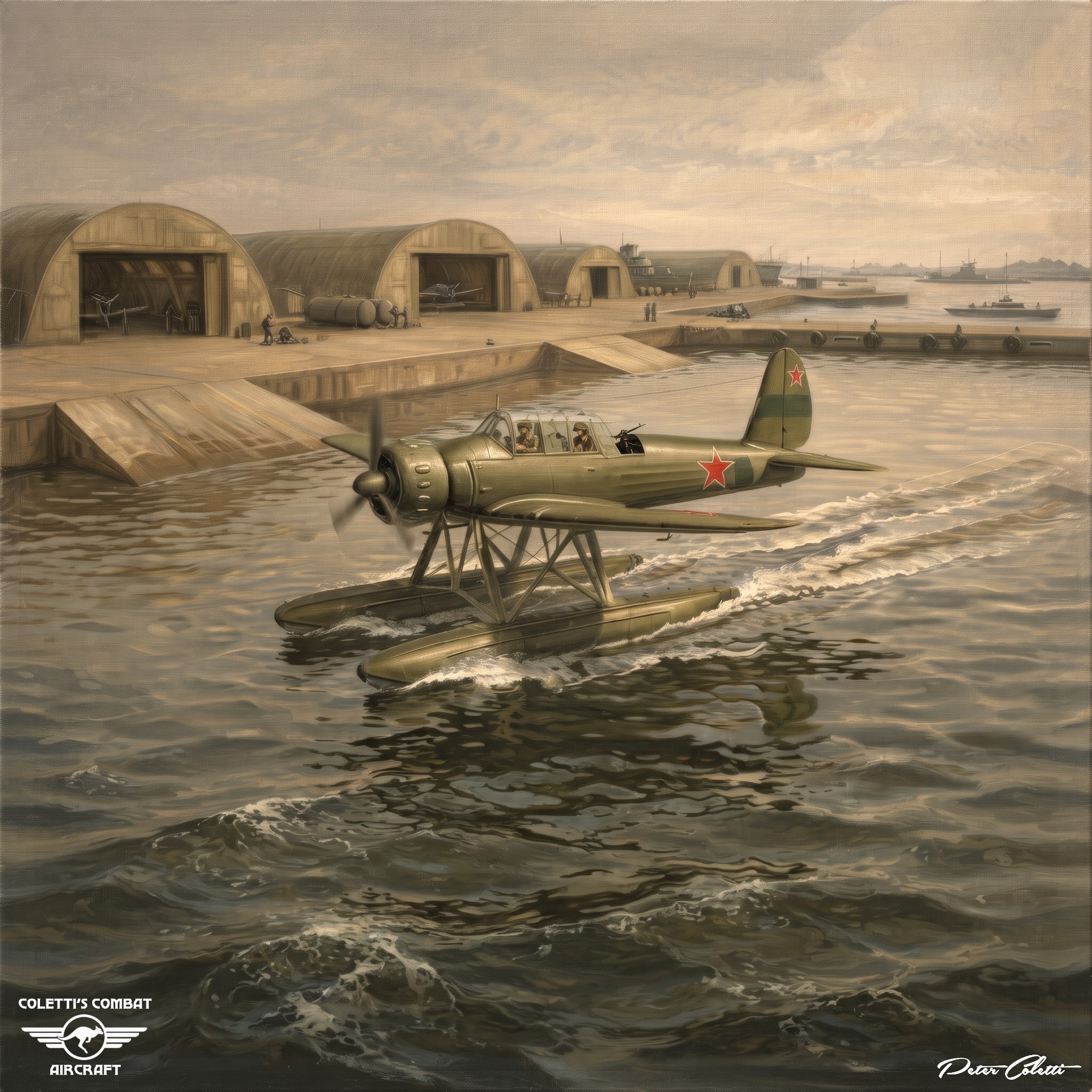
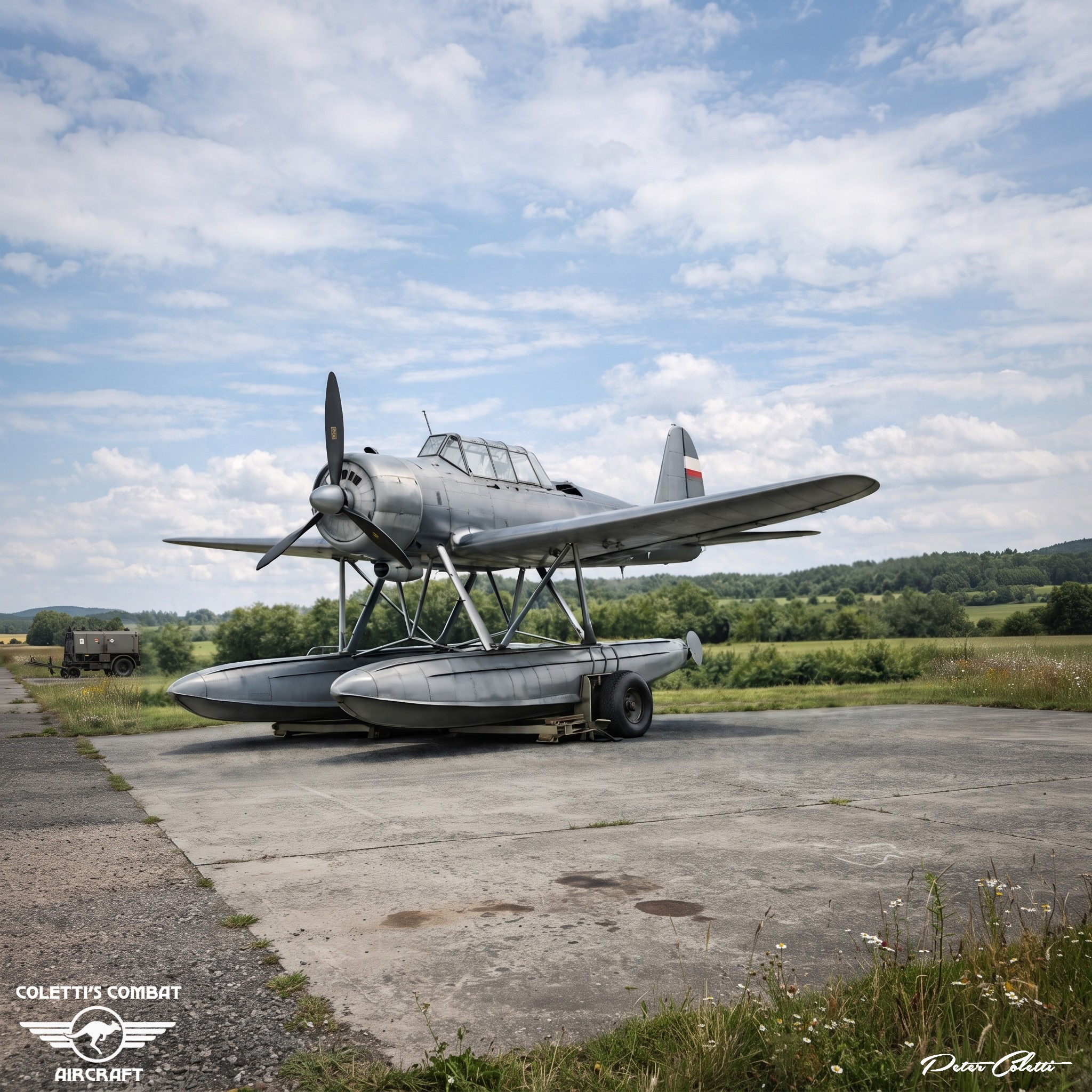
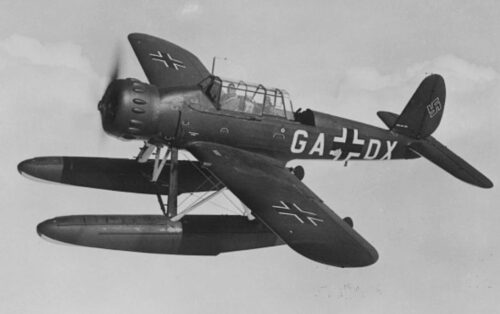
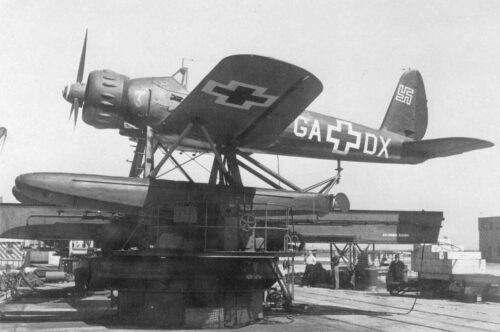
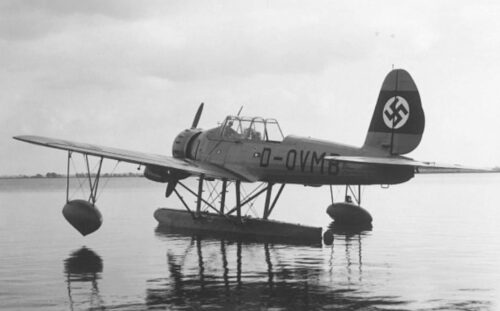
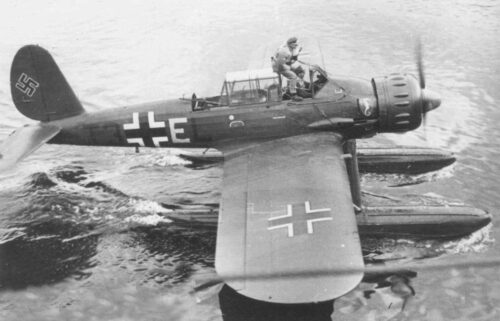
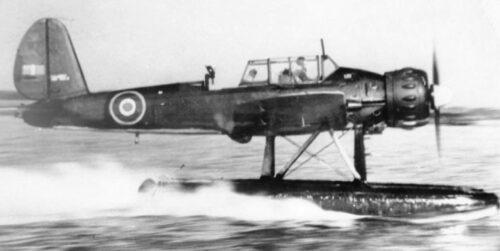
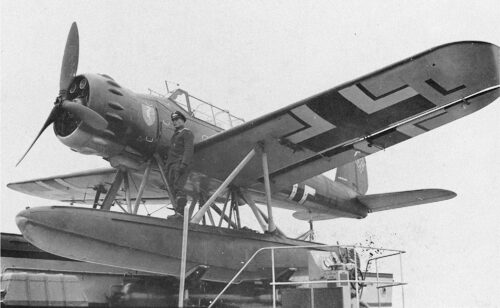
The Arado Ar 196 was the principal shipborne reconnaissance floatplane of the German Kriegsmarine during the Second World War.
Its creation stemmed from a 1936 Reichsluftfahrtministerium (RLM) requirement for a modern, catapult‑launched aircraft to replace the obsolete Heinkel He 60 and He 114.
The new design needed to be faster, sturdier, and capable of operating from both battleships and cruisers under demanding maritime conditions.
Arado Flugzeugwerke, led by chief designer Walter Blume, proposed a low‑wing monoplane of all‑metal construction, powered by a reliable radial engine and equipped with twin floats for stability.
The prototype Ar 196 V1 flew in 1937, demonstrating excellent handling and seaworthiness.
Trials against rival designs from Focke‑Wulf and Dornier confirmed Arado’s superiority, and the RLM ordered full production in 1938.
The aircraft entered service just before the outbreak of war, becoming the standard catapult reconnaissance platform aboard German capital ships.
Design and Technical Description
Airframe and Structure
The Ar 196 was a robust, all‑metal monoplane with a semi‑monocoque fuselage and a low‑mounted cantilever wing.
Its twin floats were attached by a network of steel struts designed to withstand catapult stresses and rough sea landings.
The wings incorporated automatic leading‑edge slats and large flaps, giving excellent low‑speed control and short take‑off capability from water.
The tail unit was conventional, with a single fin and rudder, and the entire airframe was treated for corrosion resistance.
Crew and Cockpit
The aircraft carried two crew members—pilot and observer/gunner—in a tandem cockpit enclosed by a long, glazed canopy.
The pilot’s forward position housed full flight controls and instrumentation, while the observer’s rear station contained navigation equipment, radio gear, and a flexible defensive gun mount.
The canopy slid rearward for access and provided good visibility for reconnaissance and gunnery spotting.
Powerplant and Systems
The Ar 196 was powered by a BMW 132 K nine‑cylinder air‑cooled radial engine producing approximately 960 horsepower, driving a three‑bladed variable‑pitch propeller.
The engine was renowned for reliability and ease of maintenance at sea.
Fuel tanks were located in the wings and fuselage, giving a range of roughly 1,000 kilometres.
Hydraulic systems operated the flaps and catapult fittings, while electrical systems powered radios and lighting.
Armament and Equipment
Standard armament consisted of:
Two fixed 7.92 mm MG 17 machine guns in the engine cowling, synchronised to fire through the propeller arc.
One flexible 7.92 mm MG 15 machine gun in the rear cockpit for defence.
Two 50 kg bombs were mounted under the wings for light attack or anti‑submarine duties.
The aircraft also carried cameras and radio transmitters for reconnaissance and artillery spotting.
Performance
Typical performance figures for the Ar 196 A‑3 production models were the following:
Maximum speed: 320 km/h (200 mph)
Cruise speed: 280 km/h (174 mph)
Range: 1,070 km (665 mi)
Service ceiling: 7,000 m (23,000 ft)
Rate of climb: 5 m/s (1,000 ft/min)
Crew: 2
These characteristics made the Ar 196 one of the most capable ship‑borne reconnaissance aircraft of its time, combining good speed, manoeuvrability, and endurance with rugged seaworthiness.
Operational History
Kriegsmarine Service The Ar 196 entered operational service in 1939 and was deployed aboard nearly all major German warships, including the Admiral Graf Spee, Scharnhorst, Gneisenau, Prinz Eugen, and Bismarck.
Catapult‑launched from these vessels, it performed reconnaissance, convoy shadowing, and artillery‑spotting missions.
The aircraft’s stability and ease of recovery made it ideal for shipboard use, and its defensive armament allowed it to engage enemy reconnaissance planes effectively.
Coastal and Land-Based Operations
Beyond shipboard duties, the Ar 196 served with coastal reconnaissance units along the North Sea, Baltic, and Mediterranean coasts.
Land‑based versions fitted with wheeled undercarriages operated from airfields for patrol and training.
The aircraft also participated in anti‑submarine sweeps and convoy escort missions, often flying from occupied territories such as Norway and France.
Combat and Encounters
The Ar 196 occasionally engaged in direct combat.
It was credited with several victories over Allied seaplanes and light aircraft.
One notable incident occurred in 1940 when an Ar 196 forced a British submarine to surface, leading to the capture of its crew—a rare achievement for a floatplane.
Foreign and Postwar Use
Several Axis allies operated the Ar 196:
Bulgaria and Romania used it for coastal patrols over the Black Sea.
Norway and France employed captured examples after 1945 for maritime surveillance.
Production continued until 1944, with approximately 530 aircraft built by Arado, Fokker, and SNCASO under licence.
Variants
Ar 196 A‑Series (Twin‑Float Production Models)
A-1: Initial production version with BMW 132 K engine, twin MG 17s, and MG 15 in the rear cockpit.
A‑2: Improved radio equipment and minor structural refinements.
A‑3: Standard wartime model with strengthened floats and bomb racks.
A‑4: Tropicalised version for Mediterranean operations.
A‑5: Final production variant with increased fuel capacity and upgraded armament.
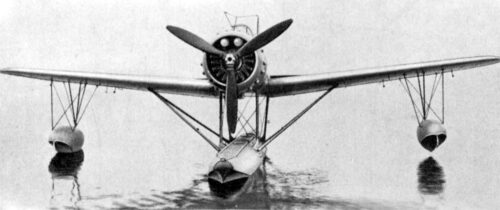
Ar 196 B‑Series (Single‑Float Prototype)
B-1: Experimental single-float version with small wingtip stabilising floats; tested for performance but not adopted due to reduced stability on water.
Assessment and Legacy
The Arado Ar 196 was widely regarded as one of the finest ship‑borne reconnaissance aircraft of the Second World War.
Its rugged construction, reliable engine, and excellent handling made it a favourite among pilots and naval officers alike.
Although its range and speed were limited compared with land‑based aircraft, it fulfilled its role with distinction throughout the war.
By 1945, the Ar 196 represented the culmination of the catapult-launched floatplane concept—a design soon rendered obsolete by radar-equipped patrol aircraft and helicopters.
Nevertheless, its engineering quality and operational success secured its place as a classic of maritime aviation history, embodying the transition from interwar seaplane technology to modern naval air reconnaissance.