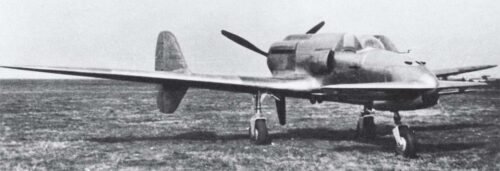
The Ambrosini SS.4 sits in that fascinating space between visionary and impractical—an aircraft that showed where fighter design might go but arrived just a bit too early, in the wrong air force, with too little institutional backing.
To understand it properly, you have to see it not as an isolated oddity but as the culmination of a very deliberate line of Italian canard experiments in the 1930s and as a small, bold counterpoint to the more conservative mainstream of Regia Aeronautica thinking.
Origins and development
Early canard experiments
SS.2 and SS.3
Concept roots
The SS.4 was the brainchild of engineer Sergio Stefanutti, who had been exploring canard—or “tail‑first”—configurations for several years before the war.
His work began at Guidonia, the Regia Aeronautica’s main experimental centre, under the Direzione Superiore Studi ed Esperienze (DSSE).
SS.2:
Type
Light experimental aircraft with a canard layout and fixed undercarriage.
Powerplant
Small Keller two‑cylinder engine of about 16 hp.
First flight
1935.
Role
Pure research platform to test stall behaviour and controllability of the canard configuration.
The SS.2 demonstrated that a properly designed canard could be very resistant to stalls and spins, with benign low-speed handling—exactly the qualities Stefanutti wanted to exploit in a fighter that would be safer and more controllable at the edge of the envelope.
SS.3 “Anitra”:
Type
Two‑seat canard testbed, still largely made of wood.
Engine
Around 38 hp for the CNA D. II.
Dimensions
Span about 12.77m,
length
6.00 m,
height
2.01m.
Performance
Max speed
roughly 140km/h,
ceiling about 4,000m,
stall around 55 km/h.
The SS.3 refined the aerodynamics, validated the twin-fin arrangement on the main wing, and proved that the canard layout could scale up in speed and size.
These two aircraft gave Stefanutti the confidence to propose a full‑scale fighter.
Transition to the SS.4 fighter project
By the late 1930s, the Regia Aeronautica was still heavily invested in more conventional inline‑engine, tractor‑prop fighters like the Macchi C.200/C.202 line and Fiat designs.
Stefanutti, however, pushed for a radical interceptor that would combine:
Canard layout for stall resistance and manoeuvrability.
Pusher propeller to free the nose for heavy armament and improve pilot visibility.
Tricycle landing gear for better ground handling and forward view on takeoff/landing.
All‑metal construction to handle higher speeds and loads than his earlier wooden testbeds.
Società Aeronautica Italiana – Ambrosini (SAI‑Ambrosini), based at Passignano sul Trasimeno, took on the project.
The aircraft was designated SS.4, continuing Stefanutti’s numbering sequence.
A single prototype was built, with work completed in early 1939.
Ground tests suggested promising performance but also revealed vibration and cooling issues that would later prove critical.
Airframe and configuration
General layout
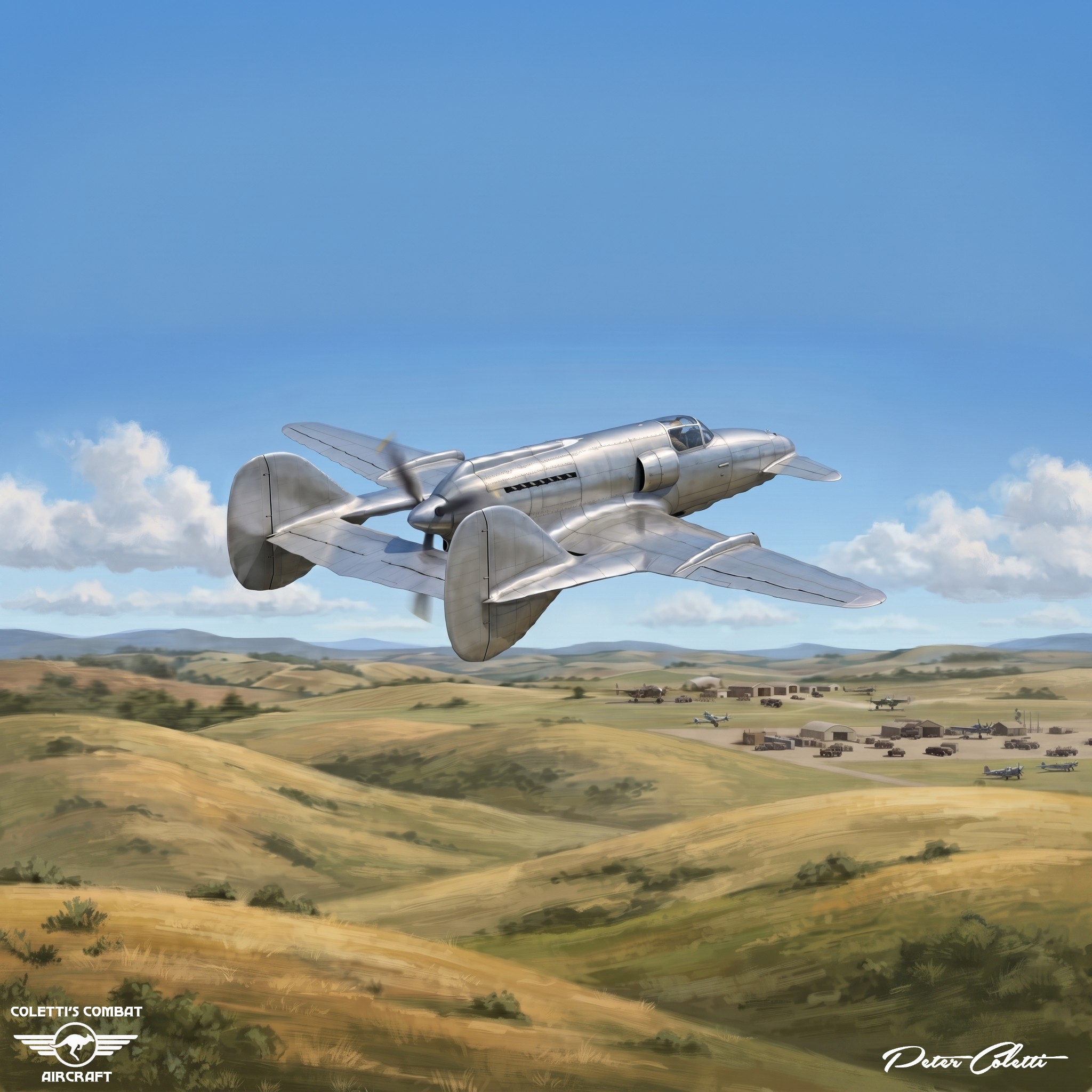
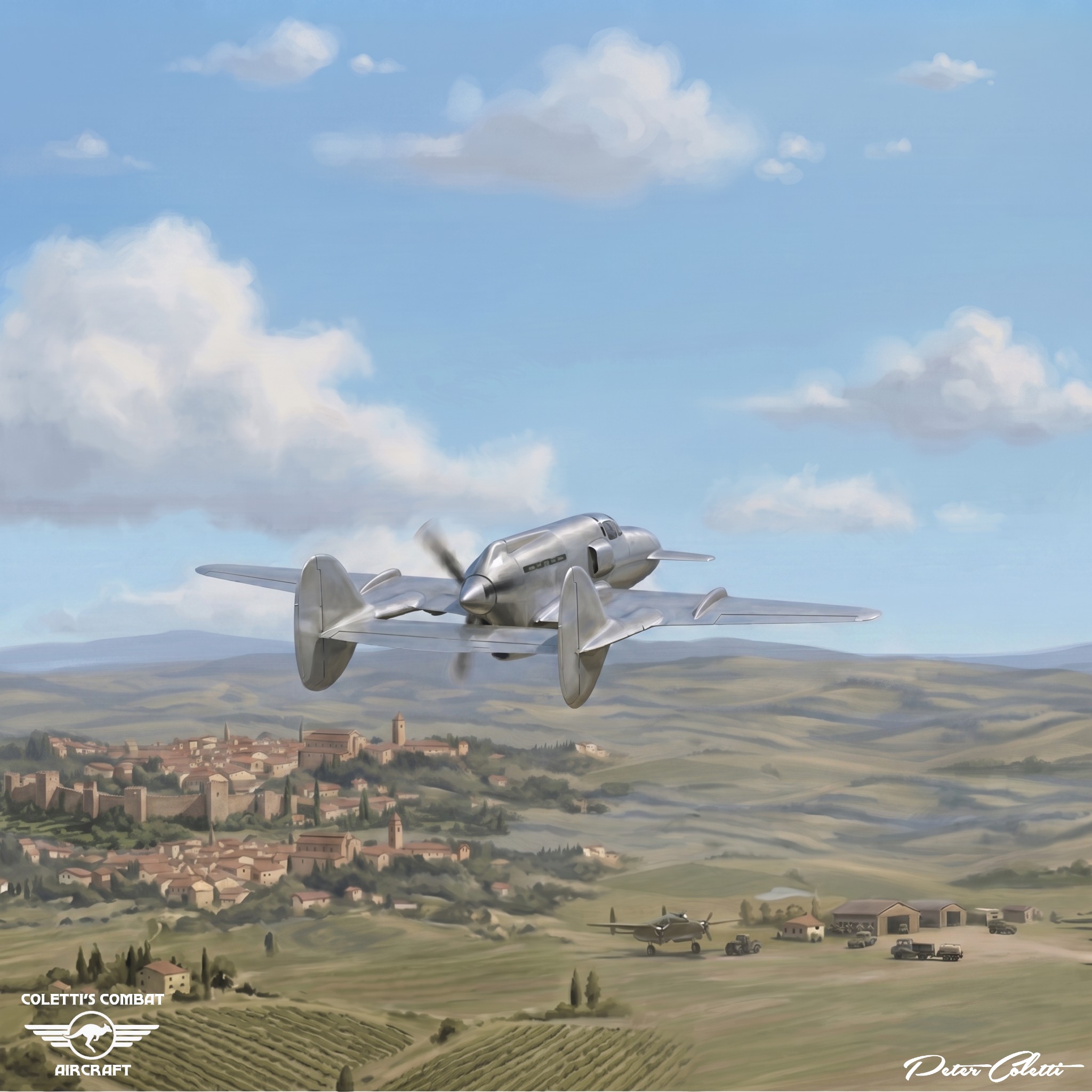
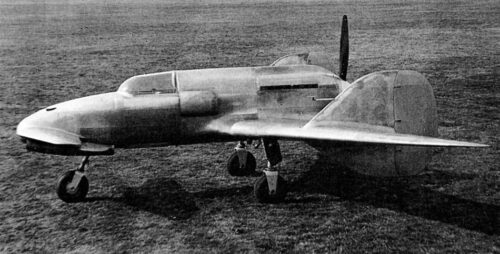
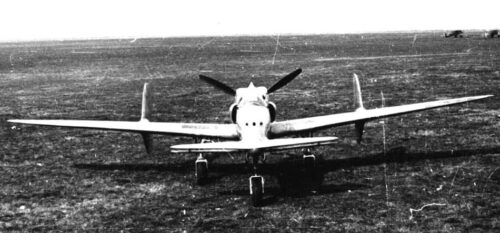
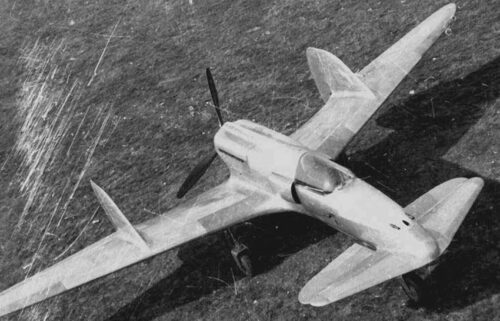
The SS.4 was a compact, single‑seat, all‑metal fighter with a very distinctive configuration:
Canard foreplane
A small forward wing near the nose, providing pitch control and contributing to lift.
Main wing
Set well aft, roughly mid-fuselage to rear, with moderate span and thickness.
Twin fins
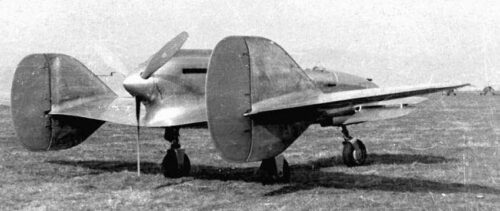
Vertical stabilisers mounted near the trailing edges of the main wing, one on each side, extending beyond the wing’s trailing edge.
Short fuselage
The cockpit sat just ahead of mid-length, with the engine behind the pilot and the propeller at the extreme rear.
Pusher propeller
Three‑bladed, variable‑pitch propeller driven by the rear‑mounted engine.
Retractable tricycle undercarriage
The nose wheel and two main wheels retract into the fuselage/wing, making the SS.4.
One of the first fighters with a retractable nose‑wheel gear.
This layout gave the SS.4 a “tail-first” appearance, with the small canard at the front and the main lifting surfaces behind.
It was aerodynamically unconventional but conceptually coherent:
The canard would stall first, dropping the nose and preventing a deep stall of the main wing.
Structure and materials
The aircraft was of all‑metal construction, a step up from the wooden SS.2 and SS.3:
Fuselage
Metal semi‑monocoque, designed to carry the loads of the rear engine and pusher propeller.
Wings
Metal structure with stressed skin, sized to provide adequate lift, with the canard contributing.
Control surfaces
Conventional hinged ailerons on the main wing, elevators on the canard, and rudders on the twin fins.
The structural design had to cope with unusual load paths—especially the engine mass and thrust line at the rear and the aerodynamic interactions between the canard and main wing.
Later events would show that some elements, particularly the aileron hinges and wing structure under dynamic loads, were not robust enough.
Powerplant and systems
Engine and propulsion
The SS.4 was powered by a single Isotta‑Fraschini Asso XI R.C.40:
Type
Liquid‑cooled V‑12 piston engine.
Power: About 960 hp(720 kW).
Installation
Mounted behind the cockpit, driving a rear pusher propeller via a direct shaft.
The pusher arrangement had several intended advantages:
Unobstructed nose
No engine or propeller in front, leaving space for heavy, concentrated armament.
Improved forward visibility
The pilot’s view forward and downward was excellent, especially combined with the tricycle gear.
Aerodynamic cleanliness
The fuselage nose could be shaped for low drag and good airflow to the canard.
However, this layout also introduced challenges:
Cooling
Getting adequate airflow to a rear‑mounted liquid‑cooled engine is non‑trivial, especially in a compact fuselage.
Vibration and structural loads
The engine and propeller at the rear imposed different vibration patterns and bending moments on the fuselage.
Pilot escape
With a propeller behind the cockpit and no ejection seat technology yet, safe bailout procedures were problematic.
Contemporary pusher designs sometimes used explosive bolts to jettison the propeller, but it is unclear how fully this was developed on the SS. 4.
Undercarriage and systems
The retractable tricycle landing gear was advanced for its time, especially in Italy:
Nose gear
Retracted rearwards into the forward fuselage.
Main gear
Retracted into the wing or fuselage roots.
Benefits
Better ground handling, reduced risk of nose‑over, and improved pilot visibility during taxi, takeoff, and landing.
Other systems—fuel, hydraulics, and controls—were conventional for a late‑1930s fighter but integrated into a very unconventional layout.
Cockpit, visibility, and armament
Pilot position and visibility
The pilot sat in an enclosed cockpit roughly in the centre of the fuselage, ahead of the fuel tanks and behind the nose armament.
Forward and lateral visibility
Excellent, thanks to the absence of a front engine and the tricycle gear stance.
Rearward visibility
Poor, as the main wing, engine, and twin fins blocked much of the view behind it.
This made the SS.4 conceptually strong as an interceptor—good for attacking from ahead or above—but potentially vulnerable in a turning fight where rearward awareness mattered.
Proposed armament
One of the most striking aspects of the SS.4 was its planned firepower:
1 × 30 mm cannon (likely hub-firing through the propeller axis or mounted centrally in the nose).
2 × 20 mm cannon in the nose.
All guns were concentrated in the forward fuselage, with no need for synchronisation gear or wing convergence.
This offered:
High hitting power for the era, comparable to or exceeding many contemporary fighters.
Straightforward aiming, since all rounds followed nearly the same line of fire.
In practice, the prototype never reached the stage of fully armed trials, but on paper the SS.4 would have been a heavily armed interceptor by 1939 standards.
Performance and estimated capabilities
Because the prototype crashed early in testing, most performance figures are estimates rather than fully verified data.
Typical figures reported:
Maximum speed
Often quoted around 540–571 km/h(about 335–355 mph).
Take-off weight
About 2,446–2,449 kg (around 5,400 lb).
Empty weight
Roughly 1,800 kg.
Wingspan
12.32 m (40 ft 5 in).
Length
6.74 m (22 ft 1 in).
Height
About 2.48–2.49 m (8 ft 2 in).
Wing area
17.5 m² (188 sq ft).
If these estimates are close to reality, the SS.4 would have been competitive in speed with early-war fighters and potentially superior in climb and acceleration thanks to its relatively low frontal area and concentrated mass.
The canard layout might also have given it good manoeuvrability at high angles of attack, though this was never fully explored.
Flight testing and crash
First flight
The sole SS.4 prototype made its maiden flight on 7 March 1939, flown by Ambrosini’s chief test pilot, Ambrogio Colombo, from the airfield at Castiglione del Lago.
Reports suggest that:
The aircraft showed promising stability and handling.
Engine vibrations and cooling issues were already apparent.
Even so, the initial impressions were positive enough to proceed with a second flight the next day.
Second flight and accident
On 8 March 1939, during the second test flight, disaster struck.
The sequence, as reconstructed from later accounts:
The starboard aileron reportedly failed or separated in flight.
This led to a high‑amplitude wing oscillation, likely a form of flutter or structural divergence.
The aircraft entered an uncontrollable dive and crashed.
Ambrogio Colombo was killed in the accident.
Some sources also mention that engine vibration, cooling problems, or structural weaknesses in the engine mountings may have contributed, but the immediate cause appears to have been a control surface/wing structural failure.
The crash ended active flight testing almost as soon as it had begun.
Variants and follow‑on plans
Planned second prototype
A second SS.4 prototype was reportedly ordered after the crash, with the intention of:
Strengthening the wing and control surface structures.
Addressing engine vibration and cooling issues.
Possibly refining the aerodynamics and systems based on the brief flight experience.
However, the project soon ran into the realities of Italy’s industrial and strategic priorities.
Programme cancellation
By the early 1940s:
The Regia Aeronautica and Italian industry were focusing on simpler, more conventional fighters, many of them wooden or mixed‑construction designs that could be built quickly and cheaply.
The SS.4, with its complex metal structure, unconventional layout, and unresolved technical issues, was seen as too risky and resource‑intensive.
In 1942, the development of the SS.4 was formally abandoned. No further prototypes were built, and the aircraft never entered operational service.
WWII context and significance
Place in pre-war fighter evolution
The SS.4 appeared at a moment when fighter design was in rapid transition:
Globally, designers were moving from biplanes to high‑performance monoplanes with retractable gear and enclosed cockpits.
Italy had produced elegant but often lightly armed fighters and was only beginning to field more powerful, heavily armed types.
In this context, the SS.4 was far ahead of mainstream Italian practice in several ways:
Canard configuration.
Pusher engine layout.
Tricycle landing gear.
Concentrated heavy nose armament.
All‑metal, high‑speed airframe.
It anticipated, in concept, later canard fighters such as the American Curtiss XP‑55 “Ascender” and the Japanese Kyushu J7W “Shinden”, both of which also used pusher propellers and unconventional layouts.
The SS.4 predates them and is often cited as the first canard fighter monoplane and among the first fighters with a retractable nosewheel undercarriage.
Why it did not progress
Several factors kept the SS.4 from becoming more than a footnote:
Technical risk
The crash exposed real structural and aeroelastic problems that would have required time and resources to solve.
Industrial constraints
Italy’s aircraft industry was already stretched; simpler designs promised quicker returns.
Doctrinal conservatism
Air forces tend to be cautious about radically unconventional fighters, especially on the eve of war.
War priorities
Once WWII began, Italy needed aircraft that could be produced and fielded quickly, not experimental concepts.
In a sense, the SS.4 was a technology demonstrator masquerading as a production candidate—brilliant in concept but not yet mature enough for wartime realities.
Legacy
Even though only one prototype flew—and only twice—the Ambrosini SS. 4 left a quiet legacy:
It proved that Italian engineers were capable of cutting‑edge, unconventional thinking in fighter design.
It contributed to the broader exploration of canard and pusher configurations that would resurface in later decades, especially with jet aircraft and modern canard fighters.
It stands as an example of how innovation and timing have to align: technically daring projects that arrive too early or in the wrong strategic climate often die after a single prototype.