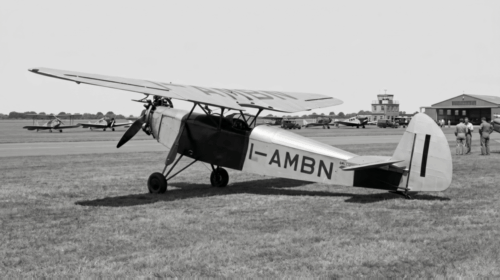
In the late 1930s, the Italian Ministero dell’Aeronautica pushed hard to expand the Regia Aeronautica’s pilot pool, anticipating a major European conflict.
That meant not just fighters and bombers, but a whole ecosystem of trainers—basic, intermediate, and advanced.
Need for modern primary trainers
Existing primary trainers were often biplanes or older designs.
A new generation of light, economical monoplanes was attractive: cheaper to build, easier to maintain, and closer in feel to modern combat aircraft.
Within this environment, SAI Ambrosini—already known for light aircraft—was tasked with producing a modern primary trainer.
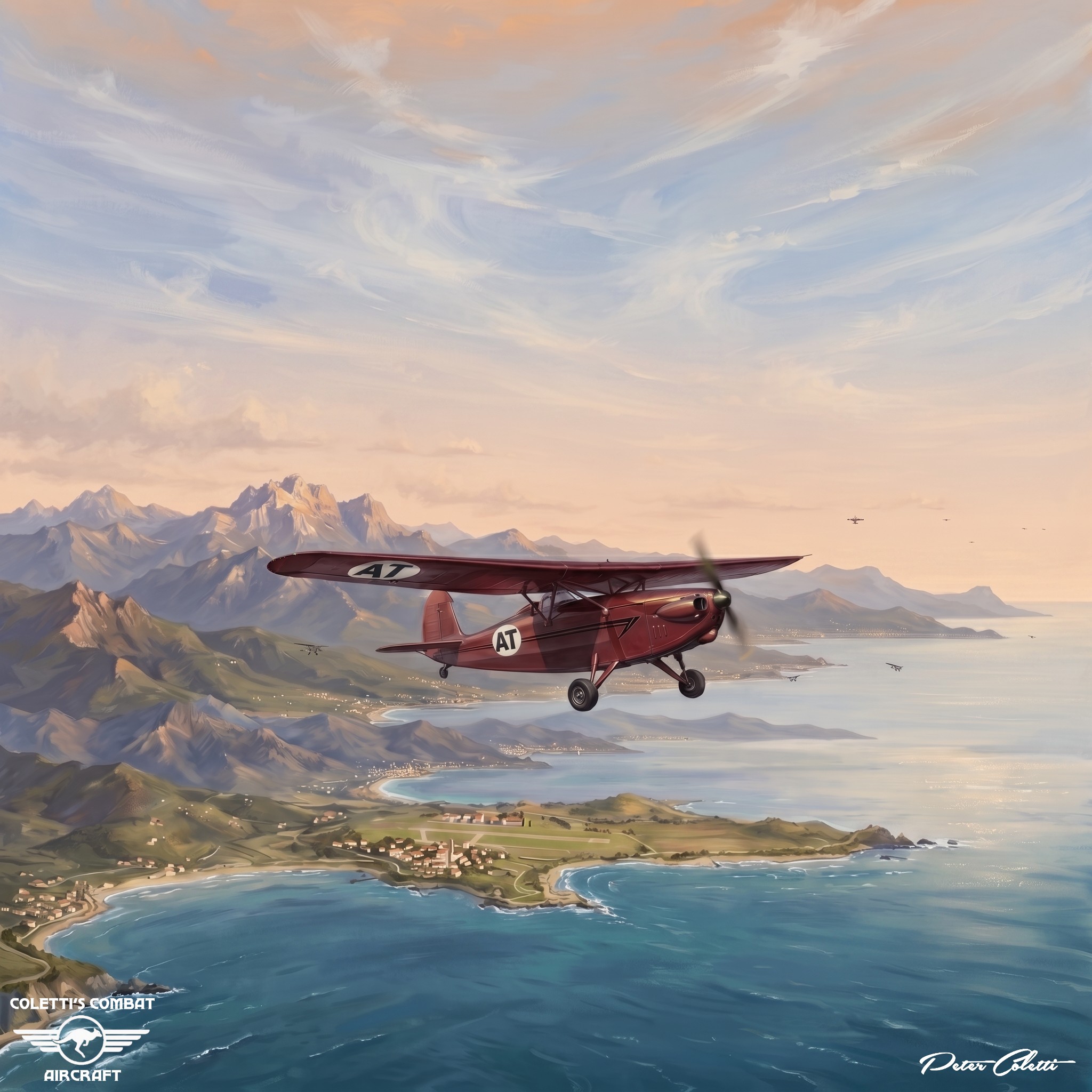
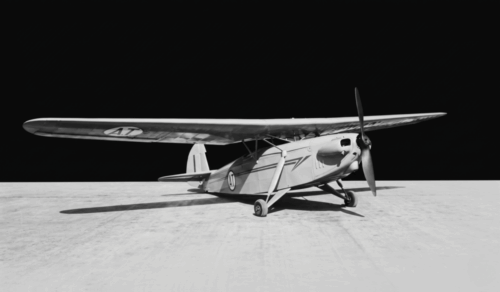
The result was the SAI.10 Grifone.
Development and programme history
Origins of the SAI. 10
Manufacturer
SAI Ambrosini (Società Aeronautica Italiana Ambrosini), an Italian firm with experience in light and sport aircraft.
Design leadership
The SAI.10 is generally credited to designer Camillo Silvia, who worked on a series of Ambrosini light aircraft.
Role
Primary military trainer (addestratore basico), intended for the early stages of pilot training.
Prototype and first flight
Configuration choice
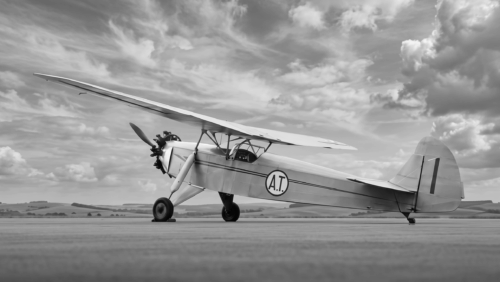
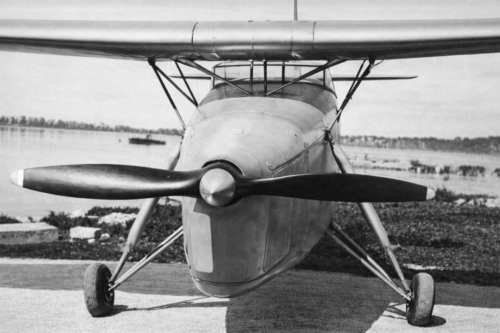
Ambrosini opted for a parasol-wing monoplane—a high wing carried above the fuselage on struts.
This gave:
Excellent downward visibility for landing and low‑level work.
Good stability and benign stall characteristics.
Simple structure and easy maintenance.
First flight
The prototype flew on 8 July 1939, piloted by Giuliano Ferrari.
Initial order
The Regia Aeronautica placed a production order for 50 aircraft, reflecting optimism about the type’s potential as a standard primary trainer.
Curtailment of production
Reduction to 10 aircraft
The order was quickly cut from 50 to just 10 production machines, all delivered in 1940.
Likely reasons (inferred):
Competing trainers
Italy already had several trainer types in service or development (e.g., Breda Ba.25, Nardi and other light monoplanes), creating overlap.
Industrial priorities
As war demands escalated, resources shifted towards combat aircraft and more standardised trainer fleets.
Limited advantage
The SAI.10, while competent, did not offer a decisive leap over existing types to justify large-scale production.
The result
The SAI.10 remained a minor, limited-run trainer, more a footnote than a pillar of Italian training doctrine.
Airframe and design features
General configuration
Type
A two‑seat, parasol‑wing primary trainer.
Crew
2—student and instructor in tandem.
Layout
Parasol wing mounted above the fuselage on struts.
Open cockpits (typical for primary trainers of the era), likely with simple windscreens.
Fixed, tailskid or tailwheel undercarriage, robust and simple for rough training fields.
Construction
Mixed construction
The SAI.10 used mixed wood and metal construction, a common Italian approach.
Fuselage
Likely a wooden structure with fabric covering, possibly with some metal fittings and reinforcement.
Wing
Wooden spars and ribs, fabric‑covered, with struts to the fuselage.
Control surfaces
Fabric‑covered, with conventional cable‑operated controls.
This kept the aircraft light, inexpensive, and easy to repair, ideal for a primary trainer.
Dimensions and layout
For the SAI.10 (and particularly the SAI.10 Gabbiano floatplane, from which most published data is derived)
Length
6.50 m (21 ft 4 in)
Wingspan
10.30 m (33 ft 9.5 in)
Height
2.10 m (6 ft 10.75 in)
Wing area
14.3 m² (154 sq ft)
These dimensions mark it as a compact, light trainer, closer in scale to a sport aircraft than to a large military machine.
SAI.11
Powerplant and systems
Engines across variants
The SAI.10 family is defined as much by its engine experiments as by its airframe.
Prototype engine:
The CNA D radial engine (a small Italian radial) was used on the first prototype.
Production engine:
Fiat A.50 radial, producing about 63 kW (85 hp).
This became the standard engine for the production SAI. 10 Grifone.
Experimental fits:
Siemens‑Halske Sh 14 radial (German), tested on at least one airframe.
The Alfa Romeo 110 inline or inverted inline engine; the aircraft fitted with this engine was redesignated SAI. 11.
This experimentation reflects Ambrosini’s attempt to find the best combination of availability, reliability, and performance in a rapidly changing wartime supply environment.
Fuel and systems (inferred)
Fuel system
Simple gravity‑feed or low‑pressure system from a wing or fuselage tank, typical of low‑power trainers.
Electrical and avionics
Minimal—basic instruments for VFR training: airspeed indicator, altimeter, turn‑and‑bank indicator, compass, and engine gauges.
Armament
None
The SAI.10 was a pure trainer, not a fighter trainer with guns.
Performance and handling
Weight and performance figures
For the SAI.10 (data commonly given for the Gabbiano floatplane, but broadly representative):
Empty weight
400 kg (880 lb)
Gross weight
615 kg (1,353 lb)
Powerplant
1 × Fiat A.50 radial,
63 kW (85 hp)
Maximum speed
187 km/h (116 mph, 101 kn)
Cruise speed
161 km/h (100 mph, 87 kn)
Given its low power and light weight, the SAI.10 would have had the following:
Gentle stall behaviour and forgiving low‑speed handling.
Short takeoff and landing distances, suitable for small fields.
Modest climb rate, adequate for training but not impressive by combat standards.
Handling qualities (inferred)
As a primary trainer, the SAI.10 was almost certainly tuned for the following:
Stability
Strong longitudinal and directional stability to help beginners.
Predictable stalls
Clean, easily recoverable stall with plenty of warning.
Responsive but not twitchy controls
Enough authority to teach coordination, but not so sensitive as to punish small errors.
In other words, it was designed to be kind to student pilots, not to mimic the sharpness of frontline fighters.
Variants and experimental developments
SAI.10 Grifone (baseline)
Role
Land‑based primary trainer.
Engine
Fiat A.50 radial (production), CNA D on prototype.
Production
10 aircraft built (plus prototype), delivered in 1940.
This is the “standard” SAI.10; most references mean when they say “Grifone”.
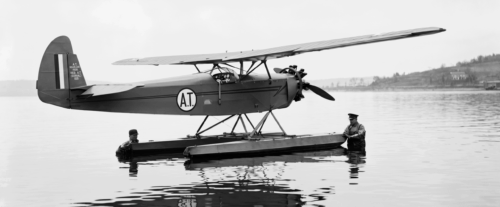
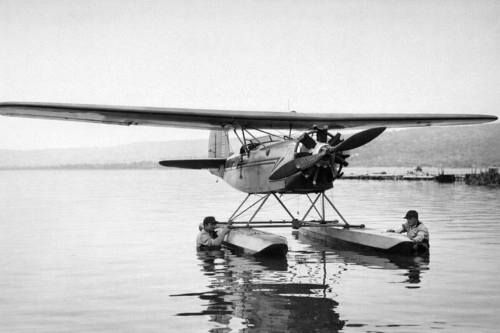
SAI.10 Gabbiano (floatplane)
Concept:
A float-equipped version of the SAI.10, named Gabbiano (“Seagull”), is intended as a seaplane trainer.
Configuration:
Main floats replacing the wheeled undercarriage.
Likely a small tail float for stability on water.
Purpose
To explore a maritime training role, possibly for naval or coastal aviation units.
Outcome
It remained experimental, with no evidence of series production.
SAI.11 (Alfa Romeo 110‑powered)
Engine change
Fitted with an Alfa Romeo 110 engine instead of the Fiat A.50.
Redesignation
This engine change was significant enough that the aircraft was redesignated SAI. 11.
Role
Still a trainer, but likely used as a testbed for engine integration and performance comparison.
Siemens‑Halske Sh 14 testbed
Engine
One SAI.10 was fitted with a Siemens‑Halske SH 14 radial, a German engine.
Purpose
Probably to evaluate compatibility with foreign powerplants, either for export possibilities or to hedge against Italian engine supply issues.
None of these variants led to large‑scale production, but together they show Ambrosini using the SAI. 10 airframes as a flexible test platform.
Operational use and WWII context
Service with the Regia Aeronautica
Primary operator
Regia Aeronautica (Kingdom of Italy).
Role in service
Used as a primary trainer in flying schools, likely in small numbers alongside more numerous types.
Scale
With only 10 production aircraft, the SAI.10 could never form the backbone of training; it was a supplementary type.
Why it remained obscure
Several factors kept the SAI. 10 in the shadows:
Competing designs
Italy fielded multiple trainers, and standardisation around more established types made logistical sense.
Wartime pressures
As the war intensified, Italy prioritised combat aircraft and rationalised its training fleet.
Limited production
Ten aircraft are barely more than a pre‑series batch; many contemporary trainers were built in the hundreds or thousands.
The SAI.10 thus became one of those “almost” aircraft—good enough to fly and serve but not compelling enough to dominate its niche.
Place in the broader WWII training ecosystem
In the wider WWII context:
Compared to Allied trainers
It was much smaller and less powerful than, say, the de Havilland Tiger Moth or Fairchild PT‑19, and far less numerous.
Italian doctrine
Italy’s training system was fragmented, with a mix of older biplanes and newer monoplanes.
The SAI.10 represents the modernising impulse within that system but not its final expression.
General characteristics (SAI.10 / SAI.10 Gabbiano data)
Crew
2 (student and instructor)
Length
6.50 m (21 ft 4 in)
Wingspan
10.30 m (33 ft 9.5 in)
Height
2.10 m (6 ft 10.75 in)
Wing area
14.3 m² (154 sq ft)
Empty weight
400 kg (880 lb)
Gross weight
615 kg (1,353 lb)
Powerplant
1 × Fiat A.50 radial,
63 kW (85 hp)
Performance
Maximum speed
187 km/h (116 mph, 101 kn)
Cruise speed
161 km/h (100 mph, 87 kn)
(Other performance figures like range and ceiling are not consistently published; given the power and weight, they would have been modest but adequate for local training flights.)
Assessment and legacy
The Ambrosini SAI. 10. Grifone is a classic “minor type”:
Technically, it was a sound, light, economical trainer with a clean parasol layout and forgiving performance.
Historically, it reflects Italy’s late‑1930s push to expand pilot training and experiment with modern monoplane trainers.
Programmatically, it was overtaken by events—competing designs, wartime resource constraints, and the need for standardisation.
Its real significance lies not in combat or mass production but in the texture of the Italian aviation landscape on the eve of WWII.
Small firms like Ambrosini were trying to carve out a role, experimenting with engines and configurations, and producing aircraft that, while never famous, tell you a lot about how mid-tier air power tried to prepare for a total war.