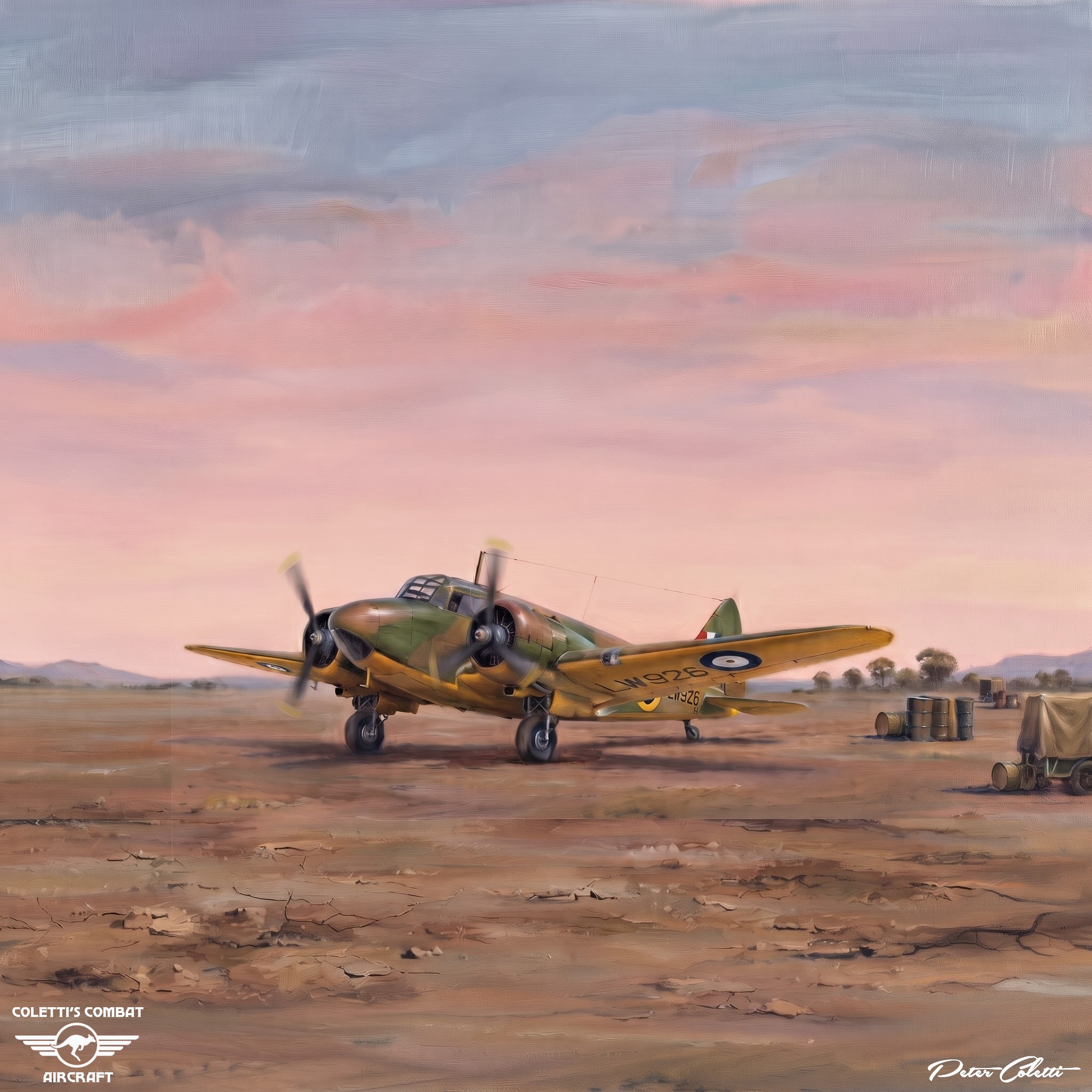
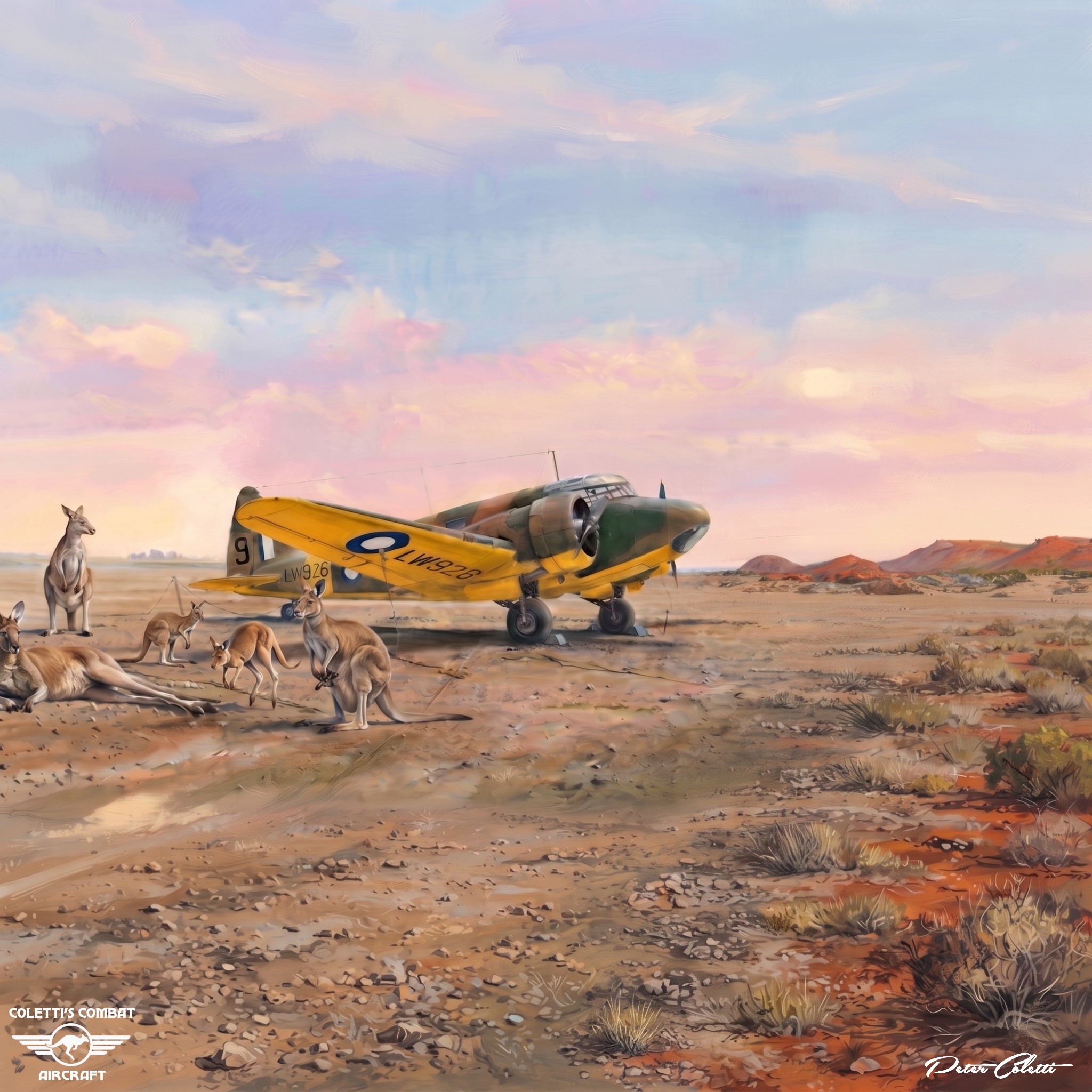
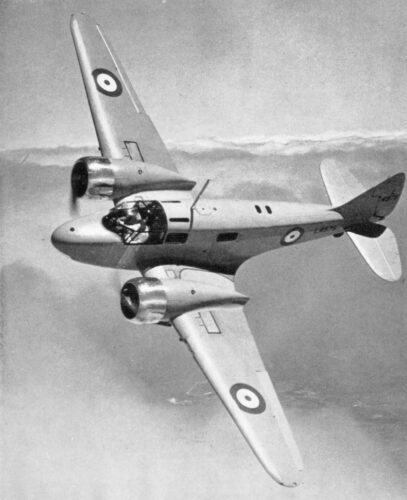
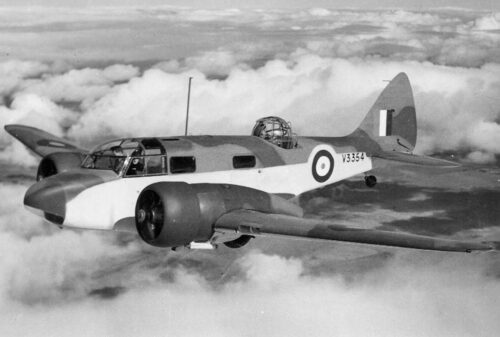
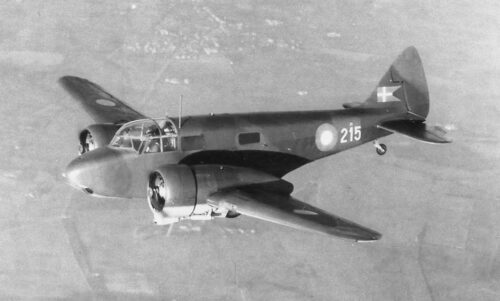
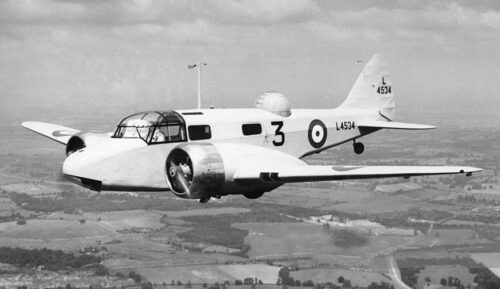
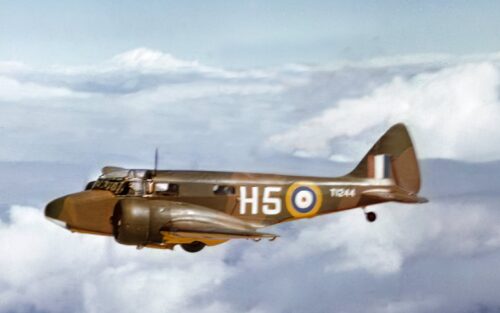
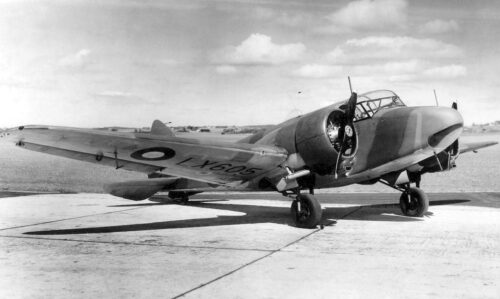
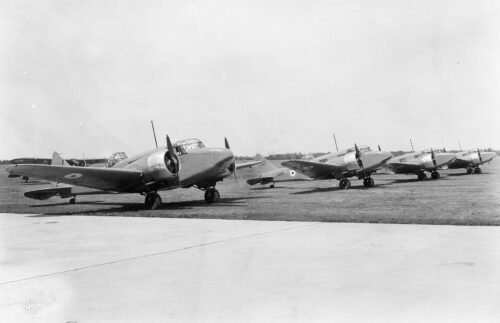
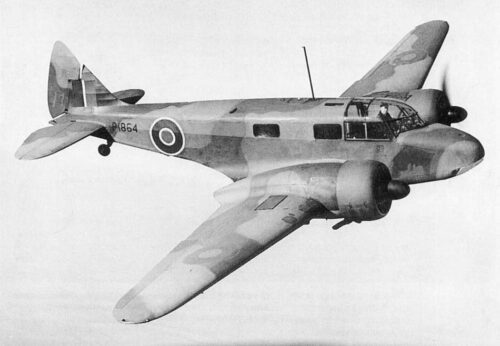
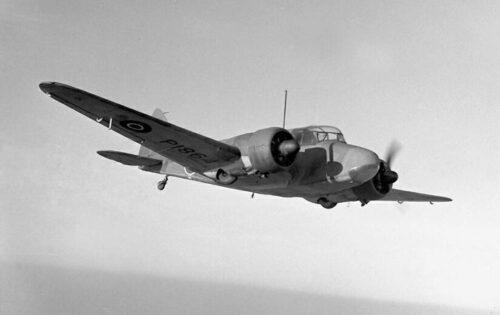
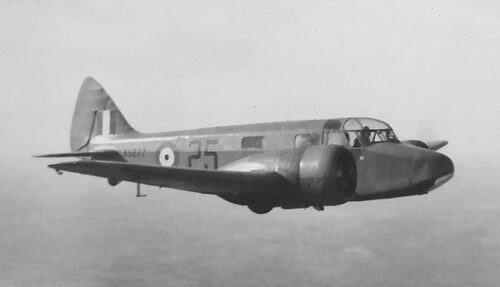
The Airspeed AS.10 Oxford was one of the most important British military training aircraft of the Second World War.
Designed as a twin‑engine advanced trainer, it provided the RAF and Commonwealth air forces with a platform for multi‑engine instruction, navigation training, wireless operation, bombing practice, and gunnery training.
Its versatility made it the backbone of the British Commonwealth Air Training Plan (BCATP), and more than 8,700 were built — making it one of the most numerous British aircraft of the war.
Origins and Development
Requirements
In the mid‑1930s, the RAF began modernising its bomber force, transitioning from biplanes to modern twin‑engine monoplanes such as the Armstrong Whitworth Whitley and Vickers Wellington.
This shift created an urgent need for a new generation of training aircraft capable of preparing crews for multi‑engine operations.
The Air Ministry issued Specification T.23/36 for a twin‑engine advanced trainer.
Airspeed Ltd is already working on the civil AS. 6 Envoy adapted that design into a military trainer with a strengthened airframe, revised cockpit, and military training equipment.
The result was the Airspeed AS.10 Oxford.
Prototype and Early Production
The prototype flew in June 1937.
Early production aircraft entered RAF service in 1938, just before the outbreak of war.
As the BCATP expanded, production accelerated dramatically, with aircraft built by Airspeed, de Havilland, Percival, and Standard Motors.
Design Characteristics
General Layout
The Oxford was a low‑wing, twin‑engine monoplane with the following:
Wooden wings and tail surfaces
A plywood‑covered fuselage
Retractable main landing gear
Dual controls for pilot training
Its twin Armstrong Siddeley Cheetah radial engines provided reliability and ease of maintenance – essential for training environments.
Training Equipment
The Oxford was designed as a multi-role trainer, capable of preparing whole bomber crews.
Depending on configuration, it could include:
Dual pilot controls
A bomb-aiming position with a bombsight
A dorsal gun turret for air-gunnery training
Wireless operator’s station
Navigation table
Camera ports for reconnaissance training
This flexibility made it the RAF’s most important advanced trainer.
Operational Military History
Pre‑War Service
The first Oxfords entered service with the RAF’s Central Flying School and No. 6 Flying Training School in 1938. They quickly replaced older biplane trainers and became the standard platform for multi‑engine instruction.
Second World War
British Commonwealth Air Training Plan (BCATP)
The Oxford became the backbone of the BCATP, operating in the following ways:
United Kingdom
Canada
Australia
New Zealand
Southern Rhodesia
South Africa
Thousands of pilots, navigators, wireless operators, and gunners trained on the type.
Its reliability and forgiving handling made it ideal for students transitioning to heavy bombers.
RAF Training Command
In Britain, the Oxford served with the following:
Flying Training Schools
Air Observer Schools
Bombing and Gunnery Schools
Wireless Training Units
Operational Training Units (OTUs)
It was used to prepare crews for aircraft such as the Wellington, Whitley, Halifax, and Lancaster.
Specialised Roles
Although primarily a trainer, the Oxford also performed several secondary military duties.
Communications and liaison flights
Air ambulance missions
Light transport
Coastal patrol training
Radar and radio trials
Its stable flight characteristics made it suitable for experimental and development work.
Combat‑Related Use
The Oxford was not designed for combat, but it occasionally found itself in operational situations:
During the early war years, some were used for coastal patrols and anti‑invasion readiness.
A small number were fitted with light armament for gunnery training, including a dorsal turret.
In emergencies, Oxfords were used to evacuate personnel or deliver urgent supplies.
However, it was never intended as a frontline combat aircraft.
Postwar Service
RAF and Commonwealth
After 1945, the Oxford continued to serve as a trainer and communications aircraft.
It remained in RAF service until the early 1950s, gradually replaced by the Airspeed Consul (civil conversion) and later by the Vickers Varsity.
Foreign Operators
Postwar users included:
Royal Australian Air Force
Royal New Zealand Air Force
Royal Canadian Air Force
South African Air Force
Belgian Air Force
French Air Force
Portuguese Air Force
Egyptian Air Force
Indian Air Force
Many nations used the Oxford as a transitional trainer for pilots moving to modern twin-engine transports and bombers.
Variants (Military-Relevant)
Oxford Mk I
Primary advanced trainer with:
Dual controls
Bomb-aiming position
Dorsal turret for gunnery training
This was the most common wartime version.
Oxford Mk II
Designed for navigation and wireless training:
No turret
Additional radio equipment
Navigation table and training stations
Oxford Mk III
Improved version with:
Revised cockpit
More powerful Cheetah engines
Strengthened structure
Used for multi‑engine pilot training.
Oxford Mk IV
Postwar development with:
Updated instrumentation
Improved electrical systems
Used mainly for communications and transport
Production
Total production exceeded 8,700 aircraft, built by:
Airspeed
de Havilland
Percival
Standard Motors
This made the Oxford one of the most numerous British aircraft ever built.
Legacy
The Airspeed Oxford trained the majority of RAF and Commonwealth multi‑engine aircrew during the Second World War.
Its influence extended far beyond its modest appearance: every bomber pilot, navigator, and wireless operator who flew in the great Allied bombing campaigns almost certainly trained on an Oxford.
Specifications
Crew
3
Length
34 ft 6 in (10.52 m)
Wingspan
53 ft 4 in (16.26 m)
Height
11 ft 1 in (3.38 m)
Wing area
348 sq ft (32.3 m²)
Empty weight
5,322 lb (2,414 kg)
Gross weight
7,500 lb (3,402 kg)
Fuel capacity
156 imp gal (187 US gal; 710 L)
Powerplant
2 × Armstrong Siddeley Cheetah X radial engines,
350 hp (260 kW) each
Performance
Maximum speed
192 mph (309 km/h, 167 kn)
Endurance
5.5 hr
Service ceiling
23,550 ft (7,180 m)
Rate of climb
1,340 ft/min (6.8 m/s)
Armament
Guns
1 × 0.303 in (7.7 mm) Vickers K machine gun in dorsal turret
Bombs
16 × 11.5 lb (5.2 kg) practice bombs carried externally.