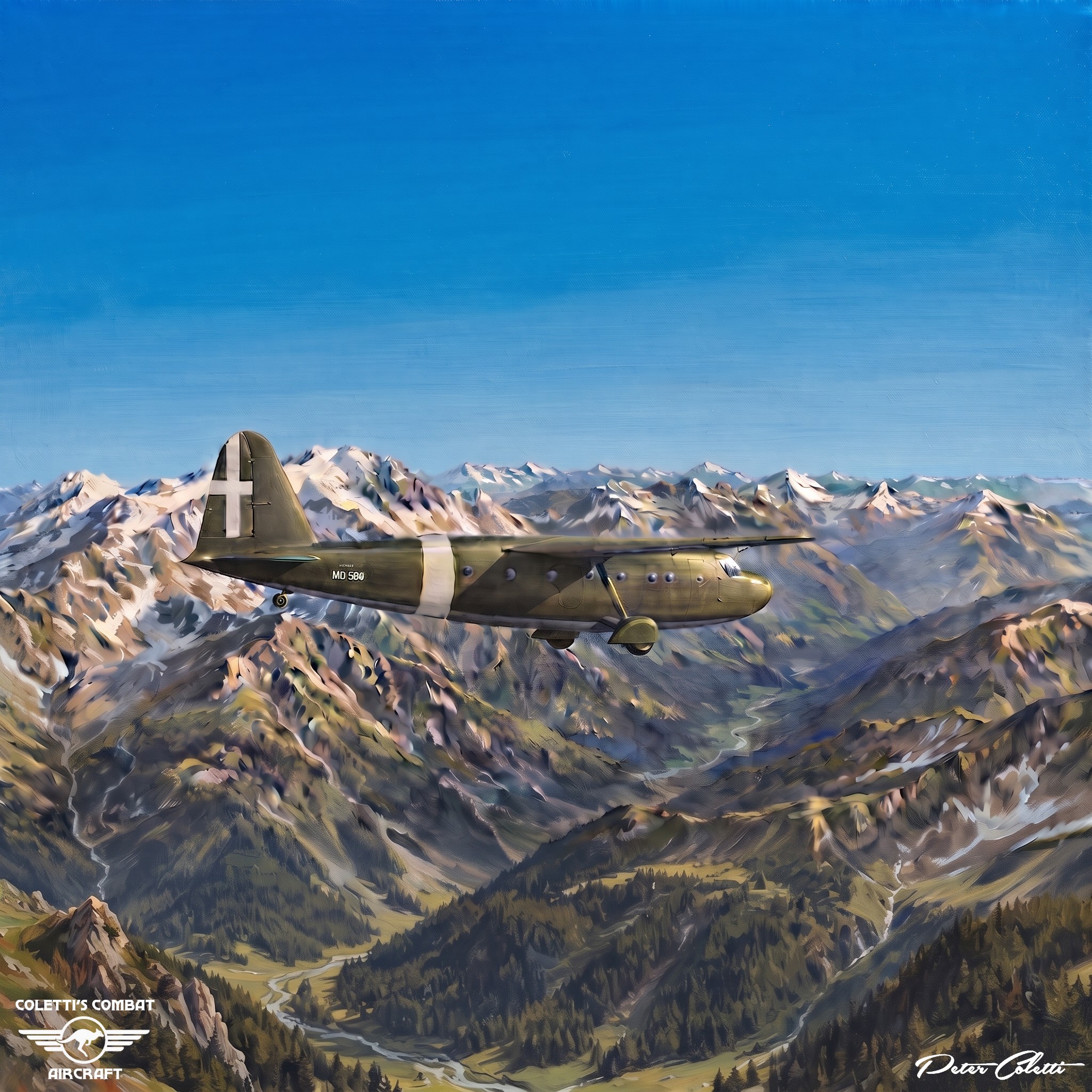
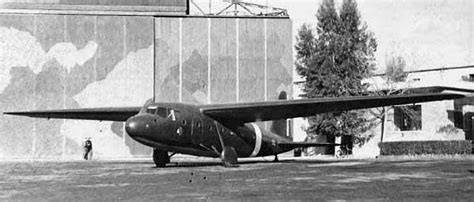
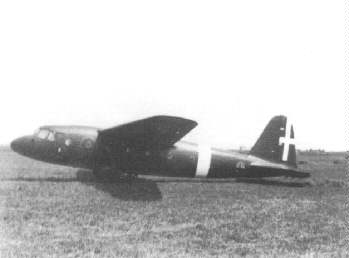
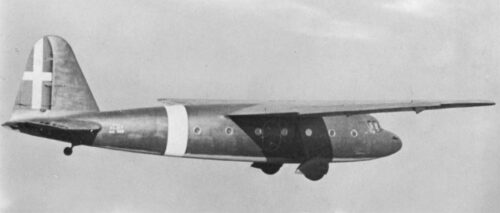
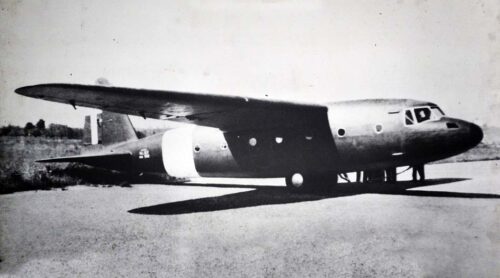
The Aeronautica Lombarda AL‑12P was an Italian military transport glider developed during the Second World War.
Designed by A. Ambrosini and built by Aeronautica Lombarda, it first flew in 1943.
Italy sought to expand its airborne capability, inspired by German successes with assault gliders, and the AL‑12P was intended to fill the role of a medium‑capacity troop and cargo glider.
Production was limited due to wartime industrial strain and the collapse of Fascist Italy in 1943.
Only 16 examples were completed before the programme ended.
Design & Construction
The AL‑12P was a high‑wing, cantilever monoplane glider, built almost entirely of wood to conserve strategic materials.
Key structural features
Fuselage: Wooden structure with moulded plywood skin, using Italian stressed‑plywood techniques.
Wing: Spruce plywood main spar with plywood skin and fabric-covered ailerons.
Spoilers: Large slotted spoilers above and below the wing for descent control.
Cockpit: Two‑seat arrangement (pilot + co‑pilot) in a steel‑tube nose section.
Nose section: Hinged to open sideways, allowing direct loading of cargo.
Access: Additional passenger door on the right side of the fuselage.
Capacity
12 fully equipped troops, or equivalent cargo weight.
The design emphasised simplicity, low cost, and ease of production — typical of wartime gliders.
Performance (as a glider)
Because the AL‑12P was unpowered, its performance depended on the towing aircraft.
However, its aerodynamic layout provided the following:
Stable flight characteristics
Controlled glide path using its large spoilers
Ability to land on short or improvised fields
Exact glide ratios and tow speeds were not widely documented, but the aircraft was comparable to other mid‑war European transport gliders.
Variants
The AL‑12P had no wartime variants.
It existed only as a pure transport glider during WWII.
(Any powered conversions occurred after the war and are not part of its WWII history.)
Operational History in WWII
The AL‑12P saw very limited operational use due to:
Its late introduction in 1943
Small production run (16 units)
The armistice and collapse of the Italian military shortly after its debut
Italy had intended to use the AL‑12P for airborne troop delivery and light cargo transport, similar to German glider operations.
However, the aircraft never reached large‑scale deployment and did not participate in any major airborne assaults.
Most AL‑12Ps were likely used for:
Training
Evaluation
Limited transport tasks
Its operational impact was minimal, but it remains notable as one of Italy’s few military glider designs of the war.
Technical Specifications (AL‑12P glider)
Crew
2
Capacity
12 troops
Length
14.02 m
Wingspan
21.34 m
Wing area
50.7 m²
Empty weight
1,588 kg
Gross weight
2,812 kg
(No engine, as it was a pure glider.)
Summary
The Aeronautica Lombarda AL‑12P was Italy’s attempt to field a practical military transport glider during WWII.
Well‑designed and structurally efficient, it nonetheless arrived too late and in too few numbers to influence the war.
Its significance lies in representing Italy’s late‑war airborne ambitions and its use of advanced plywood construction techniques.