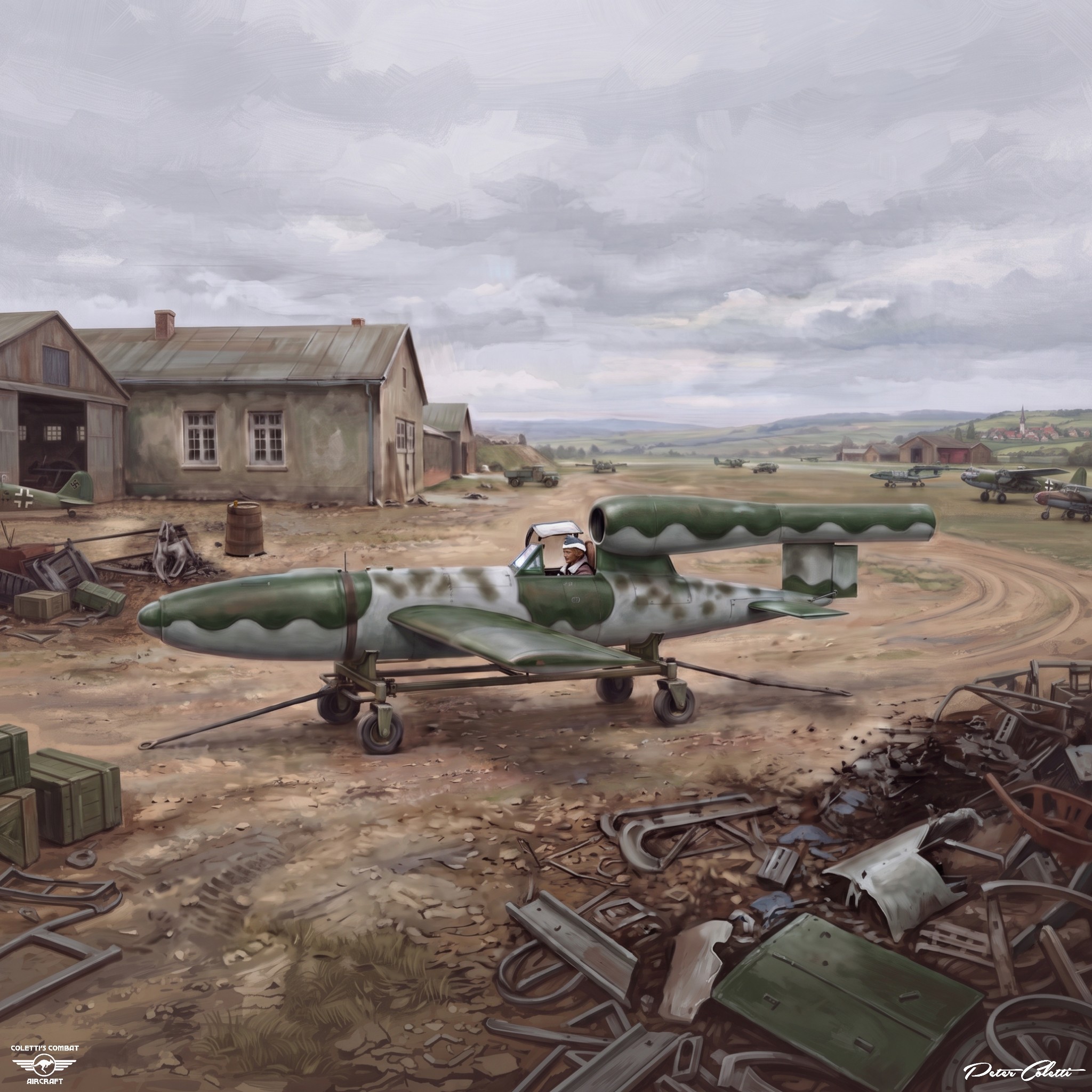
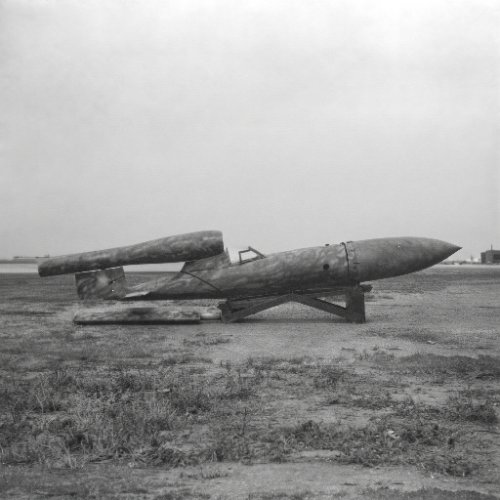
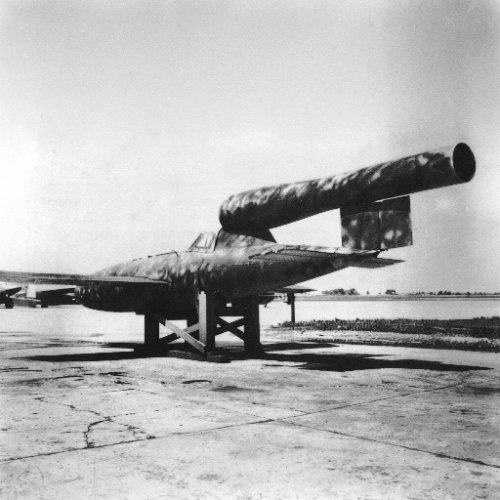
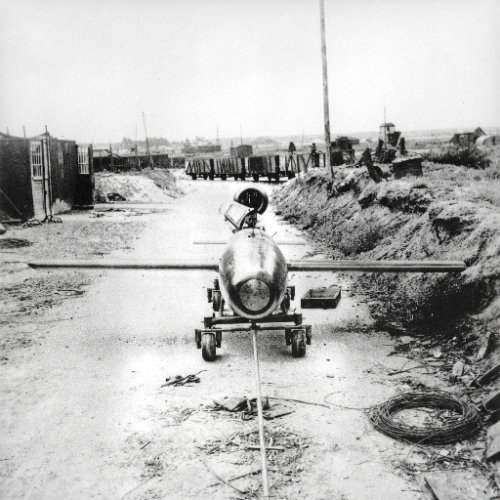
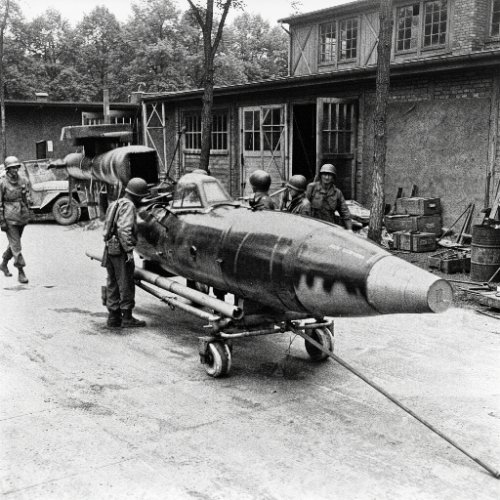
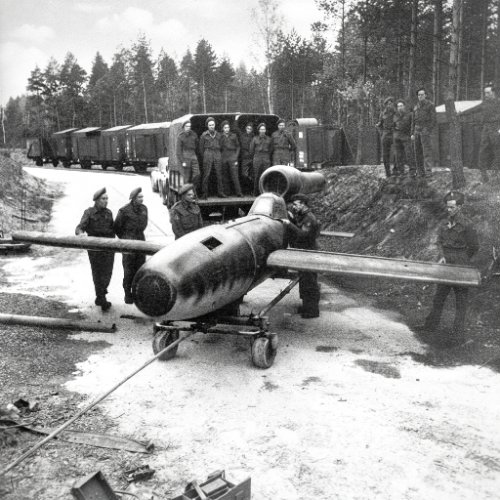
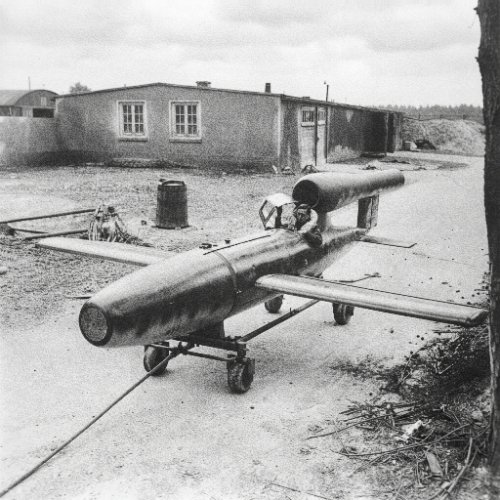
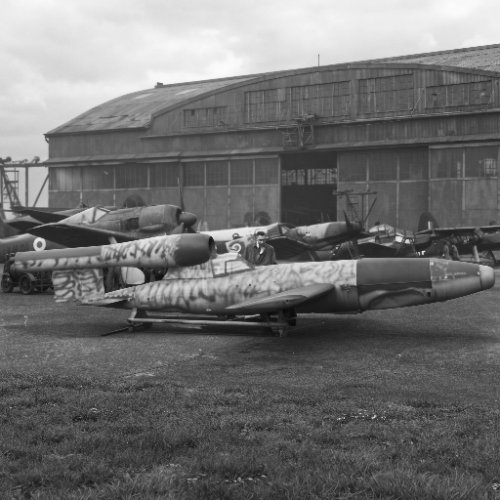
The Fieseler Fi 103R Reichenberg was a manned version of the German Fieseler Fi 103, better known as the V-1 flying bomb.
Developed during the final stages of the Second World War, it was intended to serve as a human-guided precision attack weapon against high-value Allied targets, particularly shipping.
Although frequently described as a suicide aircraft, German authorities officially maintained that the pilot would attempt to parachute clear immediately before impact.
In reality, the chances of survival would have been extremely low.
The project never progressed beyond testing and training, and no operational combat missions were flown.
Approximately 175 aircraft were completed before the programme was abandoned.
Fieseler Fi 103 Reichenberg
Historical Background
By 1944 Germany faced a steadily worsening military situation.
Allied forces had established air superiority over much of Europe, while strategic bombing campaigns were inflicting severe damage on German industry and infrastructure.
Conventional Luftwaffe attack methods were becoming increasingly ineffective against heavily defended naval and strategic targets.
At the same time, various German military and political figures began advocating unconventional solutions.
Among these was the concept of a piloted guided missile capable of striking targets with far greater accuracy than existing bombs or unmanned guided weapons.
The proposal gained support from individuals, including the famous test pilot Hanna Reitsch, who argued that volunteers could be recruited for extremely hazardous missions.
A special unit known as the Leonidas Squadron was established within Kampfgeschwader 200, Germany’s secret operations wing.
Volunteers were recruited and began training for missions involving manned explosive aircraft and guided weapons.
Origin of the Reichenberg Project
The Fi 103R emerged from efforts to increase the accuracy of the V-1 flying bomb.
The standard V-1 was a pulsejet-powered cruise missile carrying a large warhead.
While capable of reaching Britain and other targets, its guidance system was relatively crude and inaccurate.
German planners reasoned that replacing the automatic guidance system with a human pilot would allow precise attacks against:
Allied warships
Major bridges
Port facilities
Concentrated troop formations
Strategic infrastructure
An earlier attempt to create a piloted missile using the Messerschmitt Me 328 had encountered major technical problems.
As a result, attention shifted to adapting the proven V-1 airframe.
The designation “Reichenberg” referred to the city of Reichenberg (now Liberec in the Czech Republic), where much of the developmental work was conducted.
Fieseler Fi 103 Reichenberg
Design and Construction
The Fi 103R retained the basic structure of the V-1 flying bomb while incorporating a cockpit and flight controls.
General Configuration
The aircraft consisted of:
A welded steel-tube fuselage structure.
Sheet metal skinning.
Straight mid-mounted wings.
Twin vertical stabilisers at the ends of the horizontal tailplane.
A pulsejet engine mounted above the rear fuselage.
The overall layout remained almost identical to the standard V-1.
Cockpit
The primary modification was a small cockpit inserted directly ahead of the air intake and behind the warhead section.
The cockpit featured:
A simple instrument panel.
Basic flight instruments.
Control stick.
Rudder pedals.
Armoured windscreen.
Hinged canopy.
The pilot sat in an extremely cramped position with limited visibility and little protection.
Fieseler Fi 103 Reichenberg
Flight Controls
Unlike the unmanned V-1, the Reichenberg included:
Conventional aileron controls.
Elevator controls.
Rudder controls.
Manual trim systems.
These permitted complete pilot control throughout the attack run.
Warhead
The operational version carried an explosive warhead weighing approximately 850-900 kg.
This payload was comparable to that of the standard V-1 and capable of causing severe damage to large ships or hardened targets.
Propulsion System
The Fi 103R used the same Argus As 014 pulsejet engine employed by the V-1.
Argus As 014
Characteristics included:
Pulsejet design.
Approximately 3.4 kN (770 lb) thrust.
Extremely simple construction.
Low manufacturing cost.
Distinctive buzzing sound in operation.
The pulsejet produced thrust through rapid intermittent combustion cycles rather than continuous combustion as in a turbojet.
Advantages:
Cheap and easy to mass-produce.
Required relatively little strategic material.
Disadvantages:
High fuel consumption.
Intense vibration.
Deafening noise.
Limited efficiency.
Significant structural stresses.
Pilots reported severe vibration throughout the airframe, making accurate flying difficult.
Variants
Several versions were developed to facilitate pilot training.
Fi 103R-I
The first training version.
Features:
Single-seat layout.
No engine.
No warhead.
Used for ground handling and familiarisation.
Fi 103R-II
An improved unpowered trainer.
Features:
Used for glider training.
No operational equipment.
Allowed pilots to experience flight characteristics.
Fieseler Fi 103 Reichenberg
Fi 103R-III
Dual-control training version.
Features:
Two-seat arrangement.
The instructor and trainee are seated in tandem.
Powered by a pulsejet.
Intended to prepare pilots for operational aircraft.
Fi 103R-IV
Operational combat version.
Features:
Single pilot.
Full pulsejet propulsion.
Large explosive warhead.
Intended combat configuration.
Flight Testing
Flight testing began during 1944.
The programme quickly revealed serious deficiencies.
Handling Characteristics
Test pilots encountered:
Poor controllability at high speed.
Heavy control forces.
Aerodynamic instability.
Severe vibration from the pulse jet.
The aircraft also possessed dangerous stall characteristics and was difficult to recover from unusual flight attitudes.
Accidents
The first flight tests resulted in crashes that highlighted the aircraft’s shortcomings.
Several test aircraft were lost during development, reinforcing concerns regarding pilot survivability and operational practicality.
Pilot Escape Problem
A major flaw involved the supposed escape procedure.
The official concept required the pilot to:
Guide the aircraft to the target.
Open the canopy.
Exit the aircraft.
Deploy a parachute.
However:
Speeds exceeded 600 km/h.
The cockpit sat directly ahead of the pulse jet.
Strong airflow and engine effects made escape highly dangerous.
There was minimal time before impact.
Many engineers and pilots considered successful escape virtually impossible.
Performance
General Characteristics
Type: Piloted flying bomb / manned missile
Crew: 1
Length: 8.0 m
Wingspan: 5.7 m
Powerplant: 1 × Argus As 014 PulseJet
Warhead: approximately 850-900 kg high explosive
Maximum speed: about 640-650 km/h
Service ceiling: roughly 4,000 m
Production: approximately 175 aircraft built
Intended Operational Use
The Fi 103R was primarily intended for attacks against:
Allied invasion fleets.
Large naval vessels.
Port facilities.
Bridges.
Strategic infrastructure.
Launch methods under consideration included:
Air launch from larger aircraft.
Ground launch ramps are similar to those used for V-1 operations.
Pilots would guide the aircraft visually during the terminal phase, dramatically improving accuracy compared with the standard V-1.
Fieseler Fi 103 Reichenberg
Cancellation
By late 1944 the project faced growing opposition.
Several factors contributed:
Unsatisfactory flight-test results.
Poor pilot survival prospects.
Limited military value.
Scarcity of trained aviators.
Rapid deterioration of Germany’s strategic position.
Senior figures including Albert Speer and Werner Baumbach argued against committing trained pilots to near-suicidal missions.
Adolf Hitler ultimately ordered the programme cancelled before it entered combat service.
Historical Significance
The Fi 103R Reichenberg represents one of the most extreme examples of late-war German weapons development.
It emerged from the same atmosphere that produced numerous “wonder weapons” intended to reverse Germany’s military fortunes through technological innovation.
Although never used operationally, the Reichenberg is historically important because it combined characteristics of:
A conventional aircraft.
A guided missile.
A precision attack weapon.
A manned cruise missile.
The design anticipated later developments in precision-guided munitions while simultaneously revealing the limitations and desperation of Germany’s wartime situation. It remains one of the most controversial aircraft projects of the Second World War and an unusual transitional step between piloted aircraft and modern guided missiles.