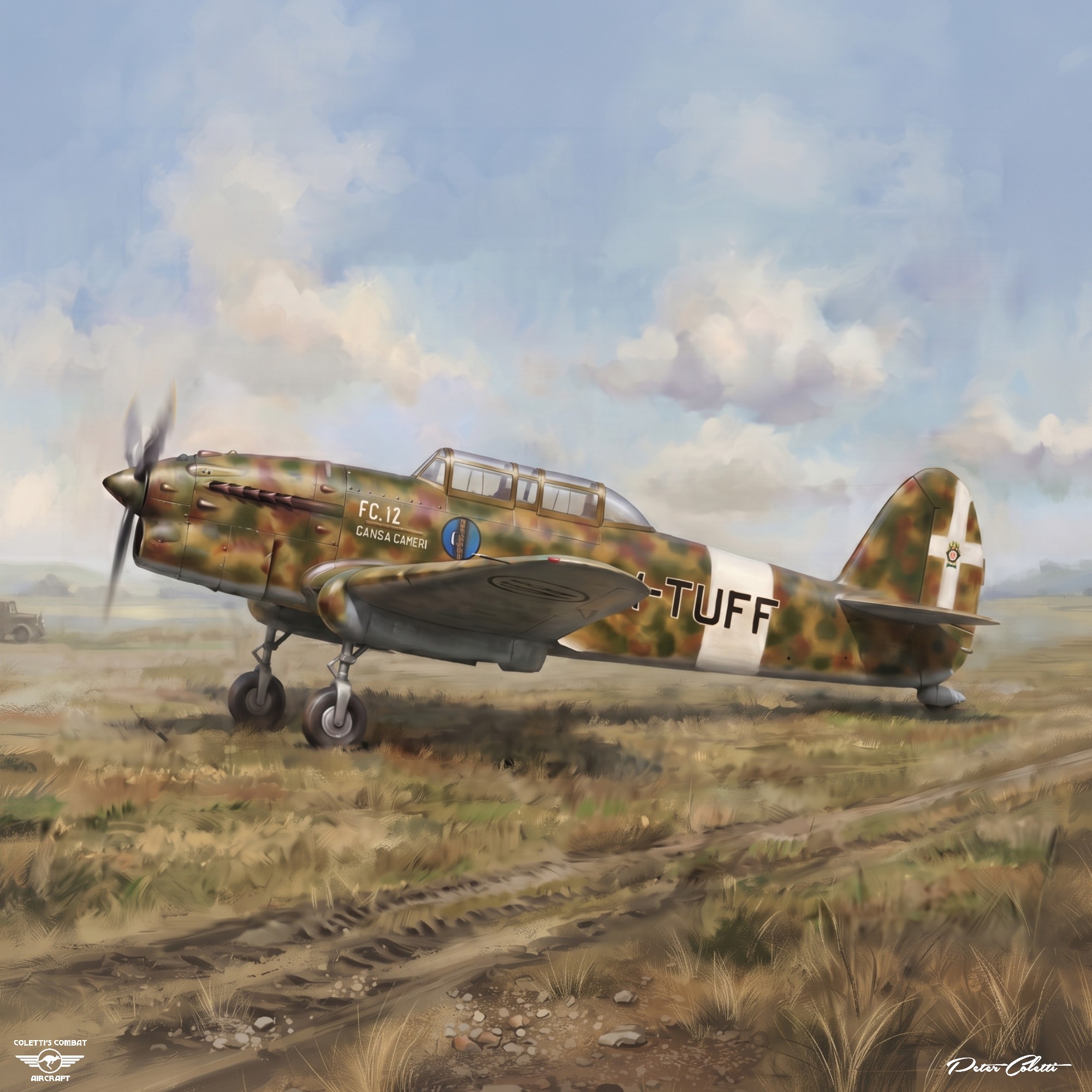
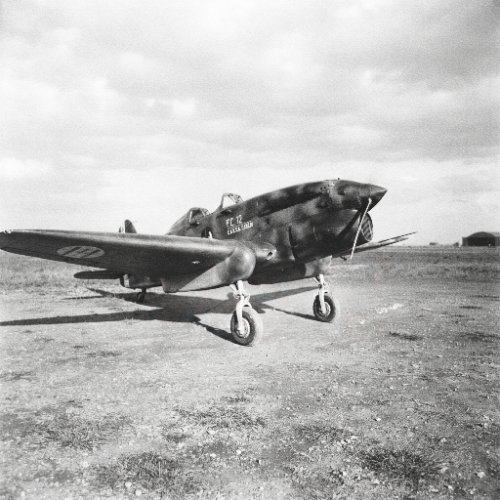
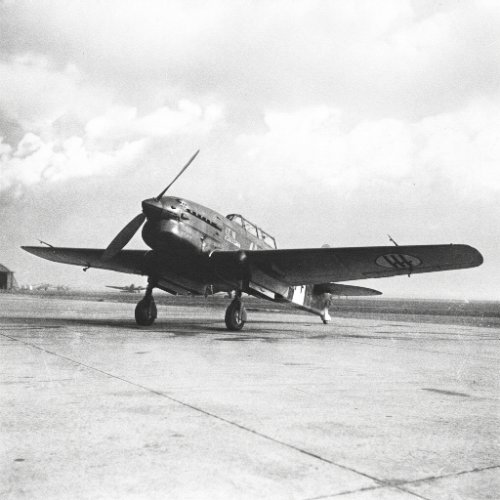
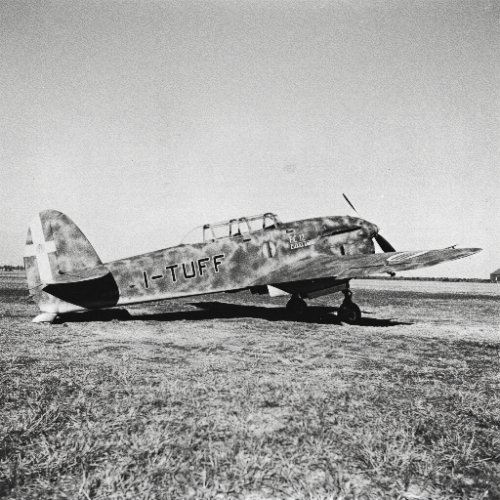
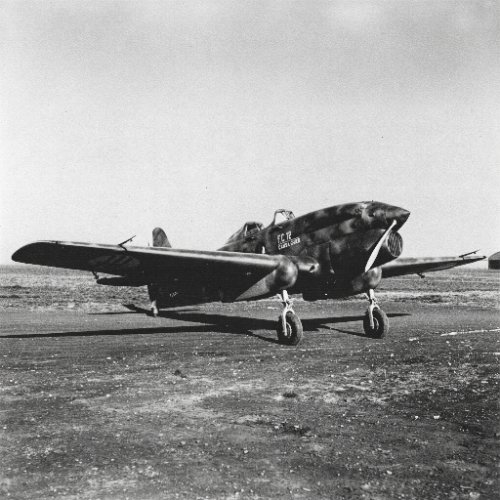
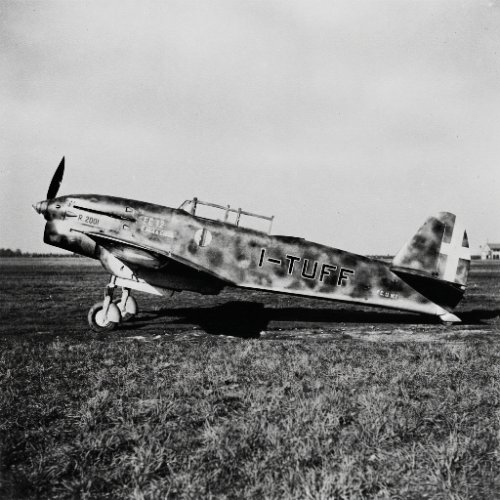
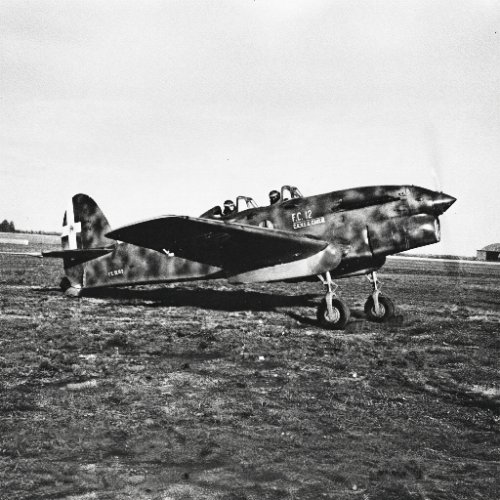
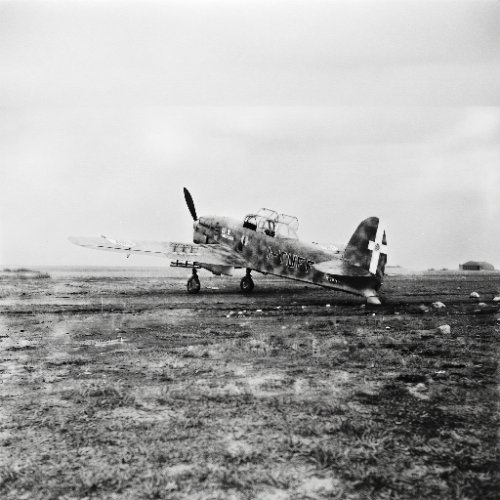
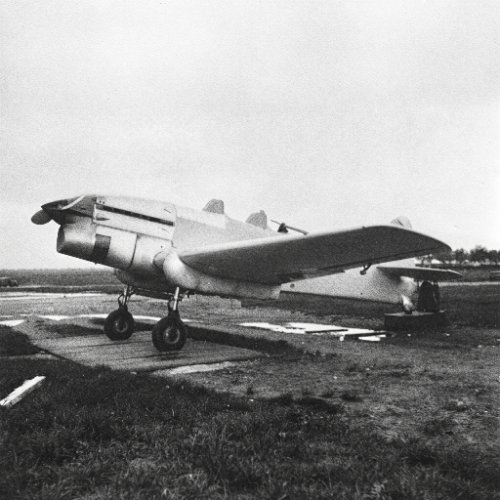
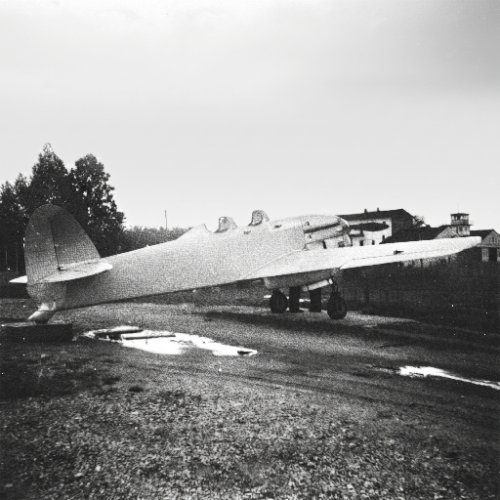
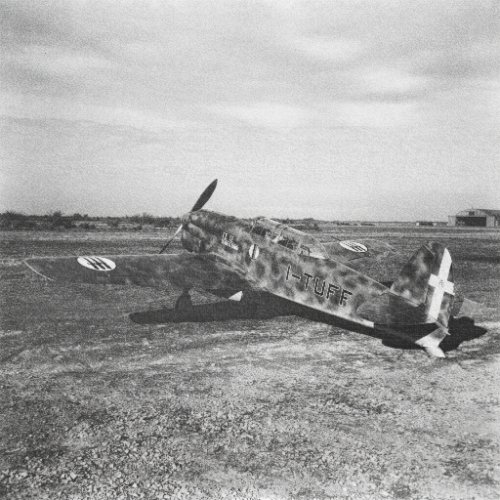
Introduction and Development Context In the late 1930s, the escalating demands for advanced military training and specialised tactical support aircraft led CANSA (Construzioni Aeronautiche Novaresi S.A.), a subsidiary of the industrial titan Fiat located in Cameri, Novara, to conceptualise a versatile light aircraft.
Formally presented to the Italian Ministry of Aeronautics in June 1939, the project was engineered primarily under the direction of designer Giacomo Mosso.
The designation FC.12 (Fiat-Cansa) was conceived as a multi-role platform intended to fill roles spanning advanced fighter instruction, gunnery training, and tactical dive-bombing preparation.
To ensure low production costs and ease of manufacturing using domestic resources, the design leveraged existing automotive and aeronautical components, notably utilising the proven Fiat A.30 R.A.bis liquid-cooled V-12 engine—the same powerplant that had driven earlier Italian fighter designs like the Fiat CR.32.
The prototype made its maiden flight on October 16, 1940, piloted by Fausto Moroni at Cameri airfield.
However, as the realities of World War II shifted tactical requirements away from specialised intermediate trainers towards frontline combat assets, the aircraft’s mandate was modified.
The design was re-targeted into a light ground attack and close-support platform.
Despite its promising aesthetic and nimble layout, production was strictly limited; alongside the prototype, only a small pre-series batch of approximately 10 production airframes was completed, rendering the FC.12 a rare footnote in Italian wartime aviation.
Technical Design and Structural Layout
The Fiat-Cansa FC.12 was constructed as a single-engine, low-wing cantilever monoplane featuring a mixed structure combining a robust metal framework with wooden or light-alloy elements depending on sub-assemblies.
Fuselage and Wings: The fuselage possessed a streamlined semi-monocoque profile.
The cantilever low-wing layout featured straight-tapered plans with rounded tips, housing integrated fuel tanks and structural attachment points.
Flight Controls and Braking: To satisfy its dive-bombing training pedigree, the aircraft was fitted with short-span dive brakes located on the undersides of the outer wings, supplemented by mid-span, mid-chord spoilers to aid in descent control.
All tail control surfaces were horn-balanced and featured adjustable trim tabs.
Landing Gear: The FC.12 featured a conventional retractable tailwheel undercarriage.
The main gear legs retracted rearward into narrow, full-chord under-wing fairings, leaving the lower portion of the wheels partially exposed to simplify emergency mechanical deployment mechanisms.
Powerplant: Propulsion was supplied by a single Fiat A.30 R.A.bis upright V-12 liquid-cooled piston engine, rated at 600 hp (450 kW), coupled with a prominent chin-mounted coolant radiator and driving a two-bladed metal propeller.
Accommodation: The crew of two (pilot and student/gunner) sat in tandem under a long, multi-framed greenhouse canopy, providing good all-around visibility essential for instructional and operational observation tasks.
Performance Specifications (FC.12 Production Standard)
Crew: 2 (pilot and observer/gunner)
Length: 7.52 m (24 ft 8 in)
Wingspan: 10.00 m (32 ft 10 in)
Height: 2.31 m (7 ft 7 in)
Wing Area: 19.80 m² (213 sq ft)
Empty Weight: 1,796 kg (3,960 lb)
Gross/Max Takeoff Weight: 2,320 kg (5,115 lb)
Powerplant: 1 × Fiat A.30 R.A.bis V-12 liquid-cooled engine, 600 hp
Maximum Speed: 452 km/h (281 mph / 244 kn)
Operational Range: 1,339 km (832 mi / 723 nmi)
Service Ceiling: 7,120 m (23,350 ft)
Variants and Modifications Due to its brief and restricted manufacturing cycle, modifications of the FC.12 family were minimal:
FC.12 Prototype: The initial proof-of-concept aircraft evaluated in late 1940, outfitted primarily for training configurations with light or generalised instrumentation.
FC.12 Ground Attack Variant: The primary operational build of 10 units.
These airframes were structurally adapted to carry heavier offensive weaponry, bomb racks, and defensive rear-cockpit provisions for light tactical support.
High-Altitude Interceptor/Fighter Concept (1941): In June 1941, CANSA explored a high-altitude variant designed to counter Allied bombing threats, proposing a more powerful engine variant (rated up to 660 hp) alongside reinforced wing-mounted gun packages.
This project did not advance beyond prototype adaptation.
Armament
Despite originating as a trainer, the operational ground-attack adaptation of the FC.12 featured surprisingly heavy armament for a single-engine light aircraft of its size:
Offensive: Typically equipped with four fixed, forward-firing 12.7 mm Breda-SAFAT heavy machine guns (two mounted in the fuselage nose and two integrated into the inner wings) with up to 250 rounds per gun.
Defensive: One flexible, swivel-mounted 12.7 mm Breda-SAFAT machine gun operated by the rear crew member in the back cockpit.
Ordnance: Provision for external under-wing bomb racks capable of carrying up to 200 kg (440 lb) of conventional munitions, usually configured as four 50 kg general-purpose or fragmentation drop bombs.
Operational History and WWII Context
The Fiat-Cansa FC.12 entered the wartime sphere at an awkward developmental crossroad.
Rolled out in late 1940, the design attempted to bridge the gap between basic flight instruction and frontline combat tactics.
However, the Regia Aeronautica was already grappling with severe standardisation challenges, supply chain bottlenecks, and the clear obsolescence of liquid-cooled V-12 engines in the 600 hp class compared to surging radial alternatives like the Fiat A.74 or Alfa Romeo 135.
While the small batch of 10 production airframes was officially delivered and entered military inventory lists, no formal combat deployment or active frontline combat use has been reliably recorded for the FC.12.
Instead, the aircraft served primarily in secondary training roles, localised evaluation tasks at experimental centres, or as utility hacks for CANSA and military test pilots.
Following the contraction of Italian wartime production and the chaotic events surrounding the September 1943 armistice, the few remaining FC.12 airframes quietly faded from service, scrapped or abandoned on home airfields without ever firing a shot in anger.