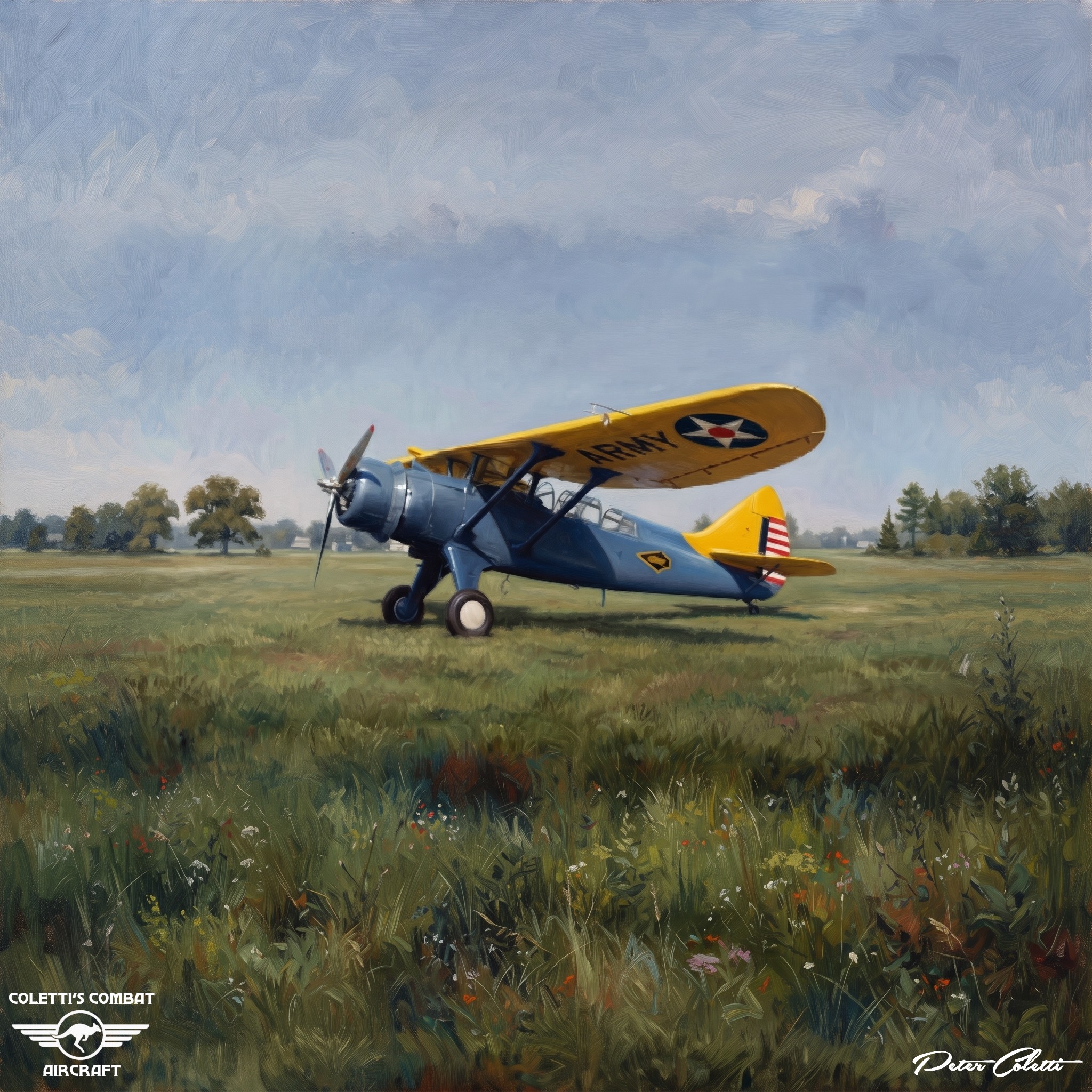
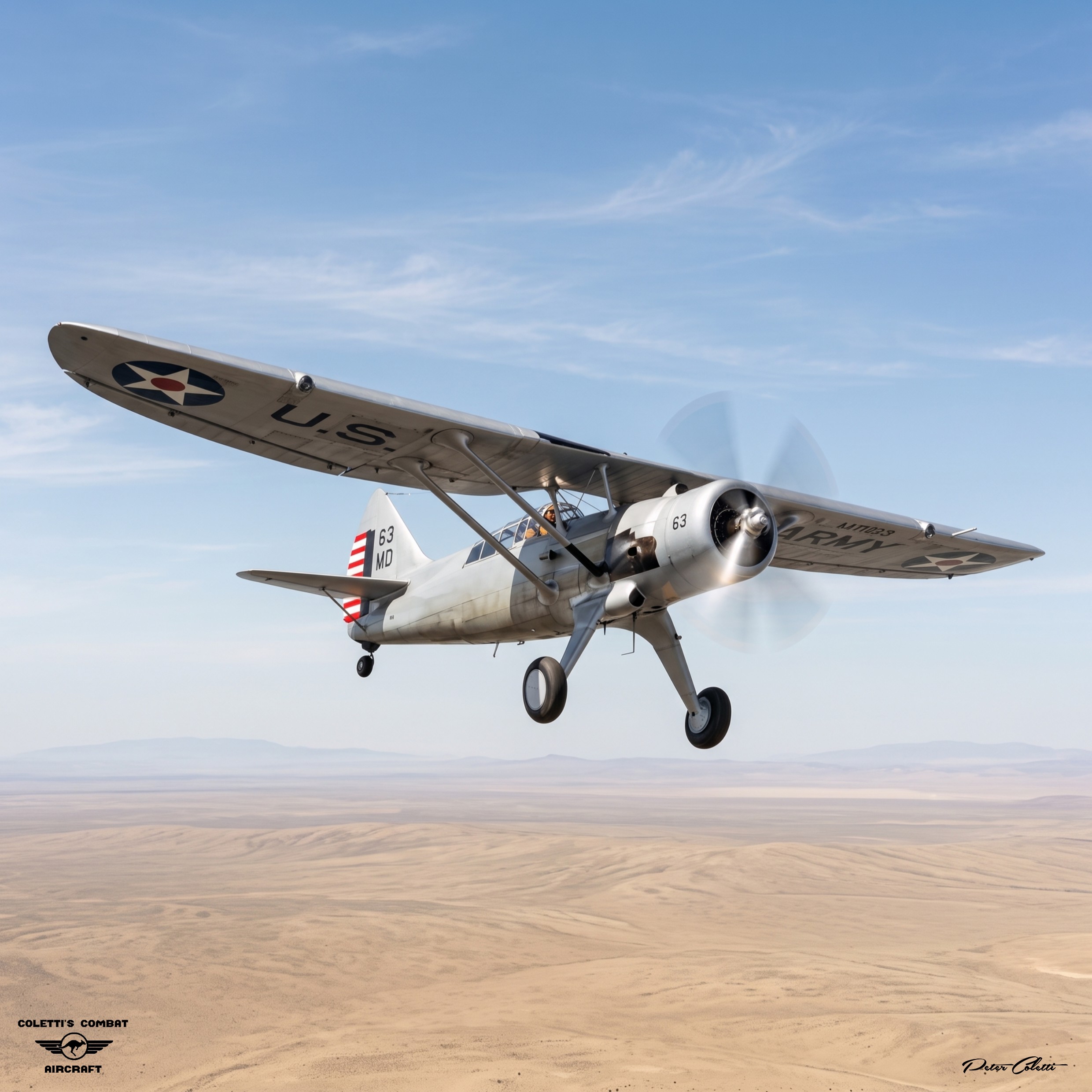
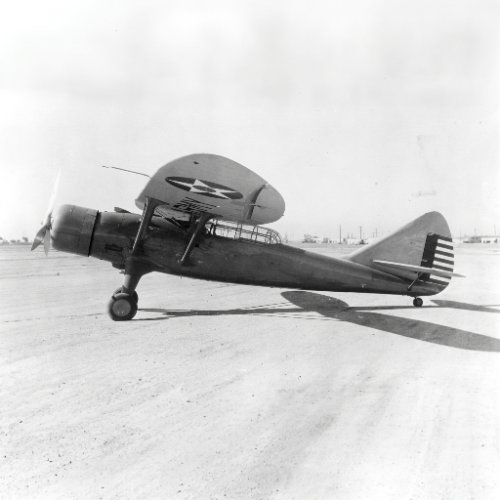
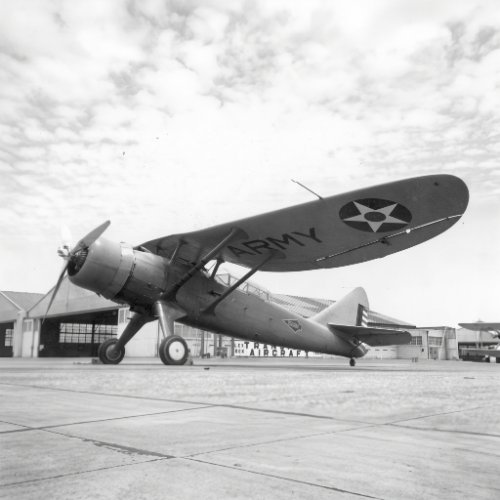
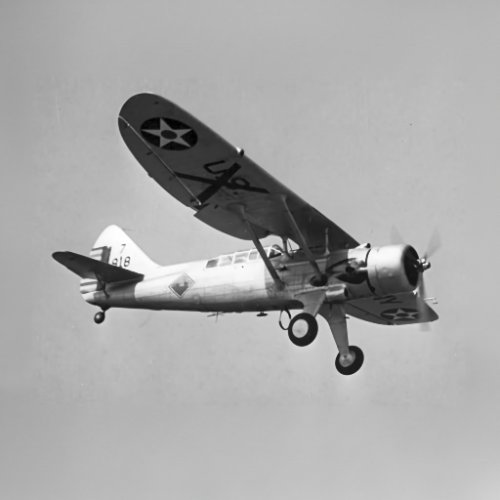
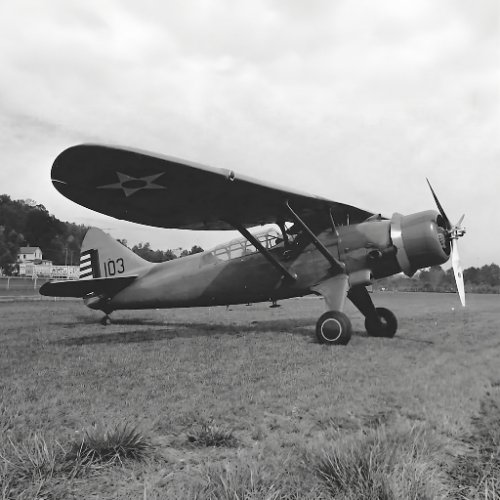
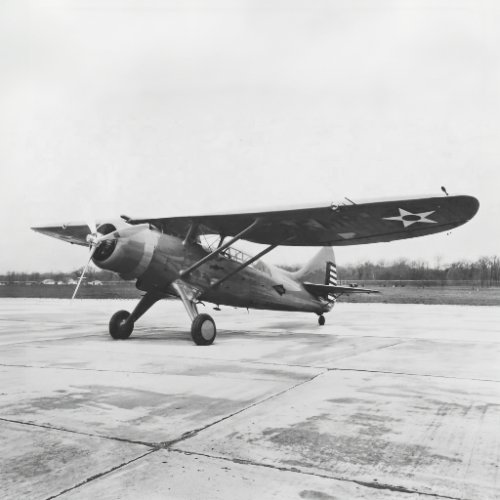
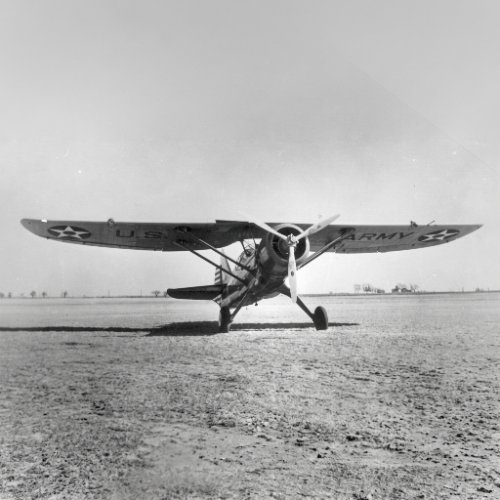
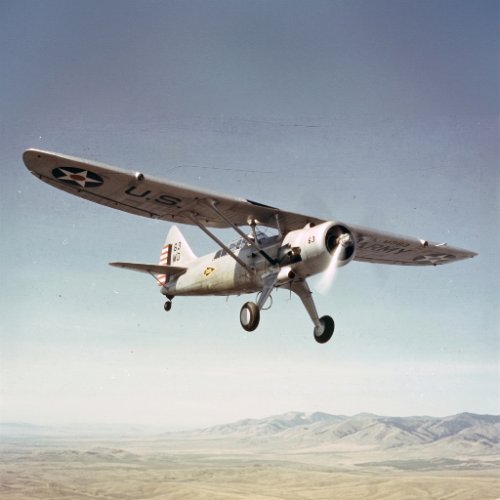
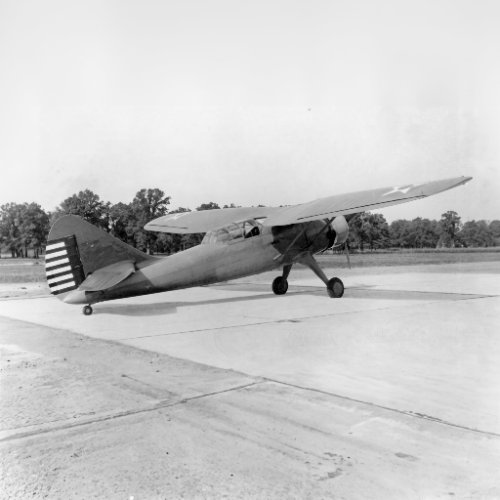
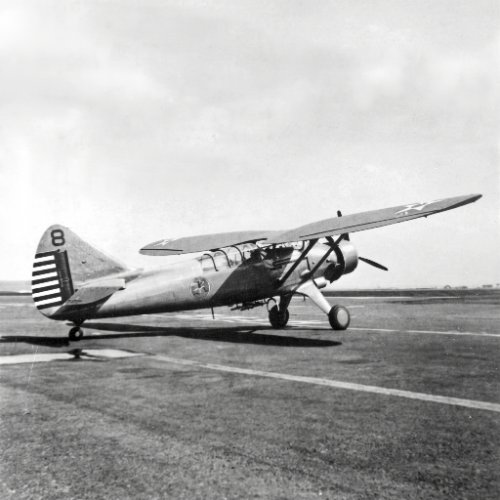
The Douglas O‑46 was the final evolution of Douglas Aircraft Company’s long line of parasol‑wing observation monoplanes developed for the United States Army Air Corps (USAAC) during the interwar period.
Conceived in the mid‑1930s, the aircraft embodied the Army’s pre‑World War II doctrine of observation from secure, established airfields behind static front lines—an approach rooted in World War I experience.
By the time global conflict erupted in 1939–1941, this doctrine and the aircraft built for it were rapidly becoming obsolete.
Origins and Development
The O‑46 was a direct development of the earlier Douglas O‑43, itself part of a lineage that began with the gull‑winged O‑31.
The prototype, designated XO‑46, was created by completing the final airframe of an O‑43A production batch (serial 33‑291) to a new standard.
This prototype incorporated several major changes: the O‑43’s inline engine was replaced with a more powerful Pratt & Whitney R‑1535‑7 radial engine, and the wing bracing was redesigned with streamlined struts instead of wire bracing.
The XO‑46 made its maiden flight in October 1934, demonstrating improved performance and structural refinement over its predecessors.
On 29 April 1935, the USAAC awarded Douglas contract AC‑7342 for the production of the O‑46A.
The initial order for 71 aircraft was later expanded by 19 additional units, bringing the total to 90 production aircraft.
These were delivered between May 1936 and April 1937, with most going to USAAC observation squadrons and two to National Guard units.
Serial numbers included 35‑161 through 35‑231, 36‑128 through 36‑144, and 36‑147/148 for National Guard aircraft.
Design Characteristics
The Douglas O‑46 was a single‑engine, two‑seat parasol‑wing observation monoplane.
Its design reflected the Army’s emphasis on stable, high‑visibility platforms for reconnaissance and artillery spotting.
Airframe and Structure
The aircraft featured a high‑mounted parasol wing supported by faired parallel struts, providing the pilot and observer with an excellent downward field of view.
The fuselage was constructed of welded steel tubing, with fabric covering aft of the cockpit.
The wing itself was partly fabric‑covered.
The crew sat in tandem enclosed cockpits, a modern feature compared to earlier open‑cockpit observation aircraft.
The landing gear was fixed in the tailwheel type, with spatted main wheels to reduce drag.
This configuration was typical of mid‑1930s Army aircraft but would later prove unsuitable for rough or improvised airstrips.
Dimensions
Wingspan: 45 ft 9 in
Length: 34 ft 7 in
Height: 10 ft 8 in
Wing area: 332 sq ft
Empty weight: 4,776 lb
Maximum takeoff weight: 6,639 lb
Powerplant and Performance
The O‑46 was powered by a Pratt & Whitney R‑1535‑7 Twin Wasp Junior, a 14‑cylinder, twin‑row, air‑cooled radial engine rated at 725 hp.
It drove a three‑bladed constant‑speed metal propeller.
Performance figures included:
Maximum speed: 200 mph at 4,000 ft
Cruise speed: ~171 mph
Service ceiling: 24,150 ft
Rate of climb: 1,765 ft/min
Range: 435 miles
These numbers were respectable for a mid‑1930s observation aircraft, but by the late 1930s they were inadequate against modern monoplane fighters and evolving tactical needs.
Armament
Armament was minimal, reflecting the aircraft’s reconnaissance role:
One fixed .30‑cal Browning machine gun firing forward from the starboard wing leading edge.
One flexible .30‑cal Browning machine gun mounted in the observer’s cockpit for rear defence.
Operational Use and Limitations
The O‑46 entered service in 1936, equipping USAAC observation squadrons such as the 104th and 119th Observation Squadrons, as well as National Guard units.
Early service focused on training, manoeuvres, and stateside reconnaissance.
However, by 1938–1939, Army evaluations identified serious shortcomings:
The aircraft was too slow and heavy to evade modern enemy fighters.
Its loaded weight of over 6,000 lb made it unsuitable for small or wet improvised fields.
Its large size made concealment under trees difficult.
These findings predicted the shift towards lighter, more agile liaison aircraft that could operate from rough forward airstrips.
World War II Context and Service
Although already obsolescent by the outbreak of World War II, the O‑46 did see limited wartime use.
Overseas Deployment
At least 11 O‑46As were deployed overseas, including to the Philippine Islands with the 2nd Observation Squadron between 1938 and 1941.
During the Japanese attack on Clark Field on 8 December 1941, two O‑46s were destroyed on the ground.
Stateside Wartime Roles
With frontline observation duties shifting to newer aircraft, remaining O‑46s were reassigned to:
Training
Utility transport
Target towing
Anti‑submarine patrols, notably by the Maryland Air National Guard off the coast of New Jersey.
By late 1942, the type was officially declared obsolete, and by 1944 most surviving airframes had been retired.
The Army’s observation designation “O” was replaced by “L” (liaison), reflecting the doctrinal shift towards light, rugged aircraft such as the Stinson L‑5 and Piper L‑4.
Variants
XO‑46
Prototype built from the final O‑43A airframe.
Featured a radial engine and revised wing bracing.
O‑46A
Main production version.
90 aircraft built between 1936 –1937.
O‑48 (proposed)
Planned variant with a Wright R‑1670‑3 engine.
Never built.
Surviving Aircraft
Only one O‑46A survives today: serial 35‑179, held by the National Museum of the United States Air Force at Wright‑Patterson AFB.
After overturning in a landing accident at Brooks Field, Texas, in 1942, it was abandoned and later rediscovered with trees growing through its wings.
Rescued in 1967 and transferred to the museum in 1970, it remains preserved as the sole surviving example of the type.