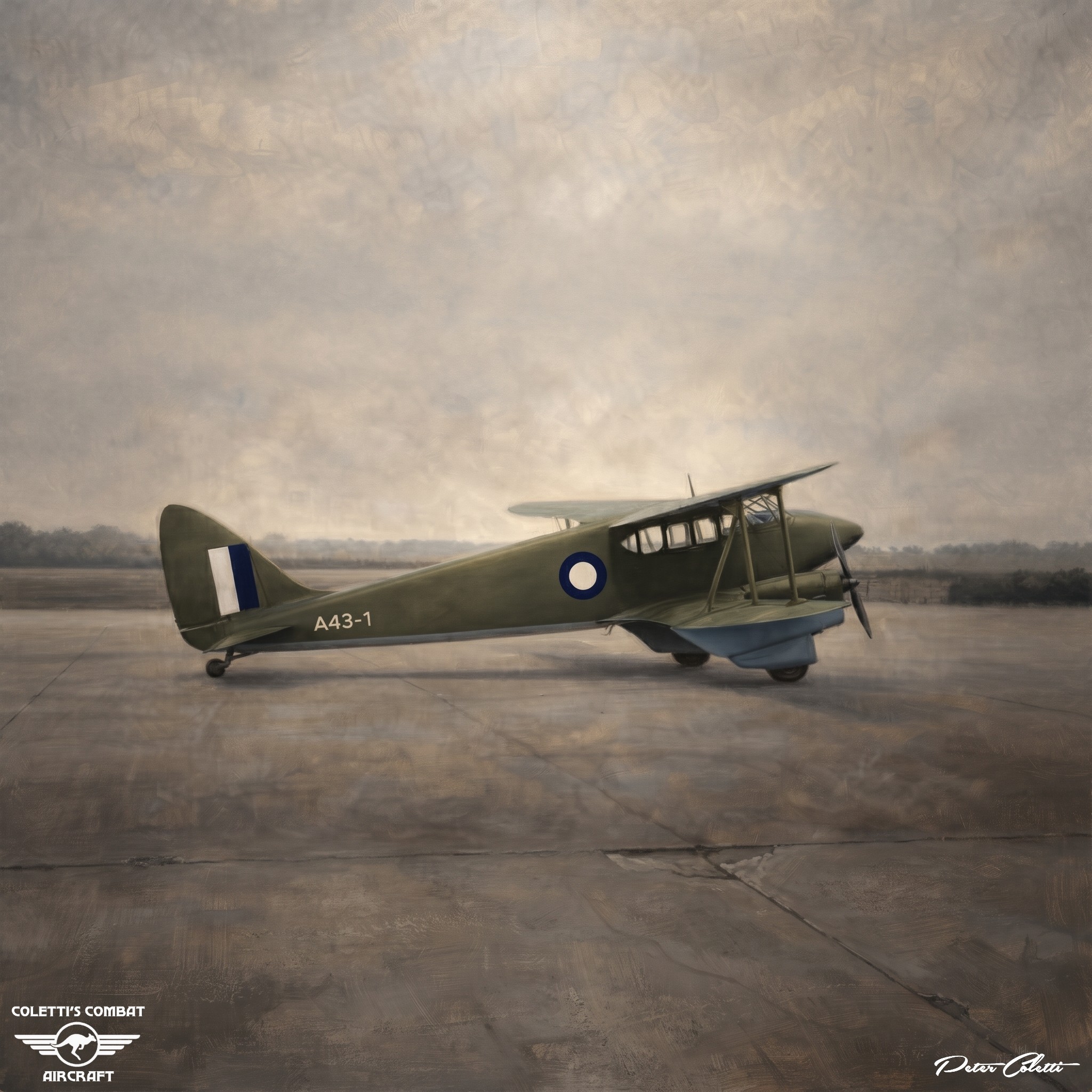
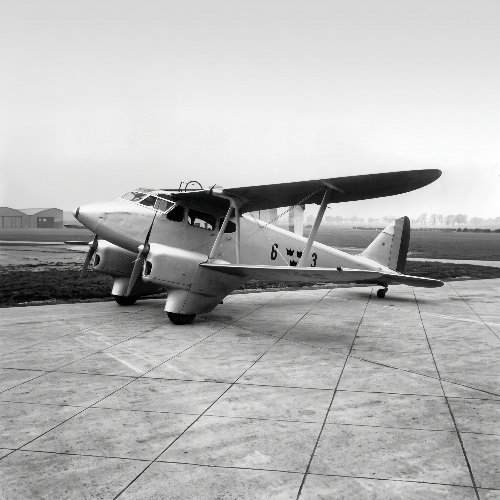
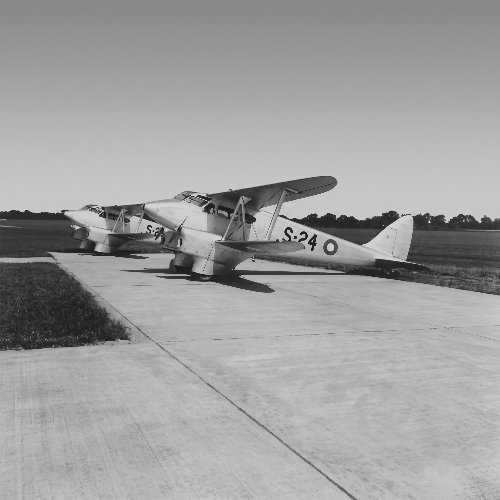
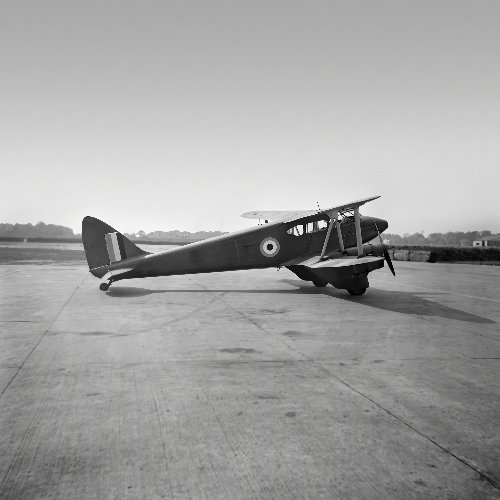
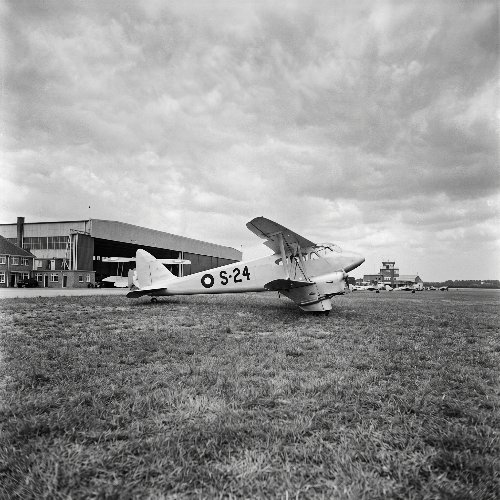
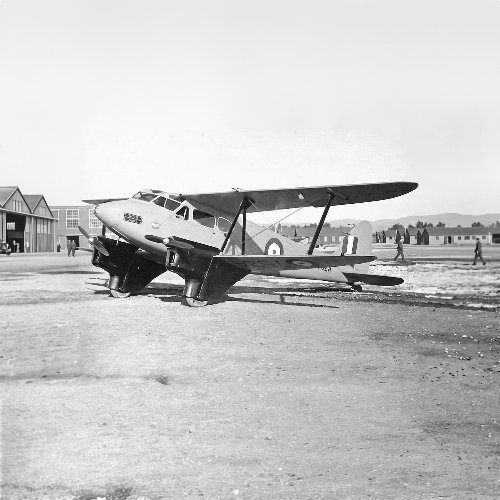
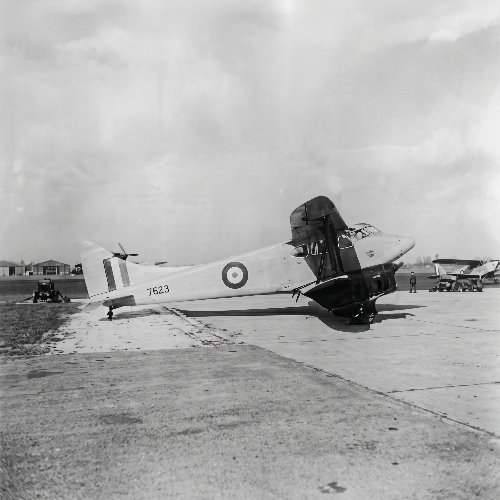
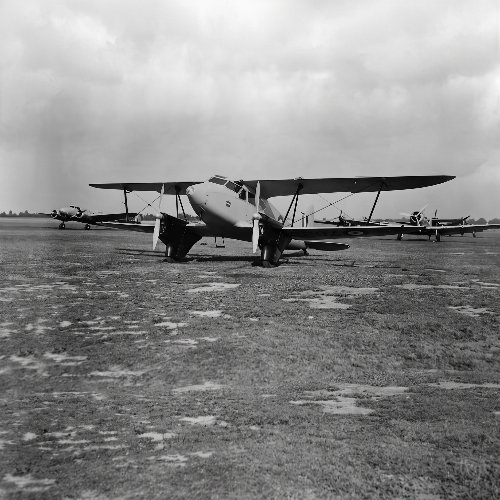
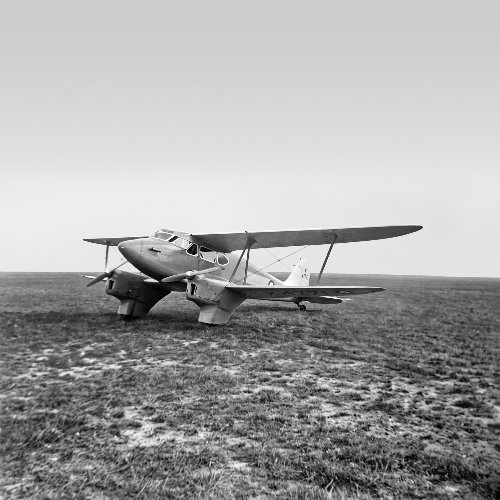
The de Havilland DH.90 Dragonfly was a British twin‑engined luxury touring and light transport biplane produced between 1935 and 1938.
Designed as an elegant, high‑performance executive aircraft, it combined advanced wooden monocoque construction with refined aerodynamics, offering a premium small‑airliner experience for private owners, air taxi services, and select military operators.
Development History
The Dragonfly emerged from de Havilland’s effort to create a more compact, high‑end companion to its successful Dragon series (DH.84, DH.86, DH.89).
Initial design studies began in late 1934, responding to demand from second‑tier airlines and wealthy private owners seeking a smaller, more luxurious aircraft.
Prototype and Early Testing
First flight: 12 August 1935 (prototype G‑ADNA).
Designed by Arthur Hagg, the aircraft incorporated construction techniques derived from the record‑setting DH.88 Comet racer, including pre‑formed plywood monocoque fuselage sections.
The prototype was entered in the 1936 King’s Cup Air Race, finishing 8th at an average speed of 231.33 km/h (143.75 mph).
Production
Production ran from 1935 to 1938, with 67 aircraft built (some sources list 66 due to counting differences).
Deliveries began in May 1936, with aircraft distributed among private owners, companies, air taxi operators, flying clubs, and several foreign air arms.
Design and Construction
The Dragonfly was a twin‑engine biplane with unequal‑span wings and a streamlined fuselage emphasising comfort and aerodynamic efficiency.
Airframe
Fuselage: Stressed‑skin semi‑monocoque plywood shell stiffened with spruce stringers, providing strength and low drag.
Wings: Tapered, slightly swept‑back biplane wings with a cantilever lower‑centre section eliminating the need for inner‑bay bracing wires.
Undercarriage: Fixed, faired main gear chosen for cost and simplicity after retractable gear was considered.
Cabin: Spacious, Art Deco‑styled interior seating four passengers plus pilot, with optional dual controls.
Engines
Prototype: Two de Havilland Gipsy Major I inline inverted air‑cooled engines (130 hp / 97 kW each).
Production (DH.90A): Upgraded Gipsy Major II engines (142 hp / 106 kW).
Engines drove two‑blade fixed‑pitch propellers.
Notable Design Innovations
Advanced wooden monocoque construction influenced later de Havilland designs, including structural concepts later refined in the Mosquito.
Simplified wing bracing improved cabin access and reduced drag.
Performance Characteristics
(Values from contemporary test and production data.)
Max speed: ~232 km/h (144 mph)
Cruise speed: ~201–204 km/h (125–127 mph)
Range: ~1,006 km (625 miles)
Service ceiling: ~5,515–5,517 m (18,100 ft)
Initial climb: 267 m/min (875 ft/min)
Take-off roll: 270 m (885 ft)
Empty weight: 1,134 kg (2,500 lb)
Loaded weight: ~1,814 kg (4,000 lb)
Handling
The Dragonfly was admired for its smooth performance but developed a reputation for ground‑looping due to its narrow undercarriage track, limiting its commercial appeal compared to the more robust DH.89 Dragon Rapide.
Variants
DH.90 (Prototype and Early Production)
Equipped with Gipsy Major I engines.
Featured initial structural and aerodynamic configuration.
DH.90A (Main Production Variant)
Introduced Gipsy Major II engines.
Minor refinements to systems and performance.
Dragonfly Mk‑I / Mk‑II
Military designations referenced in later documentation, though changes were minimal.
Operational Use
Civilian Service
The Dragonfly was primarily a luxury touring and executive transport, used by:
Wealthy private owners
Air taxi operators (e.g., Air Despatch Ltd at Croydon)
Small airlines in Europe, Australia, and South America
Flying clubs and charter services
Notable operators included:
Qantas (two aircraft, later camouflaged and chartered to the USAAF during WWII)
Connellan Airways in Australia
Western Airways (UK regional routes)
International Government and Military Use
Royal Canadian Mounted Police: Four aircraft used for anti‑smuggling patrols; one fitted with Edo floats.
Royal Canadian Air Force: Two aircraft for communications.
Danish and Swedish Air Forces: Used for training and liaison duties.
Additional exports to Argentina, Belgium, India, Nigeria, South Africa, Romania, and others.
World War II Context
Although not designed as a military aircraft, the Dragonfly entered limited wartime service:
Impressment into the RAF and Commonwealth Forces
At the outbreak of WWII, about 23 dragonflies were impressed into service.
Roles included:
Army cooperation night‑flying trainers
Communications and liaison aircraft
Light transport duties
By 1945, six impressed aircraft survived, with roughly thirteen still flying worldwide.
Wartime Limitations
The Dragonfly’s:
Wooden monocoque structure
Narrow‑track landing gear
Limited payload
made it unsuitable for frontline or rugged military operations.
As wartime priorities shifted, production jigs were discarded after 1938.
Legacy
The DH.90 Dragonfly stands as:
A pinnacle of pre‑war wooden aircraft craftsmanship
A technological stepping stone towards de Havilland’s later high‑performance wooden designs
A stylish, niche executive aircraft remembered for its elegance and innovation
Surviving examples restored for airshows highlight its distinctive Art Deco aesthetic and its role in advancing wooden monocoque construction.