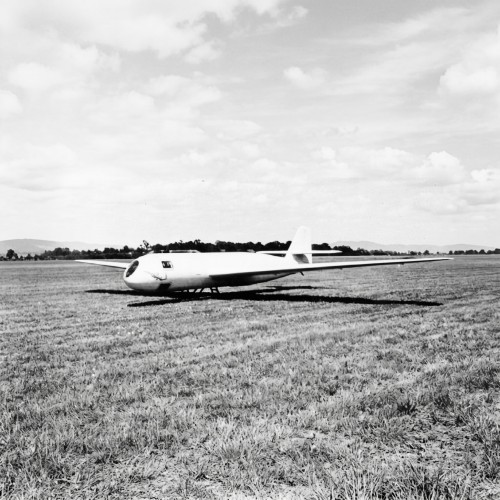
The DFS 228 originated from pre‑war German research into high‑altitude sailplanes, particularly the DFS 54, an experimental glider featuring a pressurised cabin for extreme‑altitude flight.
By 1940, the Reichsluftfahrtministerium (RLM) revived this research, seeking a reconnaissance aircraft capable of operating above 20,000 m—well beyond the interception capabilities of contemporary Allied fighters.
Germany’s deteriorating air situation by 1943 further increased the urgency for a platform able to gather intelligence without risking losses to Allied air superiority.
The Deutsche Forschungsanstalt für Segelflug (DFS), Germany’s sailplane research institute, was tasked with developing a rocket‑powered, high‑altitude reconnaissance aircraft.
Felix Kracht, a noted glider designer, led the project.
Development History
Early Concept and Design Revival
The DFS 228 was conceived as a powered evolution of the DFS 54, retaining the glider‑like aerodynamic efficiency but adding a rocket engine for rapid ascent.
The RLM requirement called for a platform that could be carried to altitude, ignite its rocket engine, climb to extreme heights, and then perform reconnaissance in a gliding “sawtooth” profile.
Prototype Construction
V1 prototype completed: March 1944 (unpowered).
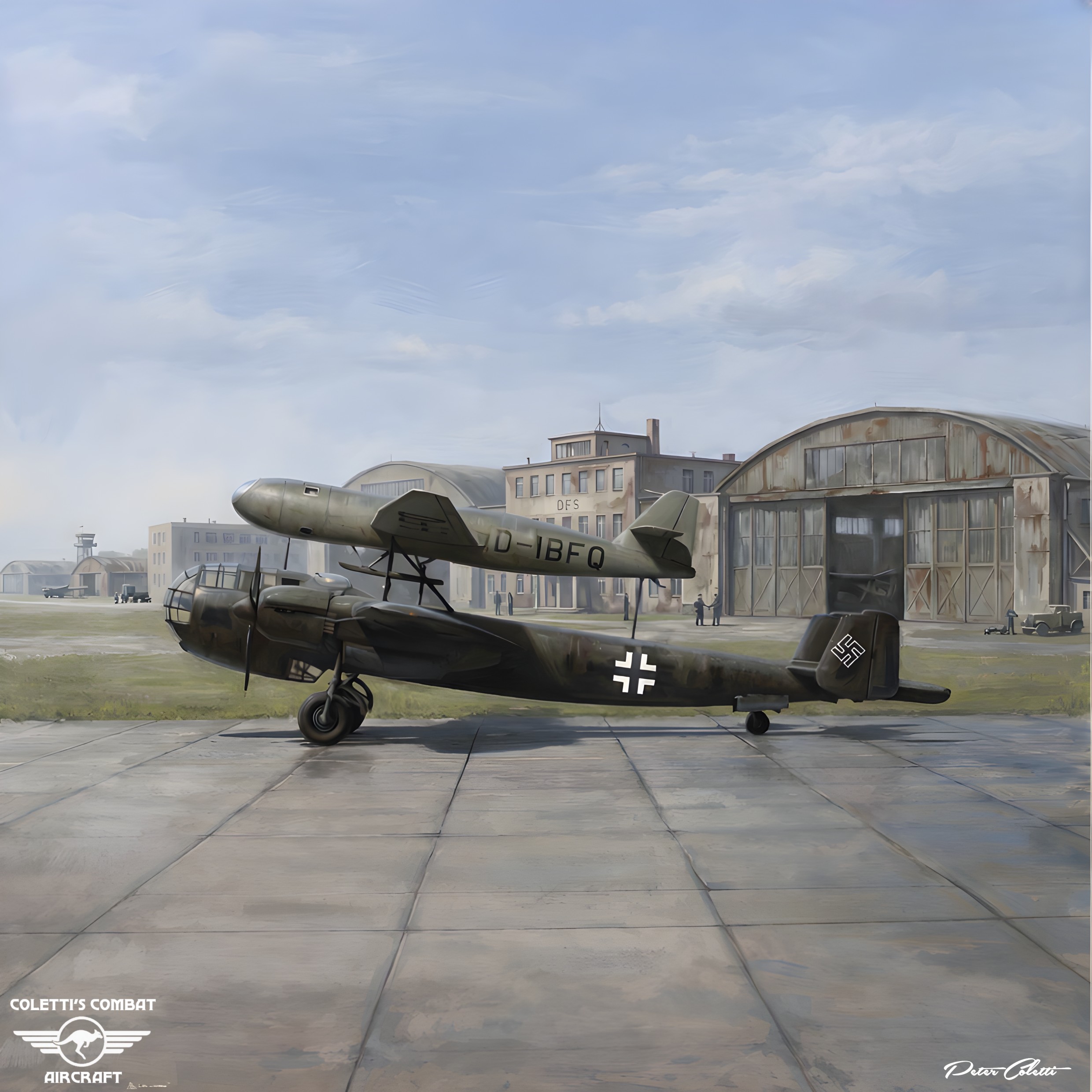
Glide tests began in August 1944, using a Dornier Do 217 as a piggyback carrier aircraft.
V2 prototype: Incorporated improvements to pressurisation and pilot position but was destroyed in a May 1945 air raid.
No powered flights were ever conducted; all tests were unpowered glides.
The V1 was captured intact by U.S. forces at Ainring in 1945.
Design Characteristics
Airframe and Aerodynamics
The DFS 228 was essentially a high‑performance sailplane optimised for extreme altitude:
Configuration: Cantilever mid‑wing glider.
Construction: Mostly wood, except for the metal pressurised cabin.
Wings: Long, slender, high‑aspect‑ratio wings (17.56 m span; 30 m² area).
Glide ratio: Approximately 25:1, enabling long unpowered returns. From 12,000 m, it could glide ~300 km.
Fuselage and Pilot Systems
The fuselage was a streamlined, torpedo‑shaped structure designed for minimal drag.
Key features included:
Pressurised cockpit: Initially seated, later redesigned for a prone pilot position due to pressurisation issues.
Escape capsule: The entire nose could detach, functioning as a self‑contained rescue pod with parachute—an innovative safety system for high‑altitude bailout.
Landing gear: A retractable ventral skid typical of sailplane designs.
Reconnaissance Equipment
The aircraft was intended to carry:
Two oblique Zeiss infrared cameras for strategic photo‑reconnaissance.
Propulsion
Planned engine:
Walter HWK 109‑509 (A‑1 or 509D variants)
Thrust: 1–14.7 kN (throttleable), up to 16.18 kN at altitude.
Propellants: Hypergolic T‑Stoff (H₂O₂) and C‑Stoff (hydrazine/methanol).
Although designed for powered flight, no prototype ever flew with the rocket engine installed.
Operational Concept and Performance
Launch and Mission Profile
The DFS 228 was intended to be:
Carried piggyback atop a Dornier Do 217 to ~10,000 m.
Rocket‑boosted to 20,000–23,000 m.
Operated in a sawtooth glide pattern, intermittently reigniting the rocket to maintain altitude.
Glide home unpowered, using its high efficiency.
Performance Estimates
Maximum speed: ~900 km/h at sea level.
Service ceiling: 22,860 m; absolute ceiling: 25,000 m.
Range: Up to 1,050 km with intermittent rocket use; ~300 km pure glide from 12,000 m.
Weights: Empty 1,650 kg; max take-off 4,200 kg.
Crew: 1 pilot.
The aircraft carried no armament, relying entirely on altitude for protection.
Variants
DFS 54
Pre‑war experimental glider with pressurised cabin; basis for DFS 228.
DFS 228 (Prototypes)
V1: First prototype; unpowered; completed March 1944; captured by U.S. forces.
V2: Improved pressurisation and prone pilot position; destroyed May 1945.
Some sources claim up to 10–12 airframes were under construction by 1945, but only two confirmed prototypes existed.
Programme Termination and Legacy
The DFS 228 never progressed beyond unpowered testing.
By early 1945, Germany’s collapsing industrial capacity and advancing Allied forces halted all work.
The V1 was shipped to Britain for evaluation in 1946, but no further development occurred.
Despite its limited testing, the DFS 228 demonstrated several forward‑looking concepts:
High‑altitude pressurisation and prone pilot ergonomics.