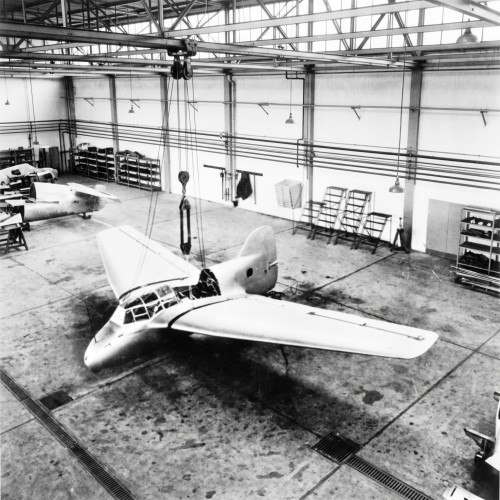
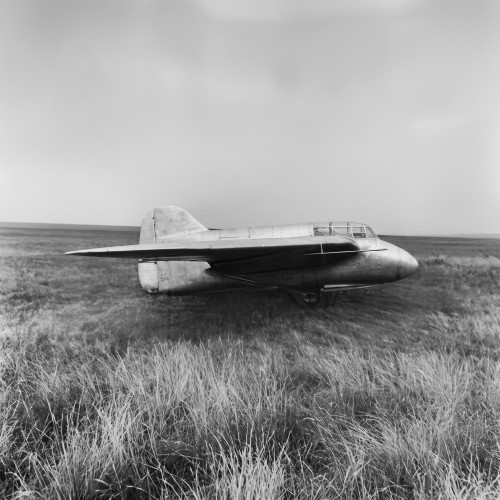
The DFS 194 emerged from Alexander Lippisch’s long‑running exploration of tailless and delta‑wing aerodynamics, a design philosophy he had been developing since the 1920s.
His earlier work at the Rhön‑Rossitten Gesellschaft and later at the Deutsche Forschungsanstalt für Segelflug (DFS) produced a series of tailless gliders, including the DFS 39 and DFS 40, which demonstrated promising stability and low drag characteristics.
By the mid‑1930s, Lippisch sought to push tailless aircraft into the high‑speed regime.
Conventional piston engines were insufficient for the speeds he wanted to explore, and the breakthrough came with Hellmuth Walter’s liquid‑fuel rocket engines, which offered exceptional power‑to‑weight ratios and altitude independence.
Lippisch recognised rocket propulsion as the key to unlocking the aerodynamic potential of tailless aircraft.
Early Development at DFS (1937–1938)
The DFS 194 began as a piston‑engined tailless testbed, essentially an evolution of the DFS 40.
The airframe was completed in March 1938 in this conventional configuration, featuring a pusher propeller and wingtip rudders.
However, stability issues in earlier tailless designs—such as flutter in the DFS 39—led Lippisch to incorporate a single large vertical stabiliser on the DFS 194, improving yaw control while retaining the swept delta‑wing planform.
Transfer to Messerschmitt and Rocket Integration (1939)
The Reichsluftfahrtministerium (RLM) saw potential in Lippisch’s tailless aircraft as the basis for a rocket‑powered fighter.
On 2 January 1939, Lippisch and his team were transferred to Messerschmitt AG under a programme known as Project X.
At Messerschmitt, the DFS 194 airframe was modified to accept the Walter R I‑203 liquid‑fuel rocket engine, producing approximately 3.9 kN (882 lbf) of thrust.
Some sources note thrust figures around 400 kg (~4.9 kN), reflecting variations in reporting.
The aircraft was constructed primarily of wood, consistent with Lippisch’s glider‑derived design lineage.
Ground Tests, Glide Trials, and First Powered Flight (1939–1940)
Rocket engine tests began at Peenemünde in October 1939, followed by unpowered gliding trials in early 1940.
The first powered flight occurred in August 1940, piloted by Heini Dittmar.
The aircraft reached 550 km/h (343 mph)—a remarkable achievement that exceeded expectations and surpassed the earlier Heinkel He 176 rocket aircraft.
Flight tests demonstrated:
Excellent controllability
Safe handling at nearly twice the anticipated speed
Exceptional climb performance (~1,615 m/min)
Fuel endurance was extremely short—only minutes per flight—typical of early rocket aircraft.
Technical Description
Airframe
Configuration:Tailless delta‑wing research aircraft
Construction:Primarily wood
Crew:1 (pilot)
Length:6.4 m
Wingspan:10.4 m
Height:2.13 m
Wing Area:18 m²
Loaded Weight:2,100 kg
Propulsion
Engine:Walter R I‑203 liquid‑fuel rocket
Thrust:~3.9 kN (882 lbf)
Fuel:Concentrated hydrogen peroxide (T‑Stoff) with catalyst (Z‑Stoff), typical of Walter engines of the era
Performance
Maximum Speed:550 km/h (343 mph)
Rate of Climb:1,615 m/min (5,297 ft/min)
Operational Role and WWII Context
The DFS 194 was never intended as an operational combat aircraft.
It served exclusively as a research platform under Luftwaffe oversight from 1940 to 1945.
Its successful demonstration of rocket‑powered tailless flight convinced the RLM to prioritise development of a refined rocket interceptor.
This led directly to the Messerschmitt Me 163, which incorporated many of the DFS 194’s aerodynamic principles and rocket propulsion concepts.
The Me 163 would become:
The world’s first operational rocket fighter
A high‑speed point‑defence interceptor used by JG 400 in 1944–45
A notoriously dangerous aircraft due to volatile fuels and unconventional landing gear
Thus, the DFS 194 occupies a pivotal place in WWII aviation history as the proof‑of‑concept vehicle that enabled Germany’s rocket fighter programme.
Legacy and Influence
The DFS 194 validated:
Rocket propulsion for manned aircraft
High‑speed tailless delta‑wing aerodynamics
Control feasibility at unprecedented speeds
Its influence extended beyond the Me 163.
Post‑war, Lippisch’s tailless delta concepts contributed to the design of many jet aircraft, and he continued aerodynamic research in the United States after 1945.
Variants
The DFS 194 had no variants.
Only one prototype was built.
Its “variant lineage” is conceptual rather than direct:
DFS 39 / DFS 40 — earlier tailless gliders
Me 163 V1— direct successor incorporating DFS 194 lessons