The DFS 40, originally designated Delta V, was conceived in 1937 by German aeronautical engineer Alexander Lippisch, the leading advocate of tailless and delta‑wing aircraft in interwar Germany.
It was developed at the Deutsche Forschungsanstalt für Segelflug (DFS)—the German Research Institute for Sailplane Flight—as a powered successor to Lippisch’s earlier tailless gliders and experimental deltas, particularly the DFS 39 (Delta IV).
Lippisch’s work throughout the 1920s and 1930s had progressively refined tailless swept‑wing aerodynamics.
The DFS 40 represented the most advanced stage of this research line, intended to compare powered delta‑wing behaviour directly with its unpowered predecessors and to explore stability, control, and high‑speed characteristics of tailless aircraft.
Design Philosophy and Configuration
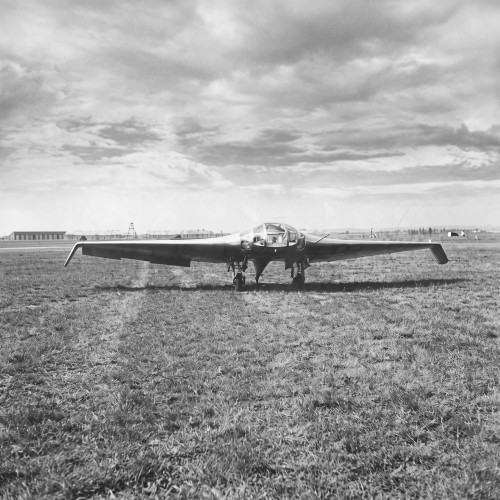
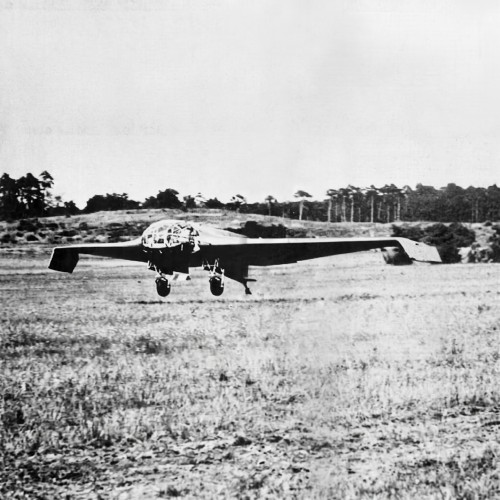
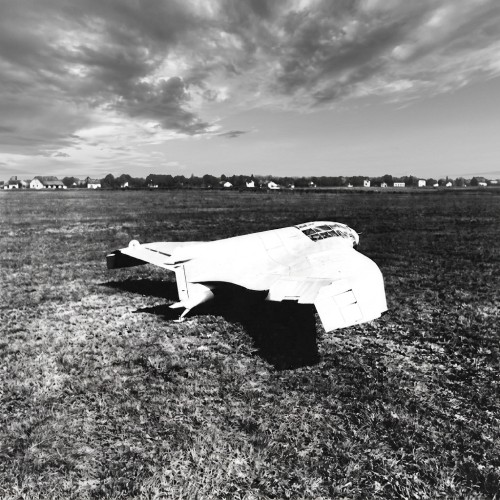
The DFS 40 was conceived as a tailless, near‑flying‑wing aircraft, with its fuselage blended smoothly into the wing roots, eliminating the distinct fuselage‑wing junction seen in earlier designs.
This made it closer to a pure flying wing than the DFS 39.
Key design features included:
Delta‑like swept wing with no horizontal tail surfaces.
Elevons along the trailing edge provide both pitch and roll control.
Small vertical fins for directional stability.
Central fuselage nacelle housing the cockpit and engine.
Pusher propeller configuration, driven by a rear‑mounted engine to keep the propeller clear of the swept wing.
This configuration aimed to reduce drag, simplify structure, and explore the aerodynamic advantages of tailless deltas—while also confronting their inherent stability challenges, such as centre‑of‑pressure movement and limited pitch authority near stall.
These specifications placed the DFS 40 firmly in the category of small experimental aircraft, optimised for aerodynamic research rather than operational performance.
Construction and Testing
Only one prototype of the DFS 40 was built.
Before powered flight, the aircraft underwent ground trials and unpowered gliding tests, confirming promising characteristics and validating the tailless delta concept sufficiently to proceed to powered evaluation.
Flight History and Performance
The DFS 40 made its first powered flight in 1938, piloted by Heini Dittmar, DFS’s leading test pilot.
Some sources note the maiden powered flight as occurring in 1939, shortly before Lippisch left DFS for Messerschmitt.
During flight testing, Dittmar explored the aircraft’s handling across its speed range, gathering data on:
Control responsiveness of elevons
Stability characteristics of tailless deltas
Sensitivity to centre‑of‑gravity (CG) placement
These findings were directly relevant to Lippisch’s emerging concepts for tailless combat aircraft, including what would become the rocket‑powered Me 163 Komet.
Accident and Loss of the Prototype
The DFS 40’s career ended abruptly.
After Lippisch left DFS for Messerschmitt—taking much of his design team with him—the aircraft continued testing under new supervision.
A miscalculation of the centre of gravity placed the CG too far aft, causing the aircraft to enter an unrecoverable flat spin.
The pilot escaped by parachute, but the aircraft was destroyed.
This incident dramatically illustrated the CG sensitivity of tailless delta designs—the very issue the DFS 40 had been built to investigate.
Variants
The DFS 40 itself had no operational variants, but it was part of a developmental lineage:
Delta IV / DFS 39 – Predecessor glider with more conventional fuselage.
DFS 194 – Direct successor incorporating lessons from the DFS 40; prototype for the rocket‑powered Me 163.
Context Within WWII Aviation
Although the DFS 40 was not a wartime aircraft and never intended for combat, its research role was deeply connected to Germany’s pre‑WWII and early‑WWII push towards advanced aerodynamics.
Its influence fed directly into:
DFS 194, the rocket‑powered experimental aircraft that validated tailless high‑speed flight.
Messerschmitt Me 163 Komet, the world’s first operational rocket interceptor, which relied heavily on Lippisch’s tailless delta research.
Thus, while the DFS 40 itself never flew in wartime service, its aerodynamic insights contributed to one of the most radical aircraft deployed during WWII.
Legacy and Significance
The DFS 40 stands as a pivotal experimental aircraft in the evolution of tailless and delta‑wing aerodynamics.
Its contributions include:
Demonstrating the aerodynamic potential of tailless deltas.
Revealing critical stability issues, especially CG sensitivity.
Providing data that shaped subsequent high‑speed aircraft research.
Forming a bridge between early glider experiments and rocket‑powered wartime aircraft.
Its destruction ended direct development, but its influence persisted through Lippisch’s later designs and postwar delta‑wing research worldwide.