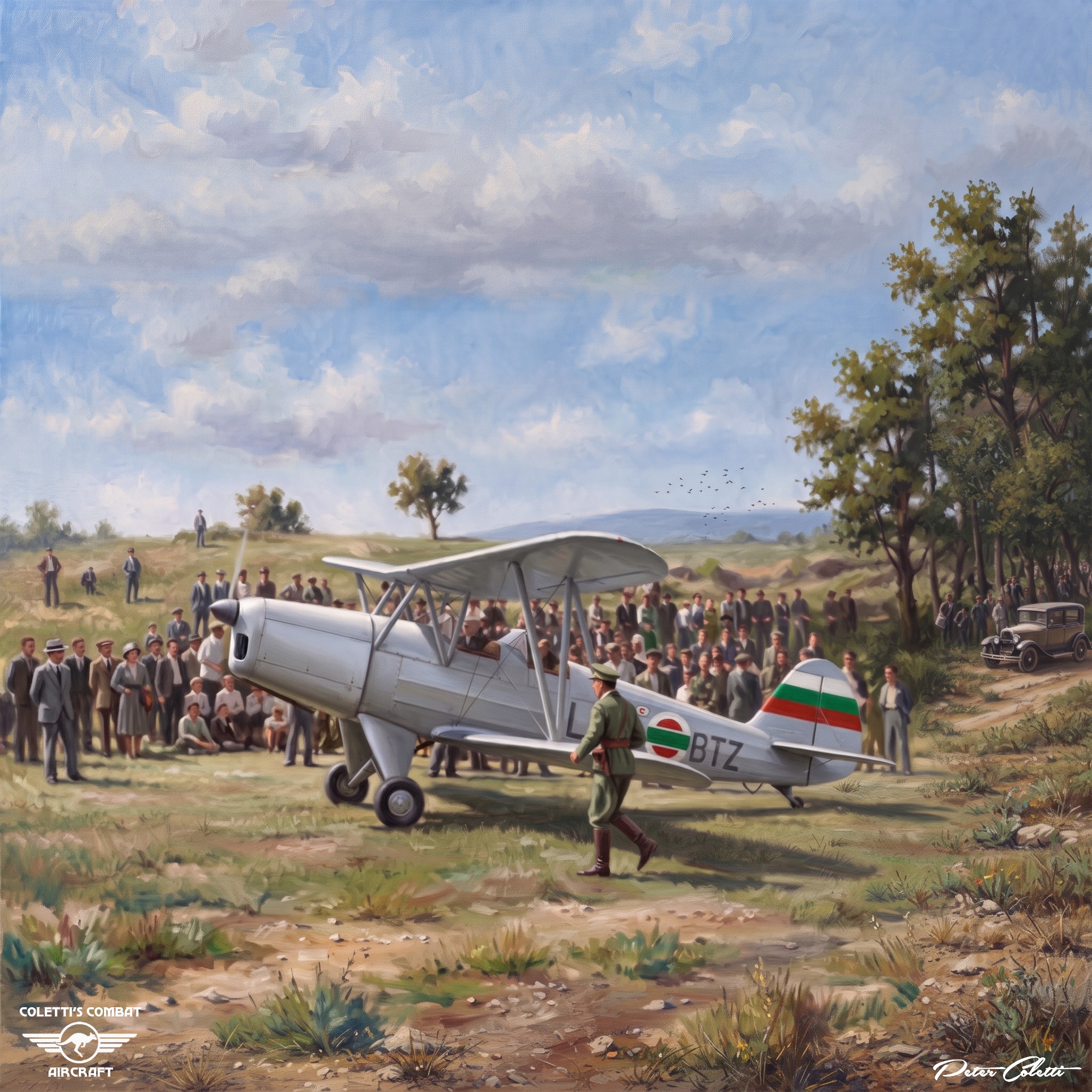
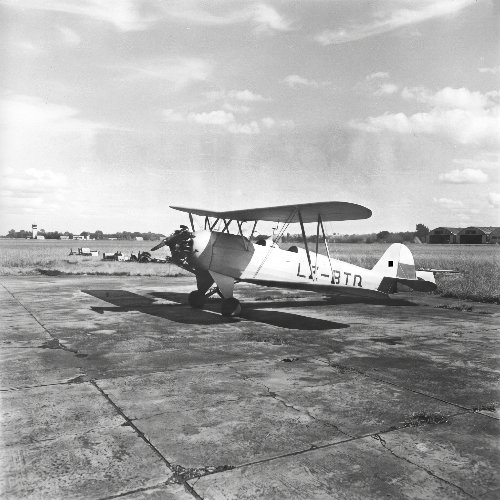
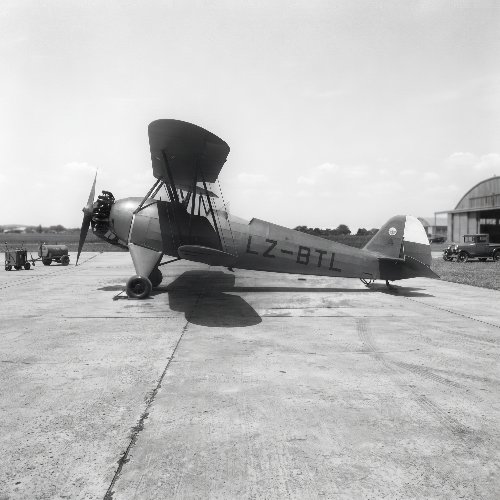
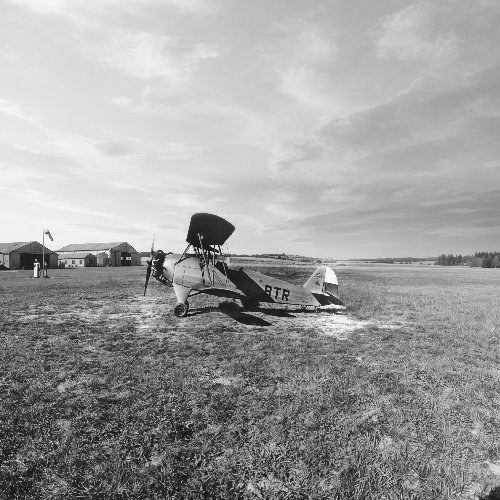
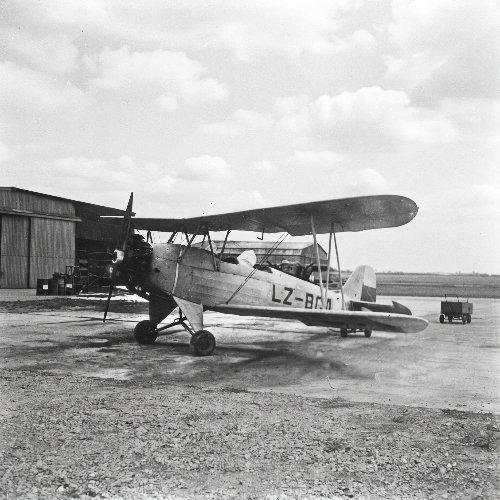
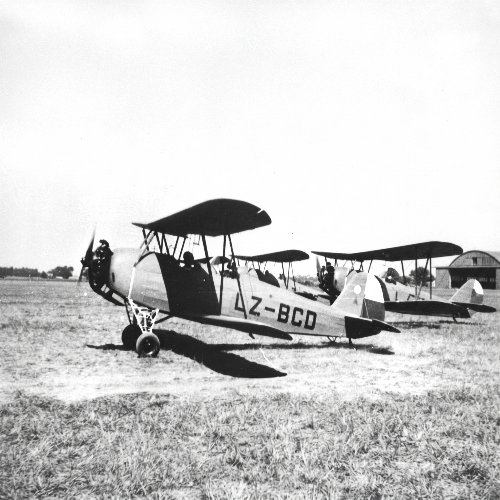
The DAR 9 “Siniger” was a two‑seat biplane trainer developed and produced in Bulgaria on the eve of and during World War II.
Conceived to give the Bulgarian Air Force a modern, domestically supported primary trainer, it combined licensed German design with local engineering experience and industrial realities.
In Bulgarian service it became a familiar workhorse of the training system, bridging the pre‑war German influence and the post‑war shift towards Eastern European equipment.
Development and industrial context
Origins of the Bulgarian aircraft industry
Darzhavna Aeroplanna Rabotilnitsa (DAR)—the State Aircraft Factory at Bozhurishte near Sofia—had been Bulgaria’s pioneering aviation works since the 1920s, initially focused on repair and overhaul of German World War I types and later on indigenous designs such as the DAR‑6A trainer.
By the late 1930s, the Bulgarian Air Force needed to replace ageing trainers and reduce dependence on imported aircraft, both for cost and for security of supply in a tense regional climate.
Licensing the Focke‑Wulf Fw 44J “Stieglitz”
The German Focke‑Wulf Fw 44J “Stieglitz” was selected as the pattern for a new Bulgarian trainer.
Bulgaria acquired a licence and full technical documentation for the Fw 44J, along with a batch of German‑built aircraft to cover immediate training needs while domestic production ramped up.
The licensed Bulgarian derivative was designated DAR 9 “Siniger” (“titmouse”), and its design drew not only on the Fw 44 but also on experience with earlier Bulgarian trainers and German types such as the Heinkel He 72 “Kanarche” and other small biplanes used in training.
Design evolution and landing‑gear controversy
Chief designer engineer Tsvetan Lazarov led the DAR 9 project at Bozhurishte.
While the basic layout followed the Fw 44J, Lazarov introduced changes, notably to the vertical tail surfaces and the landing gear.
The modified undercarriage, intended to suit local conditions, proved troublesome in service: training aircraft routinely performed dozens of take‑offs and landings per day, often with rough handling by student pilots, and the gear suffered structural issues.
This led to intervention from the Air Ministry and a redesign assignment to engineer Boshnakov, who, instead of reverting to the original German layout, adopted a concept inspired by the Czech “Osa” aircraft.
The dispute over the landing‑gear solution became a well‑known personal and professional clash among Bulgaria’s leading aircraft designers, illustrating the growing pains of a young national industry trying to balance innovation with proven foreign practice.
Production shift and series organisation
Initial series production began at DAR Bozhurishte around 1940–41.
The first batch—Series 1—comprised a small number of aircraft (construction numbers 88–93), powered by Siemens‑Halske Sh 14 radial engines and built directly at DAR.
Subsequent production was transferred to the new Derzhavna Samoletna Fabrika (DSF) near Lovech, where Series 2 through Series 5 were completed, carrying construction numbers 95–130.
In total, around 42 aircraft are generally cited in Western sources, while Bulgarian accounts mention up to roughly 48–56 built as production continued through 1943, reflecting some discrepancy in counting prototypes and late series.
Design and technical characteristics
General configuration
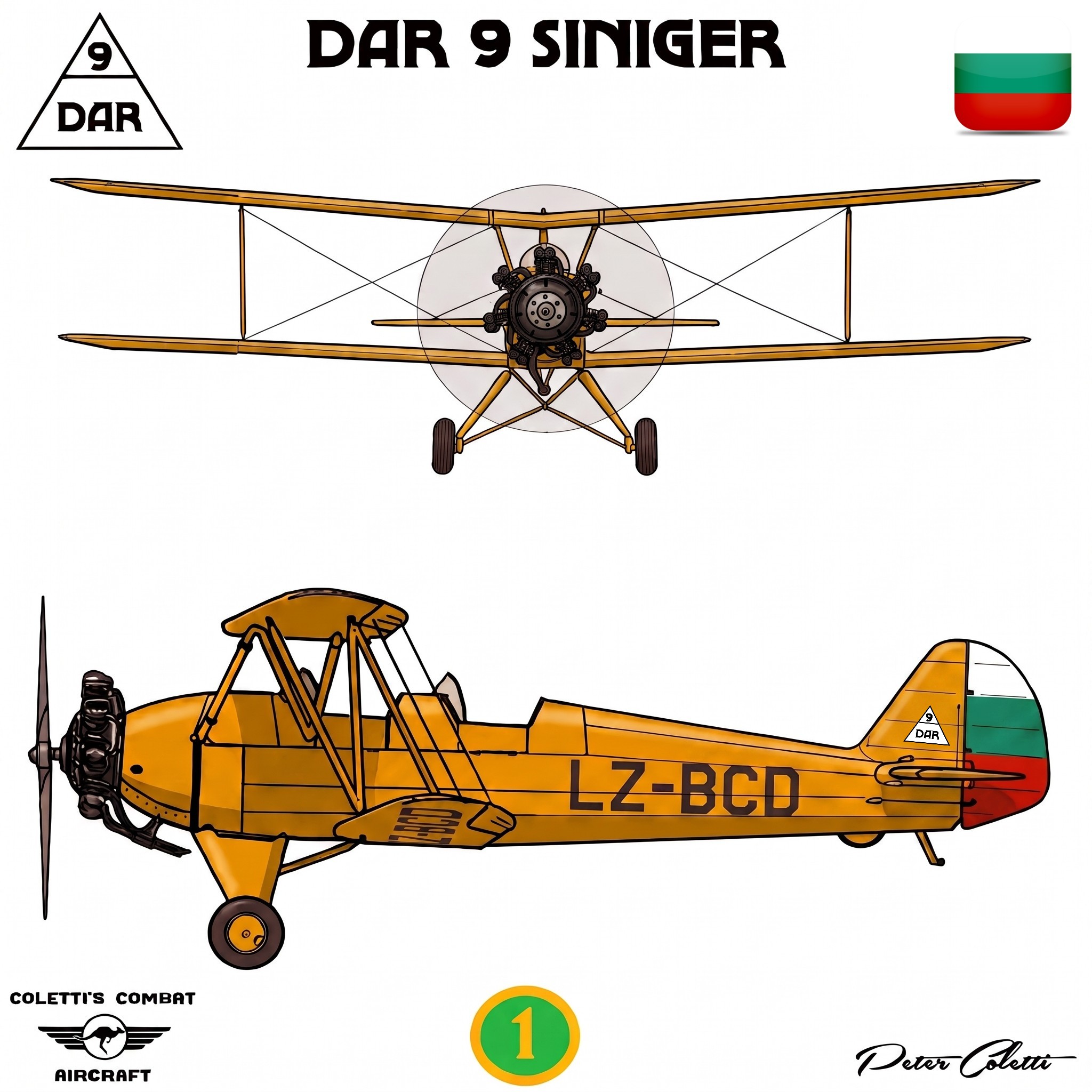
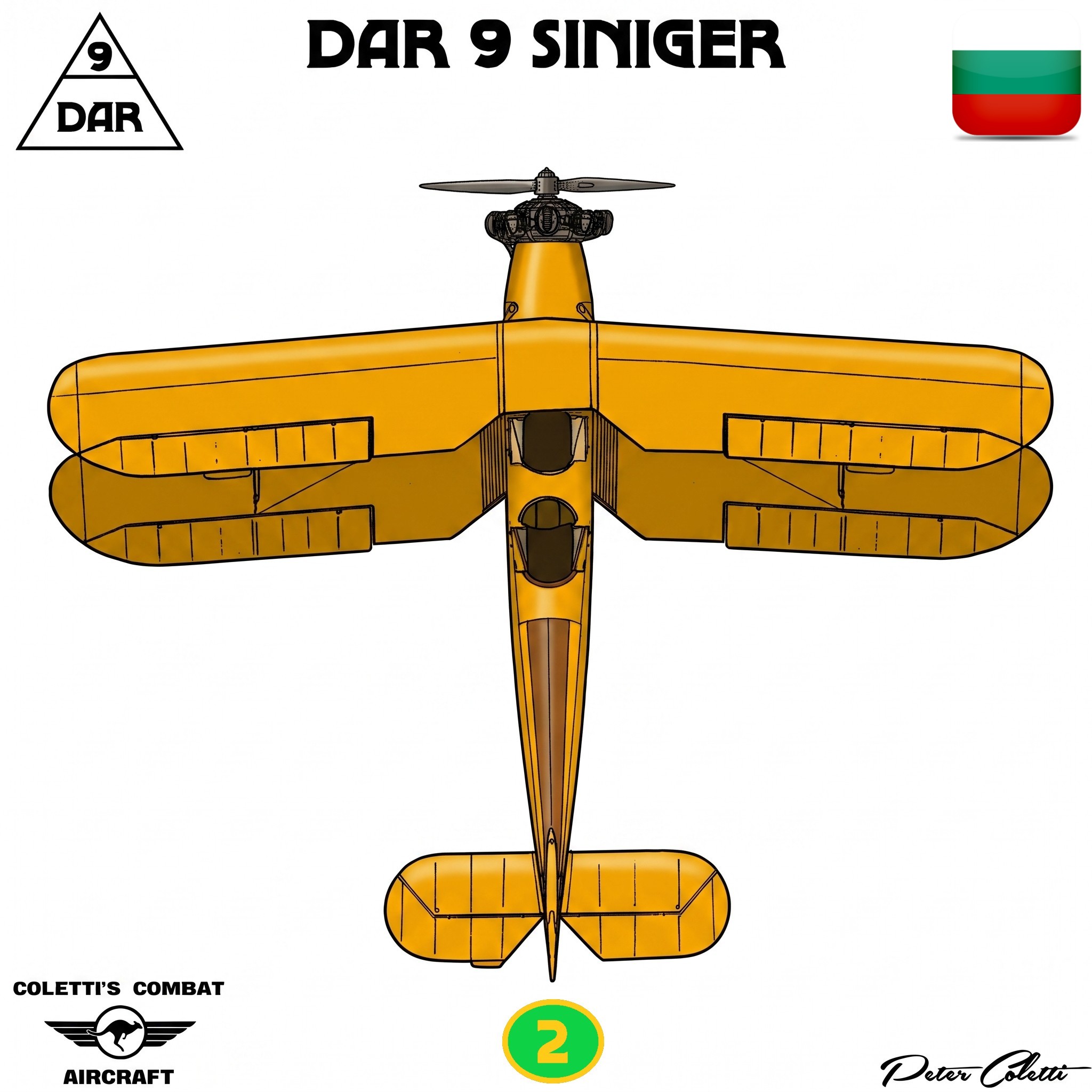
The DAR 9 was a conventional two‑seat, single‑engine biplane trainer of mixed construction, closely resembling the Fw 44J.
It featured:
Crew: two, student and instructor in tandem open cockpits
Length: 7.3 m
Wingspan: 9m
Wing area: 20 m²
Empty weight: 560 kg
Gross weight: 900 kg
The airframe used a fabric‑covered structure with wooden and metal elements typical of 1930s trainers, providing robustness and ease of repair.
The biplane wing arrangement gave good low‑speed handling and short‑field performance, important for training from modest airfields.
Powerplant and propulsion
The standard DAR 9 was powered by a single Siemens‑Halske Sh 14A radial engine, delivering about 120 kW (160 hp).
This seven‑cylinder air‑cooled radial was widely used in German light aircraft and trainers, and in Bulgarian service it offered adequate power and reliability—at least initially.
The engine drove a two‑blade wooden propeller tailored to the aircraft’s training role.
Performance
With the Sh 14A engine, the DAR 9 achieved:
Maximum speed: 185 km/h (about 115 mph)
Range: 520 km
Service ceiling: 4,400 m
These figures placed it squarely in the typical envelope for primary trainers of the era—fast enough to simulate operational handling, yet slow and forgiving enough for novice pilots.
Handling and training suitability
The DAR 9 inherited the Fw 44’s reputation for docile handling and good aerobatic qualities.
Its biplane layout and relatively low wing loading made stalls gentle and recoverable, while the robust structure tolerated the stresses of basic aerobatics and repeated training circuits.
However, the landing‑gear issues in early service highlighted the challenge of designing for the harsh realities of training use, where rough landings and high sortie rates could quickly expose weaknesses in structural design.
Operational use and World War II context
Role in Bulgarian pilot training
The DAR 9 entered service around 1940–41, just as Bulgaria was aligning with the Axis powers and modernising its air arm.
It was assigned primarily to the Kazanlak Air School and other training units, where it served as a basic trainer for initial flight instruction and first pilot qualification.
Students performed take‑offs, landings, basic manoeuvres, and elementary aerobatics on the DAR 9 before progressing to more advanced types.
The aircraft remained in training use at least until 1949, well after the end of World War II and the political changes of 1944.
Bulgarian Air Force and Axis alignment
During World War II, Bulgaria’s air force operated under Axis influence, relying heavily on German aircraft and support.
The DAR 9 symbolised a partial step towards self‑reliance: although based on a German design and using German engines, it was built in Bulgarian factories by Bulgarian engineers and workers.
This domestic production helped ensure a steady supply of trainers despite wartime constraints and allowed the air force to expand its pilot cadre to meet operational demands, including air defence and support missions within the Axis framework.
Post‑war service and Yugoslav transfer
After the war and the shift to a new political order, the DAR 9 continued to serve in the training role.
In 1947, nine surplus aircraft were transferred to the Yugoslav Air Force, where they remained in service until 1958, reflecting their continued utility as basic trainers even in a different national context.
Within Bulgaria, surviving aircraft were kept in operation through engine replacement and structural maintenance, underscoring the type’s durability and the value placed on locally built trainers in a period of limited resources.
Surviving example
At least one DAR 9 has been preserved and is displayed at the Technical Museum in Zagreb, Croatia, providing a tangible link to the era of Balkan aircraft production and the shared aviation heritage of the region.
Variants and engine re‑engining
DAR 9 (original version)
Engine: Siemens‑Halske Sh 14A radial
Role: primary trainer and sport/training aircraft
Production: initial series at DAR, later series at DSF
This baseline version formed the bulk of wartime production and service, and its characteristics define the standard performance figures associated with the type.
DAR 9A (re‑engined version)
By 1948, the Siemens‑Halske engines in surviving DAR 9s were worn, and spare parts were difficult to obtain.
The Bulgarian Air Force’s technical department arranged for the supply of Walter Minor 6.III inline engines from Czechoslovakia—six‑cylinder, air‑cooled inline units.
Aircraft re‑engined with these Walter engines were redesignated DAR 9A.
The conversion required a new propeller and modifications to the engine installation, assigned to engineer Karlov, and allowed the trainers to remain in service for several more years.
Significance and legacy
The DAR 9 “Siniger” occupies a distinctive place in Bulgarian aviation history.
Technically, it was not a radical design—its layout and performance closely mirrored the German Fw 44J—but its importance lay in what it represented: a licensed, adapted, and domestically produced trainer that helped Bulgaria build and sustain its pilot training system during a turbulent period.
The aircraft’s development highlighted the ambitions and tensions within the Bulgarian aircraft industry, from design disputes over landing gear to the logistical challenges of engine supply.
Operationally, it trained generations of pilots through World War II and into the early post‑war years, and its transfer to Yugoslavia extended its influence beyond national borders.