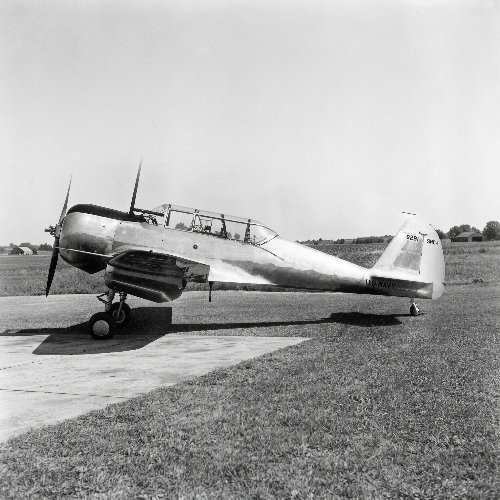
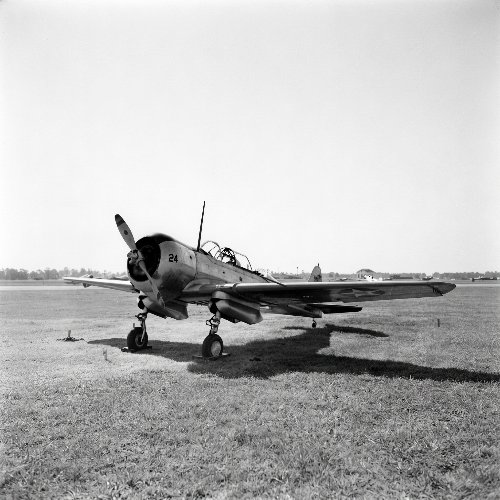
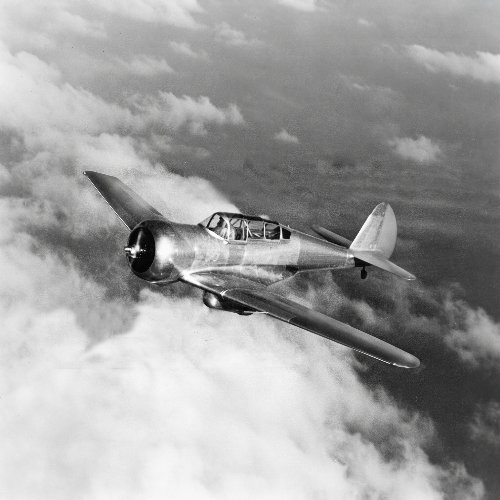
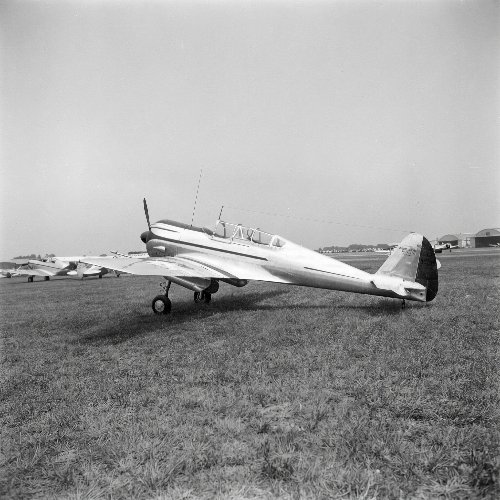
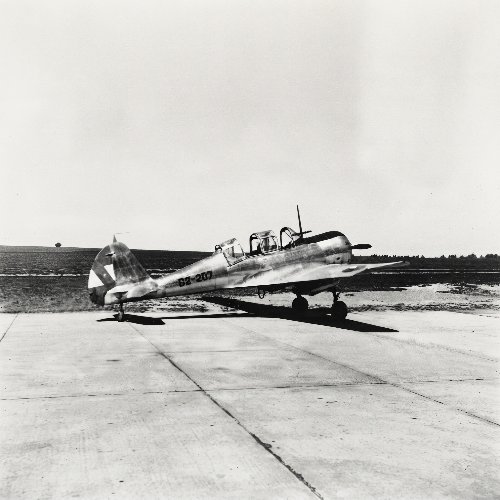
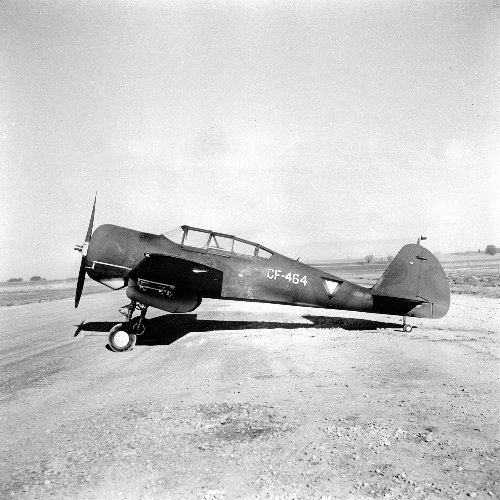
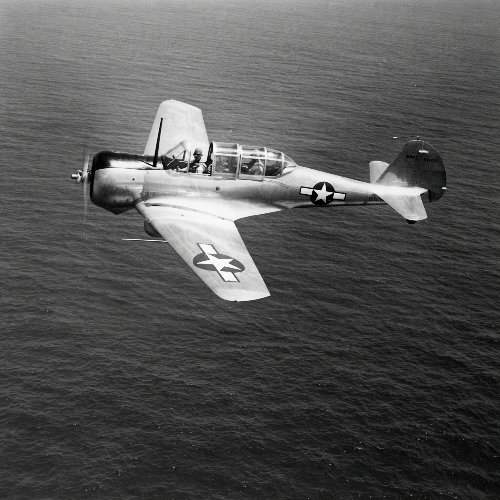
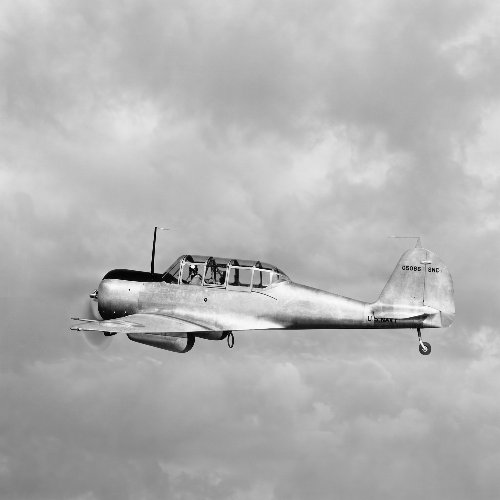
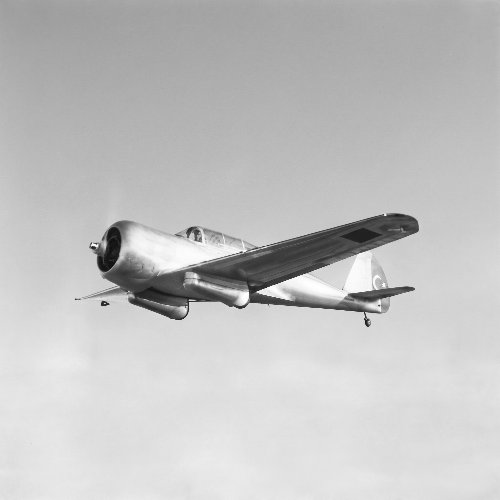
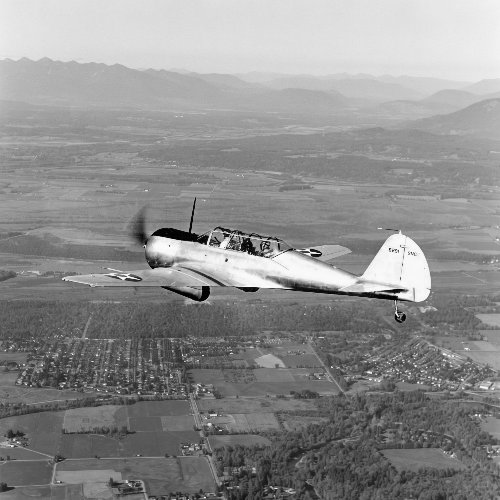
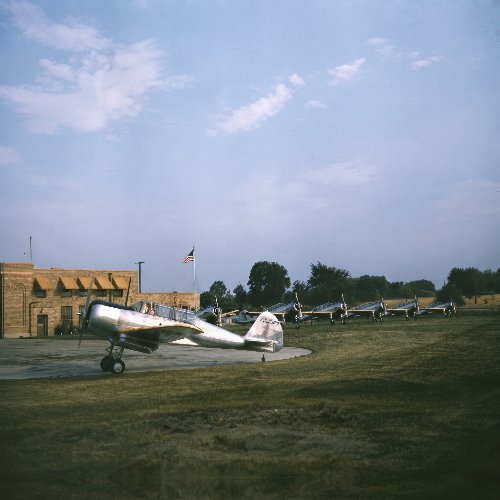
The Curtiss‑Wright CW‑22, known in U.S. Navy service as the SNC‑1 Falcon, was a two‑seat advanced trainer and general‑purpose aircraft developed in the United States in the late 1930s and early 1940s.
Its origins trace back to Curtiss‑Wright’s earlier CW‑19 and CW‑21 designs, which provided the structural and aerodynamic foundation for a more versatile, export‑friendly aircraft suited to both training and light combat roles.
The CW‑22 first flew in 1940, with production beginning soon afterwards at Curtiss‑Wright’s St Louis factory.
Origins and Development
Curtiss‑Wright’s design team sought to create an aircraft that could serve both civilian and military markets.
The CW‑22 evolved from the CW‑19L, a two‑seat monoplane originally intended for civilian training, and incorporated features from the CW‑21 Demon, a lightweight export fighter.
These influences produced a compact, low‑wing monoplane with retractable landing gear, tandem seating, and a streamlined fuselage.
The prototype, designated CW‑A22, flew in 1940 and served as a company demonstrator.
The aircraft was designed during a period of rapidly expanding pilot‑training requirements, especially in the United States.
The U.S. Navy evaluated the type as an advanced trainer capable of transitioning pilots from biplanes to modern monoplanes.
This led to the adoption of the CW‑22N variant as the SNC‑1 Falcon, with large Navy orders beginning in November 1940.
Airframe and Design Features
The CW‑22 was a low‑wing, all‑metal monoplane with tandem seating under a sliding canopy.
Its landing gear configuration mirrored the CW‑21’s system: main wheels retracted rearward into under‑wing fairings, covered by clamshell doors that protruded slightly below the wing surface.
This gave the aircraft a sleek profile while maintaining simplicity and reliability.
The aircraft’s structure emphasised lightweight and ease of manufacture, making it suitable for export customers with limited industrial capacity.
Its cockpit layout was straightforward, supporting both training and reconnaissance roles.
Combat‑capable variants included mounts for two 0.30‑calibre Browning machine guns—one fixed forward‑firing and one flexible gun for the observer.
Powerplant and Performance
All major CW‑22 variants were powered by the Wright R‑975 Whirlwind, a nine‑cylinder radial engine producing approximately 420 hp (313 kW).
This engine provided modest but adequate performance for training and light combat duties.
Key performance figures (SNC‑1 / CW‑22 family):
Maximum speed: 198 mph (319 km/h) at sea level
Cruise speed: ~195 mph
Service ceiling: 21,800 ft (6,645 m)
Range: 780 miles (1,255 km)
Rate of climb: 1,650 ft/min (8 m/s)
Dimensions included a 27 ft (8.23 m) fuselage length, 35 ft (10.67 m) wingspan, and 9 ft 11 in (3.02 m) height.
Empty weight was 2,736 lb (1,241 kg), with a maximum take-off weight of 3,788 lb (1,718 kg).
Variants and Production
Production of the CW‑22 family totalled approximately 442 aircraft, including export and U.S. Navy variants.
CW‑A22 (Prototype)
The initial demonstrator, used for company testing and marketing.
One example (NC18067) survives today.
CW‑22 (Initial Armed Export Model)
Armed with one fixed and one flexible. 30‑calibre machine gun
Powered by the Wright R‑975‑28
36 aircraft purchased by the Royal Netherlands East Indies Army Air Force (ML‑KNIL)
These aircraft were intended for delivery to the Dutch East Indies but were diverted to Australia due to the rapid Japanese advance in early 1942.
CW‑22B (Improved Armed Export Model)
Approximately 100 built
Customers included Turkey (50), the Netherlands East Indies (25), and Latin American countries (~25).
Several Dutch aircraft were captured and flown by the Imperial Japanese Army Air Force.
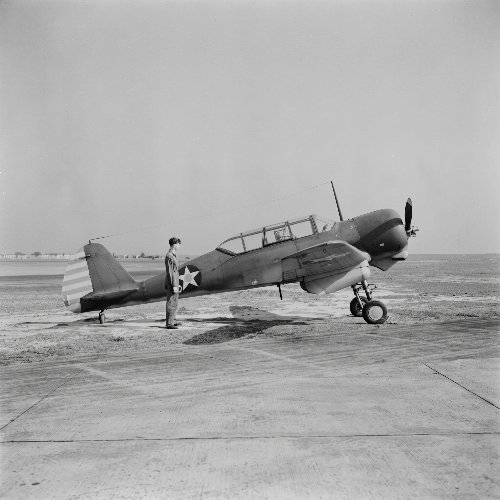
CW‑22N / SNC‑1 Falcon (U.S. Navy Advanced Trainer)
The unarmed training version adopted by the U.S. Navy.
305 aircraft ordered and delivered (serials BuNo 6290–6439, 05085–05234, 32987–32991)
Some sources note a total Navy procurement of 455 aircraft, including impressed airframes and multiple production batches.
The SNC‑1 served from 1942 to 1944, after which many were sold to private owners.
Some were withdrawn early due to structural issues near the tail during aerobatic manoeuvres such as snap rolls.
Operational History and WWII Context
The CW‑22’s operational history is divided between export combat use and U.S. Navy training service.
Dutch East Indies
The CW‑22 and CW‑22B saw their most intense combat with the Royal Netherlands East Indies Army Air Force during the Japanese invasion of Java in early 1942.
CW‑22s delivered to Australia in March 1942 were used in reconnaissance and light attack roles.
Some operated alongside U.S. Army Air Forces units such as the 49th Pursuit Group.
Several were captured intact and flown by Japanese forces.
Turkey and Latin America
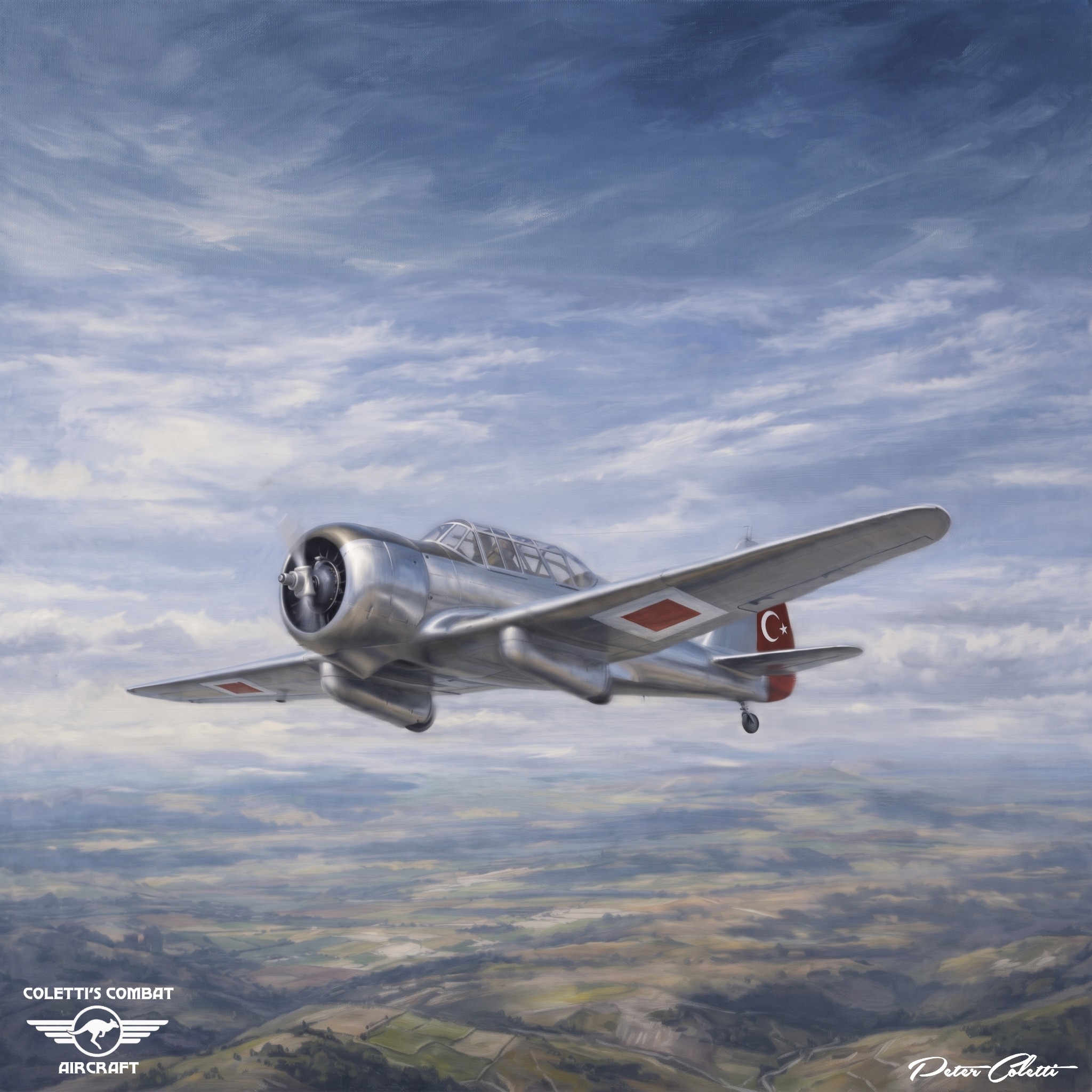
Turkey operated 50 CW‑22Bs, using them for training and general‑purpose duties.
Various Latin American nations acquired small numbers (around 25 total), reflecting Curtiss‑Wright’s strategy of marketing affordable aircraft to developing air forces.
United States Navy
The U.S. Navy employed the SNC‑1 Falcon as an advanced trainer, bridging the gap between basic trainers and frontline aircraft.
Used for navigation, gunnery, formation flying, and utility transport
Operated from 1942 until replaced by more modern trainers
The Navy did not use the CW‑22 in combat; its role was strictly instructional.
Post‑War Fate
After World War II, many SNC‑1 Falcons were sold to private owners in the United States.
Export aircraft largely disappeared from service by the late 1940s, though a handful survive in museums today.
Summary
The Curtiss‑Wright CW‑22 was a versatile, export‑friendly aircraft that served both as a combat‑capable reconnaissance/light attack platform and as a U.S. Navy advanced trainer.
Its development from earlier Curtiss designs produced a streamlined, retractable‑gear monoplane with modest performance but broad utility.
While overshadowed by more famous WWII aircraft, the CW‑22 played a meaningful role in early Pacific combat through Dutch service and contributed significantly to U.S. Navy pilot training during the war.