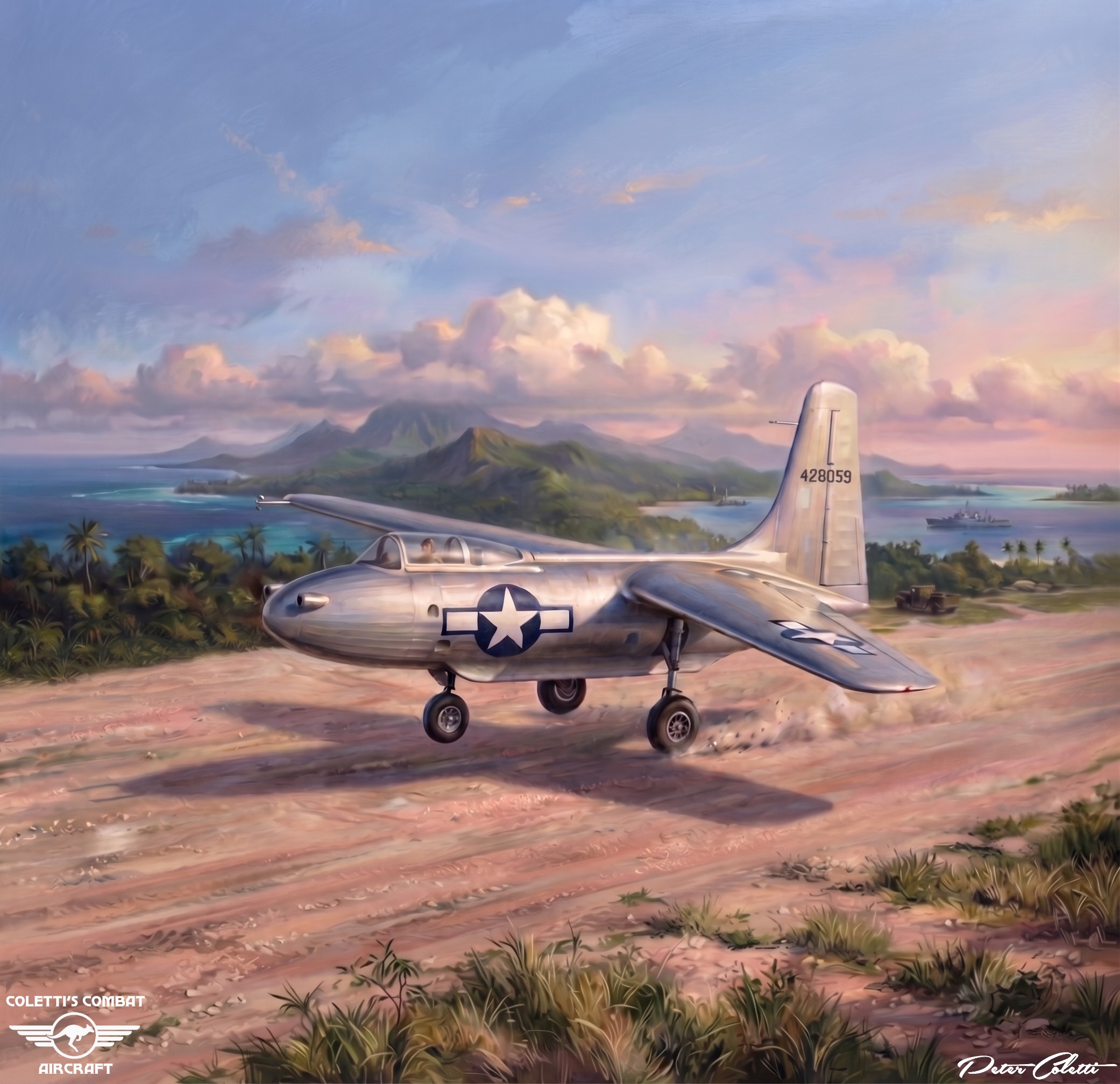
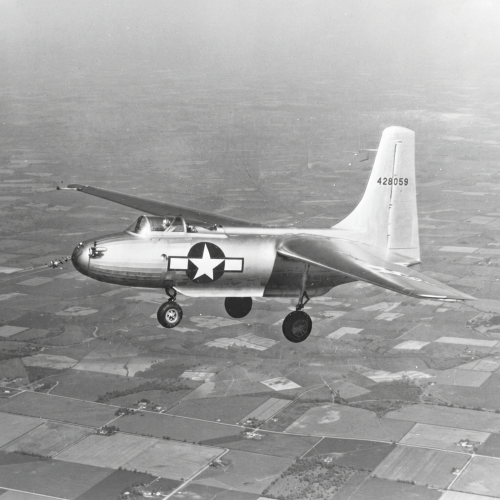
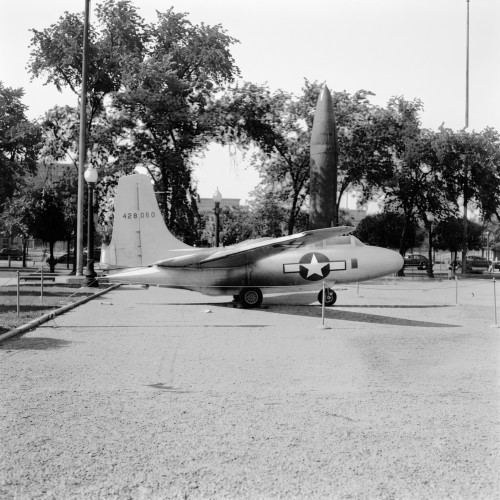
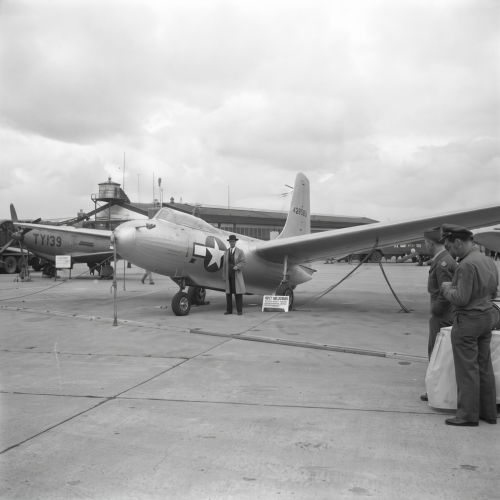
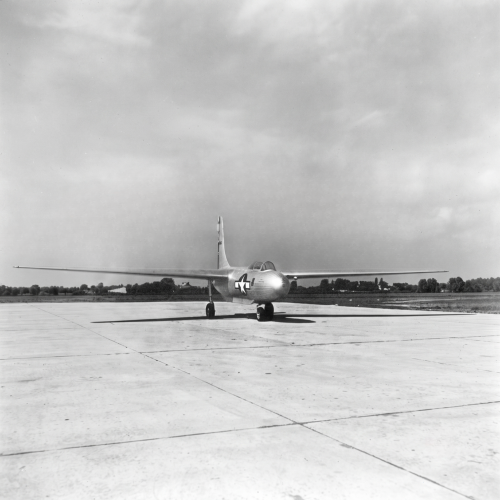
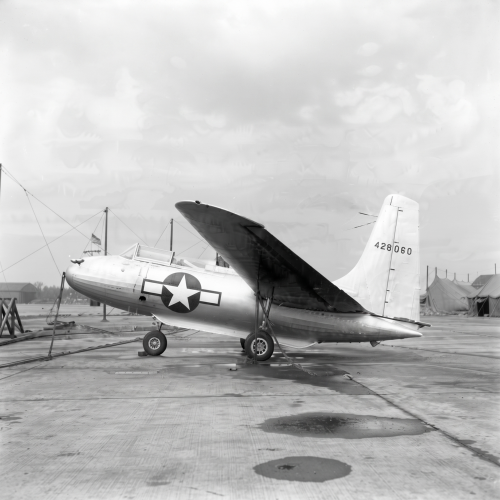
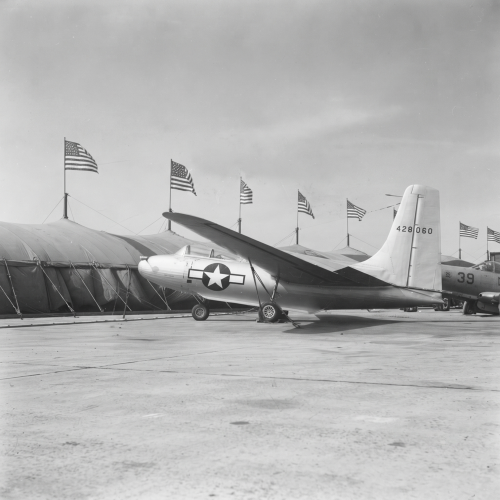
The Cornelius XFG‑1 was one of the most unconventional aircraft concepts tested by the United States Army Air Forces during World War II—a tailless, forward‑swept‑wing, fuel‑transporting glider intended to function as a towed flying fuel tank.
Conceived by designer George Cornelius, the aircraft embodied decades of his experimentation with radical aerodynamic configurations, particularly variable‑incidence wings and tailless layouts.
Two prototypes were built, flown, and ultimately abandoned as the war’s strategic landscape shifted.
Development and Program Origins
Cornelius had been exploring unconventional aircraft since the 1920s, culminating in the Cornelius Mallard of 1943—a tailless aircraft with strongly forward‑swept wings and no horizontal stabiliser.
The XFG‑1 was developed under project designation MX‑416, building directly on the Mallard’s aerodynamic lessons.
A quarter‑scale model was constructed for wind‑tunnel testing before full‑scale prototypes were authorised.
The aircraft’s intended role was highly unusual: to serve as a fuel glider (hence the “FG” designation), carrying 677 US gallons (2,563 litres) of aviation gasoline in two fuselage tanks.
It would be towed behind a bomber or transport aircraft, effectively functioning as a giant external drop tank to extend the towing aircraft’s range.
This concept emerged during a period when long‑range bombing capability was a critical strategic challenge for the U.S. in the Pacific theatre.
Two operational concepts were explored:
Piloted version: Towed behind a large transport, jettisoning its wheels after take-off and landing on skids at a designated field.
Pilotless version: Towed behind a B‑29, emptied in flight, then released and abandoned.
Both concepts reflected wartime urgency and the desire to extend bomber reach before forward bases were secured.
Design Characteristics
Airframe and Layout
The XFG‑1 was a high‑wing monoplane with its wing mounted far aft near the vertical stabiliser.
It featured:
Forward‑swept wings of modest sweep and high aspect ratio
No horizontal tailplane, relying entirely on wing‑mounted control surfaces
Fixed tricycle landing gear
Single‑seat enclosed cockpit
This tailless configuration was a direct continuation of Cornelius’s earlier experiments.
Wing Incidence Adjustment
Earlier Cornelius aircraft had variable-incidence wings adjustable in flight.
The XFG‑1 simplified this: incidence could only be set on the ground, with selectable angles of 3° or 7°.
Adjusting incidence on a forward‑swept wing also altered effective dihedral, a characteristic noted in contemporary accounts.
Fuel System and Role
The fuselage housed two large cylindrical fuel tanks forming the aircraft’s centre section.
These tanks held the full 677‑gallon load, making the XFG‑1 essentially a flying fuel tank.
The glider could be towed at 250 mph (400 km/h)—significantly faster than troop gliders like the Waco CG‑4—allowing compatibility with modern bombers and transports.
Systems and Equipment
The aircraft carried standard flight instruments, including:
Magnetic compass
Altimeter
Airspeed indicator
Variometer
Slip indicator
Radio
A small propeller-driven generator mounted on a fuselage boom provided electrical power during the tow.
Operational Testing and Performance
Two prototypes were built in 1944–45, serial numbers 44‑28059 and 44‑28060, with a total of 32 test flights conducted.
The first prototype was lost in a fatal spin accident, killing pilot Alfred Reitherman, who had flown many of the earlier tests.
The second prototype completed 19 flights before the programme was terminated.
Performance Characteristics
Crew: 1
Length: 29 ft 3 in (8.92 m)
Wingspan: 54 ft (16.46 m)
Wing area: 356 sq ft (33.1 m²)
Empty weight: 3,362 lb (1,525 kg)
These figures reflect a lightweight airframe optimised for towing rather than independent flight.
Variants and Proposed Configurations
Although only two prototypes were built, the programme explored several conceptual variants:
Piloted Fuel Carrier
Jettisonable landing gear
Landing on skids
Intended for delivery of fuel to forward airstrips or ground forces
Pilotless Fuel Glider
Towed behind a B‑29
Emptied in flight
Released and abandoned
No additional variants reached construction or testing.
World War II Context and Program Cancellation
The XFG‑1 emerged during a critical phase of the Pacific War when U.S. bombers struggled to reach distant Japanese targets.
Before the capture of forward bases, concepts like the XFG‑1 were explored as stopgap measures to extend bomber range.
The idea echoed earlier long‑range improvisations such as the Doolittle Raid, where B‑25s launched from a carrier due to insufficient land‑based range.
However, by late 1944 and early 1945, rapid Allied advances provided new airfields closer to Japan.
As a result:
The need for extreme‑range fuel augmentation diminished.
Dedicated tanker aircraft concepts began to supersede glider‑based refuelling ideas.
The XFG‑1 programme was cancelled in 1945.
The aircraft thus represents a transitional moment in aerial refuelling history—an experimental step between early wartime improvisation and the postwar development of powered tanker aircraft.
Conclusion
The Cornelius XFG‑1 stands as one of the most unusual aircraft tested during WWII: a tailless, forward‑swept, fuel‑carrying glider intended to extend bomber range by acting as a towed, flying fuel tank.
Although technically innovative and aerodynamically bold, the concept was overtaken by wartime developments and ultimately abandoned.
Its brief test history—marked by 32 flights, one fatal accident, and no operational deployment—illustrates both the ingenuity and the urgency of wartime experimentation.