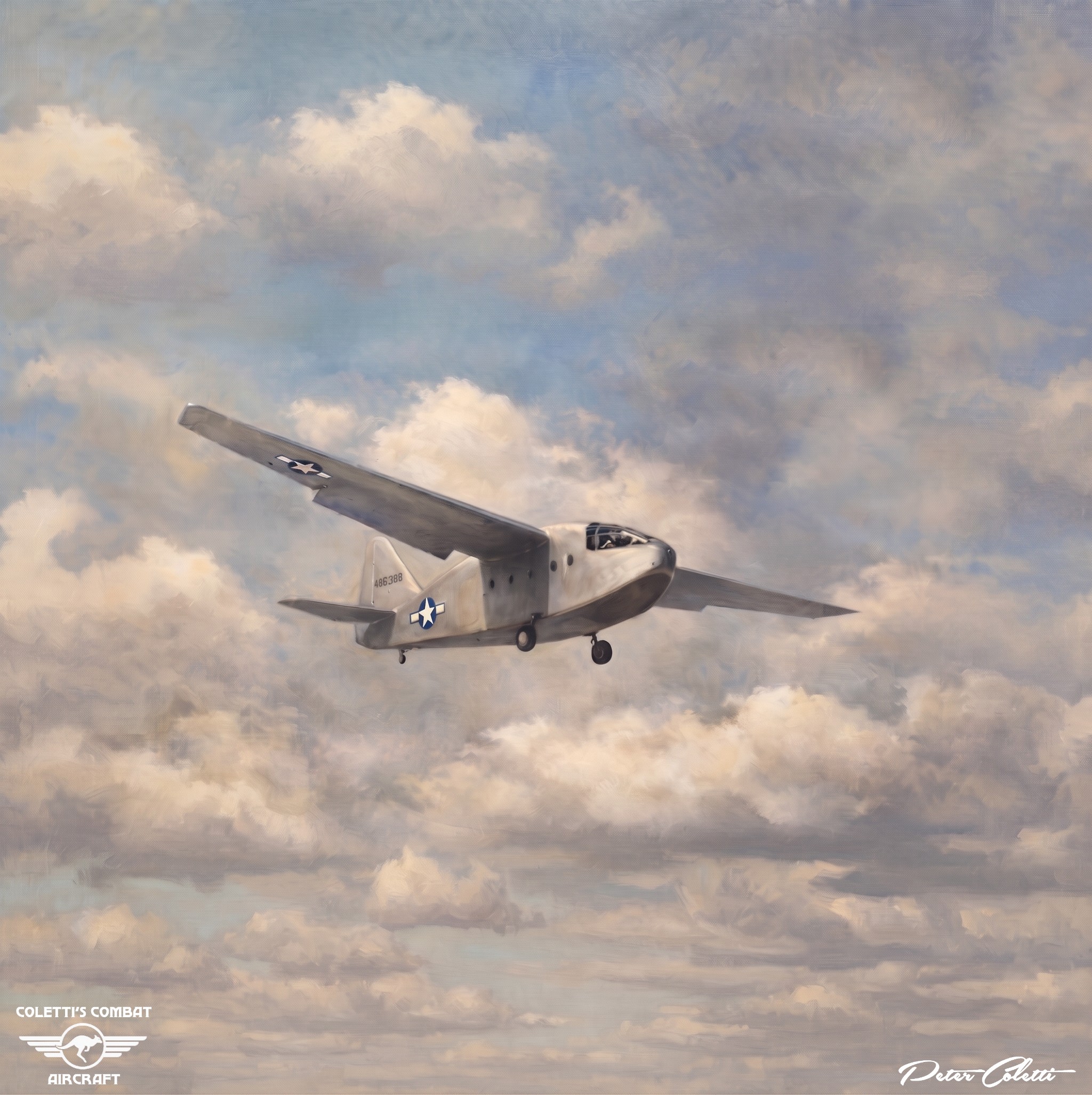
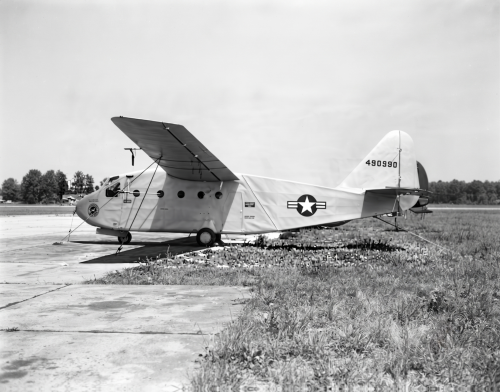
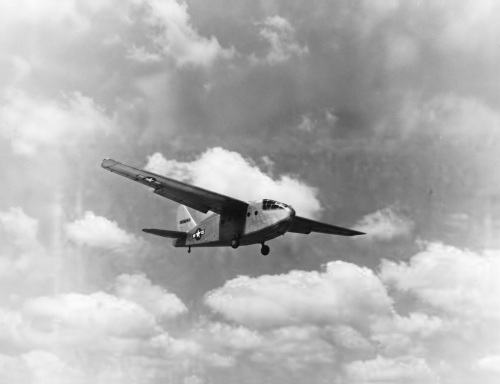
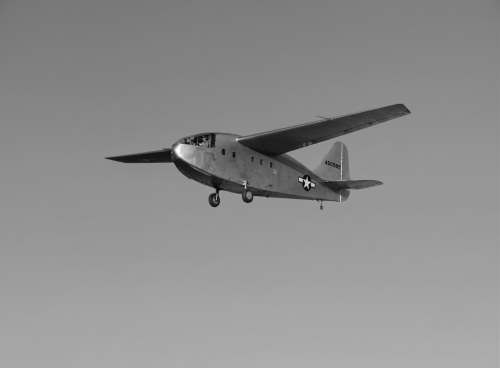
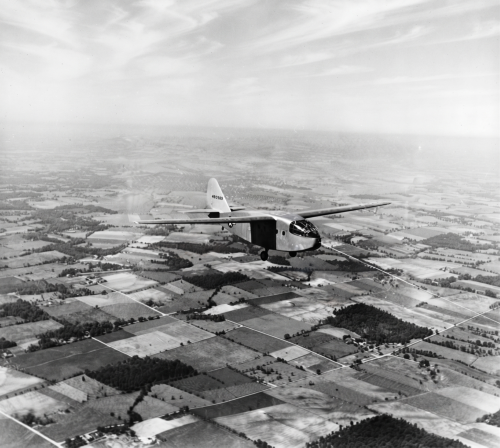
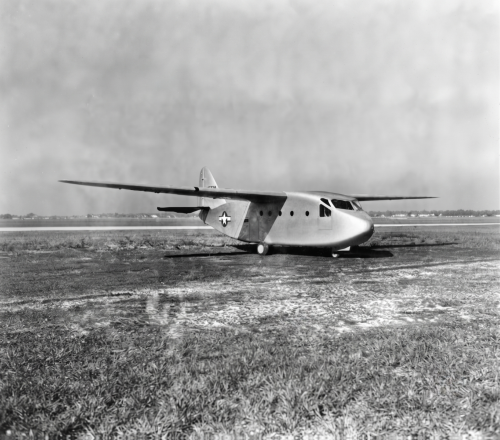
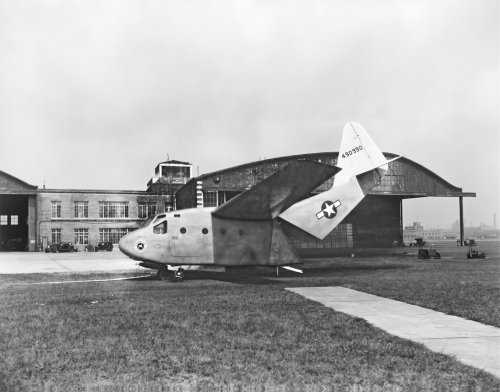
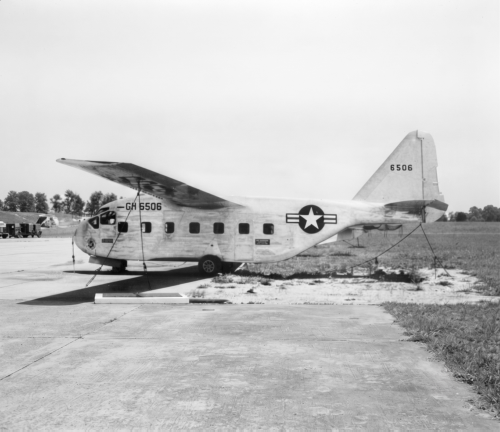
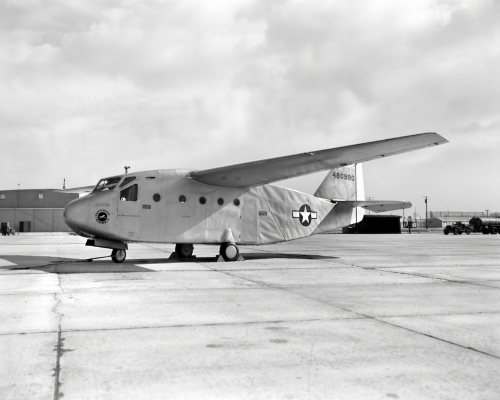
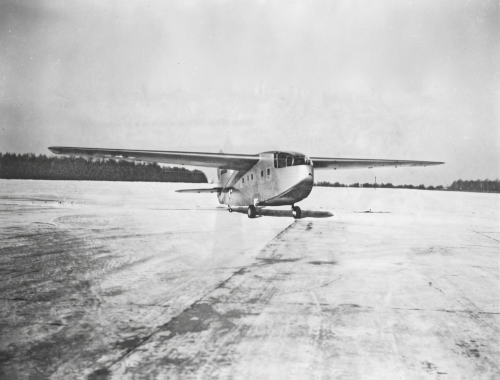
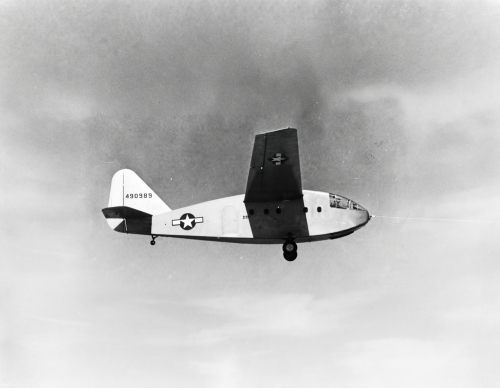
The Chase XCG‑14 emerged from late‑war U.S. Army Air Forces (USAAF) efforts to expand the capability of assault and cargo gliders.
By 1942–43, airborne operations had proven their value in Europe and the Pacific, but existing American gliders—primarily the Waco CG‑4A—were limited in payload, crashworthiness, and towing speed.
The USAAF issued a Request for Proposals in late 1942 for a new glider capable of transporting a ¼‑ton Jeep with a crew, 15 soldiers, or maintenance personnel for forward fighter bases, while also being towable at higher speeds by fighter aircraft.
Michael Stroukoff, a Russian émigré aeronautical engineer who founded Chase Aircraft Company in February 1943, had already developed high‑aspect‑ratio wing concepts that promised efficient gliding performance.
He responded immediately with a pre‑existing conceptual design, winning a contract to build the new assault glider designated XCG‑14, company designation MS‑1.
Although conceived during WWII, the XCG‑14 flew only in January 1945, when the war was nearing its end.
As a result, it never entered combat, but it represented a significant step in U.S. military glider development.
Design and Construction
Airframe and Materials
The XCG‑14 was a freestanding shoulder‑wing glider built primarily of marine‑grade mahogany plywood, a necessity because spruce was prioritised for other wartime programmes.
This material choice also provided improved crash protection compared to earlier American gliders.
The aircraft’s structure was largely wooden, with fabric‑covered control surfaces.
Its design emphasised:
High aspect‑ratio wings (ratio 10.18), using a NACA 23016 airfoil, reflect Stroukoff’s aerodynamic philosophy.
A robust fuselage capable of rear loading.
A layout optimised for towing at higher speeds than previous gliders.
Cargo and Troop Capacity
The XCG‑14 was designed to carry:
One 1‑ton 4×4 truck + 3 soldiers,
or
One M3A1 75 mm howitzer + crew,
or
18 fully equipped troops.
This represented a substantial improvement over the CG‑4A’s typical 13‑troop capacity.
Flight Testing and Performance
The prototype XCG‑14 (serial 44‑90989) made its maiden flight on January 4, 1945, validating Stroukoff’s aerodynamic concepts.
Performance Characteristics (XCG‑14)
Maximum speed: 170 mph
Stall speed (flaps down): 60 mph
Never‑exceed speed: 200 mph
Empty weight: 3,237 lb
Maximum takeoff weight: 7,605 lb
Wingspan: 71 ft 9.6 in
Length: 42 ft 10.5 in
Wing area: 507 sq ft
These figures placed the XCG‑14 among the fastest and most capable American gliders of the war, particularly in tow‑speed tolerance.
Variants and Evolution
Although the XCG‑14 itself remained a single prototype, its success prompted rapid development of improved versions.
XCG‑14 (MS‑1)
First prototype, all‑wood construction.
Capacity: 16 seats (other sources list 18 troops depending on configuration).
Redesignated XCG‑18, marking a shift towards all‑metal construction.
Two built.
Transition to the XCG‑18 and Beyond
The XCG‑14 lineage directly led to the XCG‑18, the world’s first all‑metal transport glider, and later to powered derivatives such as the YC‑122 Avitruc.
These developments occurred after WWII but were rooted in the XCG‑14 programme’s aerodynamic and structural innovations.
Operational and Historical Significance
Although the XCG‑14 never reached mass production or combat deployment, it holds an important place in U.S. glider history:
Late‑war timing: Its first flight in early 1945 meant it arrived too late for wartime use.
Technical advancement: It introduced stronger materials, higher towing speeds, and greater payload flexibility.
Postwar continuation: It was one of the few glider projects continued after WWII, reflecting its perceived potential.
Influence on future transports:
The design lineage ultimately contributed to the development of the Fairchild C‑123 Provider, a major Cold War transport aircraft.
WWII Context and Program Outcome
By the time the XCG‑14 flew, the strategic need for gliders was diminishing.
Airborne operations had shifted towards powered transports, and the war’s end further reduced urgency.
Larger and more capable gliders—such as the Chase XCG‑18 and XG‑20—soon overshadowed the XCG‑14.
The USAAF ultimately determined that gliders were becoming obsolete, and the programme ended without production.
Nevertheless, the XCG‑14 remains historically significant as the following:
The first aircraft designed by Chase Aircraft,
A bridge between wartime glider concepts and postwar powered transports,
A demonstration of Stroukoff’s aerodynamic innovations that shaped later U.S. military transport design.
Summary
The Chase XCG‑14 was a late‑WWII American assault glider prototype that embodied advanced aerodynamic thinking and improved structural design.
Although it never saw combat, its development marked a turning point in U.S. military glider evolution, leading directly to more capable postwar gliders and eventually to powered transports.
Its variants—XCG‑14A, YCG‑14A, and XCG‑14B—reflected rapid refinement, while its legacy lived on in the XCG‑18 and later the C‑123 family.