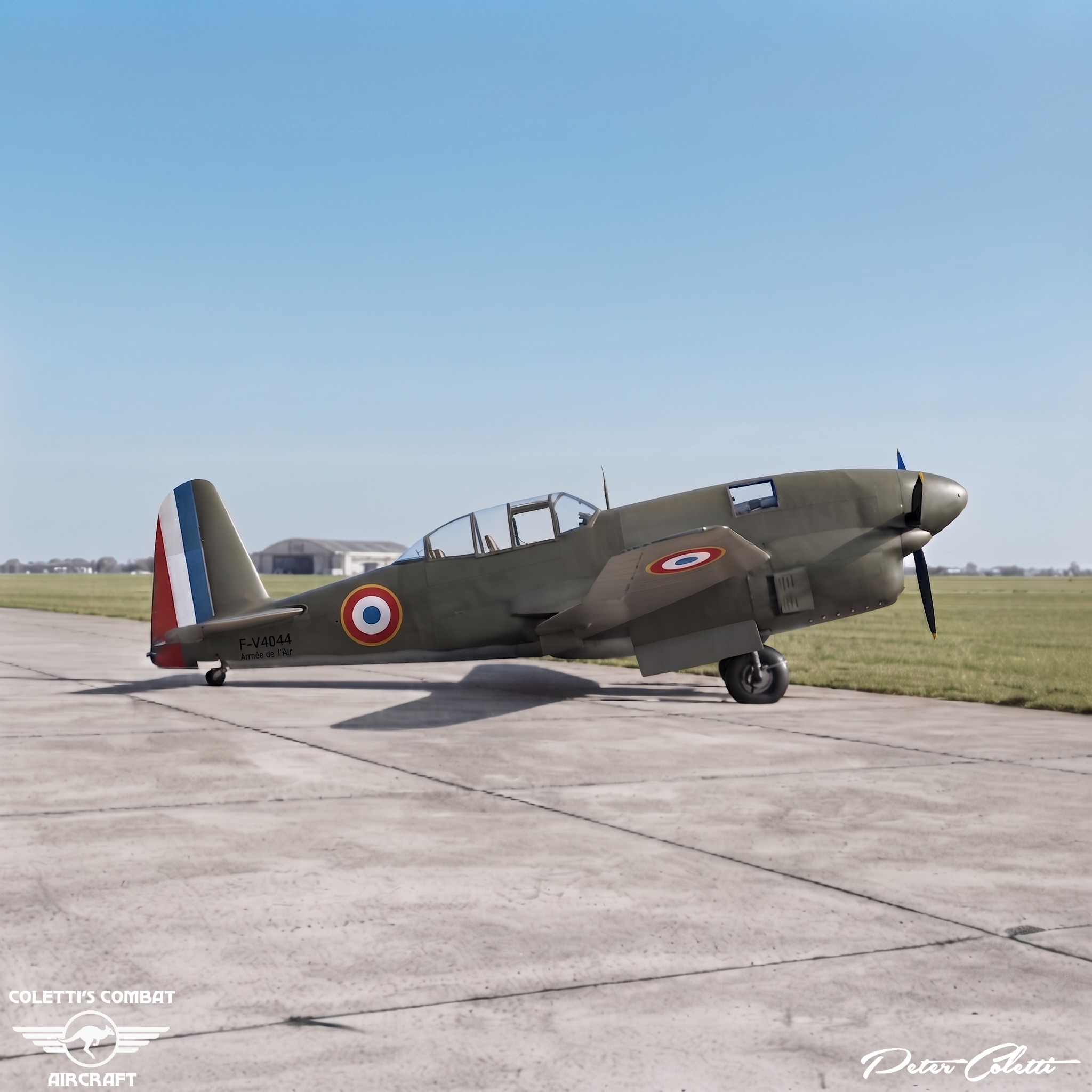
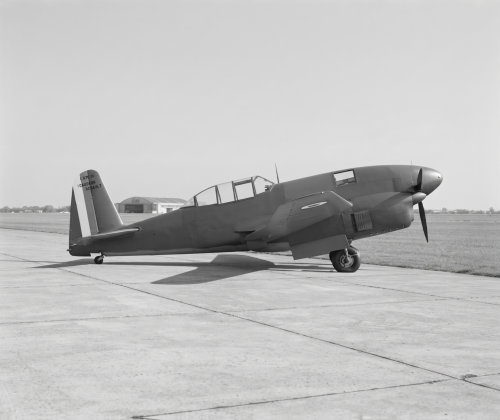
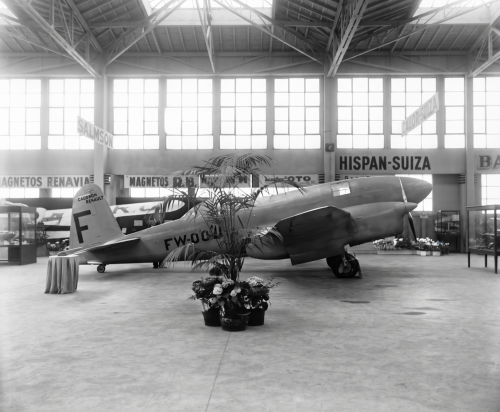
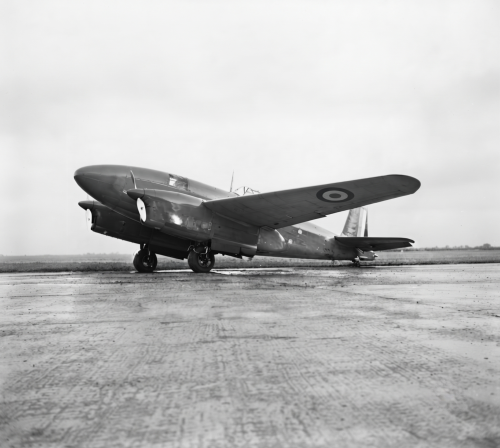
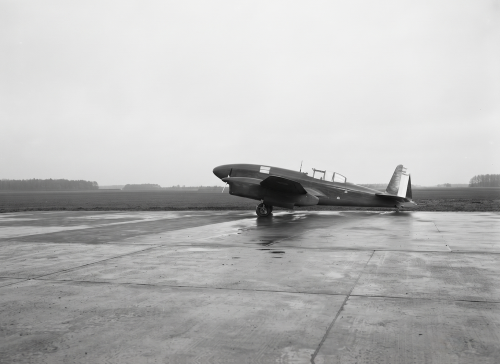
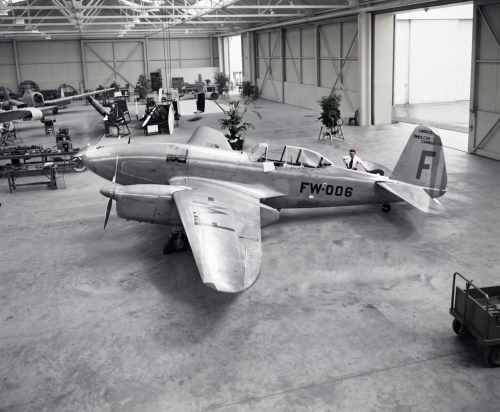
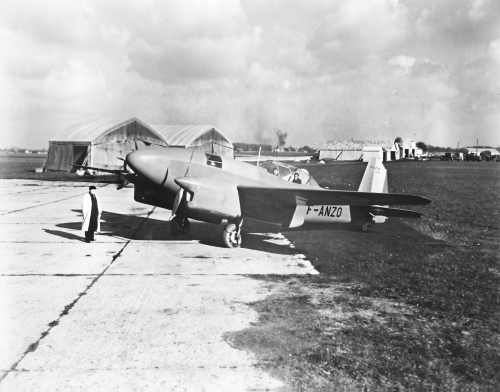
The Caudron C.670 Typhon emerged in the late 1930s, during a period when the French aviation industry was experimenting aggressively with lightweight, high‑speed aircraft powered by compact inline engines.
Caudron, already renowned for its racing machines and streamlined touring aircraft, sought to leverage its expertise in aerodynamic refinement and wooden monocoque construction to produce a new generation of fast liaison and training aircraft.
The Typhon project was conceived as a two‑seat, high‑performance monoplane intended to serve both as an advanced trainer and as a fast personal transport.
It followed the lineage of Caudron’s successful C.630–C.635 Simoun series but aimed to push performance further through a cleaner airframe and a more powerful engine installation.
The aircraft was designed at a time when the French Air Ministry was encouraging private manufacturers to develop dual-use aircraft that could be militarised quickly in the event of war.
Development began around 1938, with Caudron engineers applying lessons learned from their racing aircraft—particularly the C.450 and C.460 racers—to a practical two‑seat configuration.
The prototype was completed shortly before the outbreak of the Second World War, but the rapidly deteriorating political situation prevented the aircraft from entering meaningful production.
Only one prototype of the C.670 Typhon is known to have been built.
Design Characteristics
The Caudron C.670 was a low‑wing monoplane of wooden construction, reflecting Caudron’s established manufacturing philosophy.
The company favoured lightweight wooden structures for their aerodynamic smoothness and ease of production, and the Typhon continued this tradition.
Airframe
Construction: Primarily wood, with plywood skinning over a semi‑monocoque fuselage.
Wing: Low‑mounted, cantilever wing with a relatively high aspect ratio for efficiency.
Cockpit: Two seats arranged side‑by‑side, enclosed under a streamlined canopy.
Landing Gear: Fixed, tailwheel configuration, faired for drag reduction.
The fuselage was notably slender, a hallmark of Caudron design, and the aircraft’s overall form emphasised laminar airflow and minimal parasitic drag.
The tail surfaces were conventional but finely tapered, contributing to the aircraft’s clean aerodynamic profile.
Powerplant
The Typhon was powered by a Renault inline engine, likely in the 220–240 hp class.
Caudron and Renault were closely linked at the time, and Caudron aircraft routinely used Renault engines.
The exact model is not definitively recorded, but contemporary sources suggest a Renault 6Q series engine, which was also used in the Simoun and other Caudron types.
Performance Intent
Although detailed performance figures were never published, the aircraft was designed to:
exceed the cruising speed of the Simoun (≈ 250–260 km/h),
offer excellent climb performance,
provide stable handling suitable for advanced training,
serve as a fast courier aircraft for military or civil use.
The emphasis on speed and efficiency suggests that the Typhon was intended to compete with other European fast liaison aircraft of the era, such as the Klemm Kl 35 or the de Havilland Moth Minor, but with significantly higher performance.
Operational Context and WWII Impact
The Caudron C.670 Typhon was completed at the worst possible moment.
The prototype appeared just as France was entering the final months before the outbreak of the Second World War.
As the French Air Ministry shifted its priorities towards mass production of fighters, bombers, and proven liaison aircraft, experimental or niche designs were sidelined.
Pre‑war Evaluation
The prototype reportedly flew and demonstrated promising performance, but the aircraft never progressed beyond initial testing.
Caudron’s facilities were already heavily committed to producing the Simoun series and preparing for military contracts, leaving little industrial capacity for a new type.
Fall of France
With the German invasion in 1940, Caudron’s operations were disrupted.
Many prototypes were destroyed, captured, or abandoned.
The fate of the C.670 prototype is not fully documented, but it is generally believed that the following is true:
it was either destroyed during the war,
or seized and scrapped during the occupation.
No evidence suggests that the aircraft was flown by German forces or evaluated post‑capture.
Technical Summary (Consolidated)
Although exact specifications are incomplete, the following represents the best reconstruction based on Caudron design practices and surviving documentation:
Engine: Renault inline piston engine (likely 6Q series, ~220–240 hp)
Performance (estimated):
Maximum speed: ~270–290 km/h
Cruise speed: ~240–260 km/h
Range: ~800–1000 km
Service ceiling: ~5,000–6,000 m
These estimates align with Caudron’s design philosophy and the performance envelope of similar aircraft in the company’s lineup.
Variants
The Caudron C.670 Typhon had no known variants.
Only a single prototype was constructed, and no derivative models were developed before the programme was terminated by the war.
Legacy and Significance
The C.670 Typhon represents one of the many promising French light aircraft projects cut short by the Second World War.
Although overshadowed by the more famous Caudron Simoun and Caudron racing aircraft, the Typhon is historically significant because:
It illustrates Caudron’s attempt to merge racing‑aircraft aerodynamics with practical utility roles.
It shows the direction French light‑aircraft design was taking before wartime priorities intervened.
It stands as an example of the many “lost” prototypes whose development was halted by the collapse of France in 1940.
In the broader context of French aviation history, the Typhon is a footnote—but an intriguing one that highlights Caudron’s technical ambition and the abrupt end of pre‑war innovation.