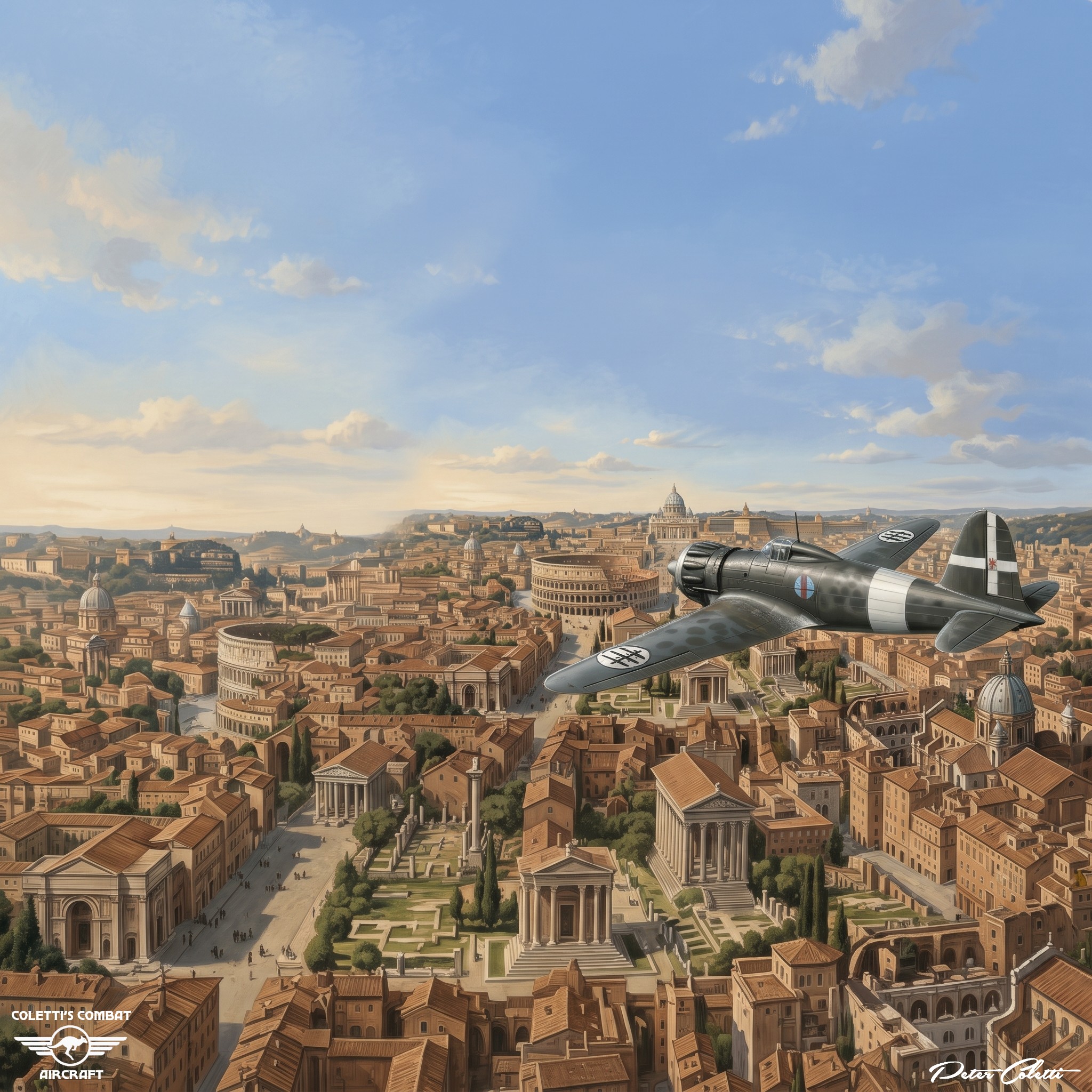
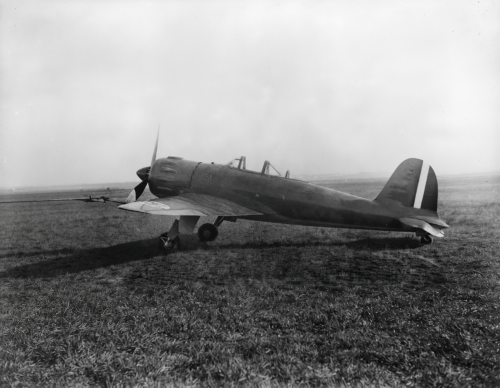
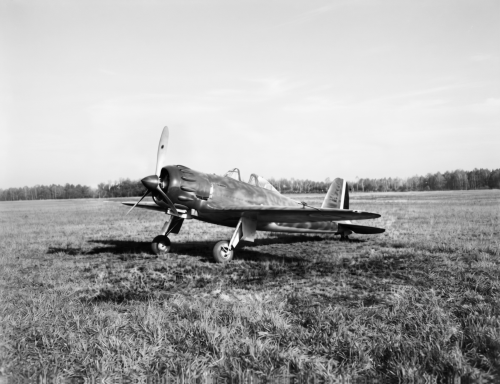
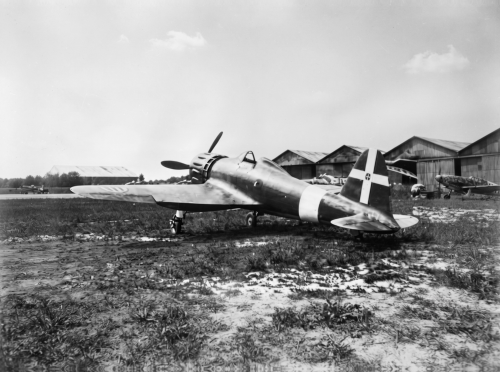
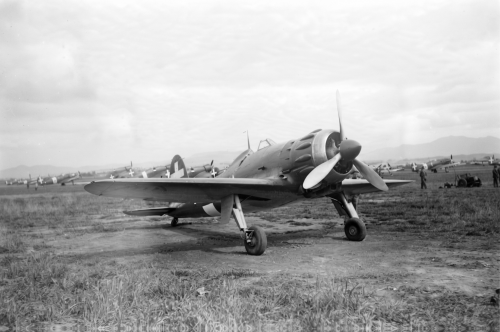
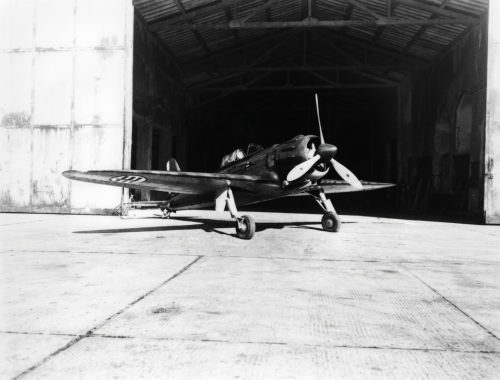
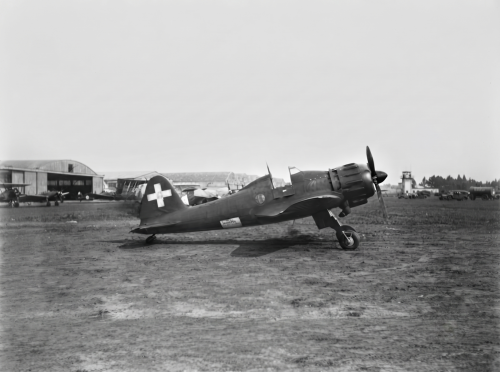
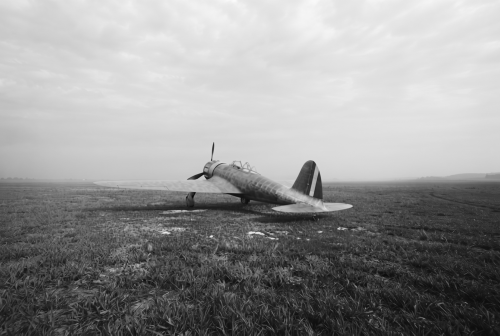
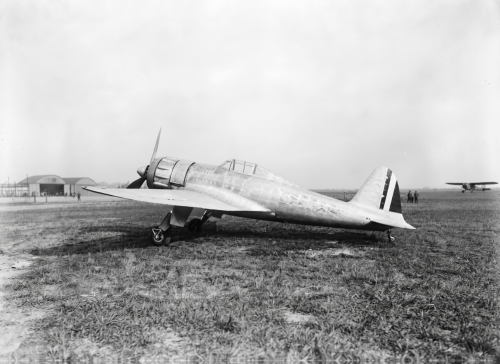
The Caproni Vizzola F.5 emerged from Italy’s late‑1930s push to modernise its fighter fleet.
In 1937, engineer Fabrizio Fabrizi began designing two parallel fighter concepts: the F.4, intended for a liquid‑cooled inline engine, and the F.5, optimised for a radial engine.
Both shared a common airframe but diverged in powerplant philosophy.
The Italian Air Ministry disfavoured the inline engine proposed for the F.4, delaying that programme and allowing the F.5 to advance more rapidly.
The first prototype, MM.392, flew on 19 February 1939, demonstrating excellent manoeuvrability and climb performance.
A second prototype followed in early 1940 with aerodynamic refinements and a variable‑pitch propeller.
These promising results led to an order for 12 pre‑production aircraft, plus one additional airframe later completed as an F.4.
In total, 13 F.5s were built.
Airframe and Construction
The F.5 embodied Italy’s transitional fighter design philosophy: modern in layout but conservative in materials.
Fuselage: Welded steel‑tube structure covered with flush‑riveted duralumin.
Wings: Wooden construction with stressed plywood skin and fabric covering.
Configuration: Single‑seat, low‑wing cantilever monoplane with fully retractable landing gear.
This mixed construction was typical of Italian fighters of the era (e.g., Fiat G.50 and Macchi C.200), balancing strength, weight, and manufacturing practicality.
Powerplant and Systems
The F.5 was powered by a Fiat A.74 R.C.38, a two-row, 14-cylinder air-cooled radial engine producing 840–870 hp depending on the source.
Key characteristics:
Propeller: Three‑bladed, variable‑pitch (on later prototypes).
Cooling: Air‑cooled radial, chosen for reliability and simplicity.
Performance
Maximum speed: 317 mph (510 km/h)
Range: 480 miles (770 km)
Service ceiling: 31,200 ft (9,510 m)
While manoeuvrable, the aircraft’s performance lagged behind contemporary fighters equipped with more powerful inline engines (e.g., DB 601‑powered Macchi C.202).
Armament
Standard armament consisted of:
Two 12.7 mm Breda‑SAFAT heavy machine guns, wing‑mounted, with 350 rounds per gun.
This was typical for Italian fighters of the period but increasingly inadequate by 1941–42 as Allied aircraft adopted heavier armament.
Flight Characteristics
Test pilots and squadron evaluations consistently praised:
High manoeuvrability, especially at low and medium altitudes.
Strong climb rate, aided by the lightweight airframe.
Stable handling, suitable for night‑fighter conversion.
However, limitations included:
Underpowered engine compared to foreign contemporaries.
Limited firepower for frontline combat.
Mixed construction that complicated maintenance during wartime shortages.
Operational History
Early Service
The Regia Aeronautica assigned 11 pre‑production F.5s to 300ª Squadriglia, 51º Stormo Caccia, beginning limited service in 1941.
Their role was primarily evaluation and local defence.
Night‑Fighter Role
By 1942, several F.5s were transferred to 167º Gruppo Autonomo Caccia Notturna as night fighters.
Modifications were minimal—basic lighting and radio enhancements—but the aircraft’s manoeuvrability made it suitable for defensive patrols.
Spare parts shortages severely limited effectiveness.
Combat Record
No confirmed aerial victories or losses are recorded.
The type saw minimal combat, largely due to its small numbers and Italy’s shift towards more capable fighters like the Macchi C.202.
Export Attempts
Peru purchased a licence to build the F.5 in 1939, but nationalisation of Caproni’s Peruvian subsidiary and later US–Peru military cooperation halted production.
No Peruvian F.5s were built.
End of Service
By 1943, surviving airframes were relegated to training or scrapped as Italy’s war situation deteriorated.
Variants
F.5 (Standard)
13 built
Fiat A.74 R.C.38 radial engine
F.5bis
One aircraft re‑engined with Alfa Romeo R.A.1000 R.C.44‑la Monsonie (license‑built DB 601A‑1) producing 1,175 hp Intended to improve performance but not pursued
F.5 Gamma
Proposed one or two‑seat advanced trainer
Powered by Isotta Fraschini Gamma R.C.35 IS (540 hp)
Armed with one 7.7 mm Breda‑SAFAT
Estimated max speed: 254 mph
Never built
Technical Specifications (Consolidated)
Length: 7.90 m
Wingspan: 11.30 m
Wing area: 17.6 m²
Empty weight: 1,818 kg
Loaded weight: 2,238 kg
Strategic and WWII Context
The F.5 illustrates the challenges of Italian fighter development on the eve of World War II:
Italy’s industry struggled to produce high‑power engines comparable to German or British designs.
Mixed‑construction airframes were durable but increasingly outdated.
The Regia Aeronautica prioritised proven fighters (Fiat G.50, Macchi C.200, later C.202), leaving little room for experimental or limited‑production types.
The arrival of the DB 601 engine reshaped Italian fighter priorities, sidelining radial‑engine projects like the F.5.
As a result, the F.5 became a technically interesting but strategically marginal aircraft, remembered today as a footnote in Italy’s wartime aviation history rather than a frontline combatant.