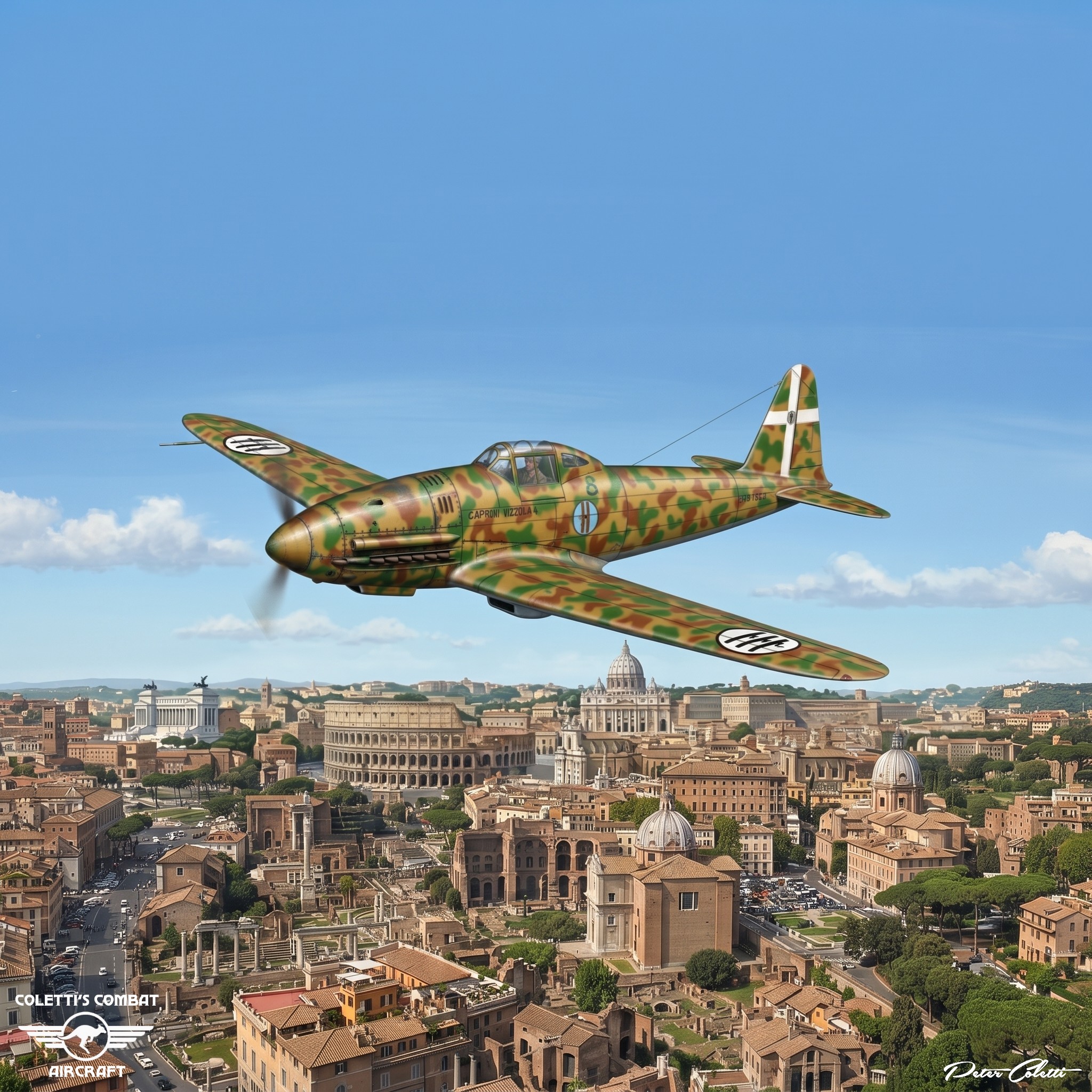
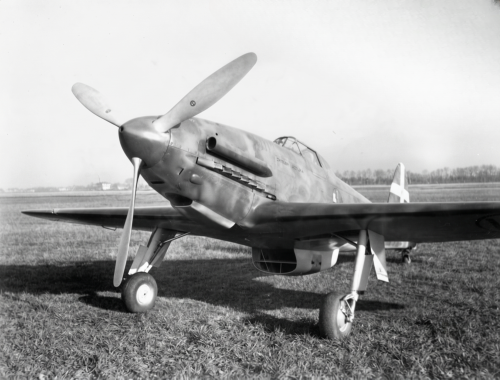
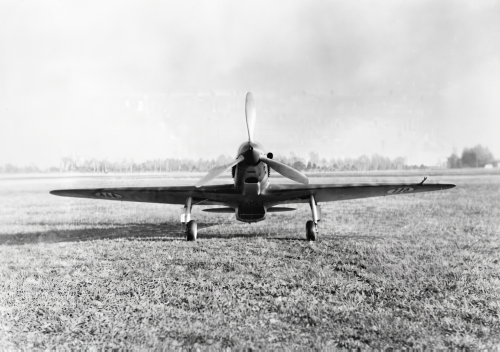
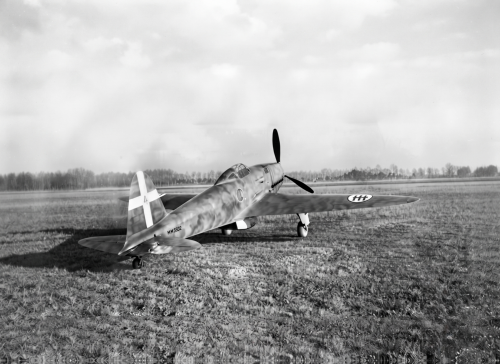
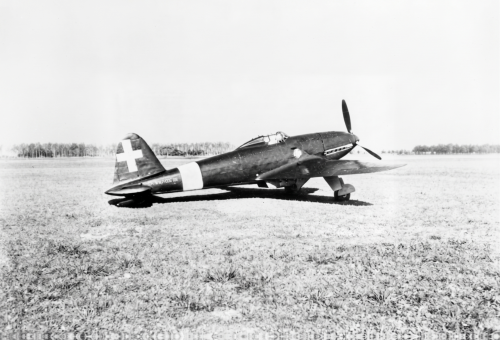
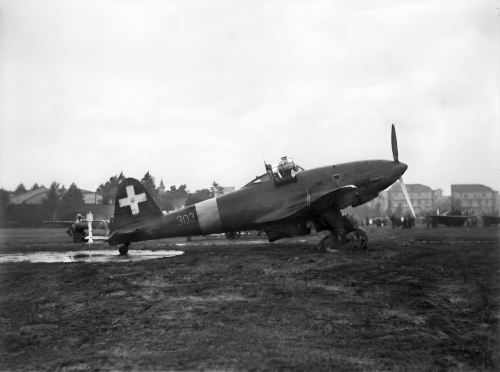
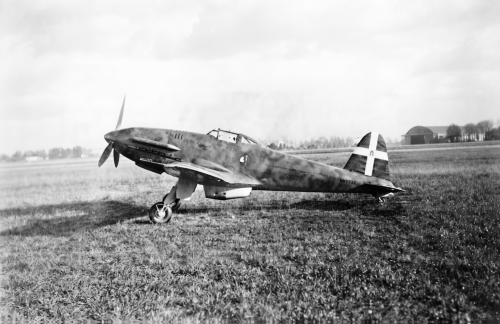
The Caproni Vizzola F.4 emerged from Italy’s late‑1930s effort to modernise its fighter fleet as Europe moved towards war.
In 1937, Caproni Vizzola began designing two parallel fighter concepts: the F.4, intended for an inline liquid‑cooled engine, and the F.5, intended for a radial engine.
Both shared a common airframe and were led by designer F. Fabrizi, whose initial vision for the F.4 centred on high aerodynamic efficiency and competitive performance for the Regia Aeronautica.
The original plan was to power the F.4 with the Isotta‑Fraschini Asso 121 R.C.40, a 12‑cylinder water‑cooled inline engine rated at 715 kW (959 hp).
However, the Italian Air Ministry opposed using the Asso series in fighters, halting the F.4 before a prototype could be built.
Development attention shifted to the radial-powered F.5.
The programme revived in summer 1939, when Italy received its first Daimler‑Benz DB 601A, a modern inverted V‑12 liquid‑cooled engine rated at 876 kW (1,175 hp).
Approved for fighter use, the DB 601A gave the F.4 new viability.
Caproni converted the last of twelve pre‑production F.5 airframes into the F.4 prototype by installing the German engine.
The aircraft achieved its first flight in July 1940, by which time Italy was fully engaged in WWII.
Despite promising performance, no production order followed.
A proposed F.5bis production version using a licence‑built Alfa Romeo DB 601A was abandoned in favour of developing the more advanced Caproni Vizzola F.6M.
Airframe and Structural Design
The F.4 embodied Caproni Vizzola’s hybrid construction philosophy:
Fuselage: Welded steel‑tube structure covered with flush‑riveted duralumin, providing strength with aerodynamic smoothness.
Wings: Wooden, low‑mounted cantilever wings with stressed plywood skin, contributing to light weight and ease of manufacture.
Cockpit: Single‑seat, fully enclosed, positioned amidships for balance and visibility.
Propeller: Three‑bladed, nose‑mounted unit driven by the DB 601A.
The aircraft’s aerodynamic form was rounded and streamlined, reflecting Italian design priorities of the era.
Its mixed wood‑metal construction was typical of Italian fighters, balancing industrial limitations with performance needs.
Powerplant and Systems
Daimler‑Benz DB 601A (Installed)
Type: Inverted V‑12, liquid‑cooled
Power: 876 kW (1,175 hp)
Origin: Germany; later licence‑built by Alfa Romeo
Reason for adoption: Superior reliability, power‑to‑weight ratio, and compatibility with modern fighter requirements compared to domestic inline engines.
The DB 601A transformed the F.4 from a shelved concept into a viable prototype, aligning it with other DB‑powered Axis fighters such as the Macchi C.202 and the German Bf 109E.
Performance Characteristics
Specifications (Prototype F.4)
Length: 8.9 m
Wingspan: 11.29 m
Height: 2.90 m
Wing Area: 17.60 m²
Empty Weight: 2,462 kg
Gross Weight: 3,000 kg
Engine: 1 × DB 601A, 876 kW
Maximum Speed: 550 km/h at 3,750 m
Cruise Speed: 489 km/h
Range: 700 km
Service Ceiling: 10,000 m
Crew: 1
Armament
2 × 12.7 mm Breda‑SAFAT machine guns, forward‑firing.
This was modest by 1940 standards, especially compared to heavily armed Allied and German fighters.
Operational History
Only one F.4 was ever built.
The Regia Aeronautica assigned the prototype to 303ª Squadriglia for experimental evaluation in 1942.
It never entered combat and served strictly in a test role.
The aircraft’s limited operational use reflected Italy’s shifting priorities towards more advanced designs and the urgent wartime need to streamline production around proven fighters.
Variants
F.4 (Prototype):
The sole aircraft, converted from an F.5 pre‑production airframe and powered by the DB 601A.
F.5bis (Proposed):
A planned production version using an Alfa Romeo‑built DB 601A. Cancelled before construction.
Related Designs:
The F.4 and F.5 informed the development of the Caproni Vizzola F.6M, which incorporated more powerful engines and refined aerodynamics.
Role in WWII and Historical Significance
Although the F.4 never progressed beyond the prototype stage, it represents a transitional moment in Italian fighter development:
Engine Modernisation:
Its adoption of the DB 601A aligned Italy with German engineering standards and paved the way for later DB‑powered Italian fighters.
Design Evolution:
The F.4’s airframe contributed to the lineage culminating in the F.6 series, illustrating Caproni Vizzola’s attempt to remain competitive during rapid wartime technological change.
Industrial Constraints:
Italy’s limited engine production capacity and preference for radial engines hindered the F.4’s prospects despite its promising performance.
Operational Footnote:
With only one aircraft built and tested, the F.4 remains a minor but instructive example of Italy’s pre‑war fighter experimentation.
Summary
The Caproni Vizzola F.4 was a streamlined, mixed‑construction Italian fighter prototype developed in parallel with the F.5 and revived only after Italy acquired the Daimler‑Benz DB 601A engine.
First flown in July 1940, it demonstrated respectable performance but never entered production.
Its single prototype served experimentally in 1942, and the design ultimately gave way to more advanced fighters as Italy sought to modernise under wartime pressures.
Today, the F.4 stands as a technical curiosity—an elegant but short-lived attempt to produce a competitive inline-engine fighter for the Regia Aeronautica.