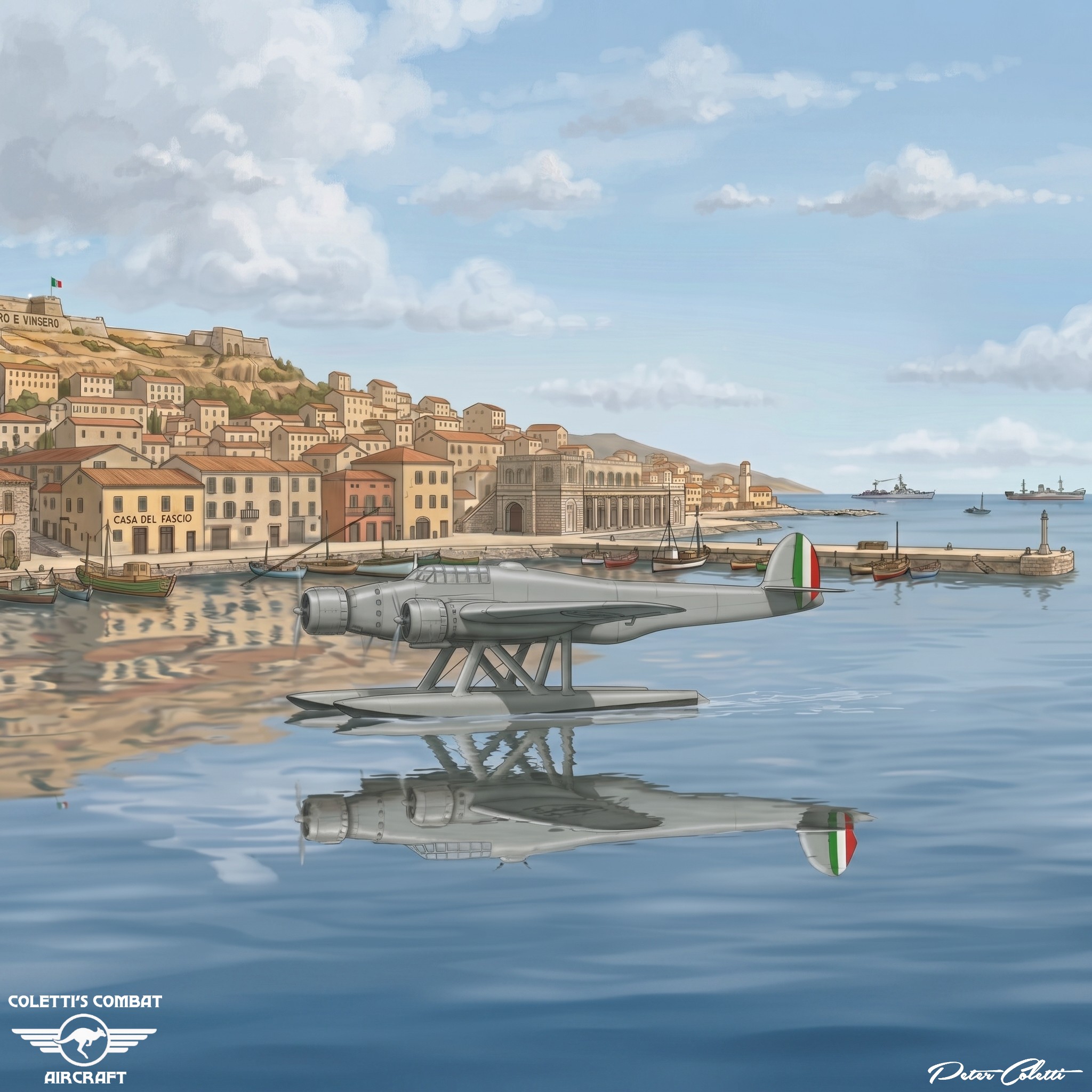
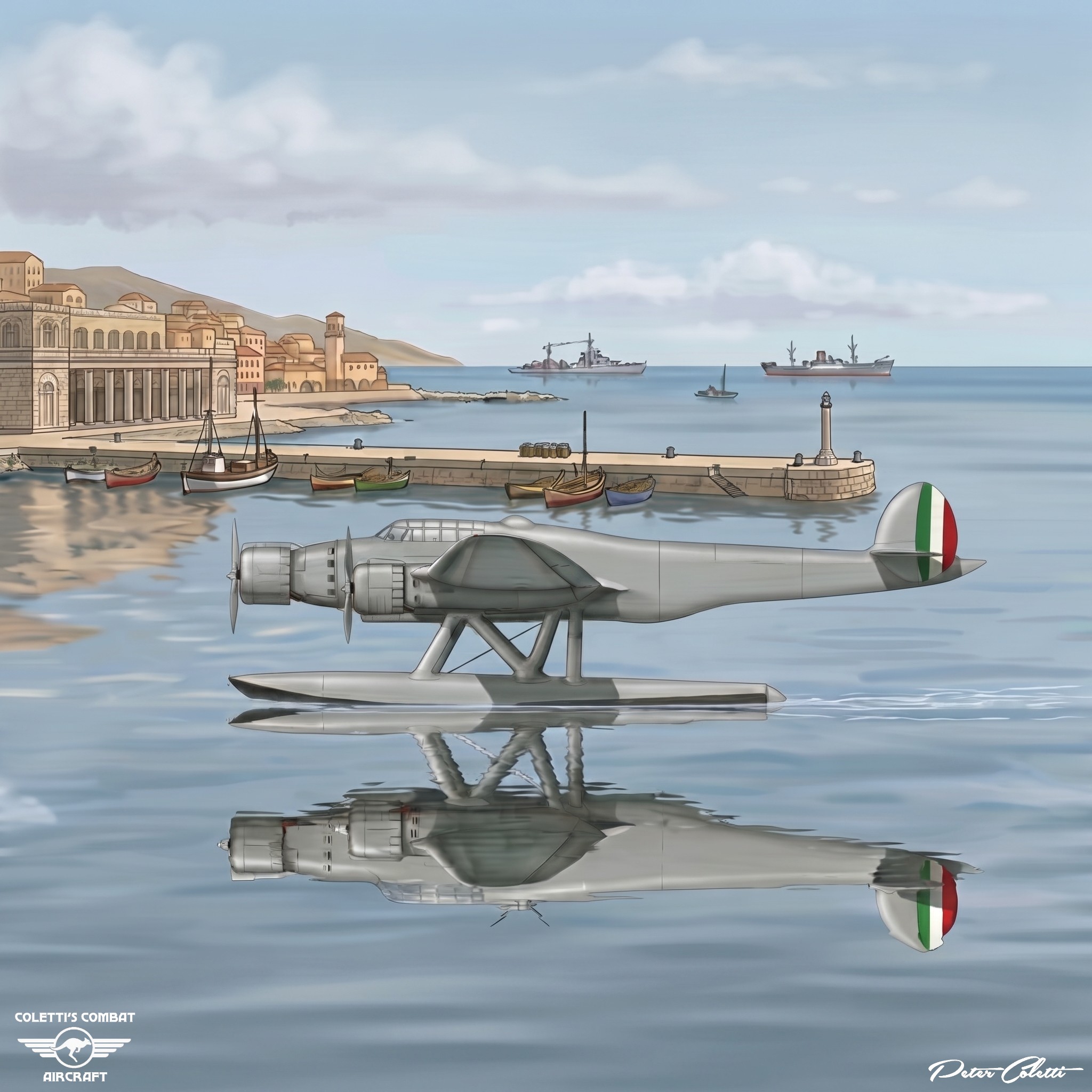
The CANT Z.516 was developed at the end of the 1930s as part of Italy’s effort to modernise its maritime strike and reconnaissance aircraft.
The Regia Aeronautica relied heavily on the CANT Z.506 Airone, a successful but ageing wooden tri-motor floatplane.
By 1939, the Z.506’s modest speed, limited payload, and vulnerability were increasingly inadequate for wartime requirements.
Filippo Zappata, chief designer at Cantieri Aeronautici e Navali Triestini (CANT), proposed a more modern floatplane based on the land‑based CANT Z.1007 Alcione.
The Z.1007 was one of Italy’s most advanced medium bombers, featuring clean aerodynamics, good speed, and a modern tri‑motor layout.
By adapting its fuselage and wings to a twin‑float configuration, CANT aimed to create a faster, more capable maritime bomber that could replace the Z.506.
The resulting aircraft, designated CANT Z.516, was completed, and one prototype was built and flown.
Its maiden flight took place on 3 August 1940.
Airframe and Structural Design
The Z.516 was essentially a floatplane derivative of the Z.1007, retaining its wooden monocoque fuselage constructed from plywood over wooden frames.
This gave the aircraft a streamlined shape and relatively low weight, though at the cost of durability under combat stress.
Key structural features:
Tri‑motor configuration — one nose‑mounted engine and two wing‑mounted engines, identical to the Z.1007’s arrangement.
Cantilever mid‑wing — plywood‑skinned wings with wooden spars, providing good lift at low speeds during water operations.
Twin floats — large metal floats mounted on struts beneath the fuselage and wings, designed to withstand hydrodynamic loads during take-off and landing.
Reinforced tail surfaces — strengthened vertical and horizontal stabilisers to counteract aerodynamic disturbances caused by the floats.
The float installation required a substantial redesign of the lower fuselage and wing root structure.
Additional bracing was incorporated to ensure stability during water operations, and the aircraft’s hydrodynamic behaviour was a major focus of testing.
Powerplant and Systems
The Z.516 used the same engines as the early Z.1007 series:
Three Isotta‑Fraschini Asso XI RC.40 liquid‑cooled V‑12 engines
Approximate output: 840 hp each
Total installed power: ~2,520 hp
This gave the aircraft significantly more power than the Z.506, improving speed and climb performance.
Systems were largely inherited from the Z.1007:
Wing‑mounted fuel tanks
Hydraulic systems for control surfaces and float bracing
Electrical systems adapted for maritime operations
Provisions for reconnaissance cameras and radio equipment
Armament was planned but not fully installed on the prototype.
Intended equipment included:
Dorsal and ventral defensive gun positions
Capacity for a torpedo or approximately 1,200 kg of bombs
Maritime reconnaissance gear
Performance (Prototype and Estimated)
Because only one prototype was built, performance figures are based on flight testing and design estimates.
They place the aircraft between the older Z.506 and the faster Z.1007.
Approximate performance:
Maximum speed: ~330 km/h
Cruise speed: ~280 km/h
Range: ~2,000 km
Service ceiling: ~6,500 m
Crew: 5–6
Payload: comparable to Z.506 (torpedo or bomb load)
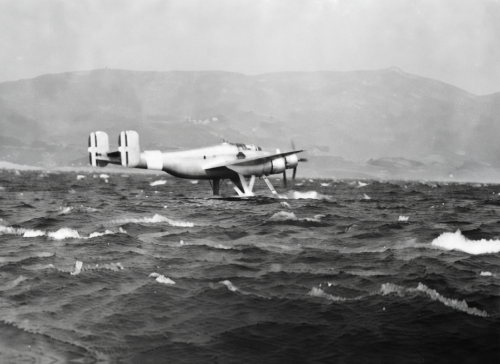
Flight testing revealed that the aircraft handled reasonably well but suffered from aerodynamic penalties imposed by the floats.
Stability on the water was acceptable, but overall performance did not meet expectations for a modern wartime floatplane.
Prototype and Evaluation
The single prototype of the CANT Z.516 was completed and flown in 1940.
It incorporated:
The early Z.1007 fuselage and wing structure
Twin floats with reinforced bracing
The full tri-motor powerplant
Partial military equipment for evaluation
During testing, the Regia Aeronautica found the aircraft’s flight characteristics unsatisfactory, particularly in comparison with expectations set by the Z.1007.
The floats imposed significant drag, reducing speed and climb rate, and the aircraft did not offer a sufficiently large improvement over the existing Z.506 to justify production.
No further prototypes or variants were built.
Operational and WWII Context
The cancellation of the Z.516 reflected Italy’s wartime industrial and strategic realities.
Reasons for cancellation:
Industrial strain: Italian factories were already committed to producing Z.1007s, SM.79s, and fighters.
Material shortages: Floatplane production required metal for floats and fittings, which Italy lacked.
Doctrinal shift: Italy increasingly relied on land‑based bombers and German maritime aircraft.
Adequacy of existing types: The Z.506, though ageing, remained serviceable and was already in mass production.
Performance shortfalls: The Z.516 did not deliver the expected improvement over the Z.506.
By 1941, the Regia Aeronautica concluded that introducing a new floatplane type was impractical.
The programme was terminated, and the prototype was likely scrapped.
Significance and Legacy
Although never produced beyond a single prototype, the CANT Z.516 is historically notable as the following:
A rare attempt to convert a modern land‑based medium bomber into a floatplane
A transitional design linking the Z.506 and the Z.1007
An example of Italy’s constrained wartime industrial capacity
A reflection of shifting maritime aviation doctrine during WWII
The aircraft remains an interesting footnote in the evolution of Italian maritime aviation—an ambitious design that ultimately proved impractical under wartime conditions.