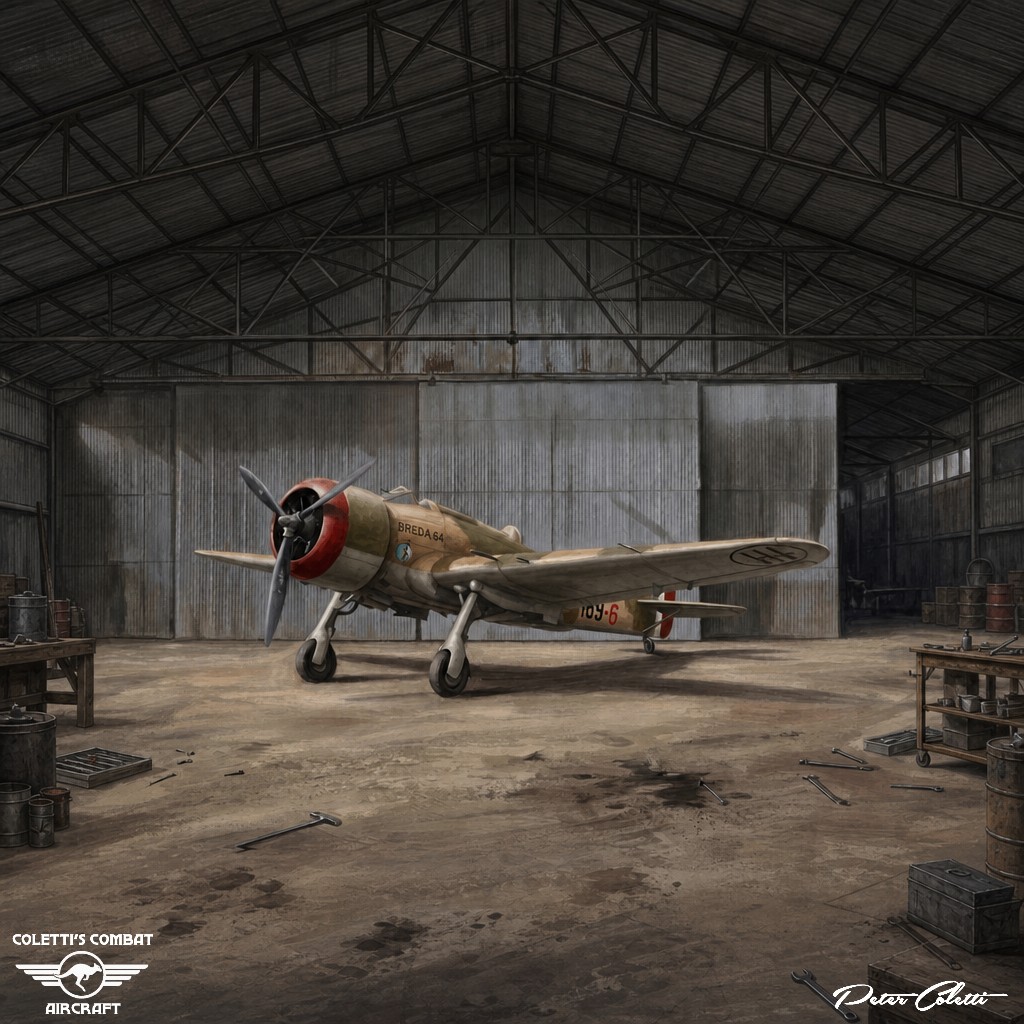
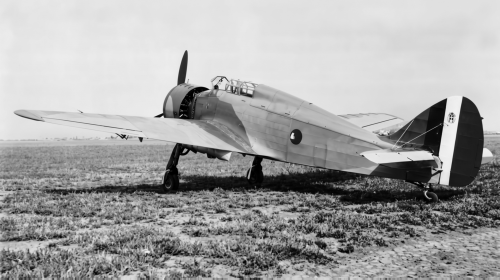
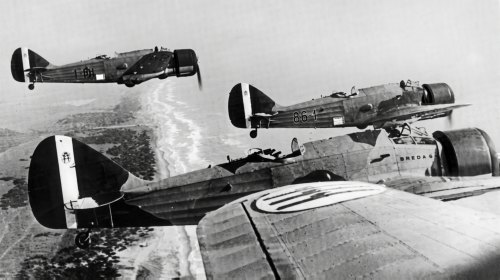
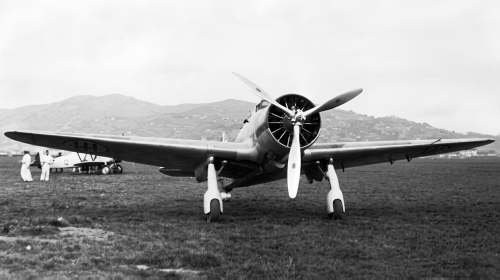
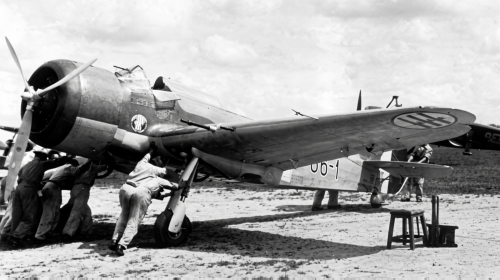
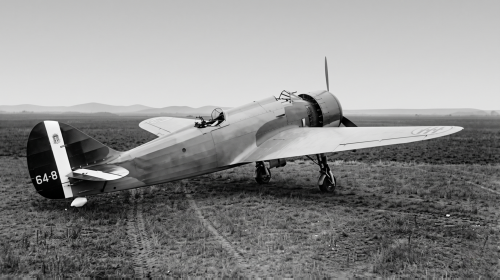
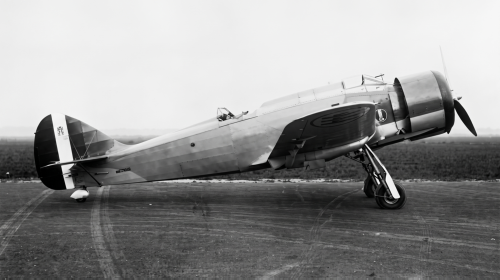
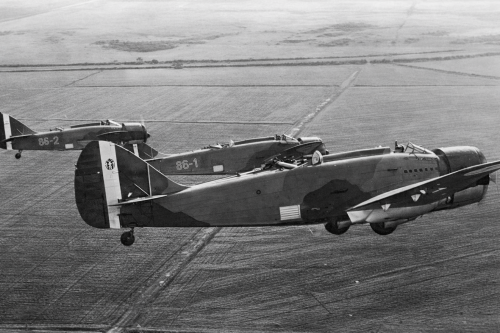
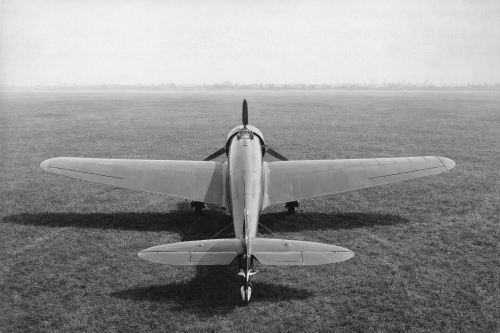
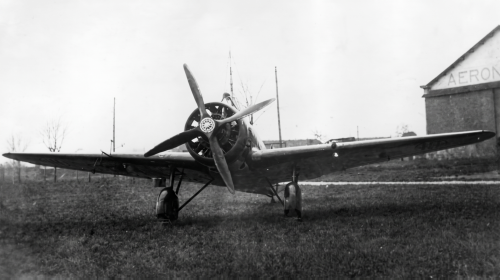
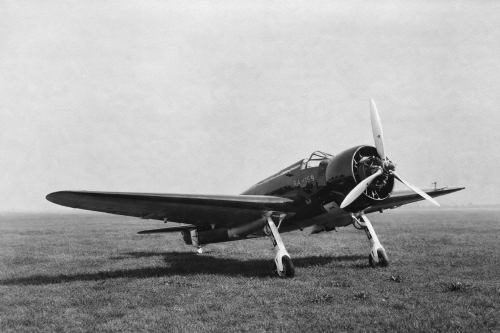
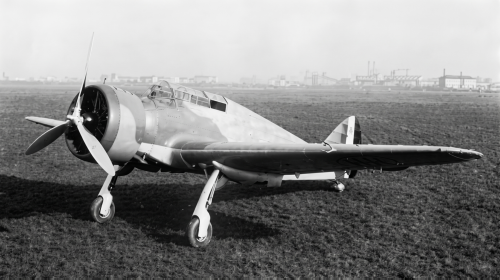
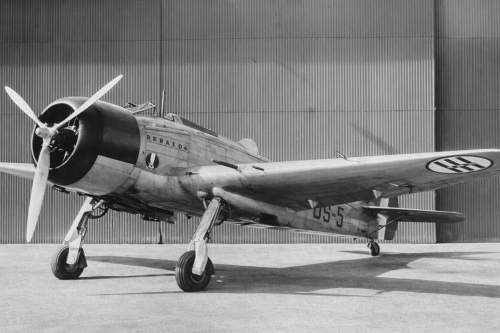
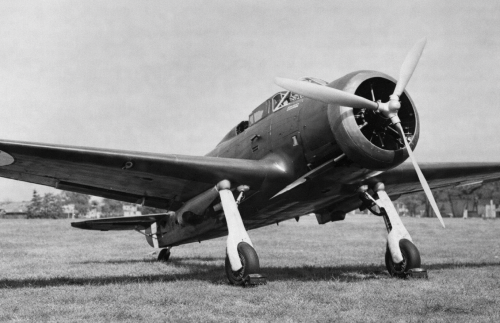
The Breda Ba.64 was an Italian single‑engine, low‑wing monoplane conceived in the early 1930s as a multirole fighter‑bomber and ground‑attack aircraft for the Regia Aeronautica.
Designed by Antonio Parano and Giuseppe Panzeri and built by Società Italiana Ernesto Breda, it was intended to serve as a fighter, light bomber, reconnaissance and close‑support platform in one airframe.
In practice, the Ba.64 proved underpowered and difficult to handle; saw only limited front‑line service; and was quickly overshadowed by its more capable derivative, the Breda Ba.65.
Production reached just 42 aircraft, and its operational career as a combat type was short, spanning roughly 1936–1939, with some airframes lingering in second‑line roles into the early years of the Second World War.
Origins, requirements and development context
Regia Aeronautica multirole requirement
In 1933 the Regia Aeronautica issued a requirement for a modern monoplane capable of multiple roles: day fighter, light bomber and reconnaissance aircraft.
Italy’s air‑power theorists, notably Colonel Amedeo Mecozzi, emphasised fast, low‑level attack and close air support, pushing industry towards robust, armed monoplanes that could deliver bombs and machine‑gun fire against ground targets while retaining some fighter capability.
Breda responded by proposing a development of its earlier Ba.27 single‑seat fighter, itself a low‑wing monoplane with mixed construction and an open cockpit.
The Ba.27 had not been widely adopted by the Regia Aeronautica, but it provided a structural and aerodynamic starting point for the new multirole Ba.64.
Design team and concept
Engineers Antonio Parano and Giuseppe Panzeri led the Ba.64 design.
Their concept was an all‑metal, low‑wing cantilever monoplane with a forward‑set cockpit for excellent downward and forward visibility—important for ground attack and reconnaissance.
The aircraft was to be adaptable: built in both single‑seat fighter and two‑seat bomber/attack configurations, with provisions for wing‑mounted machine guns and external bomb racks.
Design work progressed through 1933, with Breda aiming to satisfy the broad specification by developing two prototypes: one two‑seat bomber/attack version and one single‑seat fighter version, both powered initially by the British Bristol Pegasus radial engine rated at about 700hp.
Airframe design and technical characteristics
Structure and layout
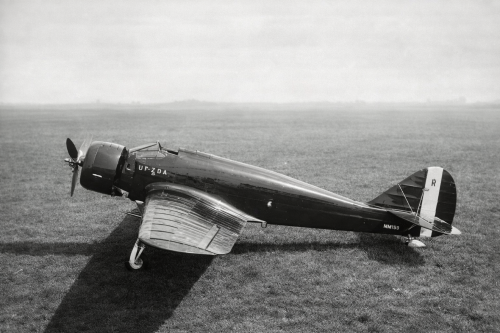
The Ba.64 was an all‑metal low‑wing cantilever monoplane.
The fuselage used a steel‑tube structure with metal skinning, while the tail unit was wire‑braced and carried a fixed tailwheel.
Control surfaces were fabric‑covered, a common practice of the era.
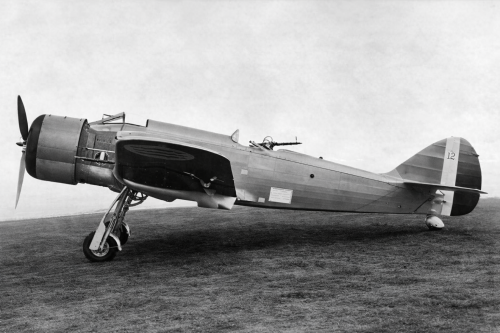
The cockpit was open and positioned well forward, roughly in line with the wing roots.
This placement gave the pilot an excellent field of view downward and ahead, aiding low‑level attack runs and navigation.
Behind the pilot, the headrest fairing extended as a streamlined spine along the upper fuselage all the way to the tail, improving airflow and reducing drag.
In the two‑seat configuration, a rear cockpit housed an observer/gunner, who could operate a defensive machine gun and assist with reconnaissance and bombing tasks.
Undercarriage
Two distinct undercarriage arrangements were used:
Fixed main gear (first prototype): The initial two-seat bomber prototype (MM 249) had fixed main landing gear with spatted wheels, plus the fixed tailwheel.
This was simpler but produced more drag.
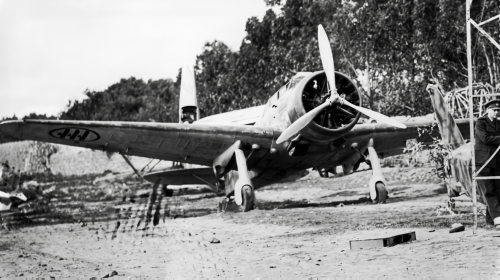
Semi‑retractable main gear (second prototype and production): The single‑seat fighter prototype (MM 250) introduced a semi‑retractable main landing gear.
The main wheels retracted rearwards into streamlined fairings, reducing drag and offering some protection in wheels-up landings.
This arrangement was adopted for production aircraft, even in the two‑seat configuration.
Powerplant and propeller
Prototypes used the Bristol Pegasus radial engine of about 522 kW (700 hp), driving a three‑bladed variable‑pitch propeller.
Flight testing showed that even with this engine the aircraft’s performance was lacklustre.
Production Ba.64s were powered by Italian‑built Alfa Romeo engines derived from the Pegasus:
Alfa W 125 / Alfa 125 RC.35: Around 485 kW (650 hp), licence‑built Pegasus variants.
These engines were similar but not interchangeable, and both appeared in production airframes.
A single Ba.64 was later tested with a more powerful Fiat A.74 radial engine, but this remained a one‑off experiment and did not lead to a new production standard.
Armament and payload
In its intended ground‑attack and fighter‑bomber roles, the Ba.64 carried:
Fixed forward armament: Typically, four 7.7 mm Breda‑SAFAT machine guns mounted in the wings.
Defensive armament: In the two‑seat configuration, a single 7.7 mm machine gun on a flexible mount in the rear cockpit for rear‑hemisphere defence.
Bomb load: Up to roughly 400 kg (∼880 lb) of bombs on external racks under the wings, suitable for light bombing and close air support.
This armament fit reflected Italian doctrine: a relatively small bomb load but multiple machine guns for strafing and rapid attacks on ground targets.
Performance and dimensions
Exact figures vary slightly by source and engine fit, but typical data for the Ba.64 are the following:
Maximum speed: About 350 km/h (217–220 mph) at altitude.
Range: Approximately 900 km (∼559 mi).
Service ceiling: Around 7,000 m (∼23,000 ft).
Wingspan: About 12.1 m (∼39.7 ft).
In practice, pilots and evaluators judged the aircraft underpowered for its weight and role, with heavy handling and poor high‑speed behaviour.
Prototypes, testing and production
Prototype programme
Two main prototypes were built:
MM 249 (two‑seat bomber/attack): Fixed landing gear, two‑seat cockpit, wing‑mounted guns and bomb racks.
MM 250 (single‑seat fighter): semi‑retractable main gear, single‑seat cockpit, optimised for fighter performance.
The first prototype flew in 1934.
Flight tests quickly revealed shortcomings: the Ba.64 was not particularly fast, acceleration was poor, and the aircraft’s handling at high speeds was problematic.
Even with a variable‑pitch propeller and the relatively powerful Pegasus engine, performance was considered “lacklustre”.
Despite these issues, the Regia Aeronautica placed a limited production order.
The chosen configuration combined the two‑seat layout of the bomber prototype with the semi‑retractable landing gear of the fighter prototype, aiming to retain multirole flexibility while improving drag characteristics.
Production run
Production Ba.64s were completed between about 1935 and 1936, with a total of 42 aircraft built.
They were powered by Alfa Romeo 125‑series engines and delivered primarily in the two‑seat ground‑attack configuration, though some early examples were single‑seat.
Ultimately, all Ba.64s were converted to two‑seat bomber/attack aircraft with a rear defensive gun.
Variants and experimental fits
Main production variants
Sources distinguish Ba.64 variants mainly by engine type:
Ba.64 (Alfa W 125): Early production aircraft using the Alfa W 125, a licence-built Walter/Bristol Pegasus derivative.
Ba.64 (Alfa 125 RC.35): Later production aircraft with the Alfa 125 RC.35, similar in power but not interchangeable with the W 125.
Both variants shared the same basic airframe, armament and semi‑retractable landing gear.
Fiat‑powered prototype
Ba.64 (Fiat A.74): A single airframe was re‑engined with a Fiat A.74 radial in 1937 to explore improved performance.
This did not lead to a new production series, but it foreshadowed the more powerful Ba.65, which adopted stronger engines and refined aerodynamics.
Operational history and WWII context
Service in the Regia Aeronautica
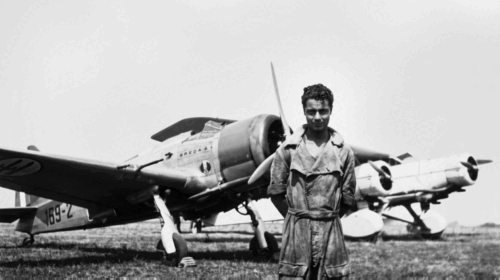
Production Ba.64s were assigned to units such as 5° Stormo and 50° Stormo.
In frontline service, pilots quickly found the type unsatisfactory as either a fighter or a bomber.
Reported faults included:
Underpowered performance: The aircraft struggled to achieve competitive speeds and climb rates for its era.
Heavy handling: Controls were considered heavy, making the aircraft tiring to fly and less responsive in combat manoeuvres.
High‑speed stall tendency: The Ba.64 had a propensity to enter high‑speed stalls, which contributed to several fatal accidents.
Because of these issues, the Ba.64 saw only limited use as a true front‑line attack aircraft.
By 1939 it was officially withdrawn from first-line service and replaced in the ground-attack role by the more capable Breda Ba.65, which offered better performance and handling.
Secondary roles and late survival
After its withdrawal from combat units, the Ba.64 fleets were converted to two‑seat trainers and relegated to second‑line duties.
In these roles, the aircraft’s shortcomings were less critical, and it could still provide useful experience in flying low‑wing monoplanes with retractable gear and radial engines.
A small number of Ba.64s reportedly remained in service in training or auxiliary capacities until around March 1943, by which time Italy was deeply embroiled in the Second World War and facing severe equipment shortages.
Limited combat use and exports
The Ba.64’s direct combat record was minimal:
Spanish Civil War: At least one Ba.64 is reported to have served with Italy’s Aviazione Legionaria in Spain around 1937, used for ground-support missions.
Its impact was negligible compared with more numerous types like the Fiat CR.32 and later the Ba.65.
Soviet evaluation: Two Ba.64s were exported to the Soviet Union in 1938 for evaluation.
They did not lead to further orders, reflecting the aircraft’s marginal performance compared with contemporary Soviet designs.
Place in an early WWII context
By the outbreak of the Second World War in 1939, the Ba.64 was already obsolete and largely absent from front‑line units.
Its brief operational life illustrates the rapid pace of aviation development in the 1930s: an aircraft conceived as modern in 1933 could be outclassed by 1937–1939.
In the broader context of WWII ground‑attack aviation, the Ba.64 was overshadowed by more specialised and capable aircraft such as the German Junkers Ju 87 Stuka and, within Italy, by the Ba.65 and later types.
Italian doctrine had sought a fast, multirole attack aircraft, but the Ba.64’s compromises in power, weight and handling meant it could not compete with dedicated dive‑bombers or high‑performance fighters.
Assessment and legacy
The Breda Ba.64 occupies a modest but instructive place in interwar and early WWII aviation history:
Technological transition: It was part of Italy’s shift from biplanes and mixed‑construction fighters to all‑metal monoplanes with retractable gear and radial engines.
Design compromise: Attempting to satisfy fighter, bomber and reconnaissance roles in one airframe led to compromises that undermined performance and handling.
Short service life: Operational shortcomings limited its front‑line use to a few years, and it was quickly replaced by the improved Ba.65.
Doctrinal experiment: The Ba.64 embodied Italian ideas about fast, low‑level attack and multirole flexibility, even if the execution fell short.
The Ba.64 stands as a transitional, experimental ground‑attack monoplane—technically interesting for its structure, semi‑retractable gear and multirole concept but operationally a marginal type whose limitations pushed Italian designers towards more capable successors.