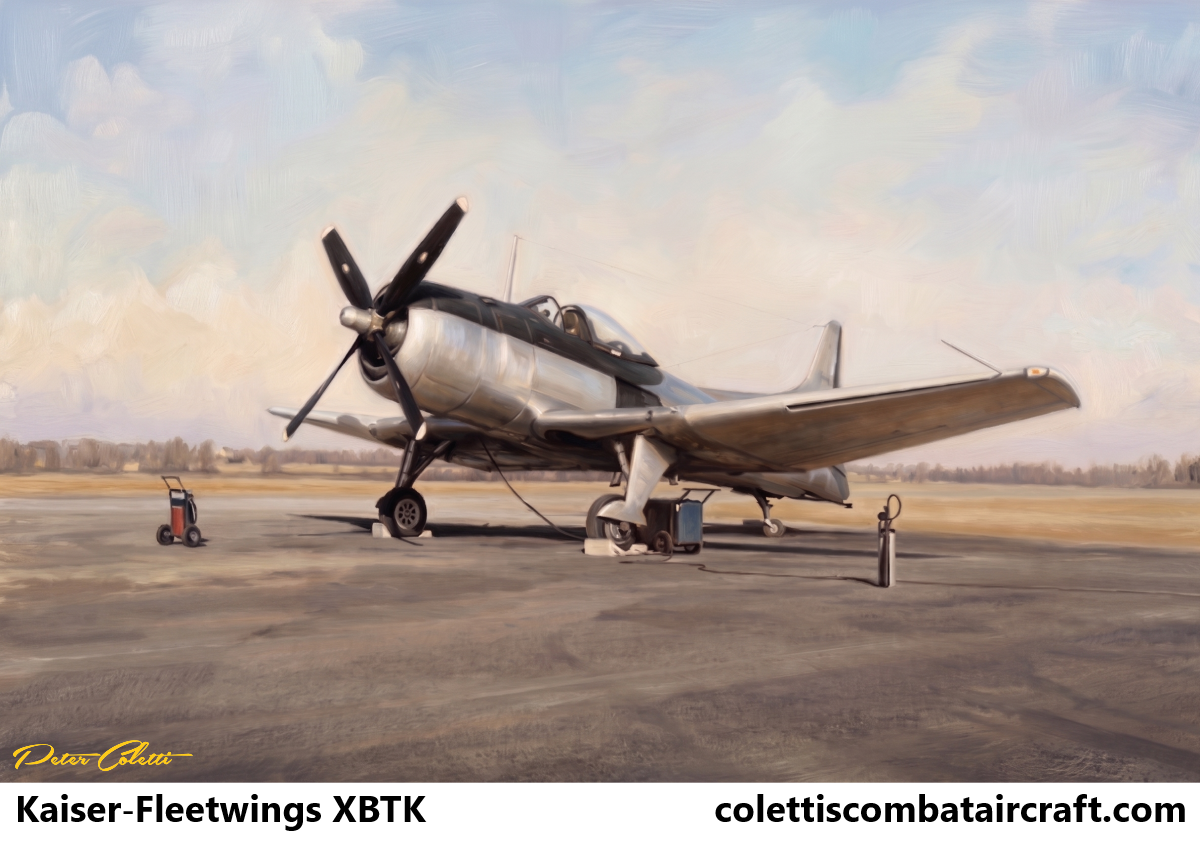
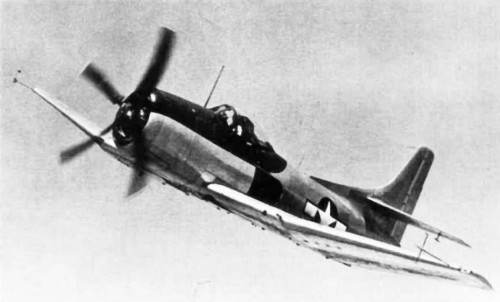
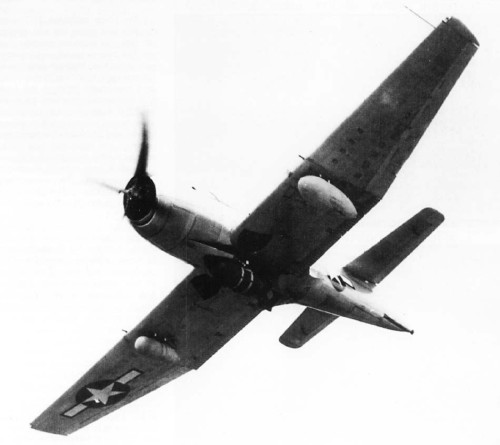
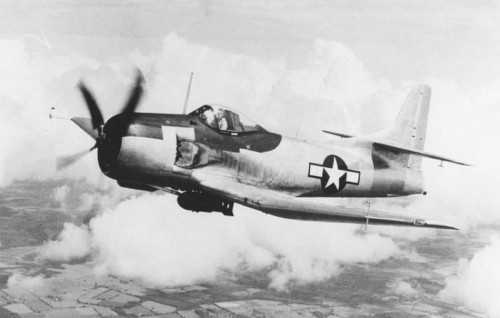
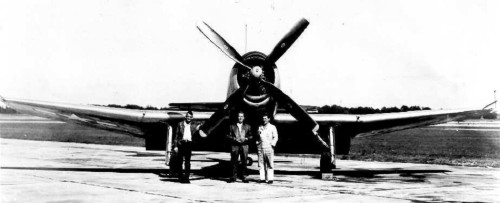
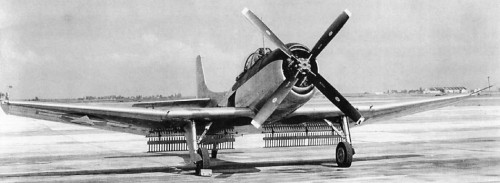
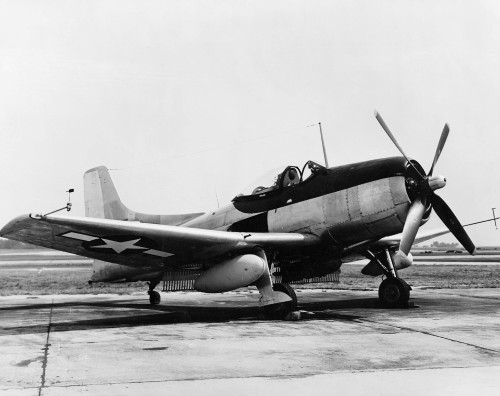
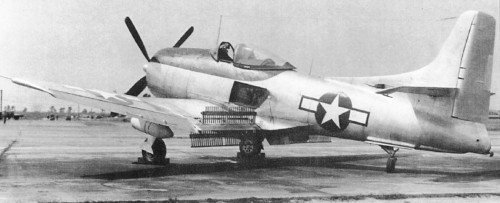
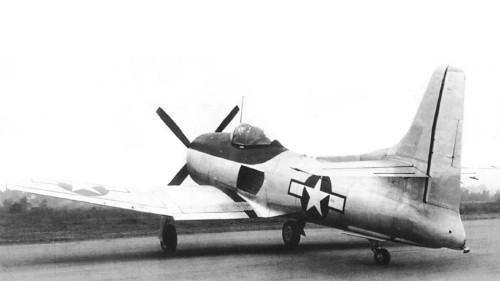
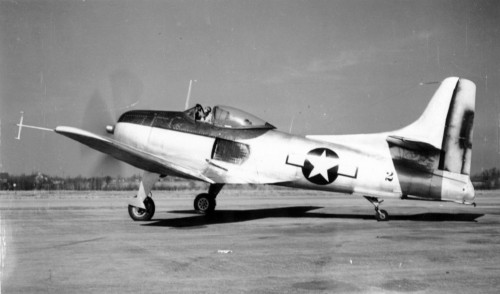
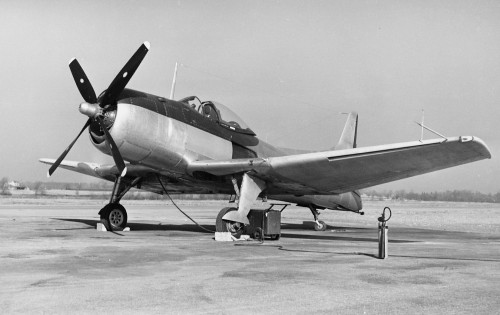
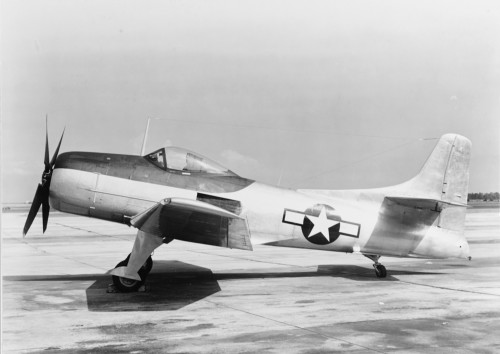
The Kaiser‑Fleetwings XBTK emerged from a moment of rapid doctrinal change within the U.S. Navy during the final years of the Second World War.
By 1943–44, the Navy recognised that its existing dive‑bombers and torpedo aircraft—such as the SBD Dauntless and TBF Avenger—were becoming obsolete in the face of faster fighters, improved anti‑aircraft defences, and the shift towards single‑seat, multi‑role attack aircraft.
The Navy’s Bureau of Aeronautics (BuAer) issued a requirement for a new single‑engine, carrier‑based attack aircraft capable of delivering bombs, torpedoes, rockets, and emerging “special weapons” with high survivability and excellent low‑altitude performance.
Fleetwings, a small company known primarily for metal‑airframe fabrication and experimental designs, was acquired by industrialist Henry J. Kaiser in 1943.
Kaiser sought to transform the firm into a major aircraft producer, and the Navy’s new attack-aircraft requirement offered an opportunity to break into a competitive field dominated by Douglas, Grumman, and Curtiss.
The resulting design was designated XBTK, where “BT” reflected the older “Bomber‑Torpedo” category that was soon to be replaced by the “Attack” (A‑) designation.
The XBTK was intended to be a compact, highly manoeuvrable, low‑level strike aircraft optimised for operations from escort carriers, whose short decks demanded excellent take-off and landing performance.
This requirement shaped nearly every aspect of the aircraft’s configuration.
Design Philosophy and Structural Features
Airframe and Aerodynamics
The XBTK was built around a small, lightweight fuselage with a mid‑mounted wing and a large vertical tail.
The design emphasised:
Excellent low‑speed handling for escort‑carrier operations
High manoeuvrability at low altitude
Compact dimensions to fit limited hangar and deck space
The wing incorporated large Fowler flaps and leading‑edge slats to reduce stall speed and improve deck‑handling characteristics.
The tail surfaces were relatively large for stability during low‑level attack runs and when carrying asymmetrical ordnance loads.
Powerplant
The aircraft was powered by the Pratt & Whitney R‑2800 Double Wasp, a 2,000‑hp class radial engine widely used in U.S. fighters and attack aircraft.
Kaiser‑Fleetwings selected the R‑2800 for its reliability, parts availability, and strong low‑altitude performance—critical for the intended mission profile.
A long, streamlined cowling and a large spinner gave the XBTK a distinctive profile compared to other R‑2800‑powered aircraft.
Cockpit and Crew
The XBTK was a single‑seat aircraft, reflecting the Navy’s shift towards eliminating the dedicated bombardier and radioman positions of earlier torpedo bombers.
The cockpit offered:
A raised seating position for improved visibility
Armor protection for the pilot
A modernized instrument layout suitable for precision low‑level attack
Armament and Ordnance Capability
The XBTK was designed to carry a wide range of weapons:
Internal bomb bay capable of holding a torpedo, 1,000‑lb bomb, or depth charge
Underwing hardpoints for rockets, bombs, or drop tanks
Machine guns or cannon in the wings (provisions varied during development)
The internal bay was a key feature, reducing drag and improving survivability during ingress.
Innovative Features
Two notable innovations were incorporated:
Perforated dive brakes on the fuselage sides, allowing stable steep‑angle dives without excessive speed buildup.
A unique exhaust and cooling arrangement intended to reduce drag and improve engine efficiency, though it proved troublesome in testing.
Flight Testing and Performance
Initial Flight Trials
The first XBTK‑1 prototype flew in April 1945. Early tests revealed:
Good manoeuvrability and responsive controls
Excellent low‑speed characteristics, validating its escort‑carrier design goals
Despite these issues, test pilots generally praised the aircraft’s handling qualities.
Performance Estimates
Although exact numbers varied across prototypes, typical performance figures included:
Maximum speed: Approximately 350–365 mph (560–590 km/h)
Range: Around 1,000 miles depending on load
Service ceiling: Roughly 25,000 ft
Ordnance load: Up to 2,000 lb internally and externally combined
These numbers placed the XBTK in the same general performance class as the Douglas AD Skyraider, though the Skyraider ultimately proved superior in payload, range, and development potential.
Variants
XBTK‑1
The primary prototype series.
Several airframes were built, each incorporating incremental improvements:
Revised tail surfaces
Modified cooling system
Strengthened landing gear
Adjusted dive-brake geometry
No production version was ever ordered.
Projected Production Models
Kaiser‑Fleetwings proposed refined versions with:
More powerful R‑2800 variants
Increased internal fuel
Revised armament layouts
However, none progressed beyond the planning stage.
Operational Fate and Cancellation
The XBTK’s development coincided with the end of World War II, which dramatically reduced the Navy’s urgency for new attack aircraft.
At the same time, the Navy consolidated its requirements into the new “Attack” (A-) category, favouring multi-role designs with greater payload and range.
The Douglas AD Skyraider, which first flew in March 1945, quickly emerged as the Navy’s preferred postwar attack aircraft.
It offered:
Greater payload capacity
Longer range
Better growth potential
A more mature design from a proven manufacturer, Kaiser‑Fleetwings, by contrast, lacked large‑scale production experience, and the XBTK’s technical issues made it less attractive in a peacetime environment where performance could be prioritised over rapid fielding.
By late 1946, the Navy cancelled further development.
Only a handful of prototypes were completed, and the programme quietly ended as Kaiser withdrew from aircraft manufacturing.
Assessment and Legacy
Although the XBTK never entered service, it represents an important transitional moment in naval aviation:
It was among the last aircraft designed under the old “Bomber‑Torpedo” classification.
It embodied the shift towards single‑seat, multi‑role attack aircraft that would dominate the postwar era.
It demonstrated the challenges faced by smaller manufacturers attempting to compete with established firms during wartime.
Its design solutions—particularly its emphasis on low‑speed handling and compactness—highlight the operational constraints of escort carriers, which themselves were phased out soon after the war.
The XBTK remains a rare and intriguing example of a promising but ultimately outpaced design, overshadowed by the Skyraider but still notable for its innovative approach to the Navy’s evolving attack mission.