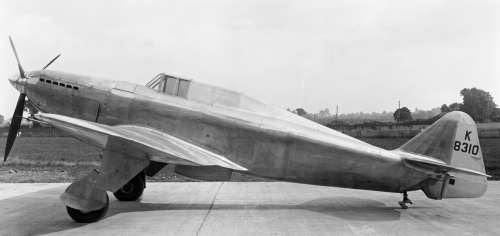
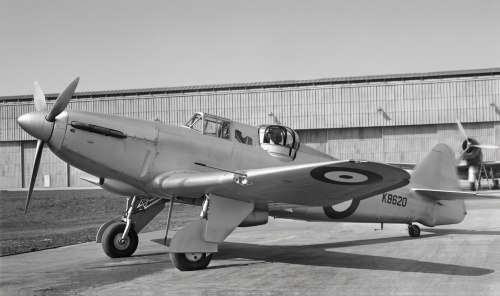
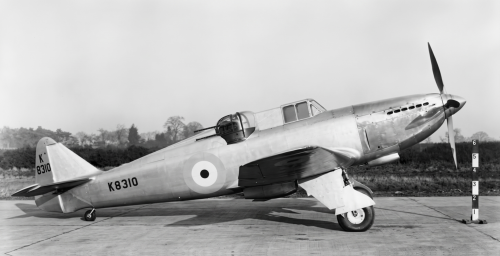
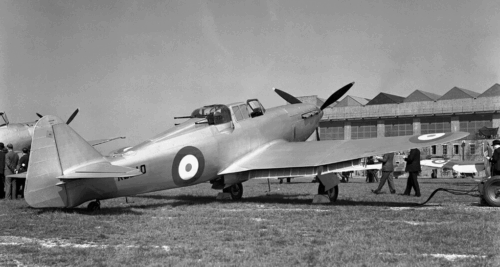
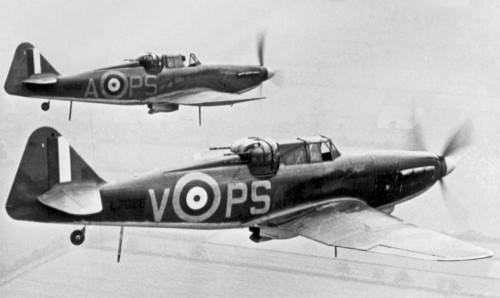
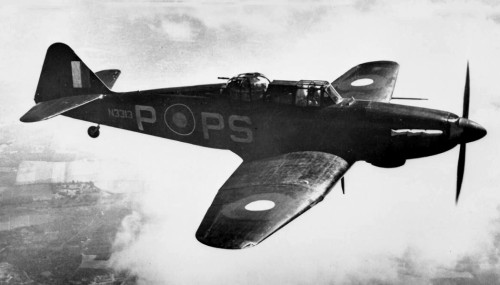
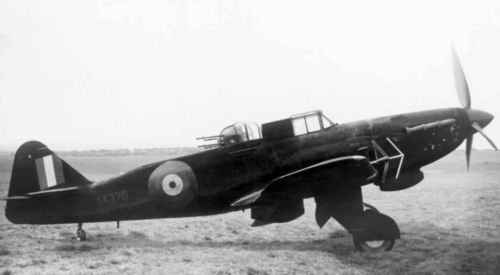
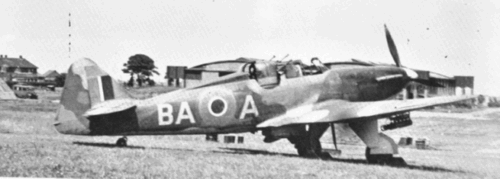
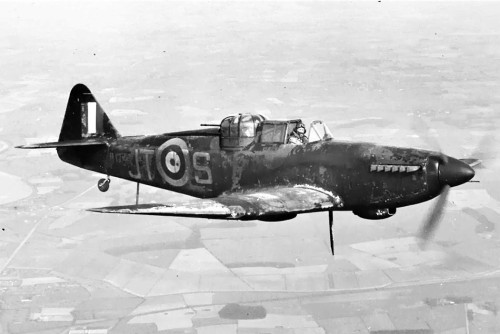
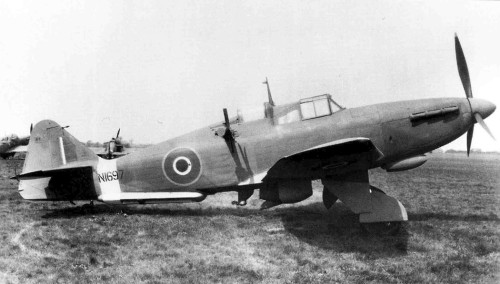
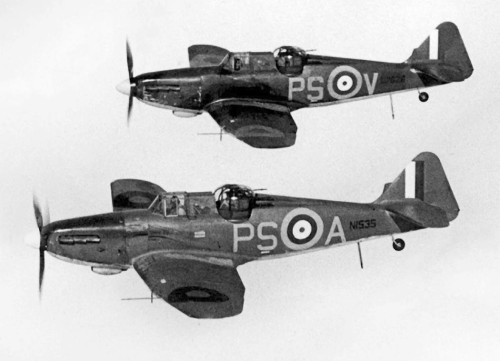
The Boulton Paul Defiant emerged from a uniquely British pre-war belief: that fast, modern bombers would outpace conventional fighters and that the best countermeasure was a fighter whose entire armament sat in a powered turret, free to fire in almost any direction.
This idea took shape in the mid‑1930s, when the Air Ministry issued Specification F.9/35, calling for a two‑seat “turret fighter” capable of engaging unescorted bombers approaching Britain’s airspace.
The RAF assumed that German fighters would lack the range to escort their bombers across the North Sea—an assumption that would later prove disastrously wrong.
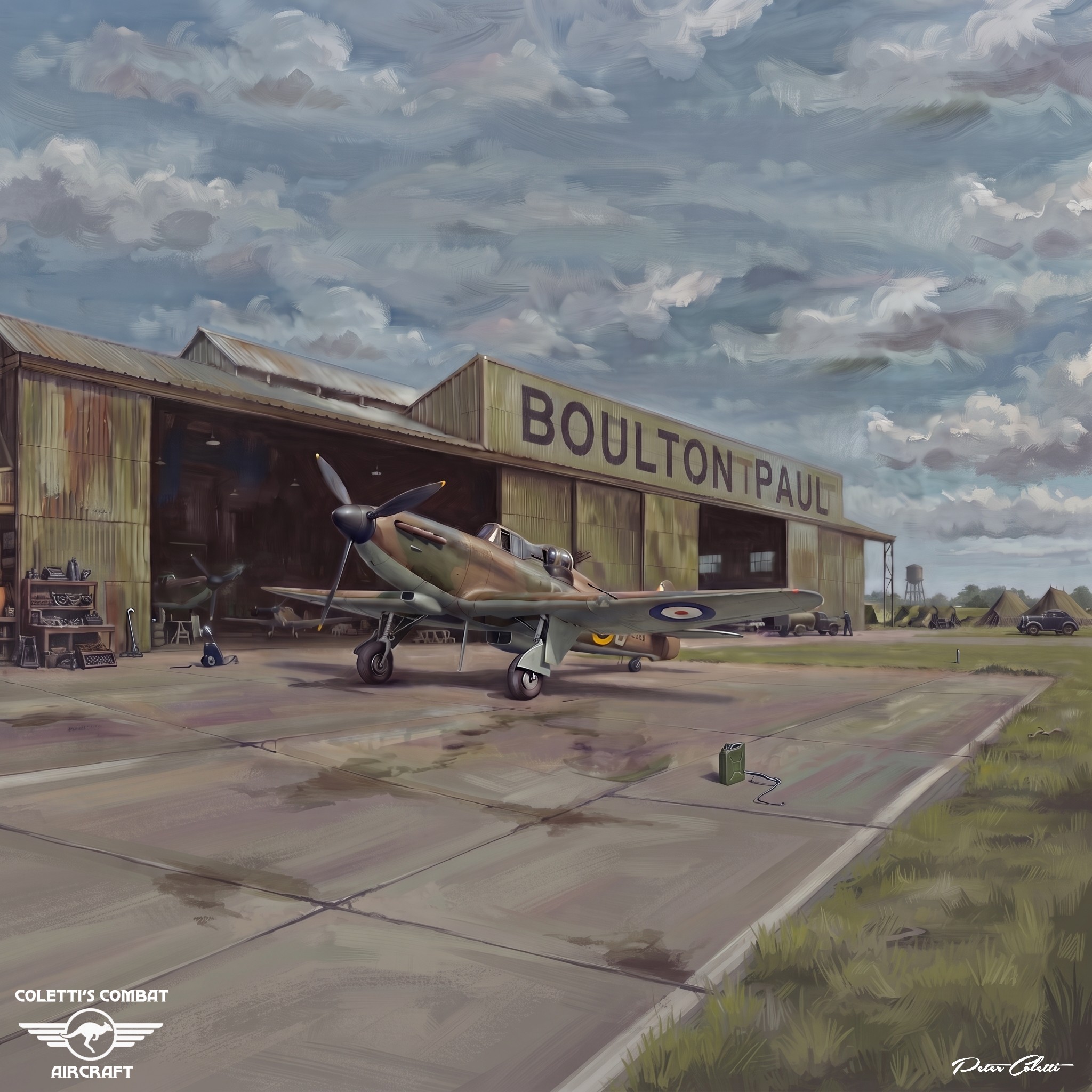
Boulton Paul, already experienced with power‑operated turrets from earlier aircraft such as the Overstrand, proposed the P.82, a sleek monoplane roughly comparable in size to the Hawker Hurricane but heavier due to its turret system.
The Air Ministry ordered prototypes “off the drawing board” in 1937, demonstrating the urgency with which the concept was pursued.
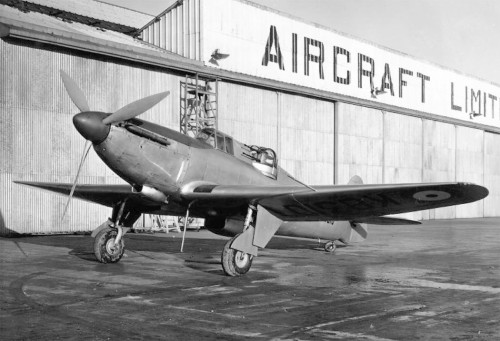
The first prototype flew on 11 August 1937, initially without its turret to test basic handling.
The second prototype, fully armed, followed in 1939.
Trials showed the aircraft to be stable and easy to fly—qualities essential for a gunner trying to track targets in a rotating turret.
Design and Technical Characteristics
Airframe and Layout
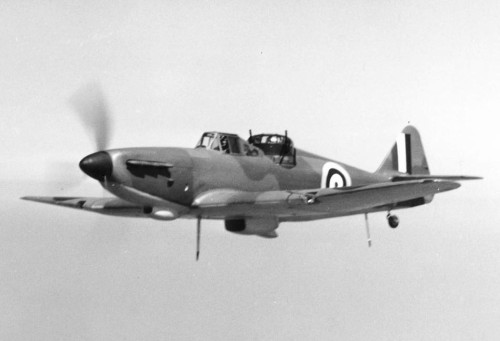
The Defiant was a low‑wing, all‑metal monoplane with retractable landing gear and a clean aerodynamic profile.
Its fuselage was built in bolted sections, a Boulton Paul manufacturing hallmark that simplified production and maintenance.
Fuel tanks were housed in the wing centre section, and a large ventral radiator gave the aircraft a silhouette reminiscent of the Hurricane.
The Turret
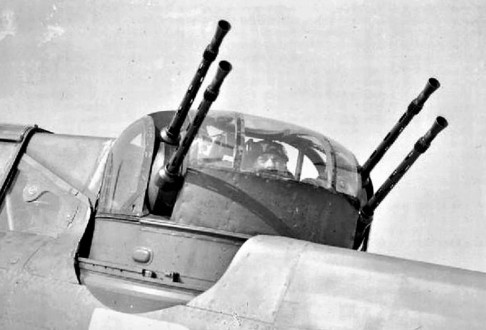
The heart of the Defiant was its Type A electro‑hydraulic turret, mounting four 0.303‑inch Browning machine guns.
The turret could rotate 360 degrees and elevate sufficiently to fire above the aircraft but could not depress far enough to fire downward—an important limitation.
The gunner sat in a cramped, rotating enclosure with no room for a conventional parachute pack, leading to the adoption of the awkward “parasuit” bailout garment.
The turret could be locked forward and controlled by the pilot, but the guns’ minimum forward elevation made this of limited practical value.
Powerplant and Performance
The Defiant Mk I used the Rolls‑Royce Merlin III, producing around 1,030 hp.
This gave the aircraft a top speed of roughly 300 mph, respectable for 1937 but increasingly inadequate by 1940.
The later Mk II adopted the more powerful Merlin XX, improving climb and high-altitude performance—especially important for its later night-fighting role.
Operational History
Early Combat: Success and Disaster
The Defiant entered service in late 1939 with No. 264 Squadron.
Early trials showed it could defend itself against fighters by flying in a tight defensive circle, allowing the turret to cover all approaches.
Its first combat in May 1940 produced encouraging results:
Defiant crews claimed several German bombers and even fighters whose pilots mistook the aircraft for a Hurricane and attacked from behind—straight into the turret’s guns.
But the illusion of success evaporated quickly.
Once the Luftwaffe understood the Defiant’s layout, Bf 109 pilots attacked from below or head-on, where the turret could not bear.
Losses mounted rapidly.
On 31 May 1940, seven Defiants were lost in a single day.
The aircraft’s weight, drag, and two‑man crew made it slower and less manoeuvrable than single‑seat fighters.
By late August 1940, more than half of all Defiants delivered had been shot down.
Night Fighter Conversion
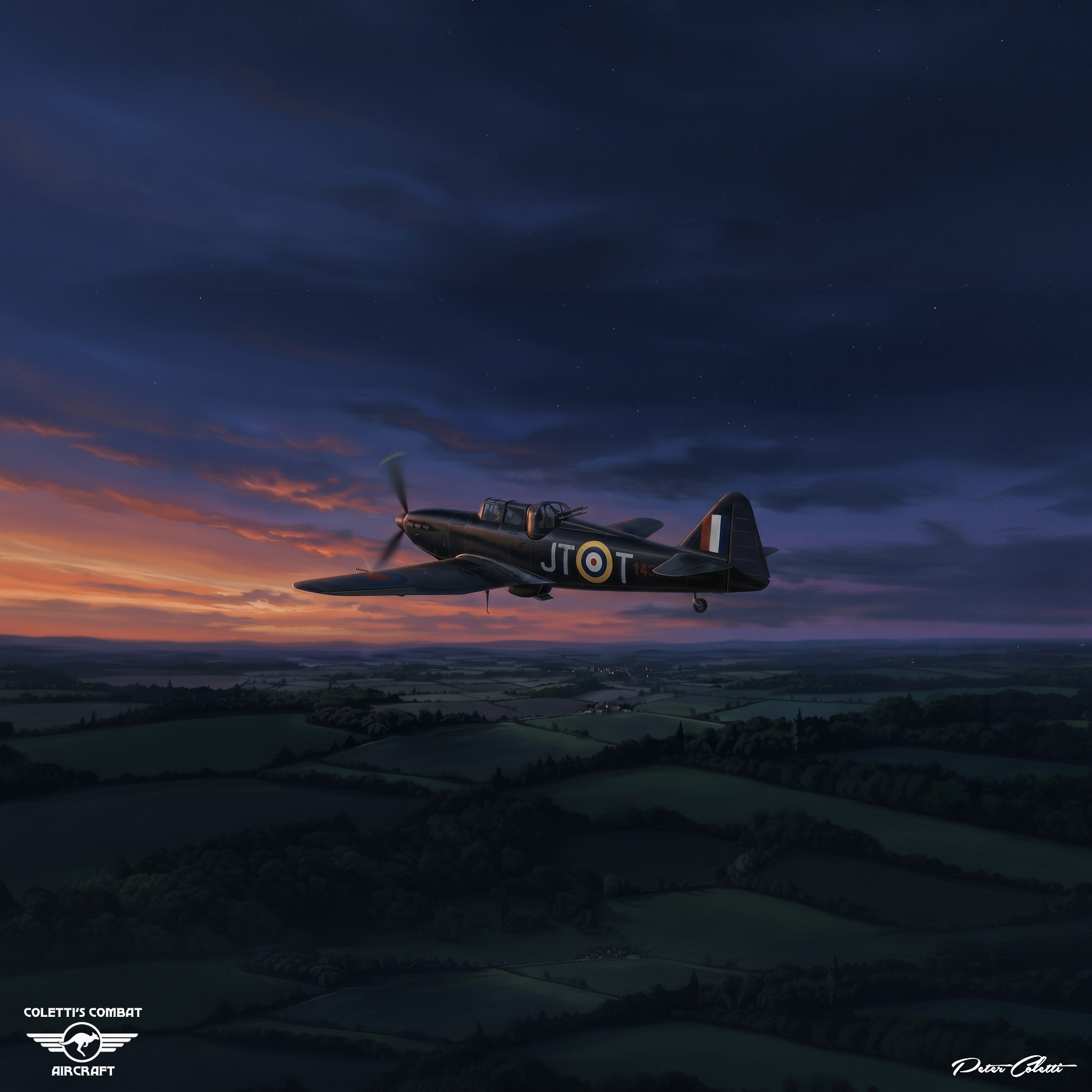
Recognising its vulnerability in daylight, the RAF reassigned the Defiant to night fighting.
Here, its stable handling and concentrated firepower proved far more effective.
Initially guided by searchlights, Defiant crews later received AI Mk IV radar, transforming the aircraft into a competent night interceptor.
During the Blitz, Defiant squadrons claimed more enemy aircraft at night than any other RAF type for a period in 1940–41.
However, by 1942, faster and more capable night fighters—especially the Beaufighter and Mosquito—replaced it.
Secondary Roles
After withdrawal from combat, the Defiant found new life in several support roles:
Target tug (TT Mk I and Mk III), with turret removed and towing gear installed
Air‑sea rescue, carrying underwing dinghy pods
Electronic countermeasures, using “Moonshine” and “Mandrel” to spoof or jam German radar
Experimental work, including early ejection-seat trials
The type remained in these roles until 1943–44 and, in some overseas units, until the end of the war.
Variants
Defiant Mk I – Original turret fighter with Merlin III; 723 built.
Defiant NF Mk I / Mk IA – Night‑fighter conversions, some with AI radar.
Defiant ASR Mk I – Air‑sea rescue version with dinghy pods.
Defiant Mk II – Improved night fighter with Merlin XX and AI Mk IV radar; 210 built.
Defiant TT Mk I / TT Mk III – Target tugs, either converted or built new.
Assessment and Legacy
The Defiant was a bold but flawed concept.
As a day fighter, it was outclassed almost immediately once German fighters appeared over Britain.
But as a night fighter, it filled a crucial gap during the darkest months of the Blitz, buying time until more advanced aircraft arrived.
Its later service as a target tug and ECM platform demonstrated the adaptability of its airframe, even if its original purpose proved misguided.
Today, only one complete Defiant survives—N1671, preserved at the RAF Museum Cosford.